

The parts of scissors are two matched halves joined by a pivot screw. Each half has a blade, a shank, and a bow. The blades cut where they cross, and the bows take the thumb and a finger.
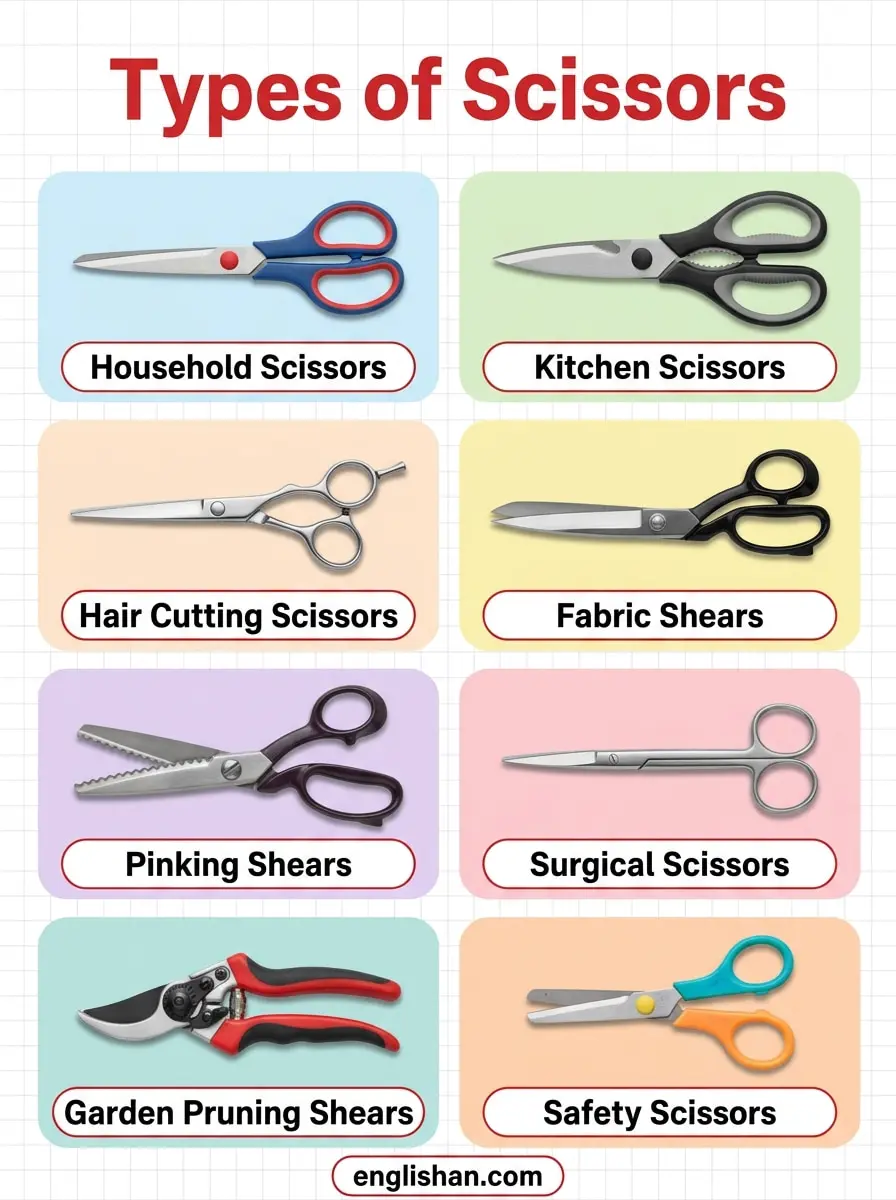
Household scissors run from the point to the bow. Kitchen, hair, fabric, surgical, garden, and children’s scissors change the blade shape or the bow. The knife has a single blade, and pliers are another two-sided tool.
Parts of Scissors Labeled Diagram
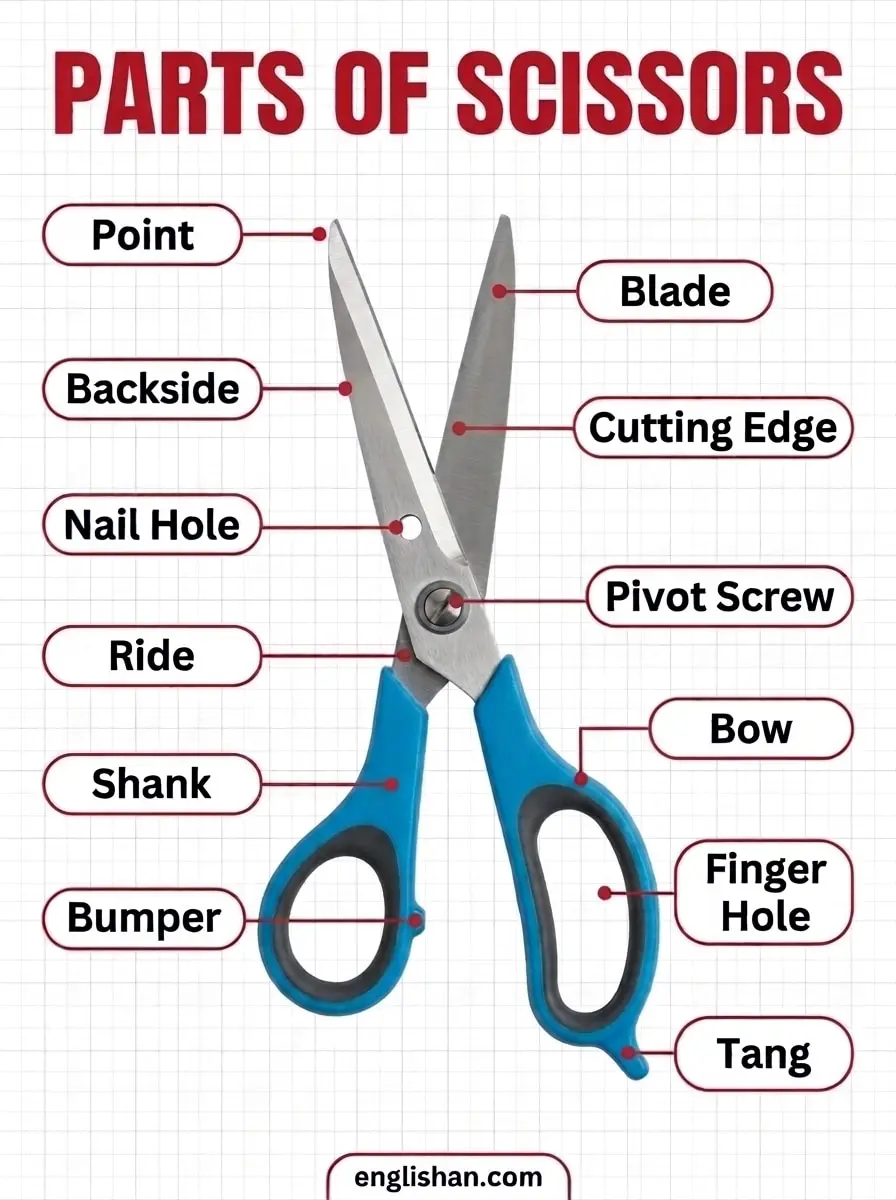
In a labeled diagram of scissors, the point is at the top where the blades meet, and the pivot screw is at the center. The shanks and the bows extend down from the screw. Every part of scissors belongs to one of the two halves, and the screw joins them.
| Part | Where you find it |
|---|---|
| 1. Blade | Sharpened metal length of each half, also called the inside blade |
| 2. Cutting edge | Sharpened inner edge of the blade |
| 3. Backside | Dull outer edge of the blade, never sharpened |
| 4. Point | Top end where the two blades meet when closed |
| 5. Pivot screw | Fastener at the crossing of the two halves |
| 6. Nail hole | Drilled hole in each half where the pivot screw passes |
| 7. Ride | Flat surface around the screw where the blades pass each other |
| 8. Shank | Arm that connects the blade to the bow |
| 9. Bow | Finger or thumb loop at the lower end of each half |
| 10. Finger hole | Opening in the bow where a finger or the thumb goes |
| 11. Tang | Curved extension on the finger bow where the little finger rests |
| 12. Bumper | Pad on the finger bow that softens the sound of closing blades |
How Many Parts Scissors Have
The parts of scissors number two, because a pair is two halves joined at a pivot.
A five-part count names the bows, the shanks, the blades, the pivot screw with its nail hole, and the point. Longer counts add the tang, the bumper, and the ride. Every count describes the same tool.
Scissors Blade Parts
The blades are the cutting parts among the parts of scissors. Each blade has a sharpened inside edge and a dull outside edge. The two blades are matched in length and curve.
Blade and Cutting Edge
The blade is the sharpened metal length of each half. The thumb blade and the finger blade are the two inside blades. The cutting edge is the sharpened inner edge.
The backside is the dull outer edge, and it is never sharpened. The inside blade is the part of scissors to sharpen.
Point and Curve
The point is the top end where the two blades meet when the scissors are closed. The curve is the matched shaping of the blades. It keeps the edges in even contact along the cut.
Scissors Pivot Parts
Among the parts of scissors, the pivot parts join the two halves at the center. The pivot screw is the fastener that passes through the nail hole in each half. The screw acts as the fulcrum of the pair.
The flat surface around the screw is where the blades pass each other. Makers call it the ride, the wing, or the halfmoon. The screw sets the tension, and correct tension prevents the blades from folding when loose or binding when tight.
Scissors Handle Parts
The shank, the bow, and the fittings on the bow are the handle parts of scissors. They connect the blades to the hand.
Shank and Bow
The shank is the arm that connects the blade to the bow. The bow is the finger or thumb loop, also called the grip or the ring. Modern bows are covered in thermoplastic or rubber for comfort.
Finger Holes and Tang
The finger hole is the opening in the bow. The tang is a curved extension on the finger bow where the little finger rests. The bumper is a cushion on the finger bow that softens the closing sound.
Spring
Some scissors have a spring between the shanks. It opens the blades after each cut, and shears with straight handles use it most.
Left-Handed Scissors
Among the parts of scissors, the grips and blades change in left-handed models. A semi-left-handed pair reverses the finger grips only. A true left-handed pair reverses the grips and the blade layout, as a mirror image of right-handed scissors.
Parts of Kitchen Scissors
The parts of kitchen scissors add a serrated edge, a notch, a cracker, and an opener to the standard parts. Kitchen scissors cut tough foods such as meat, tendon, and bones.
Serrated Blade and Notch
The serrated blade has teeth that grip meat and poultry. The notch is a semicircular cut in a blade that seats a bone.
Cracker and Opener
The cracker is a ridged feature on the shanks that cracks nuts and shells. The opener is a feature on the bow that lifts lids and caps.
Middle Part
The middle part of kitchen scissors is the serrated grip surface between the blades and the handles. It cracks nuts and shells, loosens bottle caps, steadies slippery food, and strips woody herbs.
Parts of Hair Scissors
The parts of hair scissors are the blades, the pivot screw, and the bows, with fittings made for control. Hair-cutting shears divide into a still blade and a moving blade.
Still Blade and Moving Blade
The still blade is attached to the finger ring and the finger tang, and it stays still during the cut. The moving blade is attached to the thumb ring, and the thumb alone operates it.
Tang and Rings
The finger tang, also called the finger rest, is a curved extension on the still blade that supports the little finger. The thumb ring and the finger ring are the circular openings for the thumb and the ring finger. The neck connects the shanks to the bows.
Tension Dial
The pivot screw works as a tension dial on professional shears. Open one blade to 90 degrees and release it. It should fall about one third of the way and stop.
Bumper
The bumper, also called the silencer, is a rubber or plastic insert that absorbs shock and stops clicking when the blades close.
Texturizing Blade
A thinning shear has teeth on one or both blades. A pair with 26 to 40 teeth blends hair, and a pair with 14 to 25 teeth notches it. A pair with 5 to 13 teeth removes chunks.
Fabric Shears and Pinking Shears Parts
Shears are heavy-duty scissors, and the parts of scissors are larger on them. Dressmaker’s shears cut fabric, and tailor’s scissors cut leather and several layers of cloth. Pinking shears have zigzag blades that leave a sawtooth edge. The parts of a manual sewing machine are listed on a separate page.
Parts of Surgical Scissors
The parts of surgical scissors are the blades, the finger rings, the fulcrum, and the tips. The thumb and the ring finger go through the rings, and the fulcrum is the pivot point that gives control of the tips.
Surgical Scissors Tips
Tips are sharp-sharp, blunt-blunt, or sharp-blunt. Bandage scissors have one blunt tip and one sharp tip, so they cut dressings near the skin safely. Iris scissors have fine, sharp tips, and Metzenbaum scissors have long, thin blades with blunt tips.
Blade Shape
A straight blade gives more mechanical advantage for thick tissue and suits cuts near the wound surface. A curved blade reaches deeper and gives better visibility. The cutting edge is normal or serrated.
Mayo and Suture Scissors
Mayo scissors are larger and heavier, with blades of 14 to 25 centimeters. Suture scissors have small, sharp-tipped blades that cut stitches.
Parts of Garden Shears
Garden shears are scissors made for plants. The parts of pruning shears are the blades, the handles, the spring, and the safety catch. Pruning shears cut stems up to 2 centimeters thick.
Bypass and Anvil Blades
Among the parts of scissors for plants, a bypass pruner has two blades that pass each other, and it cuts living wood cleanly. An anvil pruner has one blade that closes onto a flat anvil, and it crushes dead wood. The blade is hardened carbon or chromium steel.
Spring and Safety Catch
The spring between the handles reopens the jaws after each cut. A catch or a loop keeps the jaws closed when the shears are stored.
Loppers and Hedge Tools
Loppers are larger, long-handled shears for branches thicker than pruning shears cut. Hedge trimmers and grass shears are the other garden tools of this family.
Safety Scissors Parts
Safety scissors have small blades with blunt tips and a small size for small hands. The blunt tip reduces the risk of injury to children.
Scissors Parts and Their Materials
The materials of the parts of scissors are steel and plastic. The first modern pair, made in Sheffield in 1761, was hardened and polished cast steel.
Steel: The blades, the shanks, and the pivot screw are steel. Professional hair shears are hardened to 56 to 63 on the Rockwell C scale.
Thermoplastic and rubber: These cover the bows in modern ergonomic scissors.
FAQs
FAQs
The parts of scissors are the blades, the cutting edges, the point, the pivot screw, the shanks, and the bows. The finger hole, the tang, and the bumper complete the handles.
The two parts of scissors are the two halves joined by the pivot screw. Each half has a blade, a shank, and a bow.
You sharpen the inside blade, which is the cutting edge. The backside is the dull outer edge, and it is never sharpened.
The middle part of kitchen scissors is a serrated grip surface. It cracks nuts and shells, loosens bottle caps, steadies slippery food, and strips woody herbs.
The parts of hair cutting scissors are the still blade, the moving blade, the pivot screw, and the finger ring. The thumb ring and the tang complete them.
The blade is the wedge of scissors. Each blade is a wedge that divides the material, and the pivot screw is the fulcrum.
The parts of a pair of scissors are two halves joined at a pivot. Each half has a blade, a shank, and a bow, and the screw fastens them together.
Related:
