

The parts of pliers are the jaws, the joint, and the handles. The jaws grip or cut, the joint is the pivot, and the handles are the levers that close the jaws. The gripping surface and the cutting edge are formed into the jaws, which completes the parts of pliers.
Hand pliers run from the jaws to the handles. Combination, needle nose, diagonal, slip-joint, and locking pliers change the jaws or the joint. The hammer and the screwdriver are two other hand tools.
Parts of Pliers Labeled Diagram
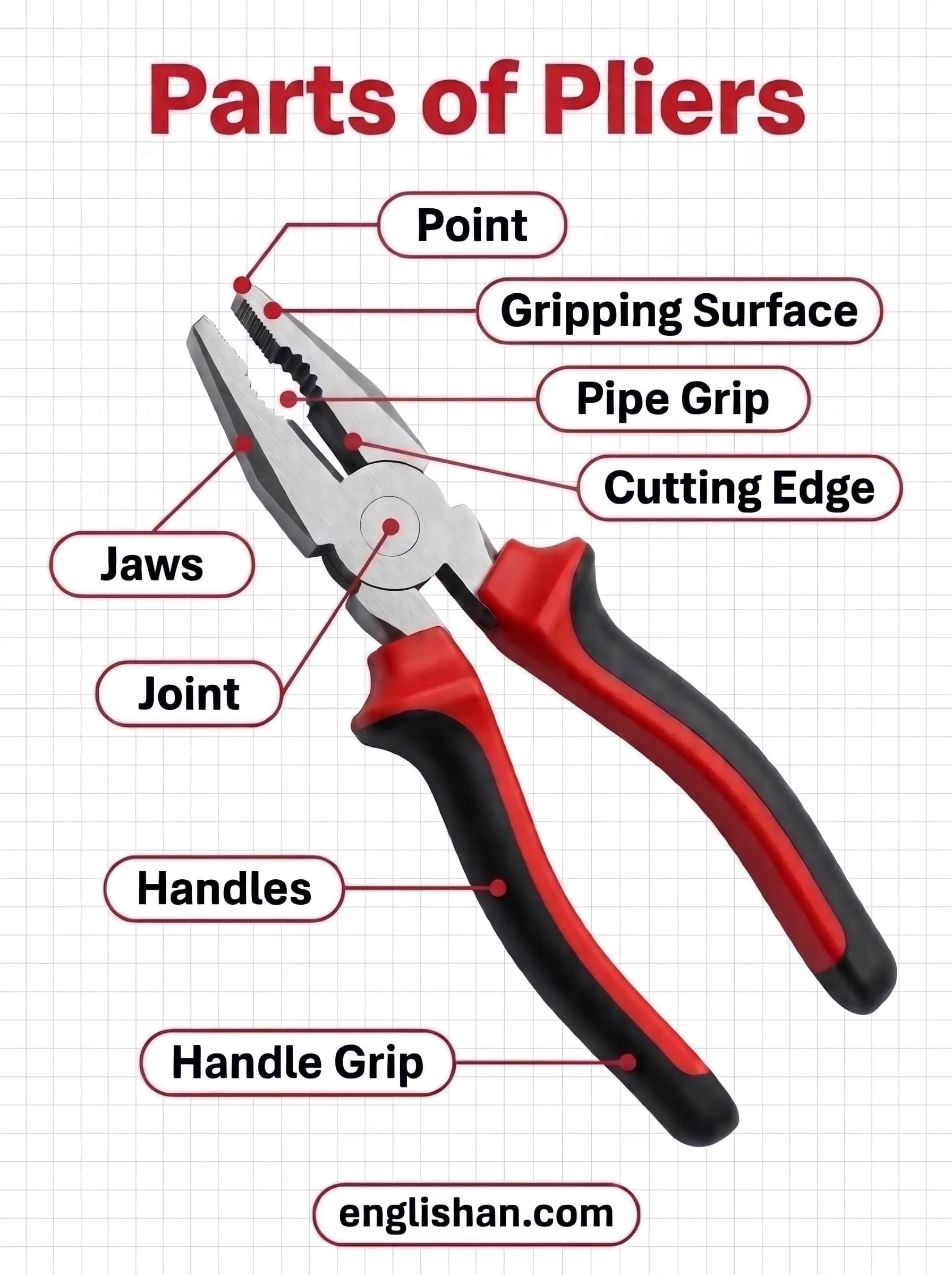
In a labeled diagram of pliers, the jaws are at the front and the joint is at the center. The handles extend back from the joint. The cutter is set into the jaws near the joint.
| Part | Where you find it |
|---|---|
| 1. Jaws | Gripping end of the pliers, in front of the joint |
| 2. Gripping surface | Smooth or serrated face of the jaws that contacts the work |
| 3. Point | Foremost end of the jaws, used for precise grips |
| 4. Cutting edge | Hardened edge set into the jaws near the joint |
| 5. Pipe grip | Rounded recess in the jaws of combination pliers |
| 6. Joint | Pivot that connects the two halves at the center |
| 7. Handles | Two arms behind the joint, squeezed by the hand |
| 8. Handle grip | Insulated or non-slip covering on the handles |
How Many Parts Pliers Have
The parts of pliers number three at the main level: the jaws, the joint, and the handles. Two halves make up the tool, and each half has one jaw and one handle. The two halves are joined at the joint. The scissors follow the same layout of two halves joined at a pivot, with blades in place of jaws.
Longer counts add the gripping surface, the cutting edge, the point, and the handle grip. Every count describes the same tool.
Pliers Jaw Parts
Among the parts of pliers, the jaws are the head, the front part that encloses the material being gripped. They are built to resist wear. Their shape decides what the pliers do: gripping, cutting, or both.
Gripping Surface
The gripping surface is the part of the jaws that contacts the material. It is smooth or serrated. Jaw surfaces are textured instead of smooth to reduce slipping.
Point
The point is the foremost end of the jaws. It gives a precise grip and reaches into narrow spots.
Cutting Edge
The cutting edge is a sharp, hardened part of the jaws. It cuts wire and other materials, and a built-in cutter is set just in front of the joint on many models.
Pipe Grip and Burner Port
The pipe grip is a rounded recess in the jaws of combination pliers. It grips round stock. The burner port is a recess in the jaw, oval or square, that is profiled with teeth.
Flank
The flank is the side of the jaw opposite the gripping surface. It gives stability and support.
Jaw Coating
Jaws are coated with a softer layer of aluminum, brass, or plastic when the work must not be scratched.
Pliers Joint Parts
Among the parts of pliers, the joint is the pivot that connects the two halves. Its usual form is a rivet. The joint is the fulcrum, and it lets the tool open and close.
Fulcrum and Leverage
Pliers are a pair of first-class levers joined at a fulcrum closer to one end. The short jaws are on one side of the fulcrum, and the longer handles are on the other side. This arrangement gives a mechanical advantage that multiplies the grip of the hand.
Box Joint
A box joint is used in parallel pliers. The jaws close in parallel, which gives more grip on square and hexagonal fasteners.
Slip Joint
A slip joint has a pivot that slides through a slot between two holes. Moving the pivot changes the opening size of the jaws.
Pliers Handle Parts
The handles, the third of the main parts of pliers, are the longer arms on the far side of the joint. The hand squeezes them to close the jaws. Handles are bent in some designs so the load of the hand lines up with the arm.
Handle Grip
Metal handles are fitted with grips of other materials for better handling. Grips are insulated in many pliers, which protects against electric shock. Some grips have a non-slip coating.
Parts of Combination Pliers
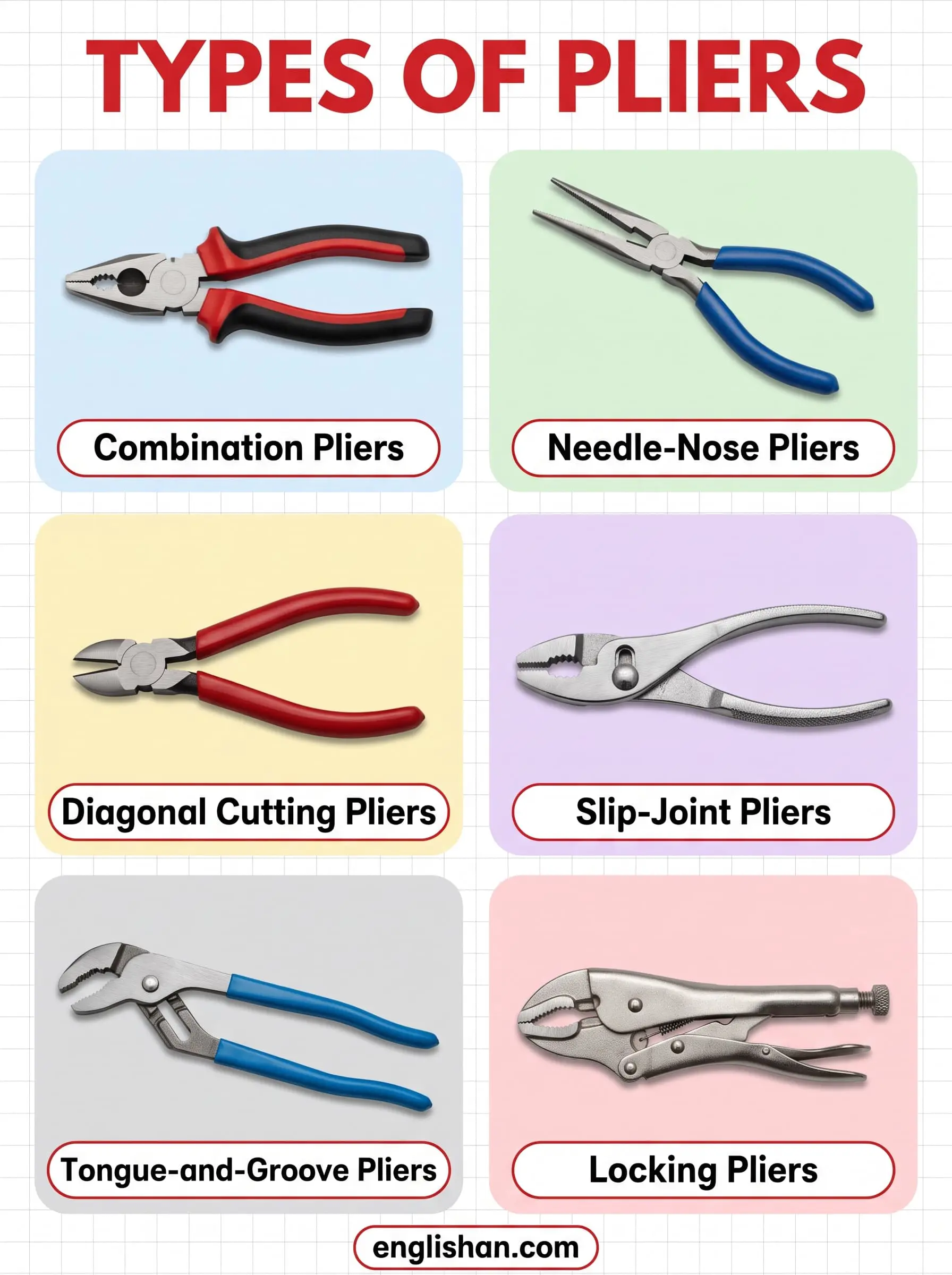
Combination pliers grip, bend, and cut, and they show the core parts of pliers. The parts of combination pliers are the jaws, the gripping surface, the pipe grip, the cutter, the joint, and the handles.
Parts of Needle Nose Pliers
Needle nose pliers are also called long nose pliers. The long, slim nose, also called the beak, gives control and reaches small areas. The parts of needle nose pliers are the nose, the point, the cutting edge near the joint, the joint, and the handles.
A bent nose pair has a curved beak. A round nose pair has conical jaws that form loops in wire.
Slip-Joint and Tongue-and-Groove Pliers Parts
The parts of pliers change at the joint in slip-joint models, whose pivot moves between positions. Straight slip-joint pliers have jaws in line with the handles, and one side has two holes joined by a slot.
Tongue-and-groove pliers, also called channel-lock pliers, have serrated jaws set 45 to 60 degrees from the handles. The upper jaw lies over a tracking channel. The lower jaw slides along it to several positions, so the tool fits several sizes. The handles are 9.5 to 12 inches long for leverage.
Parts of Diagonal Pliers
Diagonal pliers, also called side cutters, cut wire instead of holding it, and they change the parts of pliers at the jaws. Their cutting edges are the jaws. The plane of the edges meets the joint at a diagonal, which names the tool.
The parts of diagonal pliers are the cutting edges, the jaws, the rivet joint, and the handles. The cutting edges are ground into a symmetrical V. Closed, the jaws look like an X from the end. Flush cutters are ground flat on one side.
The jaws are tempered steel, hardened by induction heating and quenching. They indent the wire and wedge it apart. Higher-quality pairs cut 2 mm piano wire.
Parts of Locking Pliers
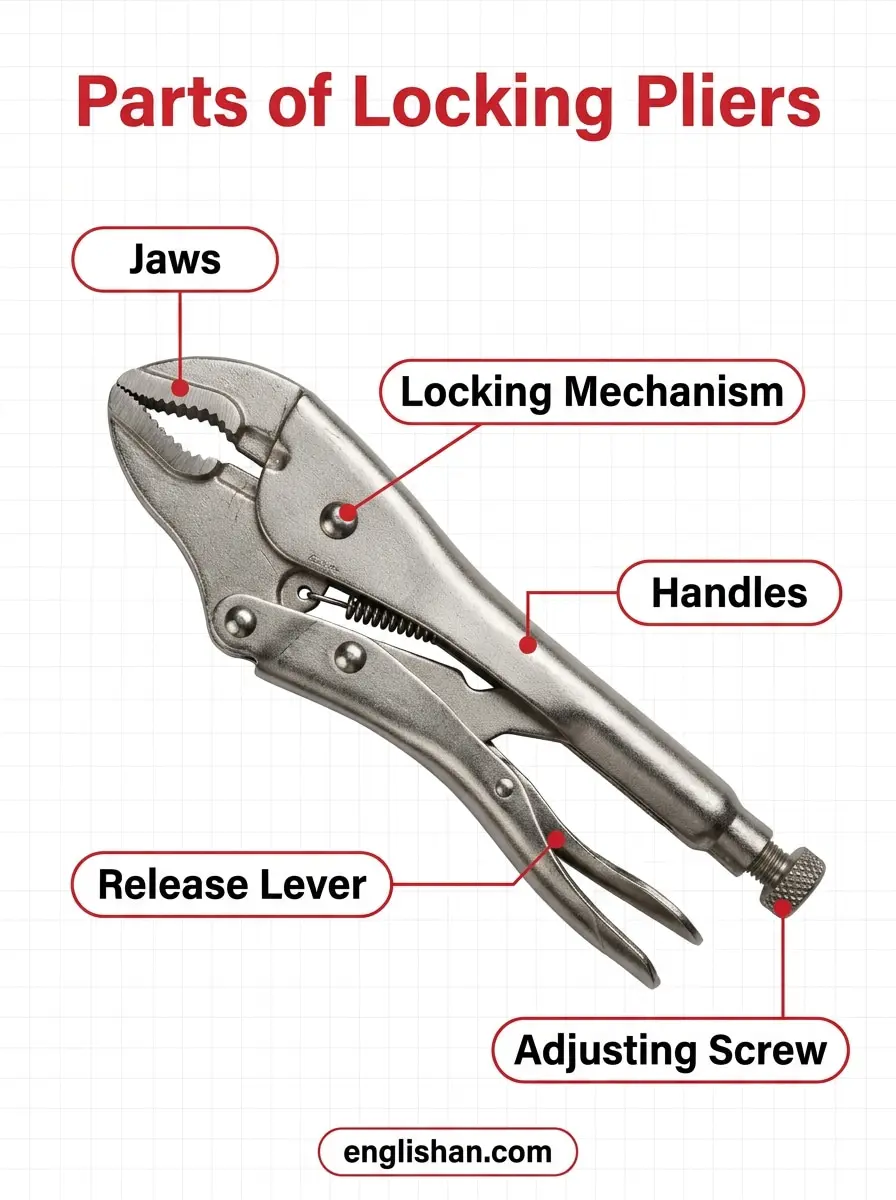
Locking pliers, also called vise-grips, clamp the work and stay closed without hand pressure, and their parts of pliers differ most at the handles. The parts of locking pliers are the jaws, the adjusting screw, the handles, and the release lever.
Adjusting Screw
The adjusting screw is a threaded bolt. It sets the jaw opening slightly smaller than the object, and the jaws close no further than that point.
Over-Center Mechanism
The handles close past the point of maximum clamping. A cam action then locks the jaws in place, and the hand releases its pressure.
Release Lever
Many modern versions have an inner or supplementary lever, frequently on the lower handle. It opens the jaws.
Lineman’s Crimping and Circlip Pliers Parts
Lineman’s pliers are made for electrical work, and some have built-in wire-cutter blades among their parts of pliers. Crimping pliers have shaped jaws that press electrical connectors. Circlip pliers have tips for fitting and removing retaining rings, and the tips are interchangeable.
Pliers Parts and Their Materials
The materials of the parts of pliers are steel alloys, with vanadium or chromium added for strength and corrosion resistance. The jaws are hardened, and diagonal pliers use tempered steel. The handle grips are plastic or rubber.
FAQs
FAQs
The parts of pliers are the jaws, the joint, and the handles. The gripping surface, the cutting edge, and the pipe grip are formed into the jaws.
The joint is the fulcrum of pliers. It is the pivot where the two halves turn, and it gives the leverage that multiplies the grip of the hand.
The joint connects the two halves and lets the jaws open and close. Its usual form is a rivet, and a slip joint moves between positions to change the jaw opening.
Yes, the gripping surface of the jaws is serrated. Pliers with smooth jaws are made for work that must not be marked.
The cutting edge cuts wire. It is a hardened edge set into the jaws near the joint, and diagonal pliers use their whole jaws as cutting edges.
Pliers are made of steel alloys with vanadium or chromium added for strength and corrosion resistance. The handle grips are plastic or rubber.
Related:
