

The parts of an accordion are the treble keyboard, the bass buttons, the bellows, the reeds, the register switches, and the straps. The right hand plays the melody on the treble side. The left hand plays bass notes and chords on the bass side.
The bellows between the two sides moves air across the reeds, and the reeds produce every note. A piano accordion has a piano-style keyboard on the right, and a button accordion has buttons in its place. Both types share the same parts inside.
Parts of an Accordion Labeled Diagram
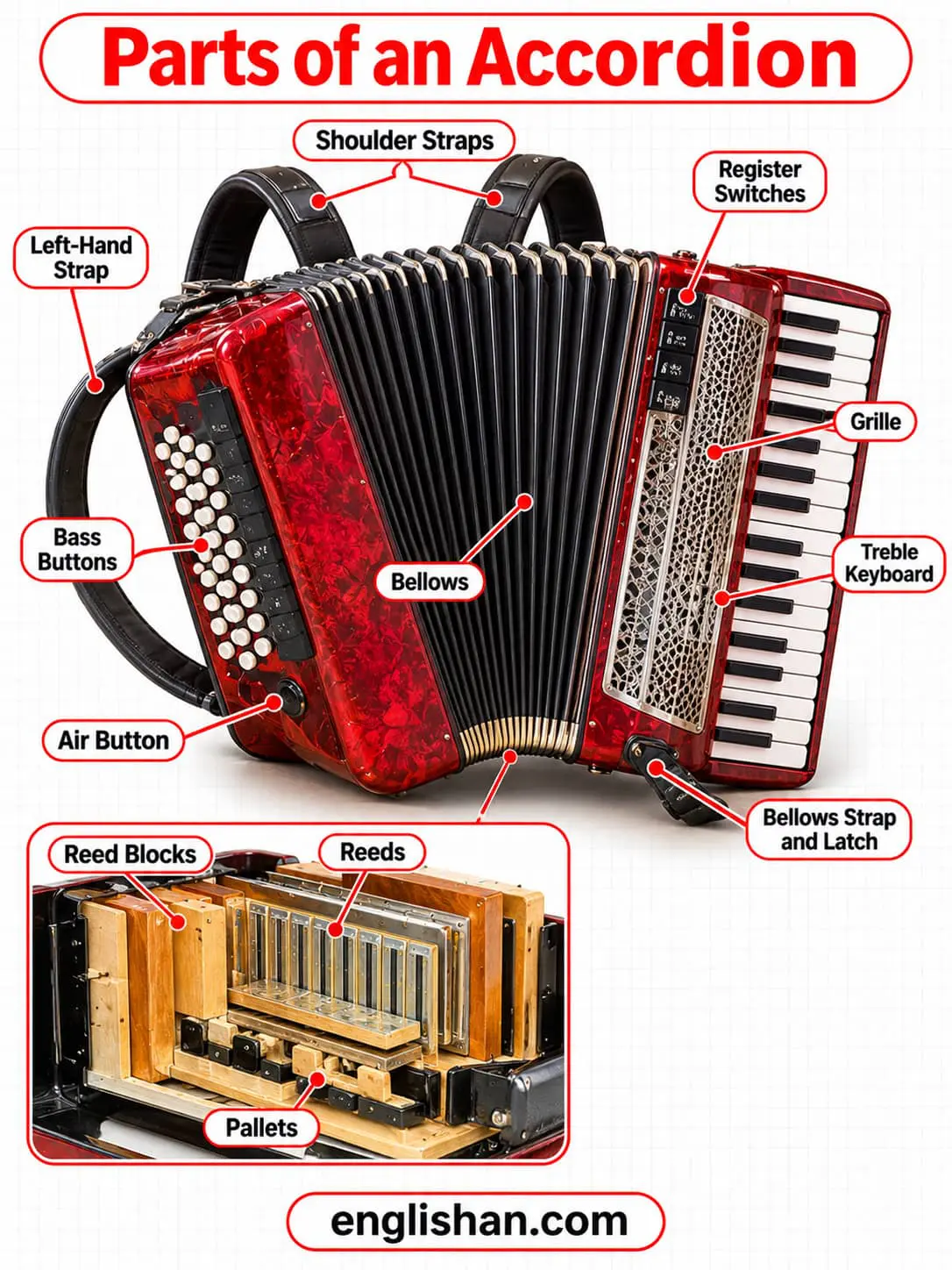
A labeled diagram of a full-size piano accordion shows the treble keyboard on the right, the bass buttons on the left, and the bellows between them. The reed blocks, reeds, and pallets are inside the casings and do not show from outside.
| Part | Location | Function |
|---|---|---|
| 1. Treble keyboard | Right-hand side | Plays the melody |
| 2. Grille | Treble casing | Lets the sound out of the instrument |
| 3. Register switches | Side and top of the treble casing | Select which reed ranks sound |
| 4. Bass buttons | Left-hand side | Play bass notes and chords |
| 5. Air button | Side of the instrument | Moves the bellows without sound |
| 6. Bellows | Between the two casings | Moves air across the reeds |
| 7. Bellows strap and latch | Bellows | Locks the bellows closed |
| 8. Pallets | Inside each casing | Open when keys or buttons are pressed |
| 9. Reed blocks | Inside each casing | Hold the reed plates |
| 10. Reeds | On the reed plates | Vibrate to make the sound |
| 11. Shoulder straps | Over the player’s shoulders | Support the instrument |
| 12. Left-hand strap | Bass side | Leather strap for the left hand |
Treble Side Keys and Buttons
Treble keyboard
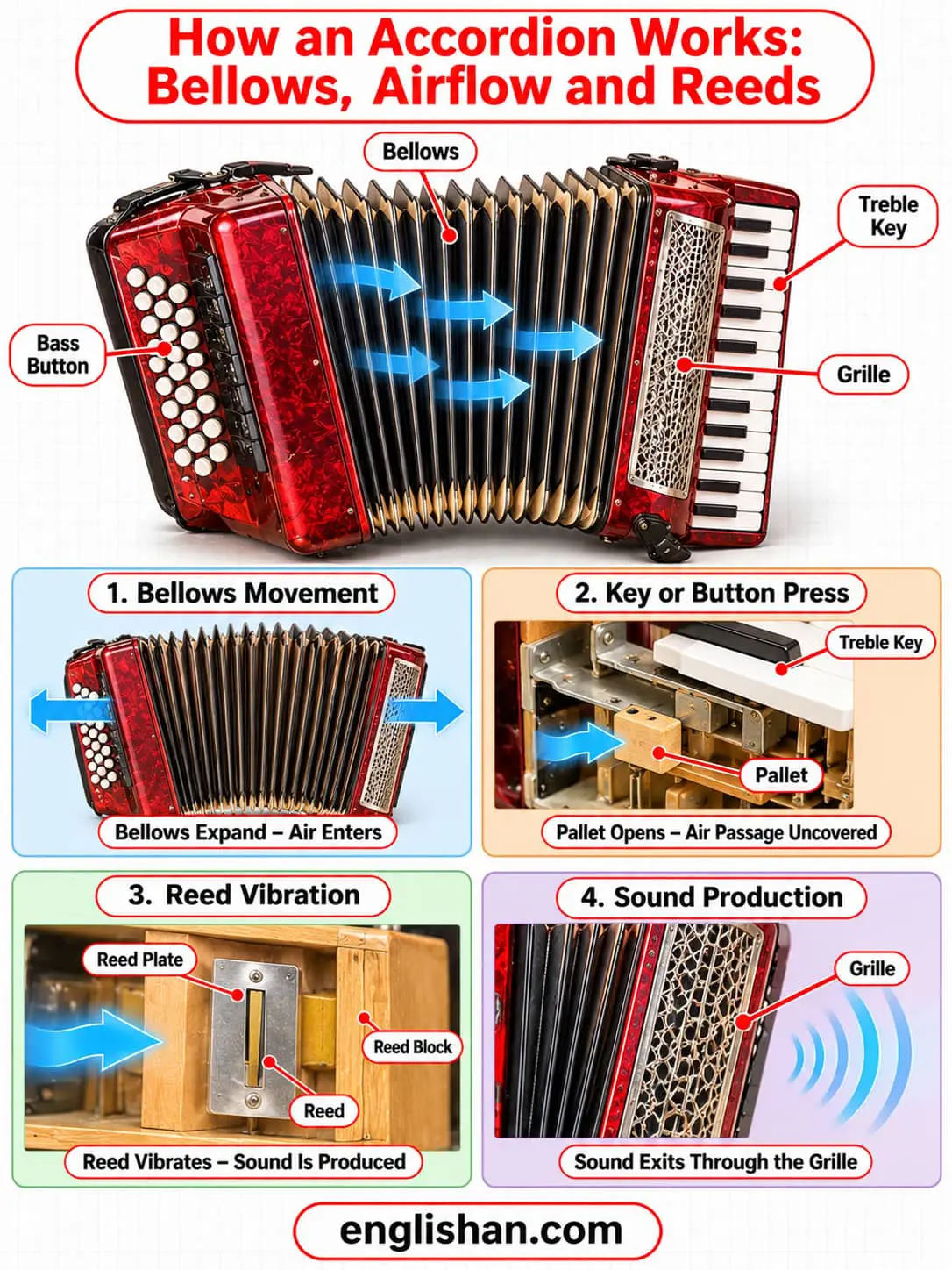
Among the parts of an accordion, the treble side is the right-hand half, and the treble keyboard or button board is its main part. Its keys and buttons control airflow through the reeds, because each one covers a hole that leads to the reeds, and pressing it uncovers the hole. The keys and buttons do not shape the tone, since all expression comes through the bellows.
Keys and buttons are injection-molded plastic.
Piano Keys
A piano accordion has between 25 and 45 treble keys, depending on the size of the instrument. A standard full-size keyboard covers 41 notes, from the F under middle C to the third A over middle C. The keys are arranged like those of a piano.
The keys extend into the body of the accordion, and each one ends in a pallet. The keys are plastic, and most are injection-molded.
Treble Buttons
A button accordion has treble buttons on the right side instead of a keyboard, and the count is around 41.
Grille
The grille is the opening on the treble casing where sound leaves the instrument. The treble grill is made of metal.
Bass Side Buttons and the Stradella System
Bass buttons
Of all the parts of an accordion, the bass side is played by the left hand, which plays buttons for single bass notes and for chords. A full-size Stradella bass has 120 buttons, or less commonly 96. Most of these buttons are out of the player’s view, so the layout is memorized.
Stradella Bass
The Stradella system arranges the buttons in columns that follow the circle of fifths. Single buttons give bass notes, and extra rows give preset chords. Rhinestones mark selected buttons, and the middle C button has a bump or indentation that the fingers find without looking.
Most makers use this system.
Free Bass
A free bass keyboard gives each chromatic button a single note. It is more popular in Europe.
Air button
The air button is on the side of the instrument and lets air in and out. It plays no note. The player presses it to move the bellows in silence.
Parts of an Accordion Bellows
Bellows
The bellows connects the treble and bass sides, and pulling it draws air in while pushing it forces air out through the reeds. The left hand works the bellows, and the air pressure it sets controls the volume.
Bellows are Manila cardboard and cloth, with leather and metal corners.
Bellows Construction
The bellows are made of strong manila cardboard that is folded and pleated, with layers of cloth. Leather covers the inner corners, and metal protects the outer corners. Makers buy the finished bellows from outside suppliers, and the casings are sealed to them with wax.
A leak in the bellows shows up as a quick fall-open or a whoosh of air.
Bellows strap and latch
The bellows strap is tightened at a notch on top of the bellows. A latch locks the bellows closed, at the top and bottom, for transport. The oldest models lack the latch.
Parts of an Accordion Inside the Case
The inner parts of an accordion are the pallets, the reed blocks, and the reeds in each casing. Air from the bellows passes through the pallets that the keys or buttons have opened, then across the reeds.
Pallets
A pallet is a valve that opens when the keys or buttons are pressed, which lets air flow across the reeds. Small leather flap valves seal the reed that is not sounding in the current direction of the bellows.
Reed blocks
Reed blocks are the wooden blocks that hold the reed plates. Three or four blocks are fitted into the treble and bass casings, depending on the model. The larger wooden parts, including the blocks, are poplar.
Frames, pallets, and reed blocks are poplar. Valves and washers are leather or plastic, the rods and treble grill are metal, and the casing seal is wax.
Reeds
A reed is a free-standing metal strip riveted to a rectangular plate. Reeds are made of brass or steel, and the steel is a highly tempered watch-spring steel. Each reed lies over a slot with a leather or plastic valve.
Length and thickness set the pitch, and longer reeds sound lower. The bagpipe also makes its sound with reeds, though it feeds them from a bag instead of a bellows.
Reeds and reed plates are brass or watch-spring steel.
Register Switches and Reed Ranks
Register switches
Register switches select which reed ranks sound together, and only one combination is active at a time. Three reed blocks give seven possible combinations. Each switch name refers to the ranks it selects.
A reed rank is one full set of reeds that covers the range of the instrument. Most accordions have two to four ranks on the treble side and three to five on the bass side. A 4/5 accordion has four treble ranks and five bass ranks.
Ranks are named by organ pitch. An 8′ rank sounds at the pitch of the note played, a 4′ rank sounds an octave higher, and a 16′ rank sounds an octave lower. When two 8′ ranks are tuned a little apart, by no more than 25 cents, they beat against each other and give a tremolo tone.
| Switch | Ranks | Pitch |
|---|---|---|
| Piccolo | 4′ | An octave higher |
| Clarinet | 8′ | Unison pitch |
| Bassoon | 16′ | An octave lower |
| Oboe | 4′ + 8′ | Higher and unison |
| Violin | 8′ + 8′ | Unison, tuned apart |
| Musette | 8′ + 8′ + 8′ | Unison, three ranks |
| Organ | 4′ + 16′ | Higher and lower |
| Harmonium | 4′ + 8′ + 16′ | Higher, unison, and lower |
| Bandoneon | 8′ + 16′ | Unison and lower |
| Accordion | 8′ + 8′ + 16′ | Unison twice and lower |
| Master | 4′ + 8′ + 8′ + 16′ | All ranks together |
Master switch and palm bar
A master switch or palm bar on the right side turns on every reed block for the fullest sound.
Chin switches and bass-side switches
Large instruments have chin switches on top. Bass-side switches near the innermost bass buttons control the left-hand reeds.
Parts of an Accordion Cassotto and the Tone Chamber
A cassotto is a sound chamber inside some higher-end accordions. It holds one or more treble-side reed blocks, with the reeds mounted at a 90° angle. The chamber works as a passive filter that reduces frequencies over 1000 Hz and strengthens those between about 500 and 1000 Hz.
The result is a warmer, mellower tone than unenclosed reeds produce. The cassotto bassoon reeds are favored by jazz accordionists. Beltuna, Pigini, Bugari, and Öllerer are Italian makers known for the design, and the construction costs considerably more than a standard reed chamber.
Shoulder Straps and Left-Hand Strap
The straps among the parts of an accordion are strong padded leather.
Shoulder straps
A larger piano or chromatic accordion has two shoulder straps. A diatonic accordion has one shoulder strap. The shoulder straps are fitted snug, so the accordion does not shift while the hands reach for notes.
Left-hand strap
Every model has a leather strap for the left hand. It is on the bass side.
Thumb strap and backstrap
The thumb strap is on a diatonic accordion and fits the right hand. A backstrap joins the two shoulder straps behind the player and steadies a large instrument.
Straps are padded leather.
Parts of a Piano Accordion and a Button Accordion
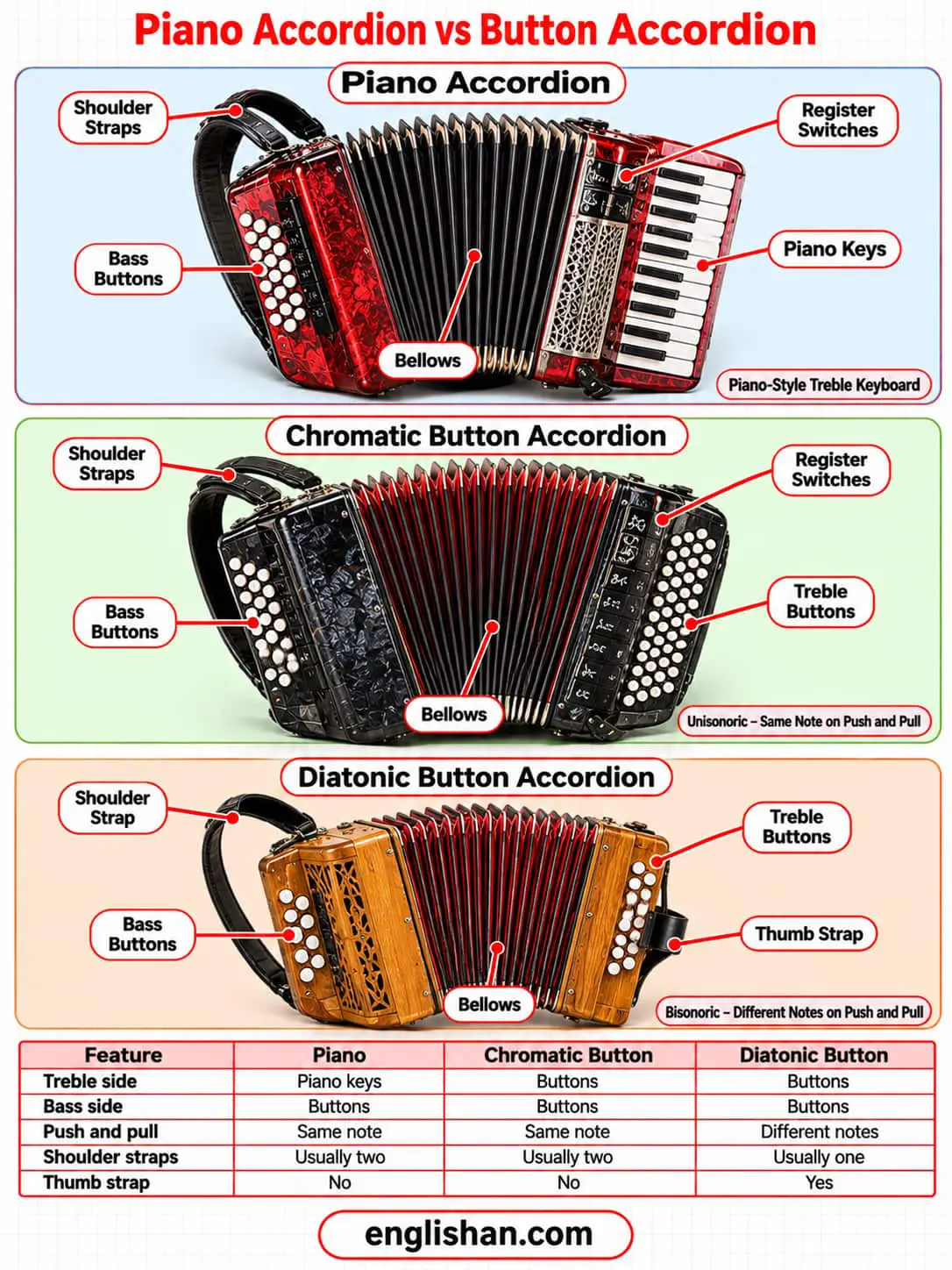
A piano accordion, a chromatic button accordion, and a diatonic button accordion share the bellows, the reeds, the pallets, and the straps. They differ in the treble side and in the way a button responds to the bellows.
| Type | Treble side | Shoulder straps |
|---|---|---|
| Piano accordion | Piano-style keys | Two on larger models |
| Chromatic button accordion | Buttons | Two on larger models |
| Diatonic button accordion | Buttons | One, plus a thumb strap |
The chromatic button accordion is classed as unisonoric, so each button gives one note on the push and the pull. The diatonic button accordion is bisonoric, so the same button sounds a different note when the bellows reverses direction.
FAQs
The parts of an accordion are the treble keyboard or buttons, the bass buttons, the bellows, the reeds, the register switches, and the straps. Inside the casings are the pallets and the reed blocks. The grille and the air button complete the outside.
The inside of an accordion holds two casings, one on each side of the bellows. Each casing holds pallets, wooden reed blocks, and metal reeds on reed plates. Rods and levers link the bass buttons to the pallets, and the treble keys extend into the body.
Sources divide the instrument into different groups of parts, so no single count applies. The labeled diagram numbers twelve parts. They cover the keyboard, the bass buttons, the bellows, the reeds, the register switches, and the straps.
The keys on a piano accordion are the treble keys on the right side, and a full-size keyboard has 41 of them. Pressing the keys opens the pallets inside the case, and the air from the bellows then flows across the reeds. A button accordion has buttons in place of keys.
A button accordion has treble buttons on the right, bass buttons on the left, a bellows, reeds, register switches, and straps. It has around 41 treble buttons and a 120-button Stradella bass. Only the treble side differs from a piano accordion.
A diatonic accordion has the same parts as other button accordions, with a few differences. It is bisonoric, so each button sounds a different note on the push and the pull. It has one shoulder strap and a thumb strap for the right hand.
The reeds are the metal strips that make the sound. Each reed is a brass or steel strip riveted to a plate, and air from the bellows sets it vibrating. Longer reeds sound lower than shorter ones.
The switches select which reed ranks sound. Each switch turns on a combination such as a single 8′ rank or the 4′, 8′, and 16′ ranks together. Only one combination is active at a time, and the master switch turns on every rank.
Related: