

The parts of a concert flute in C, the standard flute of bands and orchestras, are the head joint, the body, and the foot joint, which fit together at tenons. Like the saxophone, it is a woodwind with keys and pads, while the trumpet is a brass instrument with valves.
The crown, cork, lip plate, and embouchure hole make up the head joint. The keys, pads, and rods are mounted on the body and the foot joint.
Parts of a Flute Labeled From Mouthpiece to Foot Joint
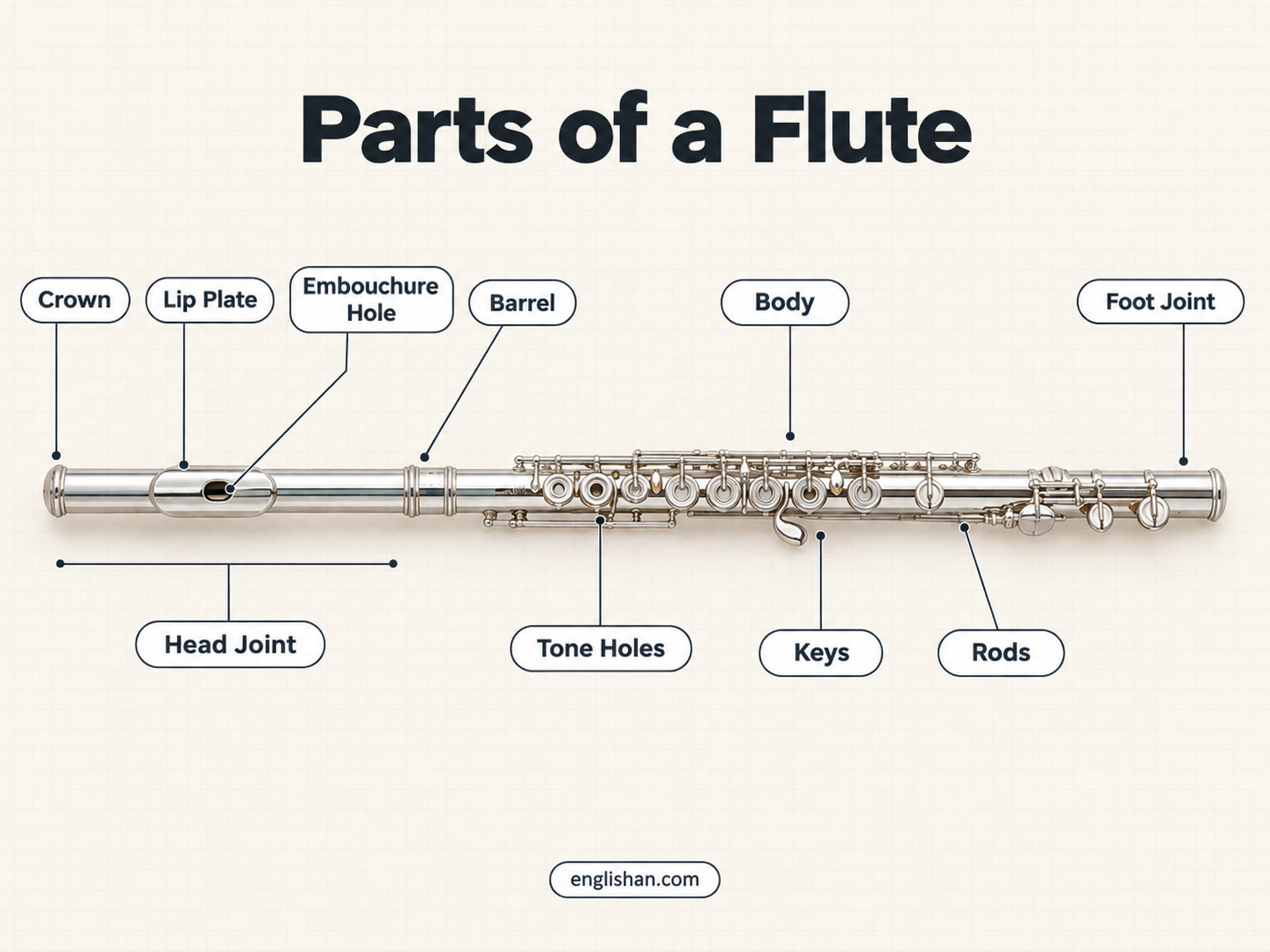
On an assembled flute, the crown caps the head joint, and the lip plate with the embouchure hole is set just under it. The body follows with the barrel, the tone holes, and the key mechanism. The foot joint ends the tube with the lowest keys.
| Part | Where you find it |
|---|---|
| 1. Head joint | Top joint of the tube, with the lip plate |
| 2. Crown | Cap screwed onto the closed end of the head joint |
| 3. Cork | Stopper inside the head joint, near the crown |
| 4. Reflector plate | Small disc fixed to the cork on the tube side |
| 5. Lip plate | Curved metal plate where the lower lip rests |
| 6. Riser | Short metal wall that joins the lip plate to the tube |
| 7. Embouchure hole | Oval opening in the center of the lip plate |
| 8. Head joint tenon | Narrow end that fits into the body |
| 9. Curved head joint | Bent head joint made for small players |
| 10. Body | Middle joint that bears most of the keys |
| 11. Barrel | Engraved top collar of the body |
| 12. Body tenon | Narrow end of the body that fits into the foot joint |
| 13. Tone holes | Round openings drilled along the body |
| 14. Tone hole chimneys | Short metal collars soldered around each tone hole |
| 15. Keys | Metal levers that cover and open the tone holes |
| 16. Key cups | Round cups that seat a pad over each tone hole |
| 17. Closed-hole keys | Solid cups that seal the tone hole completely |
| 18. Open-hole keys | Ring keys with a hole in the center of the cup |
| 19. Hole plugs | Removable discs that fill the open centers |
| 20. Inline G | Left-hand G key set in line with the others |
| 21. Offset G | G key shifted toward the left ring finger |
| 22. Pads | Felt or synthetic seals glued inside the key cups |
| 23. Rods | Long steel shafts that connect the keys |
| 24. Posts | Small pillars that mount the rods to the body |
| 25. Springs | Thin steel springs that return each key to rest |
| 26. Thumb keys | Keys under the body for the left thumb |
| 27. Bb thumb key | Lever that lowers the B to B flat |
| 28. Trill keys | Small keys for the D and D sharp trills |
| 29. G sharp lever | Left little finger lever on the body |
| 30. Split E mechanism | Linkage that eases the high E |
| 31. Foot joint | Last joint of the tube, with the low keys |
| 32. Foot joint keys | Keys played by the right little finger |
| 33. C foot | Foot joint that reaches down to low C |
| 34. B foot | Longer foot joint that reaches down to low B |
| 35. D foot | Short foot joint that stops at low D |
| 36. Gizmo key | Small lever on top of the B foot keys |
Flute Head Joint Parts
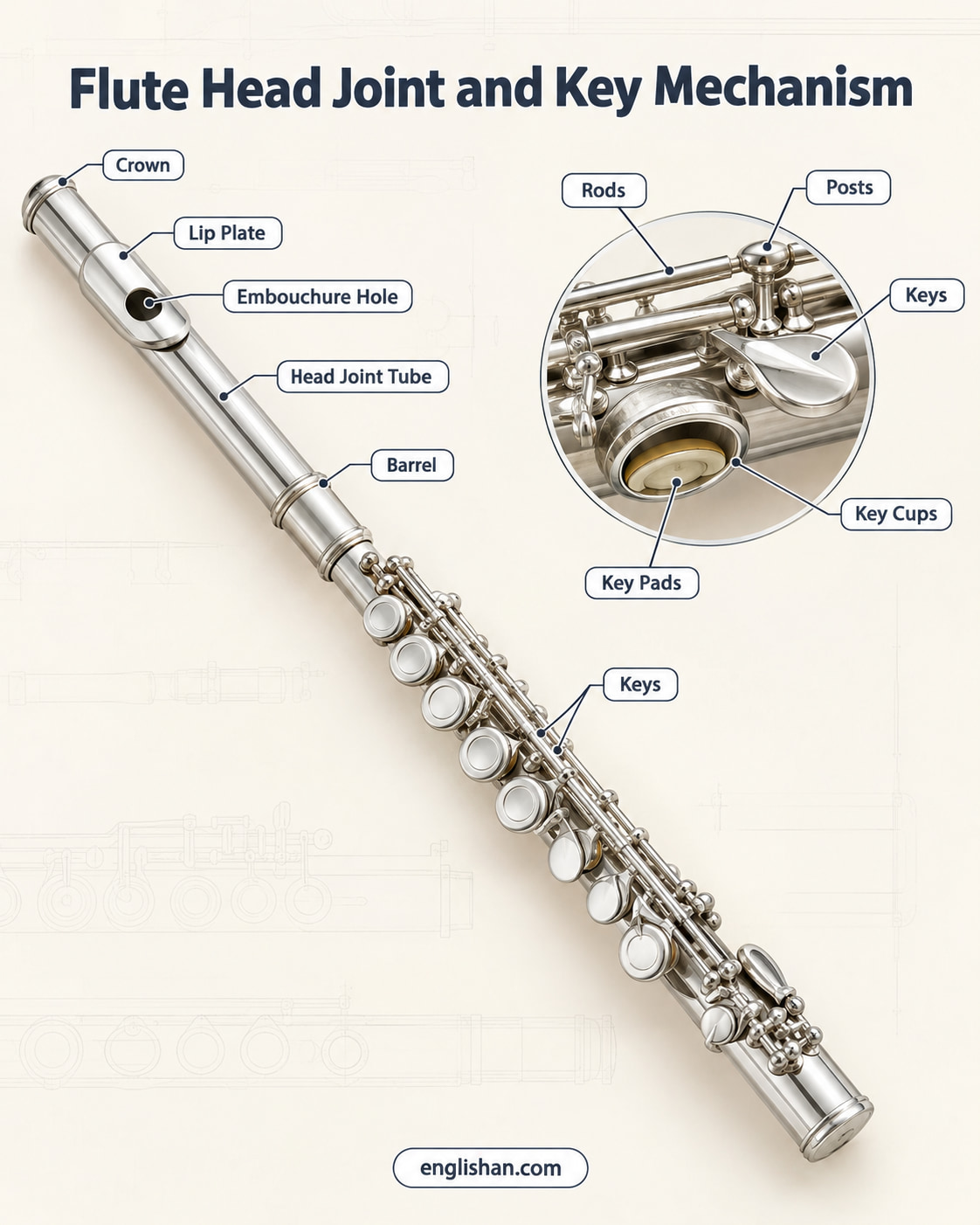
The head joint is the top joint of the flute, and it forms the tone. The parts of a flute in this group are the crown, the cork, the lip plate, the riser, and the embouchure hole.
Head Joint
The head joint is a metal tube about 8.7 inches (22 cm) long, closed at one end by the crown. The straight type is the standard, and the tube is nickel-silver, silver, gold, or platinum. The lower end is a tenon that fits into the body.
Crown
Among the parts of a flute, the crown is a cap screwed onto the closed end of the head joint. It is made of silver, gold, or another metal, and it seals the tube. A screw on its inside is joined to the cork.
Cork
The cork is a stopper inside the head joint, set near the crown. Its face is set 17.3 mm (0.68 in) from the center of the embouchure hole. Silver discs or rubber rings seal each side of it.
Reflector Plate
The reflector plate is a small metal disc fixed to the cork on the tube side. It is also called the tone reflector, and it directs the sound down the tube. The plate is set between the cork and the embouchure hole.
Lip Plate
The lip plate is a curved metal plate where the lower lip rests. It is the first of the flute head joint parts that the player touches. It is also called the embouchure plate, and the embouchure hole is cut through its center.
Riser
The riser is a short metal wall that joins the lip plate to the tube. It is also called the chimney, and it is soldered to the tube and sets the height of the lip plate.
Embouchure Hole
The embouchure hole is the oval opening in the center of the lip plate. The player blows across its far edge, and the hole is cut in the upper third of the head joint.
Head Joint Tenon
Among the parts of a flute, the head joint tenon is the narrow end of the tube that fits into the body. Pulling the head joint out of the body along the tenon lowers the pitch, which makes this the tuning adjustment. Some makers call the joint a tuning slide.
Curved Head Joint
A curved head joint is bent back in a U shape to bring the keys closer to a young player. It fits the same tenon as the straight head joint, and it is made for small hands.
Flute Body Parts and Tone Holes
The body is the middle joint of the flute and the longest one. Among the flute body parts, the barrel, the tone holes, and the tenons belong to the tube, and the keys are mounted on it.
Body
The body is the middle joint, also called the corpus. It bears most of the tone holes and the key mechanism. One tube joins the barrel at the top to the body tenon at the bottom.
Barrel
The barrel is the ridged collar at the top of the body, where the head joint tenon fits. It is engraved with the maker’s name and model on most flutes. The ridges are decorative and have no effect on the tone.
Body Tenon
The body tenon is the narrow end of the body that fits into the foot joint. It is the second tenon on the instrument.
Tone Holes
Tone holes are the round openings drilled along the body and the foot joint. Together with the keys, they are the parts of a flute that set the pitch. A metal chimney is attached around each hole to form a flat seat for the pad.
Parts of a Flute Key Mechanism
The key mechanism is the system of keys, pads, rods, posts, and springs mounted on the body and the foot joint. The guitar has frets where the flute has tone holes, and the drum set has neither. Among the parts of a flute, it has the largest number of pieces, and a modern flute has about 120 parts in all.
Keys
Among the parts of a flute, keys are metal levers that cover and open the tone holes. Each key has a cup, an arm, and a touch piece for the finger. Springs return the keys to their resting position.
Closed-Hole and Open-Hole Keys
Closed-hole keys, called plateau keys, have solid cups that seal the tone hole. Open-hole keys, called ring keys, have a hole in the center of the cup that the finger must cover. Removable plugs fill the open centers on student flutes.
Inline G and Offset G
An inline G flute has the G key set in line with the A, B, and C keys. An offset G flute shifts the G key toward the left ring finger, which suits the natural hand position. Both are made in student and professional models.
Pads
The pads are felt or synthetic seals glued inside the key cups. They press onto the chimneys to close each tone hole, and a worn pad leaks air.
Rods and Posts
Rods are long steel shafts that join the keys, and posts are the small pillars that mount the rods to the body. A key pivots on its rod, and the posts are soldered to the tube along the body.
Springs
Springs are thin steel springs set behind the keys. Each one pushes a key back to its resting position, either open or closed, and its tension is adjustable.
Thumb Keys
Thumb keys are mounted on the underside of the body, under the left thumb. The Bb thumb key lowers a B to B flat, and a Briccialdi lever on some flutes does the same. The right thumb supports the instrument and has no key.
Trill Keys
Trill keys are small keys on the upper body, played by the right hand, that make fast alternations between neighboring notes. The D trill key and the D sharp trill key are the two standard ones.
Split E Mechanism
The split E mechanism is a linkage that makes the high E easier to play. An E mechanism arm on the body is the visible part. It is an option on many student flutes.
Flute Foot Joint Parts
The foot joint is the last and shortest joint of the flute. The parts of a flute in this group are the foot joint tube, the low keys, and the foot length.
Foot Joint
The foot joint is a short metal tube with a few tone holes and the lowest keys. The right little finger plays them, and the joint fits onto the body tenon with its keys aligned to those on the body.
C Foot
A C foot joint has two keys and two tone holes. It reaches down to low C, the lowest note of the standard flute. This is the length found on most student flutes.
B Foot
A B foot joint has three keys and three tone holes. It is longer than a C foot and reaches down to low B, one note under the C.
D Foot
A D foot joint has one key and one tone hole. It stops at low D and is rare on modern flutes.
Gizmo Key
The gizmo key is a small lever on top of the low B and low C keys of a B foot. It is also called the high C facilitator. It improves the response of the highest notes.
Flute Parts and Their Materials
Each of the parts of a flute is made from a set material. The tube, the crown, the pads, and the cork are the parts that differ most between a student flute and a professional flute.
Tube and Key Metals
The tube is made of nickel-silver, sterling silver, gold, or, rarely, platinum. Student flutes are silver plated, and professional flutes are solid silver or gold.
Crown and Lip Plate
Crowns are made of silver, silver plate, gold, zirconium, or rhodium. The lip plate and the riser match the metal of the head joint tube.
Pads and Cork
Pads are made of felt or a synthetic material. The cork is natural cork or a synthetic substitute, and both are replaced when they wear.
Flute Types and Their Added Parts
The parts of a flute change with the type of instrument. The piccolo, the alto flute, and the bass flute each alter the length and the head joint.
Piccolo
The piccolo is a small flute pitched one octave higher than the concert flute. It is half the length of the concert flute, with a head joint and a body but no foot joint.
Alto Flute
The alto flute is a larger flute pitched in G, a fourth lower than the concert flute. It has a curved or straight head joint and a longer tube than the concert flute.
Bass Flute
The bass flute is over 4 feet long and is pitched one octave lower than the concert flute. It has a curved head joint that brings the lip plate within reach of the player.
FAQs
The parts of a flute are the head joint, the body, and the foot joint. The head joint has the crown, cork, lip plate, riser, and embouchure hole. The body and the foot joint bear the keys, pads, rods, posts, and springs.
The three parts of a flute are the head joint, the body, and the foot joint. They fit together at two tenons, with the head joint at the mouth end and the foot joint at the far end.
The head joint produces the tone. The body bears the keys that change the pitch, and the foot joint extends the range to low C or low B. The pads seal the tone holes, and the rods and springs move the keys.
Sound starts at the embouchure hole. The player blows a stream of air across its far edge, and the air column inside the tube vibrates. The cork position sets the pitch of the air column. A violin makes sound differently, from vibrating strings.
Open-hole flutes have ring keys with a hole in the center of the cup, and the finger must seal that hole. Closed-hole flutes have solid cups, and student flutes are closed-hole. Advanced players choose open-hole for extended techniques such as pitch bends.
A B foot flute has a longer foot joint with three keys, and it reaches down to low B. A C foot flute has two keys and stops at low C. The B foot adds one note under the standard range.
An inline G flute sets the G key in line with the other left-hand keys. An offset G flute shifts that key toward the ring finger, which suits the natural hand position. Both play the same notes, and the choice depends on hand size.