

The parts of a pencil are a graphite core, a wood casing, a metal ferrule, and a rubber eraser. The paint, the point, and the hardness marking complete the finished pencil.
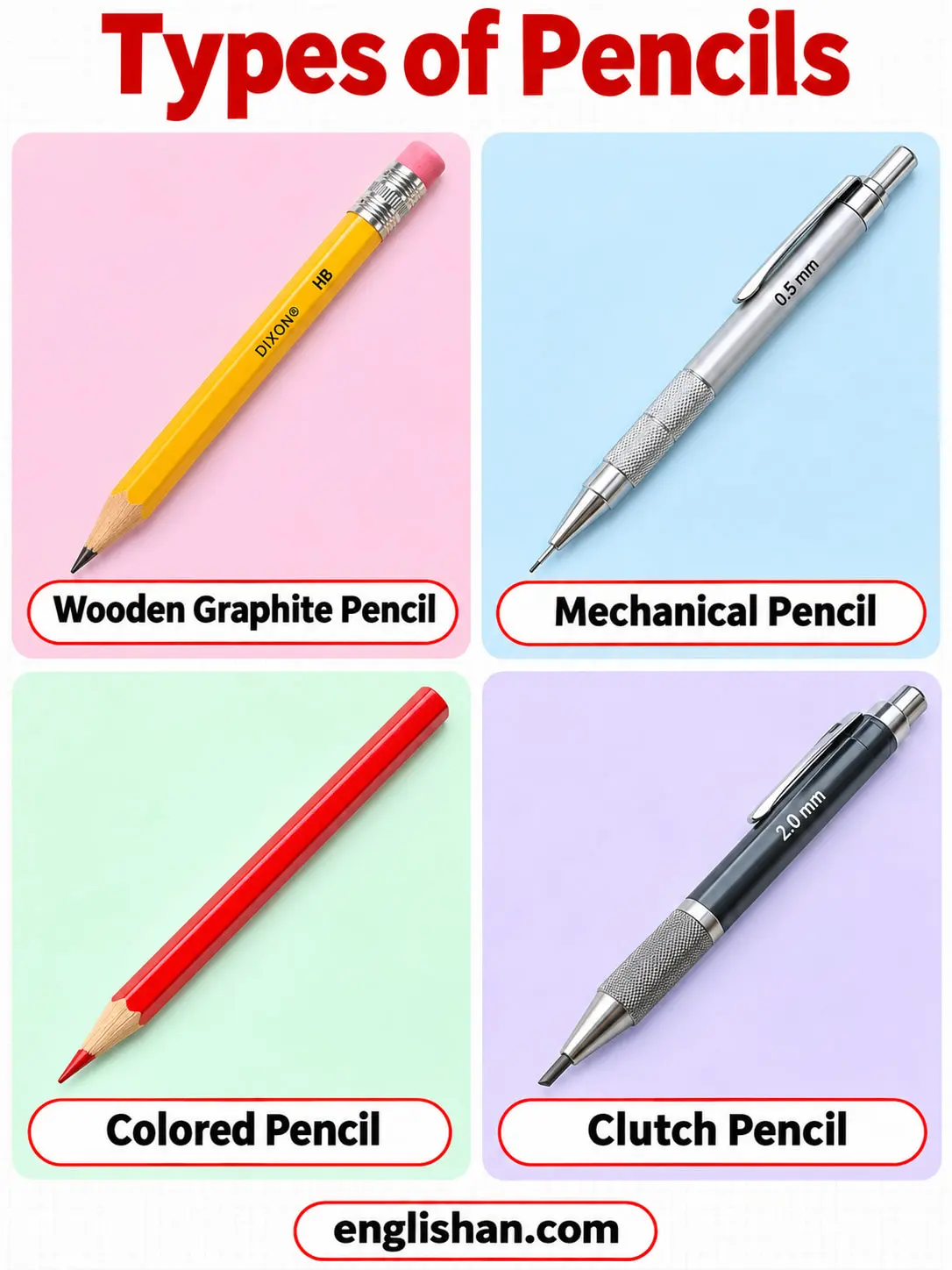
A wooden graphite pencil runs from the eraser to the point. A mechanical pencil replaces the wood casing with a barrel, and a colored pencil replaces the graphite with a pigment core. The pen and the scissors have their own parts.
Parts of a Pencil Labeled Diagram
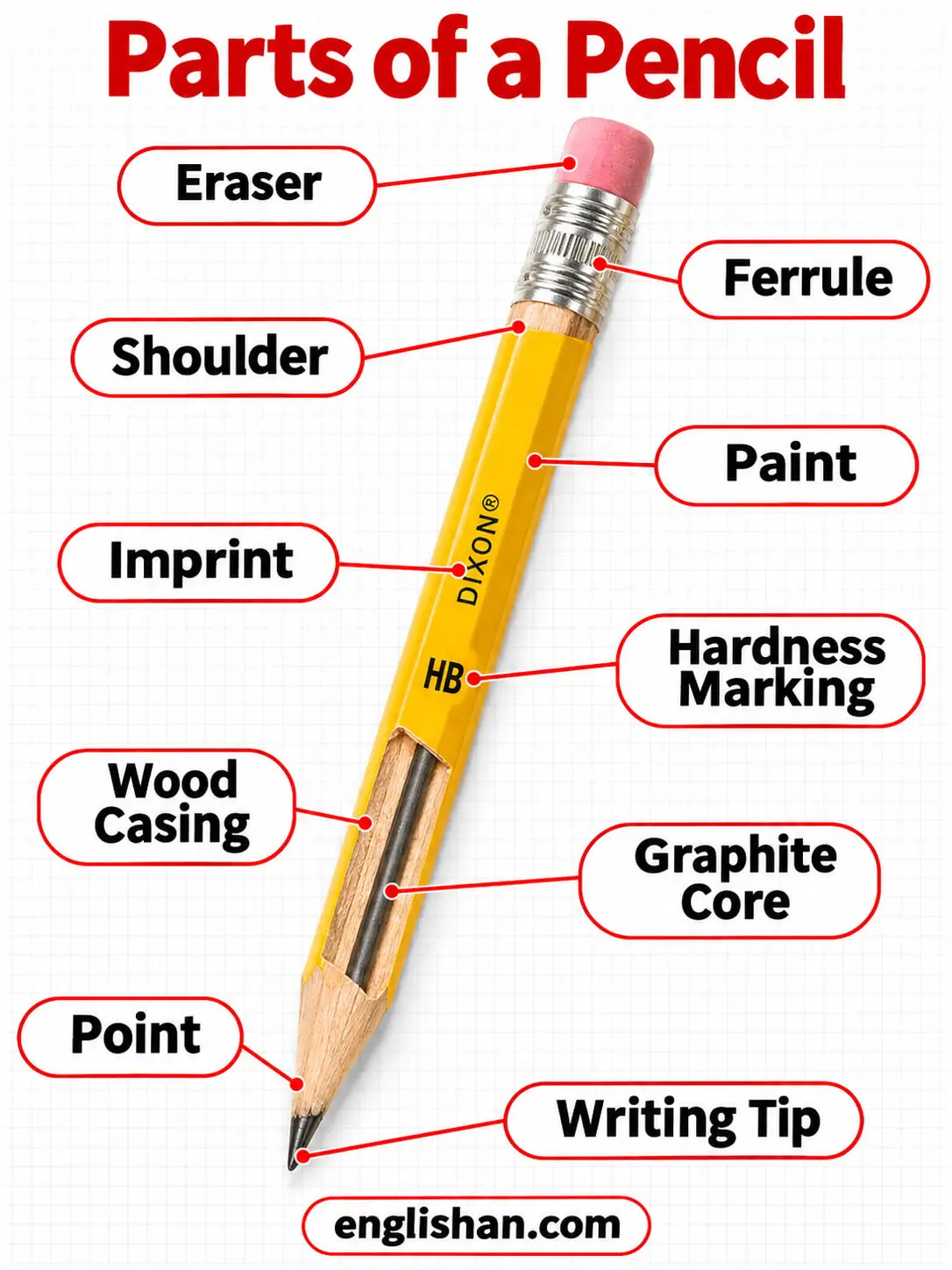
In a labeled diagram of a pencil, the eraser and the ferrule are at the top, and the point is at the bottom. The casing is between them and encloses the core. Every part of a pencil belongs to the core, the casing, or one of the two ends.
| Part | Where you find it |
|---|---|
| 1. Eraser | Rubber plug at the top end of the pencil |
| 2. Ferrule | Metal band that fastens the eraser to the casing |
| 3. Shoulder | Notched end of the wood where the ferrule is fixed |
| 4. Wood casing | Hexagonal or round wood body, also called the barrel or the shaft |
| 5. Paint | Coating on the outside of the casing |
| 6. Imprint | Brand and model name printed on the casing |
| 7. Hardness marking | Grade stamp such as HB or No. 2 |
| 8. Graphite core | Cylinder of graphite and clay at the center of the casing, called the lead |
| 9. Point | Sharpened end where the wood is cut away from the core |
| 10. Writing tip | End of the graphite that touches the paper |
How Many Parts a Pencil Has
A pencil has five main parts: the core, the casing, the paint, the ferrule, and the eraser. References give this count for a wooden pencil. The calculator is another desk tool, and its parts follow a display and keypad layout.
Counts of ten add the shoulder, the imprint, the hardness marking, the point, and the writing tip. A mechanical pencil has its own parts, which replace the casing and the ferrule with a barrel and a jaw mechanism.
Parts of a Wooden Pencil
The core and the casing are the two largest parts of a pencil with a wooden body. They are bonded together, so the casing is carved away with a sharpener to expose the core.
Wood Casing
The casing is the thin wood body that encloses the core, and it is the largest of the parts of a pencil. Makers also call it the barrel or the shaft. Most casings are hexagonal, and round and triangular casings are also made.
A standard No. 2 hexagonal pencil is 7.5 inches long. It measures about ¼ inch from flat to flat and 9/32 inch across the outer diameter.
Red cedar was the traditional casing wood, because it is aromatic and resists splintering. Incense cedar replaced it as the supply of red cedar shrank. Basswood and alder are the other casing woods.
Graphite Core
The core is the cylinder at the center of the casing. It is graphite powder bound with clay, and it leaves the mark on the paper. Makers dip many cores in oil or wax so the pencil writes smoothly.
The core is called the lead, but it contains no lead metal.
A harder core has more clay and makes a lighter mark. A softer core has less clay and makes a darker mark.
Paint and Imprint
The paint is the coat applied to the casing after assembly. It protects the wood and gives the pencil its color. Older paints contained high levels of lead.
The imprint is the brand and model name printed on the paint.
Hardness Marking
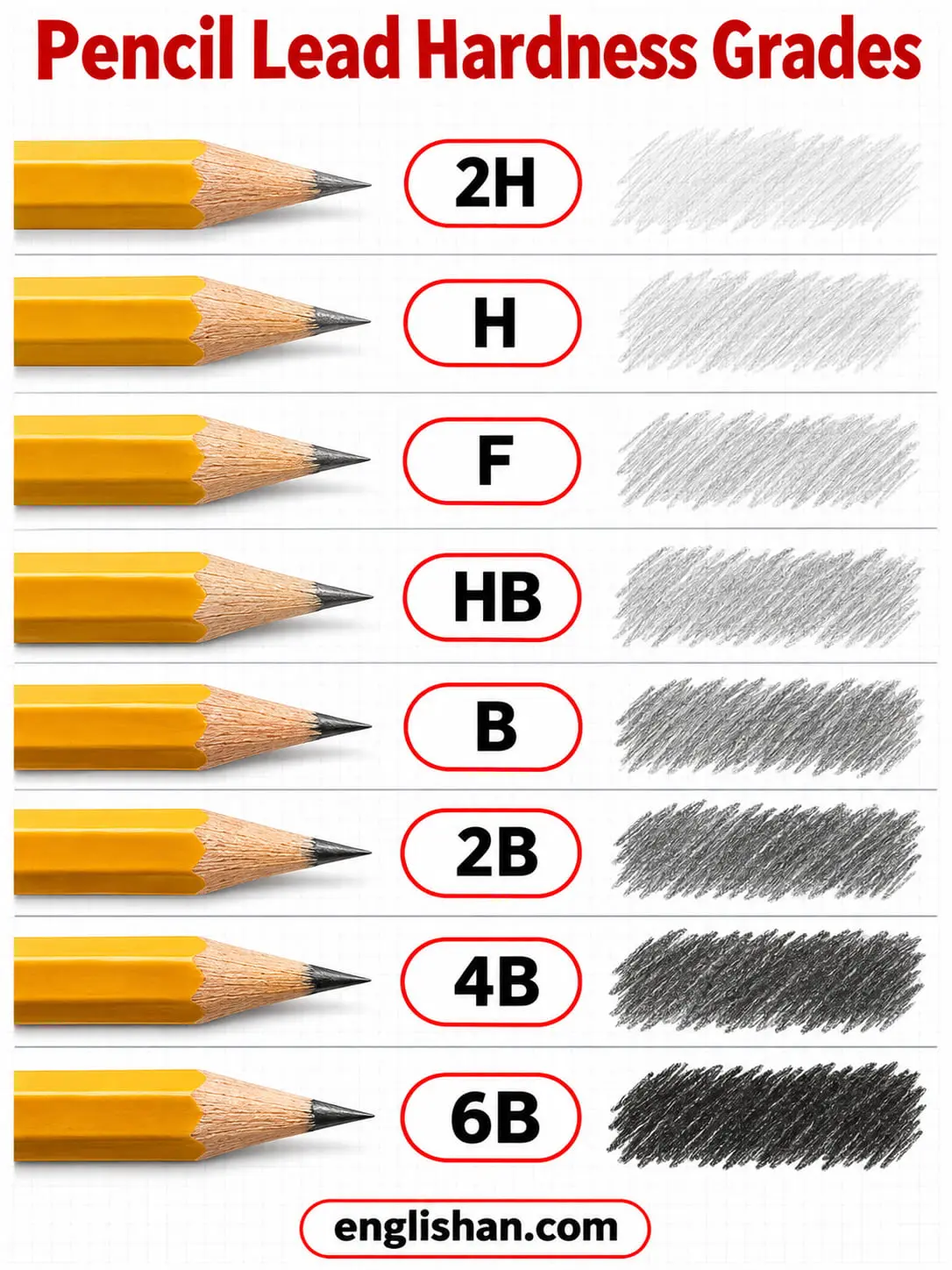
The hardness marking is the stamp that grades the core. The letter H means hardness, B means blackness, and F means fineness. HB is the standard writing grade.
Pencils sold in the US also bear a number. This number scale follows the Conté and Thoreau chart, and grades vary slightly by maker.
| Number | Grade |
|---|---|
| No. 1 | B |
| No. 2 | HB |
| No. 2½ | F |
| No. 3 | H |
| No. 4 | 2H |
Pencil Eraser and Ferrule Parts
The eraser and the ferrule form the top end of a pencil. Among the parts of a pencil, they are the two that are made of neither wood nor graphite.
Eraser
The eraser is the rubber plug at the top end of the pencil. It is the part of a pencil that removes marks from paper. The plug is inserted into the ferrule. Some pencils have no eraser.
Ferrule
The ferrule is the metal band at the top end of the pencil, made of aluminum or brass. It is crimped around the wood and holds the eraser in place.
Shoulder
The shoulder is the notch cut into the end of the wood, the part of a pencil that seats the ferrule. The ferrule is fixed at this notch, so it does not slide off the casing.
Pencil Point Parts
Among the parts of a pencil, the point is the sharpened end. A sharpener cuts the wood away and exposes the core.
Point and Writing Tip
The point is the cone of cut wood and exposed graphite. The writing tip is the end of the graphite that touches the paper. A sharp tip draws a thin, precise line, and a blunt tip draws a thick line.
Parts of a Mechanical Pencil
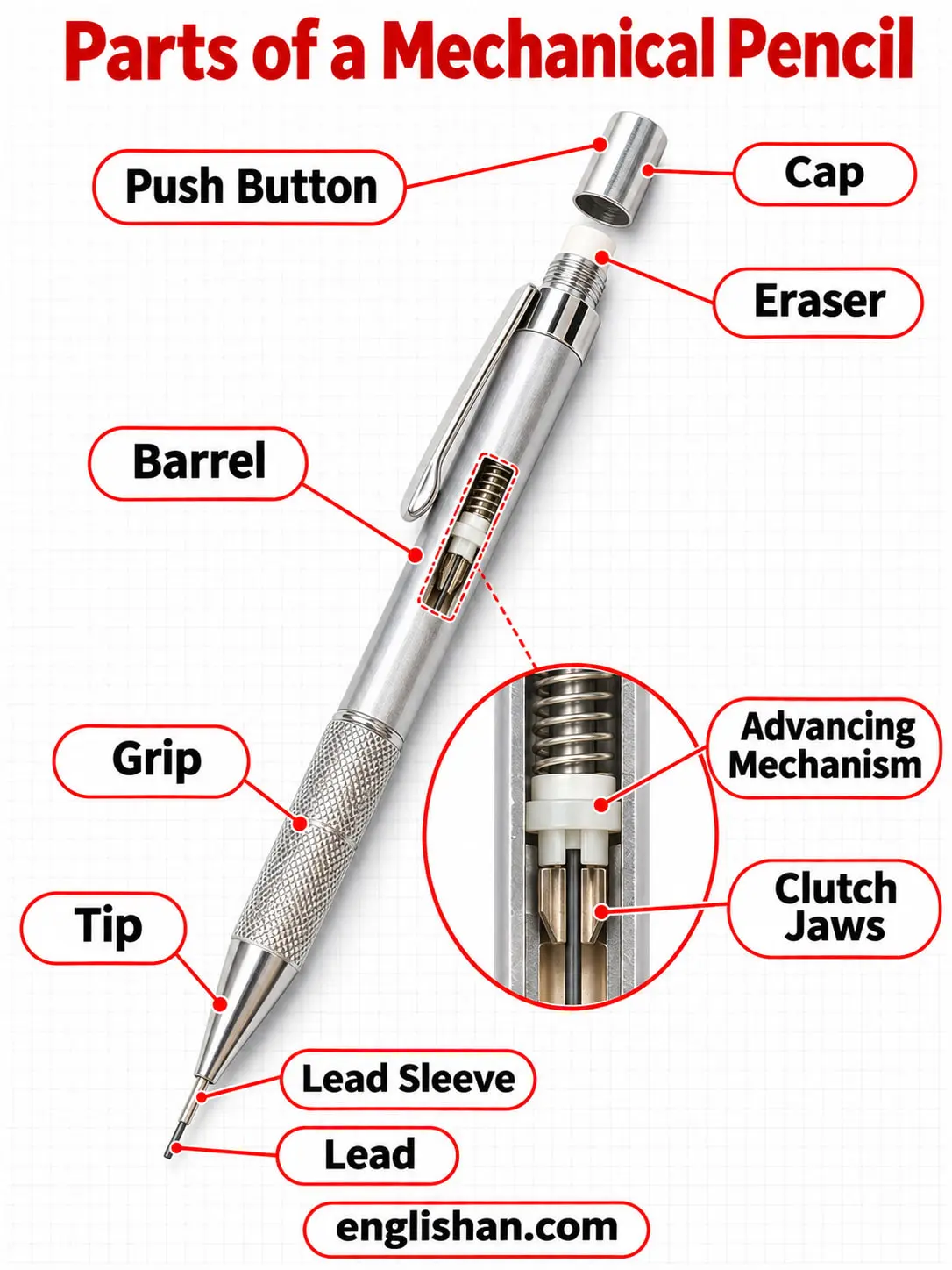
The parts of a mechanical pencil differ from those of a wooden pencil because the casing is not bonded to the core. The lead is a separate piece that is extended or retracted through the tip, and the pencil is reloaded with new leads.
Barrel
The barrel is the body that holds the lead. A clutch pencil holds one lead at a time, and a model with a sub-millimeter lead holds several.
Lead
The lead is the replaceable core, graphite bound with clay or polymer. Standard diameters under ISO 9175-1 run from 0.13 mm to 2.00 mm. Mechanical leads come in 10 grades, from 4H to 4B.
Among the parts of a pencil with a mechanism, higher-end models include a lead hardness indicator. It is a small dial or window that shows the grade loaded.
Lead Sleeve and Tip
The tip is the front end of the barrel. The lead sleeve is the guide that supports the lead as it extends. On higher-end models a lead guide pipe retracts into the body for storage.
Clutch and Jaws
The clutch is a set of jaws at the tip that grips the lead. On a clutch pencil, pressing the top cap opens the jaws, and the lead drops freely. These pencils take thick leads of 2.0 to 5.6 mm.
Push Button and Advancing Mechanism
On a ratchet pencil, a push button on the end or side moves the jaws and advances the lead. Some ratchet designs add a rubber lead retainer in the tip. An automatic-advance model has a nib, a spring-loaded collar that retracts under pressure and extends again when released.
Eraser and Cap
The eraser is fitted under the cap at the top of the barrel, and it is replaceable. On a clutch pencil the top cap that releases the lead is also the eraser cap. On larger lead sizes a sharpener replaces the eraser.
Mechanism Types
Clutch: Pressing the top cap opens the jaws, and forward movement is controlled by hand.
Ratchet: A button moves the jaws, which advance the lead in steps. Shake-activated, automatic-advance, and auto-rotating designs belong to this type.
Twist: Turning a screw moves a propelling pin down the barrel, and the lead is replaced from the front.
Parts of a Colored Pencil
The parts of a colored pencil match those of a wooden pencil. It has a casing, a core, a point, and in many cases a ferrule and an eraser.
The core is the part that differs. It is a wax-like binder holding pigment and fillers, and several colors are blended in one core. A wax-based core smears when erased, and erasable colored pencils are made with a binder that erases cleanly.
Pencil Parts and Their Materials
The materials of the parts of a pencil are graphite, clay, wood, metal, rubber, and paint.
Graphite and clay: The core is graphite powder bound with clay, and the share of clay sets the hardness.
Wood: The casing is cedar, basswood, or alder.
Metal: The ferrule is aluminum or brass.
Rubber: The eraser is rubber or a synthetic substitute, molded as a plug that fits the ferrule.
Paint: The paint is a lacquer coat applied to the casing after assembly, and it bears the imprint.
FAQs
FAQs
The parts of a pencil are the graphite core, the wood casing, the paint, the ferrule, and the eraser. The point, the shoulder, the imprint, and the hardness marking complete the finished pencil.
The inside of a pencil is called the core, or the lead. It is graphite mixed with clay, and it runs through the center of the wood casing.
The metal part of a pencil is called the ferrule. It is a crimped band at the top end, and it holds the eraser in place.
The wood casing comes from a tree, and cedar is the standard wood. The shoulder is also wood, because it is the end of the casing that receives the ferrule.
The tip of a pencil is made of graphite mixed with clay. A sharpener exposes the tip by cutting away the wood around the core.
The wood protects the brittle graphite core and gives the hand a surface to grip. The sharpener exposes fresh graphite as the point wears down.
No, a pencil contains no lead metal. The core is graphite and clay, and the word lead survives as the name of the core.
The parts of a mechanical pencil are the barrel, the lead, the lead sleeve, the tip, the jaws, the push button, and the eraser. A ratchet model adds a spring-loaded nib.
Related:
- Parts of a Clock
- Parts of a Keyboard
- Parts of a Watch
- Parts of a Monitor
- Manual Sewing Machine Parts
