

The different parts of a pen are built around the refill, the replaceable tube that stores the ink and ends in a ball. The barrel encloses the refill, the cap covers the tip, and the clip fastens the pen to a pocket.
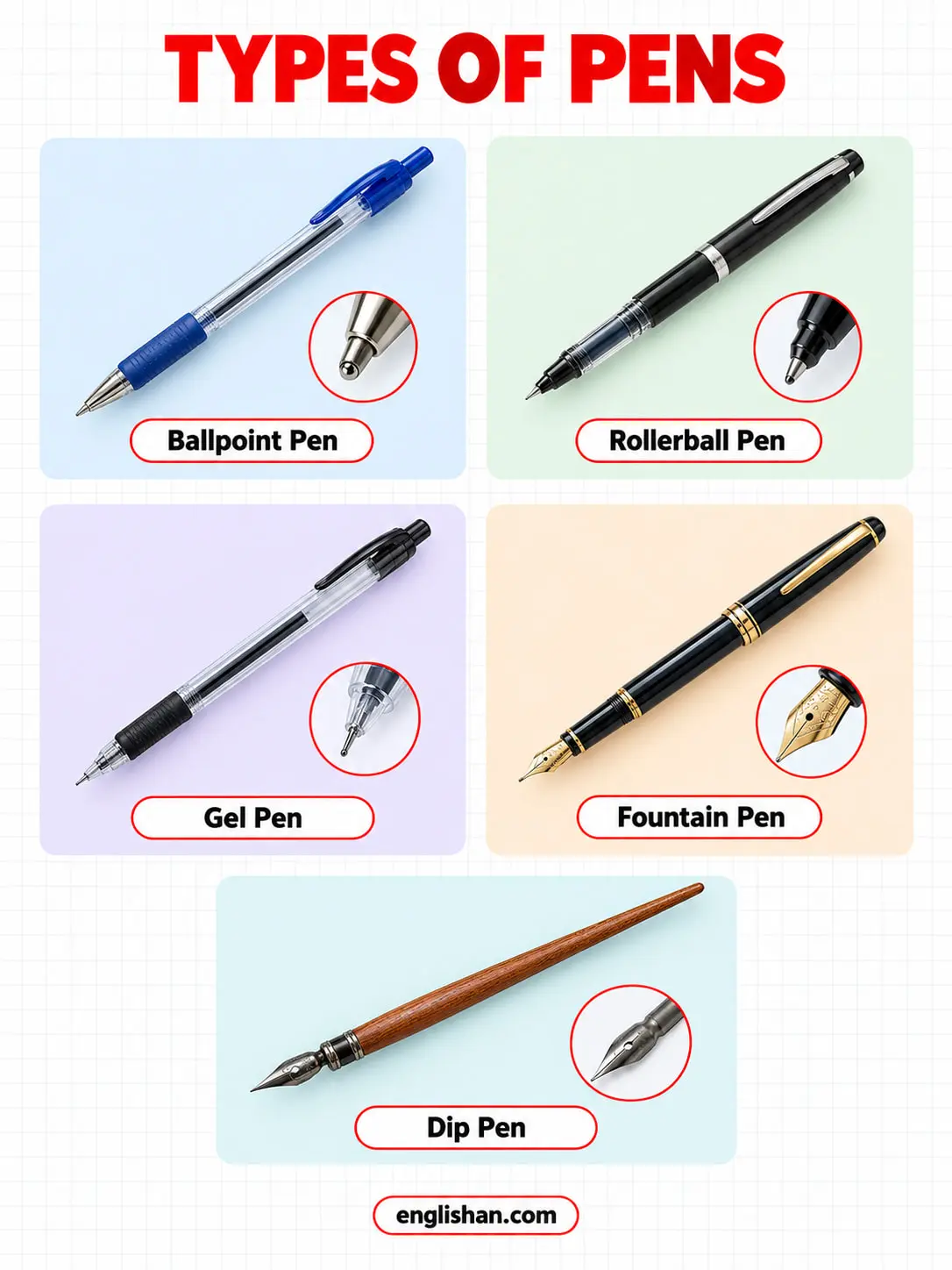
The retractable ballpoint pen is the standard layout. Rollerball, gel, fountain, and dip pens change the refill, the tip, or the ink supply. The pencil has a graphite core in place of a refill. The scissors are another desk tool with their own parts.
Parts of a Pen Labeled Diagram
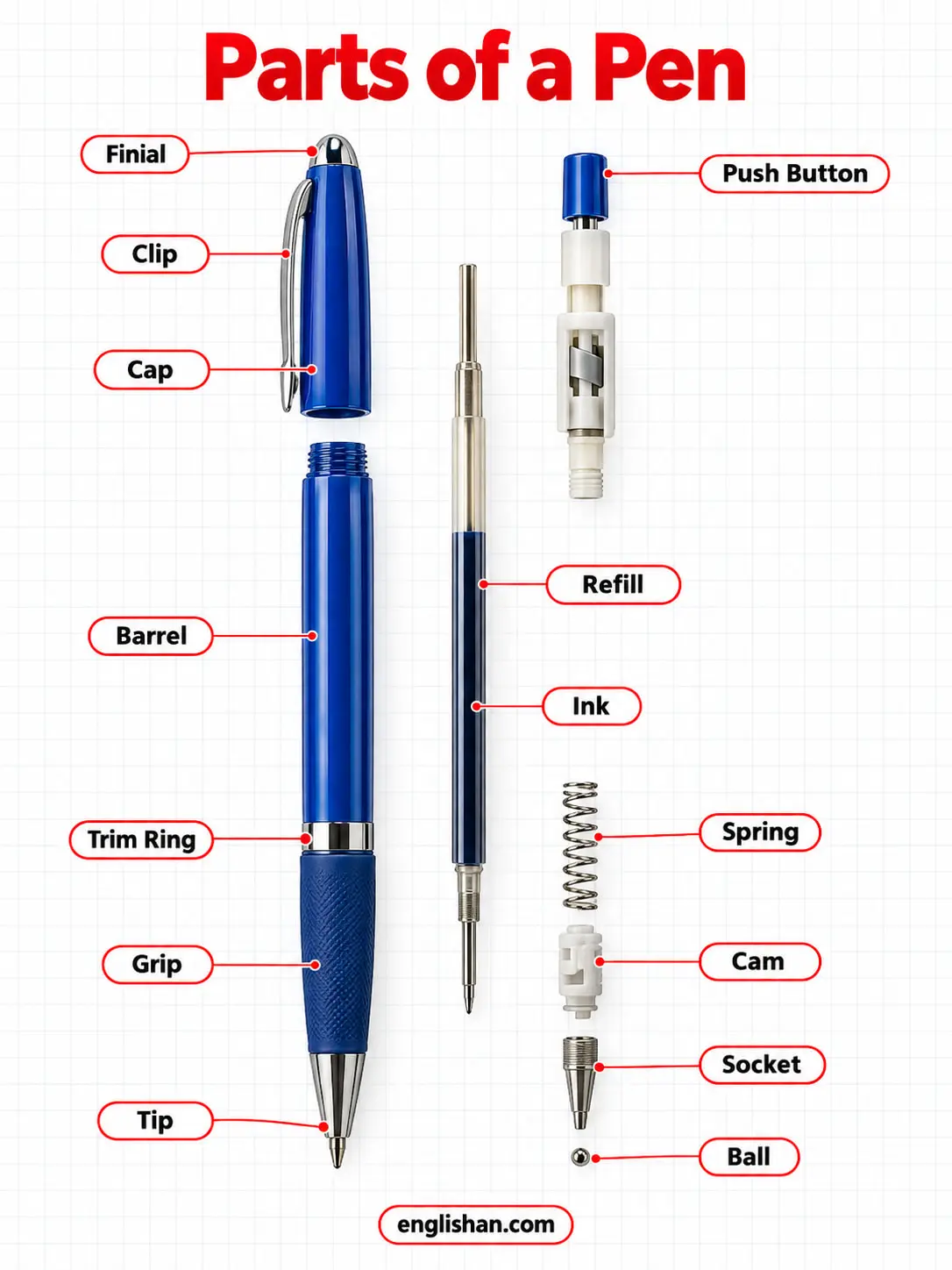
In a labeled diagram of a pen, the cap and the clip are at the top. The tip with its ball is at the bottom. The barrel and the grip enclose the refill, and the spring and the click mechanism are inside the barrel.
| Part | Where you find it |
|---|---|
| 1. Cap | Cover that closes over the tip on a capped pen |
| 2. Clip | Metal strip on the cap or the barrel |
| 3. Finial | Decorative top end of the cap or the barrel |
| 4. Push button | Top end of a click pen that the thumb presses |
| 5. Barrel | Tube of plastic or metal that forms the body of the pen |
| 6. Grip | Lower barrel where the fingers rest |
| 7. Trim ring | Decorative ring on the barrel or the cap |
| 8. Refill | Replaceable tube of ink inside the barrel, also called the cartridge |
| 9. Ink | Oil-based paste that fills the refill |
| 10. Spring | Coil that returns the refill after the button is pressed |
| 11. Cam | Rotating part of the click mechanism that locks the refill in place |
| 12. Tip | Brass cone at the end of the refill |
| 13. Socket | Seat inside the tip that houses the ball |
| 14. Ball | Tiny sphere in the socket that rotates and transfers the ink |
Pen Barrel Cap and Clip Parts
The barrel, the grip, the cap, and the clip are the outer parts of a pen. They enclose the refill and give the hand its hold. The calculator is another desk tool, and its working parts lie behind a display and a keypad in place of a barrel and a cap.
Barrel and Grip
The barrel is the tube that forms the body of the pen and contains the refill. Barrels are made of plastic, aluminum, brass, celluloid, or wood, and some pens use two barrel tubes. The grip is the lower barrel near the tip, where the fingers rest.
Cap and Clip
The cap is the cover that closes over the tip, and the parts of a pen with a retracting tip include no cap. The clip is the metal strip that fastens the pen to a pocket, and it is fixed to the cap or the barrel. The finial is the decorative end of the cap or the barrel.
Parts of a Ballpoint Pen
The writing parts of a pen with a ball are the refill, the ink, the tip, the socket, and the ball. Such a pen is called a ballpoint, a ball pen, or a Biro. The ball and its socket form the writing point.
Refill and Ink
The refill is a plastic, steel, or aluminum tube that stores the ink and ends in the tip. Makers also call it the cartridge. The ink is an oil-based paste of 25 to 40 percent dye in solvents and fatty acids, and the fatty acids lubricate the ball. Gravity pulls the ink toward the ball in a disposable pen.
Ball Socket and Tip
The tip is the brass cone at the end of the refill. Inside it, the socket seats a small ball, and the ball rotates against the paper and transfers the ink. The ball is tungsten carbide, steel, or brass, and the socket is brass. Among the parts of a pen, the ball sets the tip size: 0.7 millimeter is fine and 1.0 millimeter is medium. Ball diameter does not set line width alone, because ink type and pressure also change it.
Disposable and Refillable Pen Parts
A disposable ballpoint has a cap or a retracting tip and is thrown away when the ink runs out. A refillable pen lets the whole inner reservoir, with its ball and socket, be replaced. Designer and higher-quality pens use the refillable design.
Parts of a Retractable Pen
The retractable parts of a pen are a push button, a spring, and a cam mechanism added to the refill. Pressing the button extends the tip, and pressing it again retracts the tip.
Push Button
The push button is the top end of a click pen. The thumb presses it to move the mechanism between its two positions.
Frame and Guide Pin
The frame is the plastic housing around the mechanism. A guide pin is molded into it and steers the thruster as it moves.
Cams and Thruster
Two cams form a two-position lock, one with the refill retracted and one with the refill extended. The thruster, also called the plunger, pushes the refill forward.
Spring
The spring is the coil that returns the refill into the barrel. It supplies the tension for the retracted position.
Click Twist and Stick Mechanisms
A click pen extends the tip when the thumb presses the button. The cam, also called the thrust device, sets the refill in position. A twist-to-open pen extends the tip when the barrel turns. A stick pen has a removable cap and no mechanism.
Rollerball and Gel Pen Parts
The parts of a rollerball pen are a ball and a reservoir like a ballpoint, and it uses thin water-based or gel ink. The ink flows more freely than ballpoint paste, so the ink blots if the pen rests on the page.
Liquid Ink Reservoir
The reservoir of a liquid-ink pen feeds the ball in a way similar to a fountain pen. The ink is dye-based and thinner than ballpoint paste.
Gel Ink
Gel ink is thick and holds pigments in suspension. It gives brighter colors, metallic effects, and glitter. The parts of a pen that uses gel ink match a rollerball.
Bic Cristal Parts
The parts of a pen are visible on the Bic Cristal, a ballpoint pen sold worldwide. Its parts are the barrel, the cap, the ink tube, the ball, and a brass bearing.
Hexagonal Barrel
The barrel is a transparent polystyrene tube with six sides. The shape gives three grip surfaces, and the wall shows the ink level.
Cap and Vent Hole
The cap is a polypropylene cover. A small vent hole, added in 1991, reduces the risk of suffocation if the cap is inhaled.
Ink Tube and Ball Bearing
A polypropylene tube holds the thick ink. The ball was a 1 mm stainless steel sphere until 1961, when a harder tungsten carbide ball replaced it. A brass bearing seats the ball.
Parts of a Fountain Pen
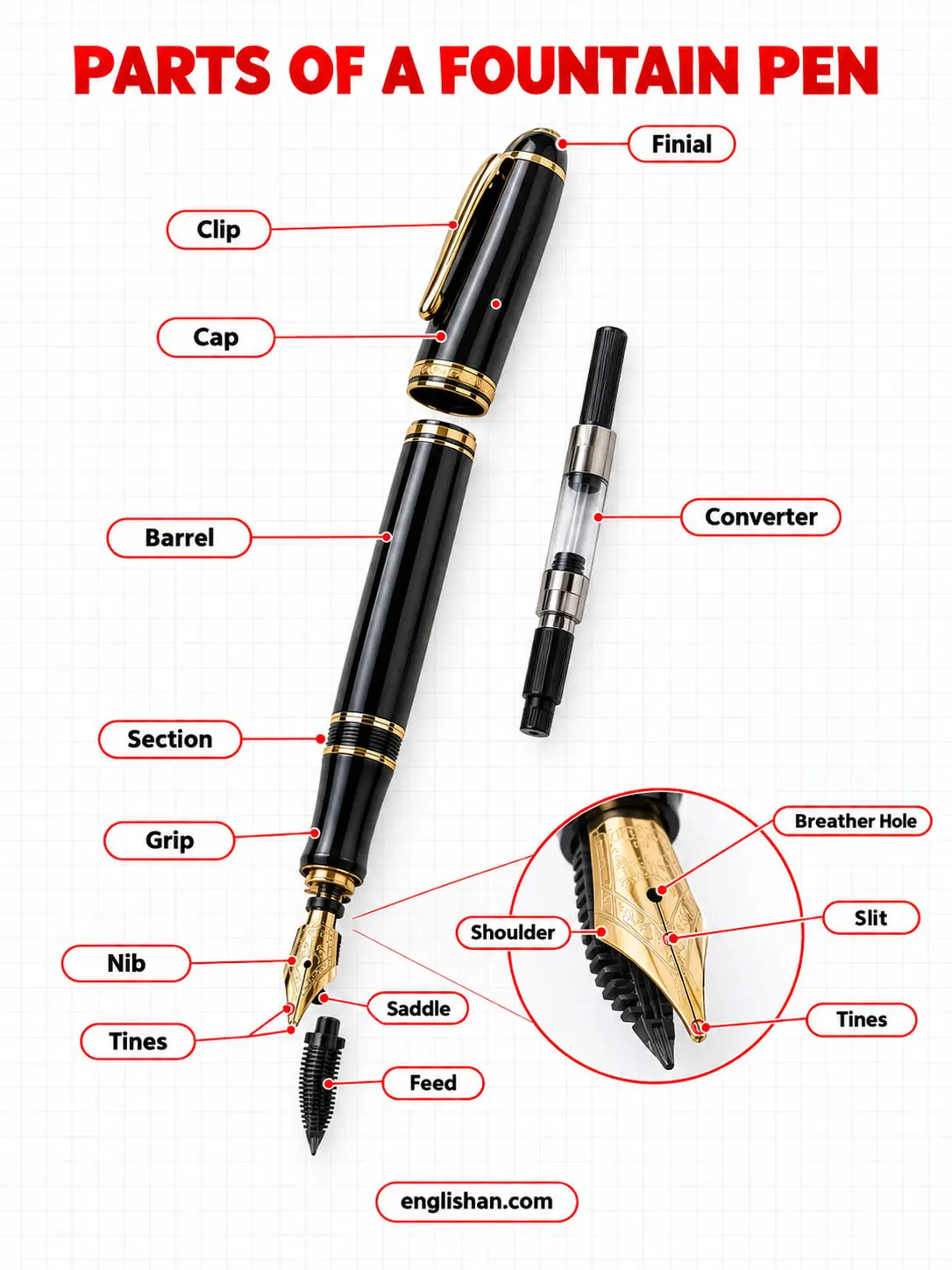
The parts of a pen change in a fountain pen, which swaps the ball and socket for a nib, a feed, and a section. All parts of a fountain pen are the nib, the feed, the section, the filling system, the barrel, and the cap.
Nib
The nib is the metal tip that touches the paper, and it is the most recognized of all the parts of a pen. Its point is a hard, wear-resistant metal, an iridium alloy in many nibs, welded on and ground to size. The imprint is the engraved brand, model, or size.
Slit and Tines
The slit is the thin cut that moves ink to the point of the nib. The breather hole at the end of the slit admits air. The tines are the two halves of the nib on either side of the slit.
Shoulder
The shoulder is the widest part of the nib, where the nib begins to taper.
Feed
The feed is the plastic or ebonite piece behind the nib that delivers the ink from the reservoir. A narrow ink channel in it moves ink by capillary action. Thin fins regulate the flow when the writing speed changes.
Section
The section is the part of a pen where the nib and the feed are fitted. Its front end is the grip where the fingers rest.
Fountain Pen Cap and Barrel
The cap of a fountain pen has the finial at the top and the clip on its side. Some caps contain an insert, a plastic liner that seals the nib and slows drying. A centerband is a decorative metal ring near the cap lip. The barrel has fine threads that join the cap and the body.
Cartridge and Converter
Among the parts of a pen that hold ink, a cartridge is a disposable capsule whose narrow mouth is pierced by the feed. A converter is a small refillable reservoir with a screw piston, for pens that also accept cartridges.
Piston and Vacuum Filling Parts
Among fountain pen parts, a piston-fill pen builds the mechanism into the barrel. The blind cap at the rear turns the piston rod that moves the piston head. An eyedropper pen uses the whole barrel as the reservoir, with a shut-off valve beside the feed. A vacuum-fill pen builds pressure in one stroke and draws the ink into the barrel.
Parts of a Dip Pen
A dip pen has no ink reservoir. The parts of a dip pen are the holder, the nib, and a small hole or pocket. The pocket keeps a drop of ink by capillary action.
Holder: The holder is the handle of the pen, wood in most cases and also bone, horn, metal, plastic, or glass.
Nib: The nib is the metal tip, steel or brass, with a central slit that acts as a capillary channel. Nibs are interchangeable, and a flexible nib draws lines of varying thickness.
Reservoir: A clip-on metal reservoir at the top of the nib holds enough ink for several sentences of uninterrupted writing.
A calligraphy pen is a dip pen with an oblique holder that sets the nib at about 55 degrees. Dip pens use waterproof, pigmented, iron gall, and India ink more easily than fountain pens do.
Pen Parts and Their Materials
The materials of the parts of a pen are plastic, metal, and ink. The barrel is plastic, aluminum, brass, celluloid, or wood. The tip is brass, and the ball is tungsten carbide, steel, or brass. The ink is oil-based in a ballpoint and water-based or gel in a rollerball.
FAQs
The parts of a pen are the barrel, the cap, the clip, the refill, the ink, and the tip with its ball and socket. A retractable pen adds a push button, a spring, and a cam. Every part of a pen belongs to the body, the refill, or the mechanism.
The inside of a pen is called the refill, or the cartridge. It is a tube that stores the ink and ends in the tip and ball. A retractable model also has a spring and a cam inside.
The parts of a ballpoint pen are the tip and ball, the refill, the ink, the barrel, the clip, and the retraction mechanism. The ball rotates in a socket at the tip and transfers the oil-based ink.
The parts of a fountain pen are the nib, the feed, the section, the filling system, the barrel, and the cap. The nib touches the paper, and the feed delivers the ink from the reservoir.
The clicky part of a pen is the push button, and the cam under it is the thrust device. The button moves the cam between the extended and the retracted position.
The top of a pen is the finial on a capped pen and the push button on a click pen. The clip is fixed just under the top, on the cap or the barrel.
The count depends on the type. A Bic Cristal has five parts: the barrel, the cap, the ink tube, the ball, and the brass bearing. A retractable pen adds the button, the frame, the cams, and the spring.
The nib is the part of a pen that begins with N. It is the metal writing tip of a fountain pen or a dip pen.
Related:
- Parts of a Clock
- Parts of a Keyboard
- Parts of a Watch
- Parts of a Monitor
- Manual Sewing Machine Parts
