

A drum set is a group of drums and cymbals mounted on stands around one seat and struck with sticks and two foot pedals. The parts of a drum set divide into the drums, the cymbals, and the hardware that holds them.
Every drum shares the same shell, heads, and tuning parts. The pedals, stands, and throne are clamped in fixed positions around the drummer.
Parts of a Drum Set Labeled on a Five-Piece Kit
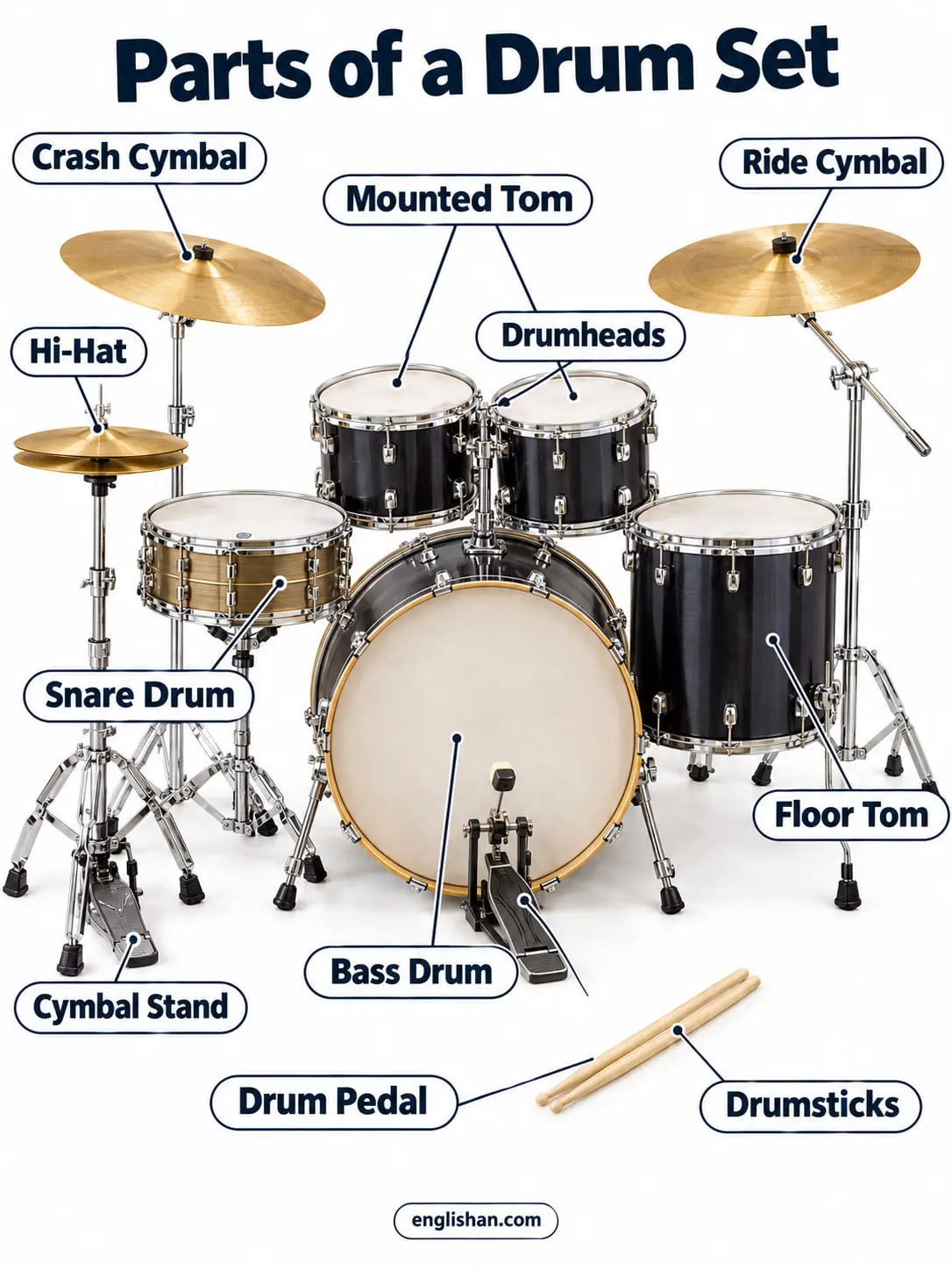
A five-piece kit has a bass drum on the floor, a snare drum between the knees, and two rack toms over the bass drum. A floor tom on legs completes the drums. A hi-hat, a crash cymbal, and a ride cymbal are mounted on stands around them. These are the parts of a drum set, or the parts of a drum kit, as drummers and technicians name them.
| Part | Where you find it |
|---|---|
| 1. Bass drum | Large drum on the floor, struck by the pedal |
| 2. Kick drum | Common name for the bass drum |
| 3. Bass drum pedal | Foot pedal clamped to the bass drum hoop |
| 4. Footplate | Part of the pedal that the foot presses |
| 5. Offset cam | Pedal part that changes power and speed |
| 6. Double bass pedal | Pedal with two beaters for both feet |
| 7. Beater | Felt or plastic head on the pedal that strikes the drum |
| 8. Bass drum spurs | Folding legs at the front of the bass drum |
| 9. Snare drum | Shallow drum between the knees |
| 10. Snare wires | Metal strands across the lower head of the snare |
| 11. Strainer | Lever that tightens or releases the snare wires |
| 12. Throw-off lever | Another name for the strainer lever |
| 13. Snare stand | Tripod with a basket for the snare drum |
| 14. Rack toms | Two small drums mounted over the bass drum |
| 15. Hi-tom and mid-tom | The higher rack tom and the one beside it |
| 16. Tom mount | Bracket and arm holding the rack toms |
| 17. Floor tom | Large tom on three legs at the right |
| 18. Floor tom legs | Three metal legs bolted to the floor tom shell |
| 19. Shell | Round wooden or metal body of a drum |
| 20. Batter head | Top drumhead that the stick strikes |
| 21. Resonant head | Bottom drumhead on the underside of the shell |
| 22. Lugs | Metal casings bolted to the side of the shell |
| 23. Tension rods | Bolts that pull the hoop down over the head |
| 24. Hoops | Metal rings that clamp the head to the shell |
| 25. Bearing edge | Angled rim of the shell where the head rests |
| 26. Vent hole | Small hole drilled through the shell wall |
| 27. Hi-hat cymbals | Pair of cymbals on a pedal stand at the left |
| 28. Hi-hat stand | Tube with a clutch and a foot pedal |
| 29. Hi-hat pedal | Footboard that closes the hi-hat cymbals |
| 30. Clutch | Clamp that holds the top hi-hat cymbal on its rod |
| 31. Crash cymbal | Thin cymbal on a stand to the left |
| 32. Ride cymbal | Large cymbal on a stand to the right |
| 33. Ride bell | Raised dome at the center of the ride |
| 34. Ride shoulder | Curved part of the ride near the edge |
| 35. Crash ride | Ride cymbal that is also played like a crash |
| 36. Effects cymbals | Splash, china, stack, and holed cymbals |
| 37. Cymbal stack | Two cymbals stacked for a short trashy sound |
| 38. Splash cymbal | Small, thin accent cymbal |
| 39. China cymbal | Flanged cymbal with an upturned edge |
| 40. Cymbal stand | Tripod with an upright tube for a cymbal |
| 41. Boom arm | Angled arm that extends from the stand |
| 42. Upright cymbal stand | Cymbal stand with a straight tube and no arm |
| 43. Cymbal felt | Felt washer under the cymbal on the stand |
| 44. Wing nut | Winged nut that locks the cymbal on its stand |
| 45. Drum throne | Round padded stool with a height screw |
| 46. Tripod base | Three-legged base of the throne |
| 47. Saddle throne | Throne with a contoured saddle-shaped seat |
| 48. Drumsticks | Pair of wooden sticks with beads at the tips |
| 49. Drum key | T-shaped wrench that turns the tension rods |
| 50. Drum rug | Mat that keeps the kit from sliding |
| 51. Cowbell | Mounted metal bell struck with a stick |
Drum Set Drum Parts
The drums are the largest parts of a drum set, and each one is a shell with a head at each end.
Bass Drum
The bass drum, also called the kick drum, is the largest drum in the kit, laid on its side on the floor. The beater of a foot pedal strikes it. A standard bass drum is 22 inches across. Rock kits use 24 inches, fusion kits use 20 inches, and jazz kits use 18 inches. Folding spurs at the front keep it from rolling.
Bass Drum Dampening
Among the parts of a drum set, bass drum dampening is a soft pillow or towel placed inside the drum against the batter head. It cuts the boom and the ring, so each beat sounds shorter.
Snare Drum
Among the parts of a drum set, the snare drum is the shallow one, 14 inches across and 5 inches deep. A stand holds it between the drummer’s knees. Metal snare wires are stretched across its lower head. They rattle against it when the top head is struck, which adds a sharp crack to the tone.
Wood and Metal Snares
Among the snare parts of a drum set, a wood shell has a warmer, more resonant tone. A metal snare is brighter and snappier, so the shell material changes the tone of the drum.
Rack Toms
The rack toms are small drums mounted on arms over the bass drum. A three-piece kit has a single 12-inch rack tom. A fusion kit pairs 10-inch and 12-inch rack toms with a 14-inch floor tom. Their pitch is higher than the floor tom.
Hi-Tom and Mid-Tom
Among the toms of a drum set, the hi-tom is the highest rack tom. The mid-tom is the one between it and the floor tom. Their diameter sets the pitch, and their depth sets the sustain and the attack.
Floor Tom
The floor tom is the largest tom, 14 inches across in jazz kits and 16 inches in most other styles. It rests on three metal legs bolted to its shell, and its pitch is the lowest of the toms.
Drum Shell and Head Parts
Every drum in the kit is built from the same shell and head parts. These parts of a drum set are tuned with the same drum key. A tabla uses the same head-and-shell design in a hand drum.
Shell
The shell is the round body of the drum, made of layered maple, birch, or mahogany plies, or of steel or brass. Wooden shells are bent into a cylinder and glued, and the plies run in alternating grain directions.
Drumheads
The batter head is the top head, the one the stick strikes. The resonant head is the bottom head, and it rings with the top head when the drum is struck. Heads are stretched sheets of polyester film, and a coated head has a rough white layer for brush playing.
Lugs and Tension Rods
Lugs are small metal casings bolted to the side of the shell. Each lug receives a tension rod, a long bolt with a square head. Turning the rod with a drum key tightens the hoop and raises the pitch of the head.
Hoops
Hoops are the metal or wooden rings of a drum that clamp the head to the shell. The tension rods pass through holes in the hoop. The hoop on a snare drum is a die-cast or triple-flanged ring that holds the strainer.
Bearing Edge and Vent Hole
The bearing edge is the angled rim of the shell where the head rests. A vent hole is a small hole in the shell wall that lets air escape when the head is struck. A badge plate surrounds it on most shells.
Snare Wires and Strainer
Snare wires are a bundle of thin coiled steel strands stretched across the resonant head of the snare. The strainer, also called the throw-off lever, is a lever on the side of the shell that releases them or tightens them. A butt plate on the opposite side anchors the other end.
Drum Set Cymbal Parts
Cymbals are thin round plates of bronze, and these parts of a drum set sound when a stick strikes them. Each cymbal has a bell at the center, a bow around it, and an edge at the rim.
Hi-Hat Cymbals
The hi-hat is a pair of cymbals, 12 to 14 inches across, mounted face to face on a pedal stand. The foot pedal opens and closes the pair. Pressed shut, the cymbals give a short chick, and open they ring with a long wash.
Crash Cymbal
The crash cymbal is a thin cymbal, 16 inches across on a standard kit. It swells and fades fast when struck on the edge. A second crash is 1 to 2 inches larger or smaller than the first.
Ride Cymbal
The ride cymbal is the largest cymbal in the kit, 20 to 22 inches across on most kits. The tip of the stick strikes the bow to keep a steady pulse, and the bell gives a loud, high ping.
Splash and China Cymbals
A splash cymbal is a small, thin cymbal that makes a short, bright accent. A china cymbal has an upturned flange at the edge and makes a harsh, trashy sound.
Effects Cymbals and Cymbal Stacks
Among the cymbal parts of a drum set, effects cymbals are the cymbals beyond the crash, ride, and hi-hat. The splash, the china, the stack, and the holed cymbal are all effects cymbals. A cymbal stack is two or more cymbals bolted together, and it gives a short, trashy sound.
Crash Ride and Top Hat
A crash ride is a ride cymbal with a thinner shoulder, so it is also played like a crash. The top hat is the upper cymbal of a hi-hat pair, and it faces down, while the bottom hat is the lower cymbal.
Cymbal Bell and Bow
The bell is the raised dome at the center, and a cymbal hole passes through its top. The bow is the sloped body of the cymbal, and the shoulder is the curved part near the edge. The edge is the thin rim.
Drum Set Hardware Parts
Hardware is the set of stands, pedals, and clamps that hold the drums and cymbals in position. These parts of a drum set are adjusted for the height and reach of each drummer.
Bass Drum Pedal
The bass drum pedal is a foot pedal clamped to the hoop of the bass drum. The footboard pulls a chain or a strap that swings a beater against the batter head. A spring returns the beater after each strike.
Double Bass Pedal
Among the pedal parts of a drum set, a double bass pedal has two beaters. One drummer plays the bass drum with both feet. The second footboard is set beside the hi-hat stand.
Footplate and Offset Cam
The footplate is the part of the pedal that the foot presses. The offset cam is the pedal piece, set off the center of the axle, that changes the power and the speed of the beater.
Hi-Hat Stand and Pedal
Among the hardware parts of a drum set, the hi-hat stand is a tube. It has a footboard at the bottom and a clutch at the top. The footboard lowers a rod that presses the top cymbal onto the bottom one. The clutch grips the top cymbal and sets the gap between the pair.
Clutch
Among the hi-hat parts of a drum set, the clutch is the clamp that holds the top hi-hat cymbal on its rod. It sets the gap between the pair of cymbals.
Snare Stand
The snare stand is a tripod topped with a three-arm basket that cradles the snare drum. A tilt adjuster angles the drum toward the drummer.
Cymbal Stand and Boom Arm
A cymbal stand is a tripod with a telescoping tube and a tilter at the top that angles the cymbal. A boom arm is an angled extension that moves the cymbal farther from the base. A felt washer and a wing nut hold the cymbal on the tilter.
Upright Stand and Boom Stand
An upright cymbal stand is a straight tube with no arm. A boom stand is a cymbal stand with an angled arm that extends sideways, so the cymbal reaches over the drums.
Tom Mount and Floor Tom Legs
The tom mount is a bracket with an arm that holds each rack tom over the bass drum. The floor tom legs are three metal legs with locking brackets, bolted to the floor tom shell.
Drum Throne
The drum throne is a round padded stool on a threaded or telescoping column. A tripod base spreads its weight, and a height screw adjusts the seat.
Tripod Base and Saddle Throne
The tripod base is the three-legged base of the throne, and it spreads the weight of the drummer. A saddle throne has a contoured seat shaped like a saddle, and it keeps the hips open.
Drum Set Accessory Parts
Accessories are the small parts of a drum set that are held in the hand or replaced. The drummer owns them separately from the kit.
Drumsticks
Drumsticks are a pair of sticks of hickory or maple, with a bead at each tip. The shaft is held in the hand and the tip strikes the head. The butt end is the thick opposite end.
Drum Key
A drum key is a T-handled wrench with a square socket that fits the tension rods. It tunes the heads and also adjusts hardware with square-headed bolts.
Drum Rug
A drum rug is a thin rubber-backed mat under the kit. It keeps the bass drum spurs and stand feet from sliding on the floor.
Cowbell and Percussion Add-Ons
A cowbell is a mounted metal bell struck with a stick. It is an add-on percussion part, clamped to a stand beside the kit.
Drum Set Types and Kit Sizes
The parts of a drum set vary with the kit type. A starter kit, a complete kit, and a hybrid kit group them differently.
Complete Kit and Shell Kit
A complete kit includes every group of parts of a drum set: the drums, the cymbals, and the hardware. A shell kit has only the drums, so the cymbals and the stands are bought separately.
Hybrid Kit
A hybrid kit is an acoustic kit with electronic pads or triggers added. It plays acoustic drums and recorded sounds together.
Diameter and Depth
The diameter of a drum mostly sets its pitch, and the depth mostly sets its sustain and attack. Drum sizes are listed as depth by diameter, though some makers reverse the order.
Old Names
The snare drum is also called the side drum. Traps and the contraption kit are older names for the whole kit or its hardware.
Electric Drum Set Parts
An electric drum set replaces acoustic drums and cymbals with pads, and it plays recorded sounds through a module. These parts of a drum set follow the same layout as an acoustic kit.
Drum Pads and Cymbal Pads
Pads are round rubber or mesh surfaces that replace the drumheads. Each pad has a trigger, a sensor that detects the strike and its force. Cymbal pads are flat disks with a similar sensor.
Module
The module is the control box mounted on the rack. It stores the drum sounds, receives each trigger signal, and sends audio to headphones or a speaker.
Rack and Hi-Hat Controller
The rack is a metal frame of tubes that holds the pads in place of stands. The hi-hat controller is a pedal that reports how far it is pressed, so the module plays a closed or open sound.
Related:
FAQs
FAQs
The parts of a drum set are the bass drum, snare drum, rack toms, floor tom, hi-hat, crash cymbal, and ride cymbal. The bass drum pedal, stands, and throne hold them in place. A drum key, drumsticks, and a rug complete the setup.
The main parts of a drum set are the drums, the cymbals, and the hardware. A starter kit has a bass drum, a snare drum, a hi-hat, one rack tom, and a floor tom. A crash and a ride cymbal are added to it.
The bass drum makes a low thud, and the snare drum makes a sharp crack. The toms sound in descending pitches. The hi-hat gives a short chick when closed and a long wash when open. The crash swells fast, and the ride keeps a steady ping.
The hi-hat opens and closes. It is a pair of cymbals on a stand with a foot pedal. Pressing the pedal clamps them together, and lifting it lets them part.
A drum has a shell, a batter head, a resonant head, hoops, lugs, and tension rods. A snare drum adds snare wires and a strainer. A bass drum adds spurs and a pedal mount.
An electric drum set has rubber or mesh pads, cymbal pads, a module, and a rack. It also has a hi-hat controller and a kick pad with a pedal. Each pad has a trigger that sends a signal to the module.
The bass drum is the biggest drum in the kit, 22 inches across on a standard kit. The ride cymbal is the biggest cymbal, at 20 to 22 inches on most kits.
