

A tabla is a pair of hand drums: the dayan, played with the right hand, and the bayan, played with the left. The parts of a tabla are the two shells, the two goatskin heads, the straps and rings that bind each head, and the hammer that tunes the pair. Like the drum set, the tabla is a membranophone, a drum that sounds from a stretched skin.
The harmonium accompanies the tabla in vocal music, and the sitar plays beside it in instrumental concerts. The dholak is a related two-headed hand drum with a different build.
Parts of a Tabla Labeled on the Dayan and Bayan
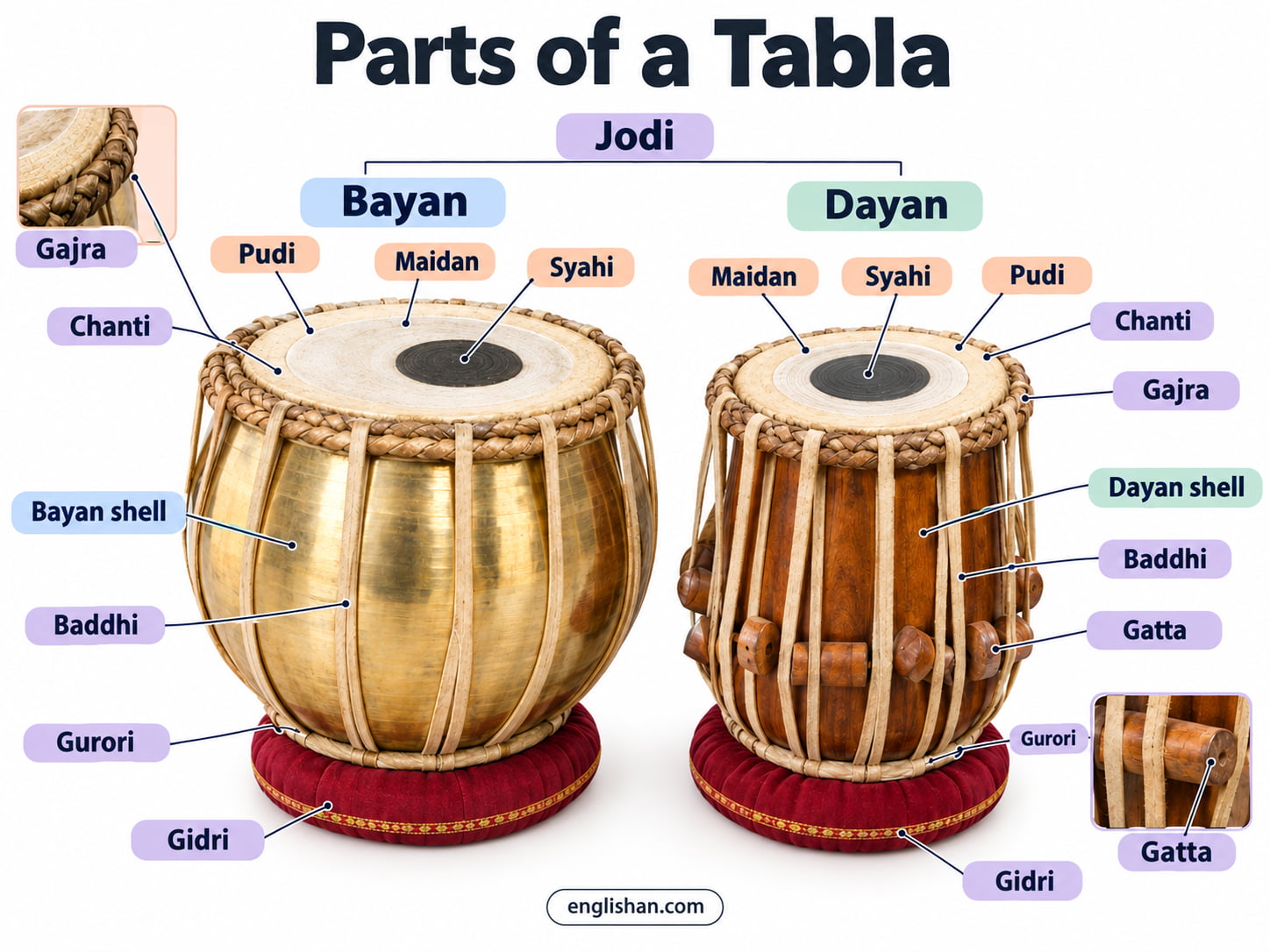
The dayan is set at the player’s right and the bayan at the left, each on a ring cushion. Both drums have a goatskin pudi, a braided gajra, and rawhide baddhi straps. The shells and the gattas differ, because the dayan alone has gattas.
| Part | Where you find it |
|---|---|
| 1. Jodi | The matched pair of dayan and bayan |
| 2. Dayan | Right-hand drum with a tapered wooden shell |
| 3. Bayan | Left-hand drum with a rounded metal or clay shell |
| 4. Dayan shell | Hollow wooden body, open at the base |
| 5. Bayan shell | Closed bowl of metal or clay, wider than the dayan |
| 6. Pudi | Goatskin head stretched over the mouth of each shell |
| 7. Chanti | Outer rim of the pudi, just inside the gajra |
| 8. Maidan | Ring of bare skin between the chanti and the syahi |
| 9. Syahi | Black circle of dried paste on the pudi |
| 10. Gajra | Braided leather ring that binds the edge of the pudi |
| 11. Baddhi | Rawhide strap laced between the gajra and the base ring |
| 12. Gatta | Wooden block set under the baddhi straps on the dayan |
| 13. Gurori | Base ring where the baddhi straps gather |
| 14. Gidri | Padded ring under each drum |
| 15. Hathauri | Small tuning hammer, kept with the pair |
| 16. Tabla cover | Cloth cover for each drum |
| 17. Powder | Fine powder dusted on the hands before playing |
Dayan and Bayan Shell Parts of a Tabla
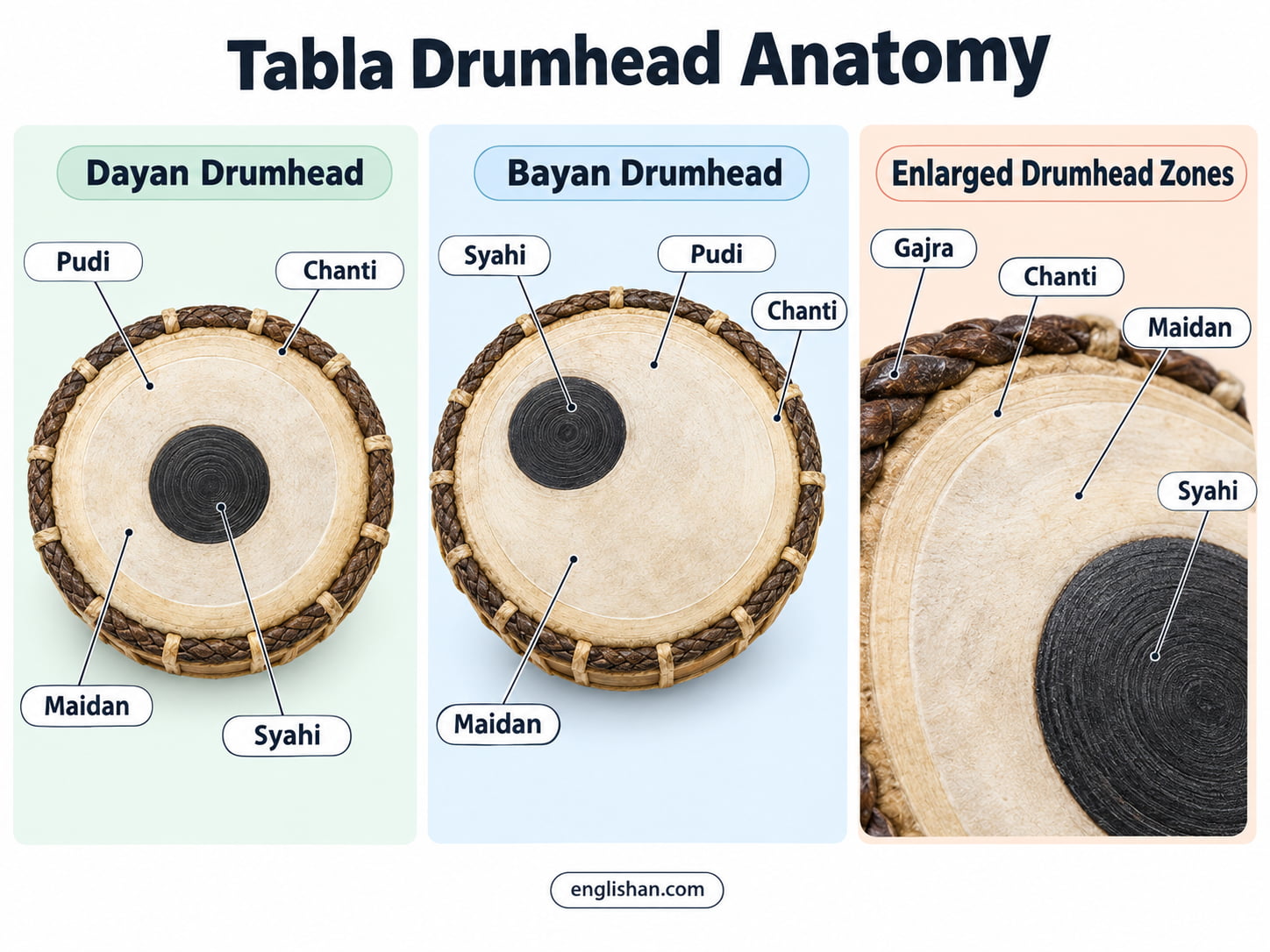
The shells are the largest parts of a tabla, and they set the two registers of the pair. The dayan produces the treble, and the bayan produces the bass.
Dayan
The dayan is the right-hand drum and the treble drum of the pair. Its shell is a tapered wooden cylinder, hollow and open at the base, with the pudi stretched over the wide top. In common speech, tabla names the pair, though some players apply the word to the dayan alone.
Bayan
The bayan is the left-hand drum and the bass drum. Its shell is a rounded bowl of metal or clay, closed at the base and wider than the dayan. Most bayans measure about 10 inches across the pudi.
Parts of a Tabla Head From the Chanti to the Syahi
The head of each drum is one pudi with three concentric zones. The chanti forms the outer ring, the maidan the middle ring, and the syahi the center. Each zone is the playing surface for a different stroke.
Pudi
The pudi is the goatskin head of the dayan or the bayan. It is stretched over the mouth of the shell, and its edge is plaited into the gajra. The syahi is pasted onto its center.
Chanti
The chanti is the outer rim of the pudi, a narrow ring of bare skin just inside the gajra. The name kinar refers to the same ring. The nā stroke is played on this ring.
Maidan
The maidan is the ring of bare skin between the chanti and the syahi. Players also call it the lav, the lab, or the sur. The tā stroke is played on this ring.
Syahi
The syahi is the black circle of dried paste at the center of the pudi. On the dayan the syahi is centered, and on the bayan it is set off-center, closer to the rim. The name gaab refers to the same circle.
Tabla Lacing and Tuning Parts
The gajra, baddhi, gatta, and gurori bind the pudi to the shell and set its tension. T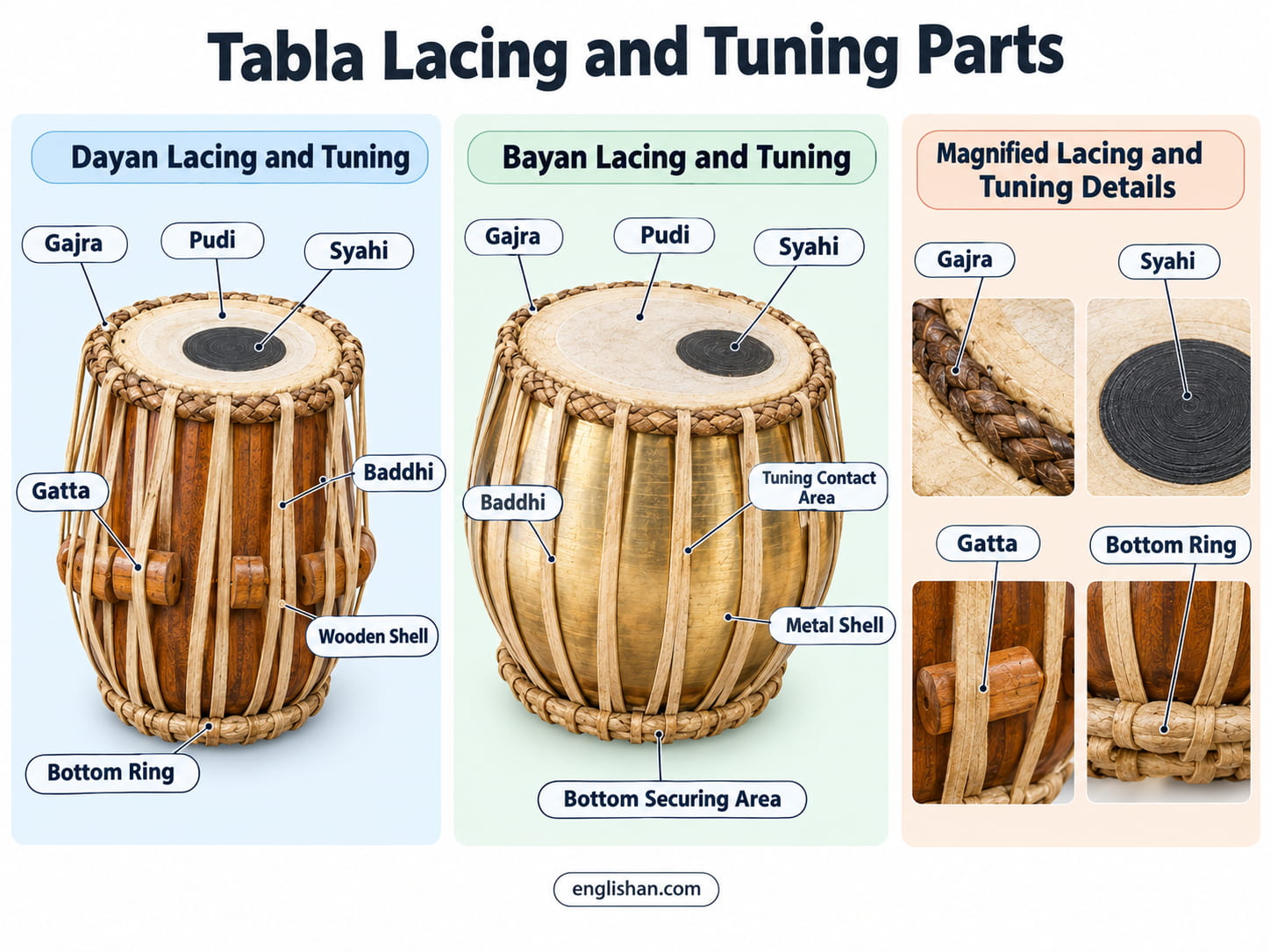 hese parts of a tabla are made of leather, rawhide, and wood, and the player adjusts them with the hammer.
Gajra
The gajra is a braided leather ring fitted over the edge of the pudi. The baddhi straps pass through its loops, and the pudi is pulled down evenly around the shell. On the bayan, the gajra is the part the hammer taps for tuning.
Baddhi
The baddhi is the rawhide strap, also called the tasma, that is laced between the gajra and the base ring. The straps form a vertical band around the shell. Tightening the baddhi stretches the pudi and raises the pitch.
Gatta
The gatta is a cylindrical wooden block set between the shell and the baddhi straps on the dayan. A dayan has eight gattas. The player strikes the gattas with the hammer to adjust the tension of the straps and tune the dayan to the tonic of the performance.
Gurori
The gurori is the rawhide ring at the base of the drum where the baddhi straps gather. The name kundal refers to the same ring. The gidri cushion is placed under it.
Tabla Accessory Parts
The gidri, the hathauri, the cover, and the powder are separate from the drums. They complete the pair for tuning, protection, and playing.
Gidri
The gidri is a padded ring, wrapped in cloth, that supports each drum from underneath. The gidri is also called the bere or the bira.
Hathauri
The hathauri is a small hammer with a flat face, used to tap the gattas and the gajra. It is the tuning tool of the tabla. The spelling hathodi names the same hammer.
Tabla Cover
The tabla cover is a cloth bag that fits over each drum. The cover protects the pudi and the syahi from dust, and a pair takes two covers, one for the dayan and one for the bayan.
Powder
The powder is a fine dust that the player applies to the hands before playing. It dries the fingers for the strokes on the pudi.
Tabla Parts and Their Materials
The materials of the parts of a tabla are goatskin, rawhide, wood, metal, clay, and a handmade paste. Each material forms a different part of the pair.
Shell Woods and Metals
Dayan shells are cut from shisham, the North Indian rosewood, or from teak. Bayan shells are made of brass, copper, steel, or clay.
Goatskin and Rawhide
The pudi is goatskin, and the baddhi and the gurori are rawhide. The gajra is braided leather.
Syahi Paste
The syahi is made of iron filings bound in a flour paste. The finished syahi is black and slightly raised from the surface of the pudi.
Tabla Parts Names in English and Their Alternate Names
Tabla parts names vary by teacher, by region, and by spelling. Each part has a standard English form, and the alternates are the spellings and regional names a student meets in books and lessons.
| Part | English gloss | Alternate names |
|---|---|---|
| Dayan | Right-hand treble drum | Dahina, daya |
| Bayan | Left-hand bass drum | Duggi, dagga, dugga, dhama |
| Lakdi | Wooden dayan shell | Lakri |
| Kudi | Bayan shell | Khod |
| Pital | Brass shell | None |
| Pudi | Goatskin head | Puri |
| Chanti | Outer rim of the pudi | Kinar, kaani |
| Maidan | Middle ring of the pudi | Lav, lab, low, luv, sur |
| Syahi | Black center circle | Gaab, gab |
| Gajra | Braided leather ring | None |
| Baddhi | Rawhide strap | Tasma, baddi, chot |
| Gatta | Wooden tuning block | None |
| Gurori | Base ring | Kundal |
| Gidri | Padded support ring | Bere, bira |
| Hathauri | Tuning hammer | Hathodi |
Related:
FAQs
The parts of a tabla are the dayan, the bayan, the pudi, the chanti, the maidan, the syahi, the gajra, the baddhi, the gatta, and the gurori. The hathauri hammer, the gidri cushion, the cover, and the powder complete the set.
The two parts of a tabla are the dayan and the bayan. The dayan is the smaller wooden drum played with the right hand, and the bayan is the larger metal or clay drum played with the left.
Yes, a tabla is a pair of hand drums. Each drum has a hollow shell and a goatskin pudi, so the tabla is a membranophone, the same class as the snare drum and the dholak.
A tabla is tuned with the hathauri hammer. The player taps the gattas on the dayan to adjust the tension of the baddhi straps, and taps the gajra on the bayan. The dayan is tuned to the tonic of the performance, and the bayan is tuned lower.
The black part on a tabla is called the syahi, or gaab. It is a circle of dried paste on the pudi, centered on the dayan and set off-center on the bayan.
The tabla parts names in Hindi and in other Indian languages are the same words used in English: dayan, bayan, pudi, syahi, gajra, baddhi, and gatta. Spelling changes with the script and the region, which is why the alternate names are listed beside the English gloss.
The difference is the pitch, the shell, and the syahi. The dayan is smaller, has a wooden shell, and produces the treble. The bayan is larger, has a metal or clay shell, and produces the bass.