

A sofa is an upholstered seat for several people, built on a hardwood frame with an arm at each end. The parts of a sofa divide into the frame, the cushions on top, and the upholstery stretched over both.
Every other part of the sofa belongs to one of these three layers. In a frame cutaway, each layer is visible in its fixed position beneath the cover.
Parts of a Sofa Labeled in a Frame Cutaway
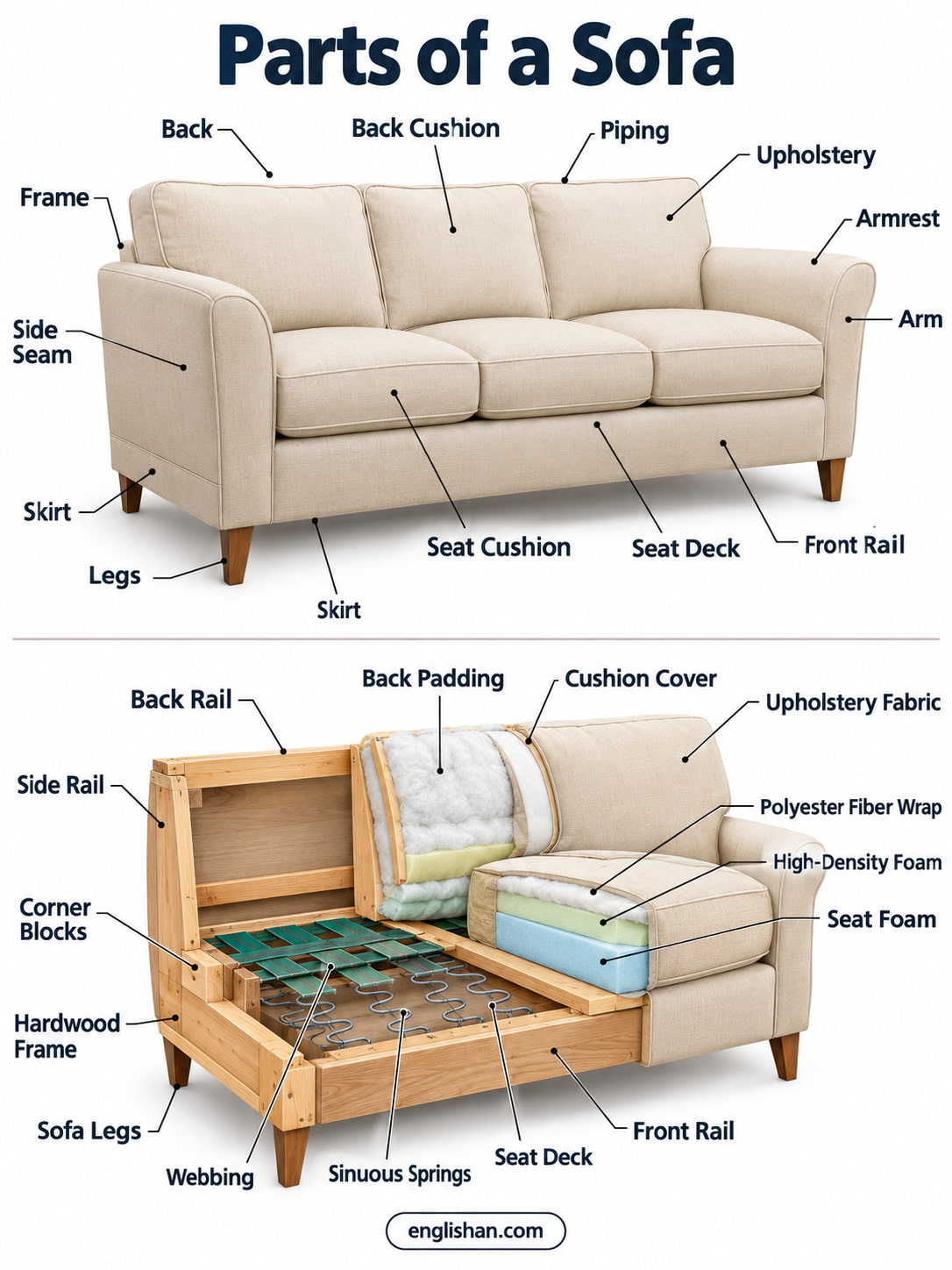
In a sofa cutaway, the hardwood frame forms the base. Springs and webbing are stretched across the seat deck, and the seat cushions are fitted onto that deck. Legs lift the frame off the floor. These are the parts of a sofa, or the parts of a couch, as upholsterers name them.
| Part | Where you find it |
|---|---|
| 1. Frame | Hardwood skeleton inside the sofa |
| 2. Seat deck | Platform between the arms under the seat cushions |
| 3. Webbing | Woven straps stretched across the deck |
| 4. Springs | Steel coils or S-shaped wire fixed to the deck |
| 5. Seat cushion | Loose pad on the deck |
| 6. Back | Upright part behind the seat |
| 7. Back cushion | Pillow or tight pad against the back |
| 8. Arm | Side part at each end of the seat |
| 9. Legs | Wood or metal feet at the four corners |
| 10. Skirt | Fabric apron around the base of a skirted sofa |
| 11. Upholstery | Fabric or leather cover over the frame |
| 12. Piping | Cord trim along the seams |
| 13. Sofa bed mechanism | Folding steel frame under the seat cushions |
| 14. Sofa bed mattress | Thin mattress folded inside the seat |
| 15. Chaise | Extended seat on a sectional sofa |
Sofa Frame and Suspension Parts
The frame and suspension are the parts of a sofa beneath the cover, and they decide how long the seat keeps its shape.
Frame
The frame is a rectangular skeleton of kiln-dried hardwood such as oak, maple, or beech. A front rail and a back rail span the width, side rails join them, and arm posts rise at each end. Corner blocks, small wooden wedges glued and screwed into the joints, brace each corner.
Seat Deck
The seat deck is the platform between the front and back rails, directly under the seat cushions. Springs and webbing are fixed across it. Seat height measures 17 to 19 inches from the floor to the top of the cushion.
Webbing
Webbing is woven strapping of jute or elastic rubber, tacked across the deck in a crosswise weave. Elastic webbing stretches more than jute and is fitted on lighter modern sofas.
Springs
Sinuous springs are S-shaped steel wires that extend from the front rail to the back rail, clipped at both ends. Eight-way hand-tied springs are coils tied to each other and to the frame with twine in eight directions. A sofa with hand-tied coils is a high-end build.
Sofa Cushion and Back Parts
Cushions are the parts of a sofa you touch most, and each one is a foam core in a zipped cover.
Seat Cushion
A seat cushion is a loose pad with a foam core, wrapped in polyester fiber or down feathers and zipped into its own cover. Bench seats use one long cushion, and cushioned seats use two or three. A tight seat has no loose cushion, because the padding is upholstered straight onto the deck.
A T-cushion has extensions that wrap around the front of the arm. A straight cushion stops short of the arm. Seat depth measures 20 to 24 inches on a standard sofa.
Back
The back is the upright part behind the seat, built on the frame’s back rail and padded with foam. A tight back is upholstered into the frame with no loose cushions. A pillow back has several loose pillows against the frame, and a channel back has vertical stitched grooves. A camel back rises in a hump at the center of the top rail.
Back Cushions
Back cushions are pads placed against the back and filled like seat cushions. Loose back cushions lift out for plumping and rotation. Semi-attached cushions are sewn to the back along the bottom edge, so they keep their position without moving.
Sofa Arm Parts
The arms close both ends of the seat, and the arm style sets the overall look of the sofa.
Arm
An arm is the side part at each end of the seat, built on the frame’s arm posts and padded with foam. The top surface of the arm is the armrest. Most arms measure 24 to 28 inches from the floor.
Arm Styles
A rolled arm curves outward at the top, and an English roll arm is lower and more rounded. A track arm has flat vertical sides and a square top. A Lawson arm is a soft square arm set lower than the back. A tuxedo arm is as tall as the back, so the arms and the back form one level line. A pleated arm has a fabric panel gathered into folds.
Sofa Leg and Base Parts
Legs and base lift the frame off the floor, and these parts of a sofa are the only ones that touch it.
Legs
Sofa legs are wood or metal feet fixed to the four corners of the frame. Block legs are square and straight, bun legs are rounded, and tapered legs narrow toward the floor. Splay legs angle outward, and sled legs are flat bars of wood or metal. Screw-on legs thread onto hanger bolts set in the frame corners, so legs with the same bolt size and thread are interchangeable.
Skirt and Plinth
A skirt is a fabric apron, pleated or straight, that hangs from the base of the frame to the floor. A plinth is a solid platform base, wrapped in upholstery, with no legs showing. Both finish the lower edge of a sofa that has no exposed legs.
Sofa Upholstery and Trim Parts
The outer layer is made of the parts of a sofa that are seen first: the cover, the seams, and the trim.
Upholstery
Upholstery is the fabric or leather stretched and stapled over the padded frame. Polyester, linen, and cotton blends are the common fabrics. A layer of ticking, a tightly woven inner lining, keeps the foam and fiber from working through the cover.
Piping
Piping, also called welt, is a cord wrapped in a strip of fabric and sewn into a seam. It outlines the edges of the cushions and arms. Contrast piping in a darker color marks each cushion edge.
Sofa Variants and Their Added Parts
The parts of a sofa extend with the type, because a sofa bed, an armchair, and a sectional each change the frame.
Sofa Bed
A sofa bed adds a folding steel mechanism and a thin mattress to the frame. The mechanism is a hinged bar frame under the seat cushions, and the mattress folds in thirds inside it. A sleeper sofa is another name for this type. The bed page names each part of the bed itself.
Armchair
An armchair has the same parts as a sofa at the width of one seat. These are a frame, a deck, one seat cushion, a back, two arms, and four legs. A sofa set pairs a sofa with one or two matching armchairs. The chair page names the parts of dining and desk chairs.
Sectional
A sectional is built from separate modules joined by metal connector brackets. A corner unit turns the line of seating, and armless units extend it. The chaise is the long seat module that ends the L, with a seat long enough for the legs to extend.
Related:
FAQs
The parts of a sofa are the frame, seat deck, springs, seat cushions, back, arms, legs, and upholstery. The frame is the hardwood skeleton, and the springs and webbing are fixed to the deck. The sofa part names are the same for a couch.
A sofa frame has a front rail, a back rail, two side rails, and arm posts at each end. Corner blocks brace the joints. The frame is kiln-dried hardwood such as oak, maple, or beech.
A sofa cushion has a foam core, a wrap of polyester fiber or down feathers, a ticking liner, and a zipped outer cover. The core shapes the cushion, and the wrap softens the surface.
A sofa bed has a hardwood frame, a folding steel mechanism, a thin mattress, seat cushions, and legs. The mattress folds in thirds inside the mechanism when the bed is closed.
An armchair has a frame, a seat deck, a seat cushion, a back, two arms, and four legs. These are the same parts as a sofa at the width of one seat.
A hardwood frame, webbing or springs across the deck, and foam padding with a fiber wrap are inside a sofa. A ticking liner and the outer upholstery cover them.
The L part of a couch is the chaise, the long seat module at one end of a sectional. A corner unit joins it to the main run of seating.