

The parts of a rickshaw are built around a three-wheeled chassis, with one wheel at the front and two at the rear. A handlebar steers the front wheel, and a canvas hood is stretched over the passenger bench behind the driver.
An auto rickshaw drives the rear axle with an engine, and a cycle rickshaw drives it with pedals and a chain. Each part is bolted or welded to the chassis at a fixed position.
Parts of a Rickshaw Labeled on an Auto Rickshaw in Side View
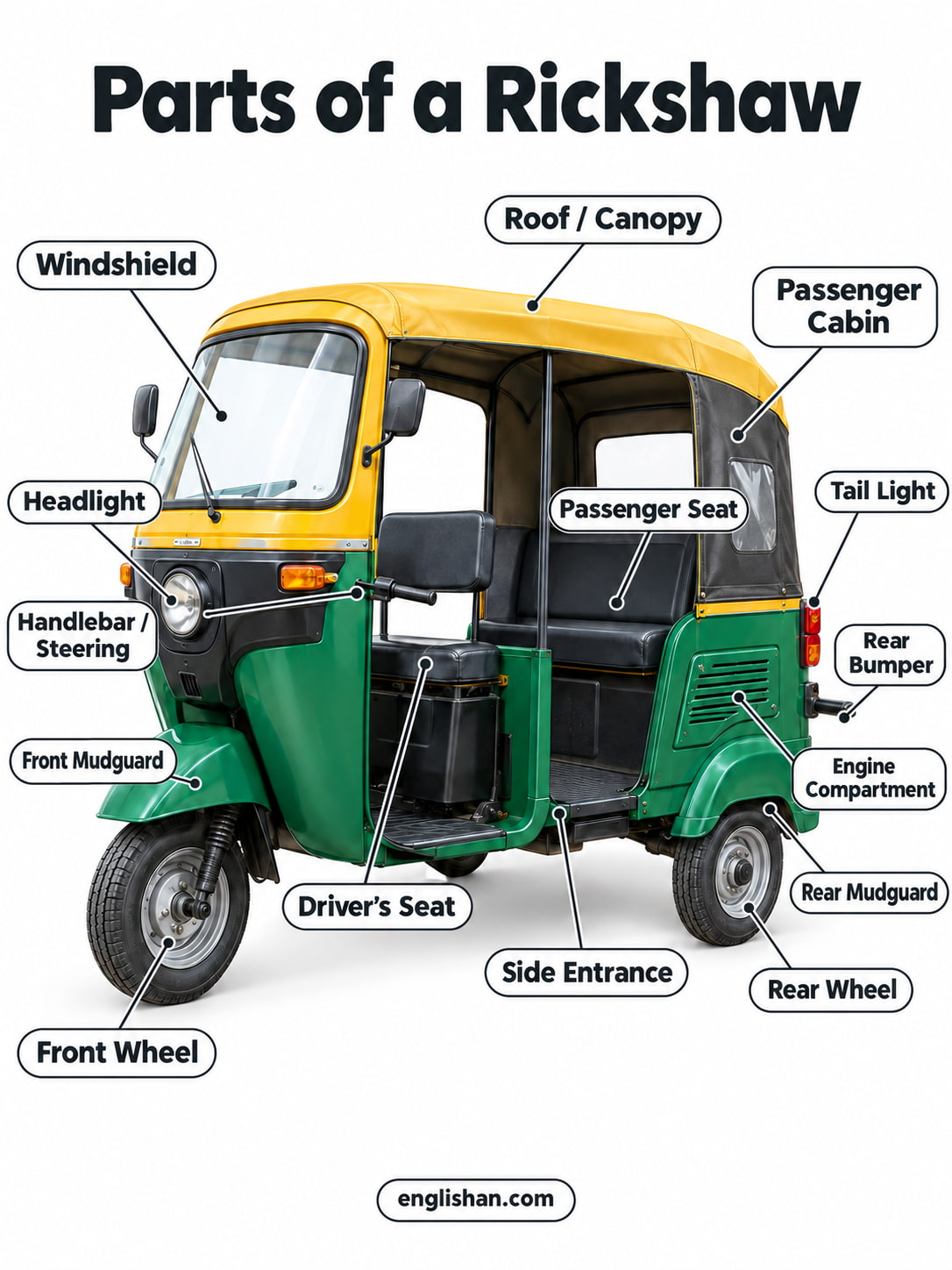
In side view, the handlebar and the single front wheel are at the nose. A windshield is fitted ahead of the driver cab, and a roof extends back over the seats. The engine and the rear axle are mounted to the chassis between the two rear wheels. These are the parts of a rickshaw, and the parts of an auto rickshaw, as mechanics and body builders name them.
| Part | Where you find it |
|---|---|
| 1. Handlebar | Steering bar at the front of the cab |
| 2. Steering column and linkage | Shaft and rods on wheel-steered e-rickshaws |
| 3. Front fork | Pair of tubes holding the front wheel |
| 4. Front wheel | Single wheel at the nose |
| 5. Front mudguard | Curved fender over the front wheel |
| 6. Headlight | Round lamp on the cab nose |
| 7. Turn signals | Indicator lamps beside the headlight |
| 8. Horn | Electric or bulb horn on the cowl |
| 9. Rearview mirrors | Pair of mirrors on the cab frame |
| 10. Windshield | Glass or plastic screen ahead of the driver |
| 11. Wiper | Single arm sweeping the glass |
| 12. Driver seat | Padded bench at the front of the cab |
| 13. Hood | Canvas roof over the cab and the bench |
| 14. Passenger bench | Padded rear seat behind the driver |
| 15. Side curtains | Drop-down sheets closing the open sides |
| 16. Body panels | Pressed sheet-metal sides and front cowl |
| 17. Chassis | Welded steel frame under the body |
| 18. Engine | Compact unit under the driver seat or at the rear |
| 19. Fuel tank | Tank under the driver seat or behind the cowl |
| 20. Exhaust pipe | Muffler at the rear of the chassis |
| 21. Clutch | Hand-lever clutch on the left grip |
| 22. Gearbox | Manual box with four forward gears and one reverse |
| 23. Accelerator | Twist throttle on the right grip |
| 24. Rear axle | Steel shaft joining the two rear wheels |
| 25. Differential | Gear set in the rear axle housing |
| 26. Driveshaft | Shaft from the gearbox to the differential |
| 27. Suspension | Springs and shock absorbers on the axle |
| 28. Rear wheels | Two wheels with drum brakes |
| 29. Brake drum | Steel drum on each wheel hub |
| 30. Tail lamp | Red lamp at the rear of the body |
| 31. Reflectors | Red reflectors on the rear panel |
| 32. Seat belts | Belts on the driver seat and the bench |
| 33. Speedometer | Dial on the handlebar console |
| 34. Cycle rickshaw pedals | Crank pedals on the pedal-driven model |
| 35. Cycle rickshaw chain | Chain from the chainring to the rear axle |
| 36. Rim brakes | Brake blocks that press on the wheel rim |
| 37. Battery pack | Lead-acid or lithium-ion block under the bench |
| 38. Electric motor | Brushless motor on the rear axle |
| 39. Controller | Unit that regulates current to the motor |
| 40. DC-DC converter | Step-down unit for lamps and horn |
| 41. Charging port | Socket for the charger cable |
| 42. Wiring harness | Bundled cables joining every electrical part |
Rickshaw Cab and Steering Parts
The cab is the front compartment of an auto rickshaw, and these parts of a rickshaw are the ones the driver operates.
Handlebar
The handlebar is the steering bar at the front of the cab. A twist throttle grip, a gear-shift grip, and a brake lever are fitted to it. On a handlebar model, it turns the front fork directly. Some wheel-steered e-rickshaws use a steering wheel with a column and a linkage instead.
Front Fork and Wheel
The front fork is a pair of tubes that hold the single front wheel on its axle and pivot with the handlebar. A coil spring inside a damper tube absorbs shock from the road. The wheel is a steel rim fitted with a tire.
Front Mudguard
Among the parts of a rickshaw, the front mudguard is a curved sheet-metal fender fixed to the fork over the front wheel. It blocks the water and mud thrown up by the tire.
Headlight
The headlight is a round lamp mounted on the nose of the cab or on the front mudguard. Two small indicator lamps are set on either side of it on newer models.
Windshield
The windshield is a glass or plastic screen set in a metal frame ahead of the driver. A single wiper arm sweeps the glass in an arc from a pivot at the base of the frame.
Driver Seat
The driver seat is a padded bench at the front of the cab, built over the engine bay on older models. A steel partition separates it from the passenger bench.
Rickshaw Body and Passenger Parts
The body is the sheet-metal shell behind the driver cab, and these parts of a rickshaw hold the passengers.
Hood
The hood is the roof among the parts of a rickshaw body, made of canvas stretched over a tubular steel frame. Its rear edge extends over the passenger bench, so the hood protects both the cab and the seat from rain and sun.
Passenger Bench
The passenger bench is the padded rear seat, wide enough for three passengers behind the driver. A standard rickshaw seats four, counting the driver. The backrest is vinyl over a steel frame.
Side Curtains
Side curtains are drop-down sheets of plastic or canvas that close the open sides of the cab and the bench. Snap fasteners fix each curtain to the hood frame, and the curtains roll up when the weather is dry.
Body Panels
The body panels are the pressed sheet-metal sides and the front cowl, riveted or welded to the chassis. They enclose the engine bay and form the lower walls of the cab.
Rickshaw Chassis and Drive Parts
The chassis and the drive form the structural base. The parts of a rickshaw in this group bear the load of the body and the passengers.
Chassis
The chassis is the steel frame beneath the body, built from welded tubes and channel bars. It joins all the parts of a rickshaw into one structure. The front fork, the engine mount, and the rear axle housing are fixed to it.
Engine
The engine is a compact unit mounted beneath the driver seat on older rickshaws and at the rear on newer ones. Fuel options are gasoline, diesel, CNG, and LPG. Electric models use a motor in place of it.
Rear Axle and Wheels
The rear axle is the steel shaft that joins the two rear wheels and turns them. Each wheel is a steel rim with a tire, and a rear mudguard curves over it.
Brakes
The brakes are the parts of a rickshaw that stop all three wheels, and they are the main safety system. Each wheel has a drum brake, a steel drum that holds a pair of brake shoes. A foot pedal works the rear brakes, and a hand lever on the handlebar works the front.
Rickshaw Drivetrain Parts
The drivetrain moves power from the engine to the rear wheels. These parts of a rickshaw are placed between the engine and the rear axle.
Clutch and Gearbox
A clutch lever on the left grip disconnects the engine from the gearbox during a gear change. The gearbox is a manual unit with four forward gears and one reverse on most models, and a gear-shift grip selects the gear.
Driveshaft and Differential
The driveshaft transmits torque from the gearbox to the differential in the rear axle housing. The differential lets the two rear wheels turn at different speeds in a corner.
Accelerator
The accelerator is the twist throttle on the right grip. Turning it opens the throttle and raises engine speed.
Fuel Tank and Exhaust Pipe
The fuel tank is a steel tank mounted under the driver seat or behind the cowl. The exhaust pipe runs from the engine to a muffler at the rear of the chassis, where it reduces noise.
Suspension
Front suspension is the spring and damper in the fork. The rear has leaf or coil springs with hydraulic shock absorbers between the axle and the chassis.
Rickshaw Lighting and Safety Parts
The lamps, mirrors, and restraints among the parts of a rickshaw make the vehicle visible to traffic and protect the people inside.
Rickshaw Lamps and Horn
Turn signals are small indicator lamps beside the headlight. The horn is fixed to the cowl and is sounded from the handlebar. A red tail lamp and two reflectors mark the rear of the body.
Mirrors and Seat Belts
Two rearview mirrors are fixed to the cab frame, one on each side. Newer models add seat belts on the driver seat and the passenger bench. The speedometer is a dial in the handlebar console.
Cycle Rickshaw Parts
The parts of a cycle rickshaw differ from the auto model, since a cycle rickshaw is a pedal-driven tricycle with a passenger seat. The parts of a cycle rickshaw follow those of a bicycle.
Frame
The frame is a welded steel tube structure that joins the driver saddle, the handlebar, the rear axle, and the passenger seat. Its front half matches a bicycle frame, while its rear half is extended into a platform.
Pedals and Chain
Pedals turn a chainring, and a chain drives a sprocket on the rear axle. Rim brakes press blocks against the wheel rims to stop the rickshaw. Cycle rickshaws outside Asia have multiple gears and stronger brakes. Electric-assist models add a motor, such as the 500-watt unit on the German CityCruiser.
Passenger Seat and Hood
In Bangladesh, India, and China, the passenger seat is behind the driver. In Indonesia, Malaysia, Cambodia, and Vietnam, it is in front of the driver. Bangladeshi cycle rickshaws have a folding hood, which is a canvas roof on curved metal bows.
Footrest
A footrest is a steel bar or plate fixed to the frame in front of the passenger seat. It braces the feet of the passengers and keeps their feet off the front wheel.
Rickshaw Types and Their Added Parts
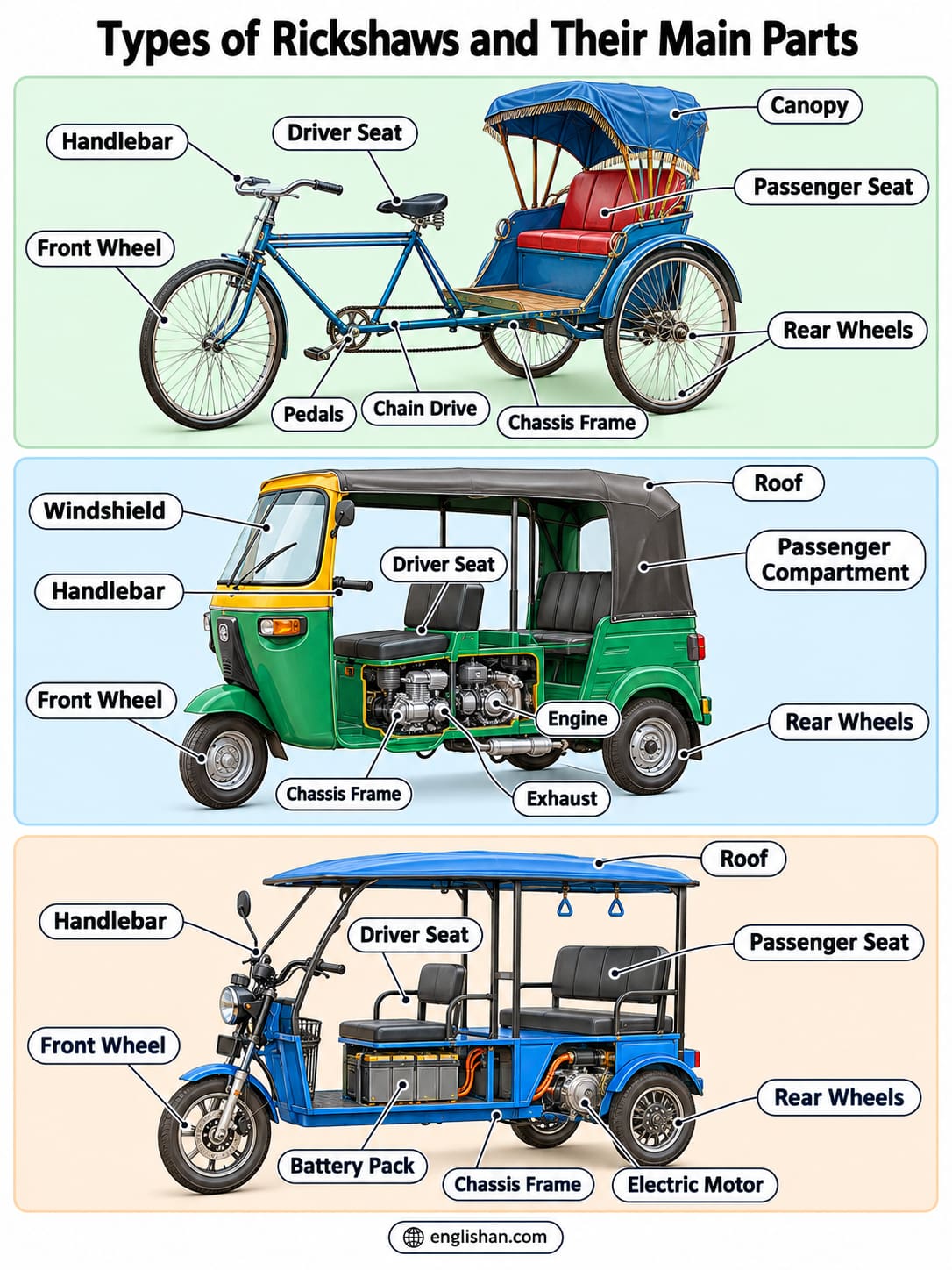
The parts of a rickshaw change with the type. An e-rickshaw, a cargo rickshaw, and a sidecar rickshaw each alter the body or the drive.
E-Rickshaw
An e-rickshaw replaces the engine and the fuel with a battery pack, an electric motor on the rear axle, and a controller. The electric bike page names the same battery, motor, and controller parts.
The battery pack is lead-acid or lithium-ion and is mounted under the passenger bench. A brushless motor with a reduction gear turns the rear axle. The controller regulates current from the battery to the motor in an e-rickshaw.
A DC-DC converter steps the battery voltage down for the lamps and the horn. A charging port takes the charger cable, and a wiring harness joins every electrical part. Many e-rickshaws use a steering wheel with a column and linkage in place of the handlebar.
Cargo Rickshaw
A cargo rickshaw replaces the passenger bench with an open rear bed, built on the same chassis and rear axle. The hood is removed or cut back to the cab.
Sidecar Rickshaw
A sidecar rickshaw mounts a passenger sidecar to a three-wheeled motorcycle or to a bicycle. The Philippine pedicab is made by fitting a sidecar to a regular bicycle.
Related:
FAQs
The parts of a rickshaw are the handlebar, front fork, windshield, driver seat, hood, passenger bench, chassis, engine, gearbox, differential, and rear axle. A cycle rickshaw replaces the engine with pedals and a chain.
An auto rickshaw has a driver cab with a handlebar and a windshield, a canvas hood, and a passenger bench. It also has a steel chassis, an engine, a rear axle, and three wheels, and side curtains close the open sides.
The body parts of an auto rickshaw are the body panels, the front cowl, and the mudguards. The hood, the side curtains, and the passenger bench complete the body. All of them are fixed to the chassis.
A cycle rickshaw has a steel frame, pedals, a chain, and a rear axle. A passenger seat, a folding hood, and a footrest complete it. The handlebar and front fork follow the design of a bicycle.
An e-rickshaw has a battery pack, an electric motor, a controller, a DC-DC converter, and a charging port. Its chassis, cab, hood, and passenger bench match those of an auto rickshaw, and it has no engine or fuel tank.
A rickshaw is a three-wheeled vehicle with a single front wheel and two rear wheels. A driver cab is at the front, and a hooded passenger bench is behind it. An auto rickshaw has an engine, and a cycle rickshaw has pedals.
A standard auto rickshaw seats three passengers plus the driver, four in all. Six-seat versions exist, and the city of Pune banned them in 2003.
