A kitchen grinder is a countertop or hand-held tool that crushes food between blades, burrs, or a screw and a plate. The parts of a grinder change with the food, so meat, coffee, spices, and batter each need a different grinding part.
This page names the parts of a grinder in the kitchen types you use most: the meat grinder, mixer grinder, coffee grinder, and pepper grinder.
Grinder Parts Labeled in One Diagram
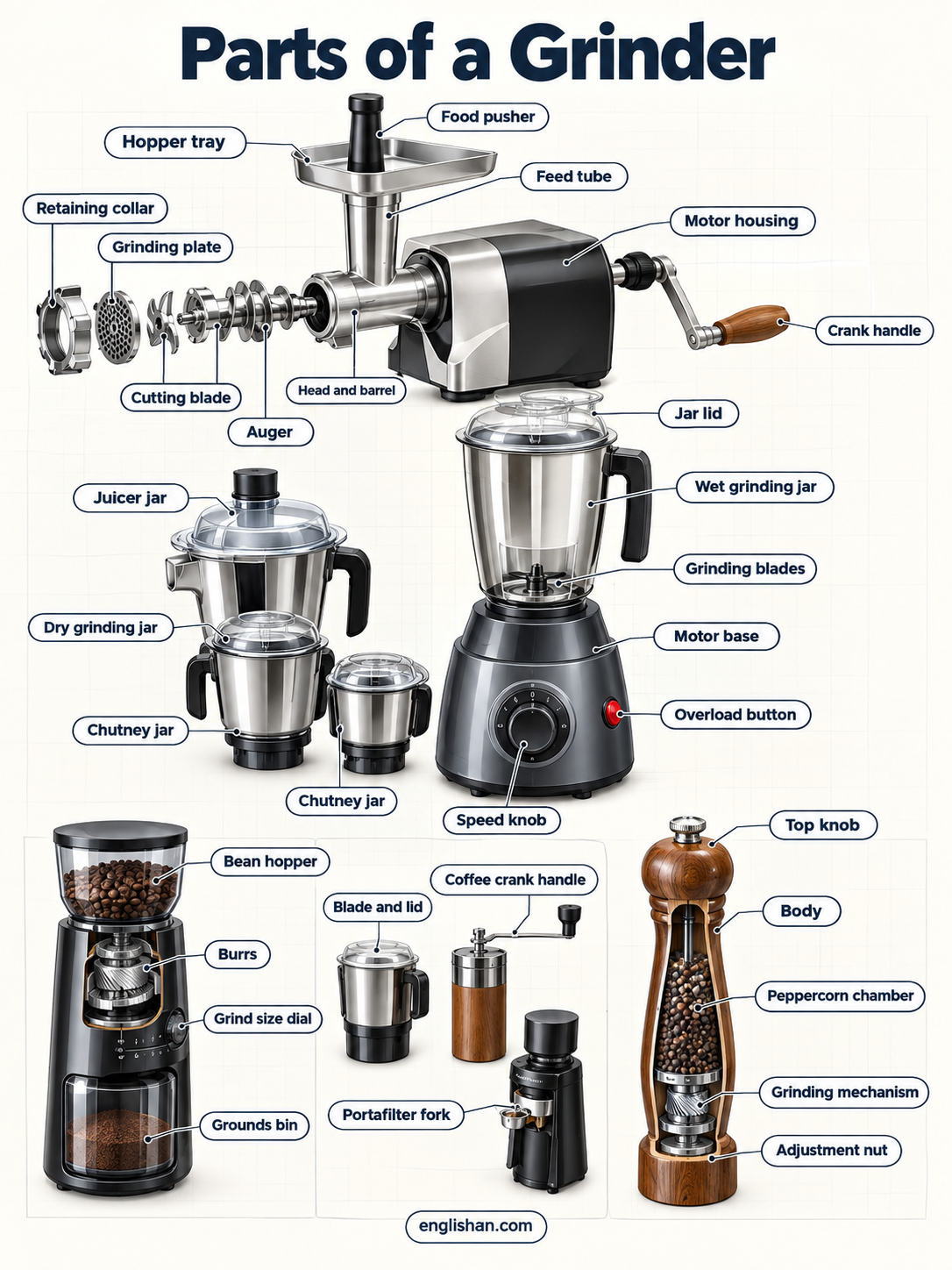
A kitchen grinder has an opening on top that takes the food and a grinding part at its center. A motor or a crank turns that part, and a jar, bin, or plate outlet catches the result. The four types differ in shape. A meat grinder is a horizontal steel barrel, and a mixer grinder is a base with three jars. A coffee grinder is a funnel over a bin, and a pepper grinder is a hand-held column. These are the parts of a grinder in each type, numbered from the grinding part outward.
| Part | Where you find it |
|---|---|
| 1. Auger | Spiral screw inside the meat grinder barrel |
| 2. Cutting blade | Four-arm knife at the barrel mouth |
| 3. Grinding plate | Perforated steel disc against the blade |
| 4. Retaining collar | Threaded ring at the front of the barrel |
| 5. Head and barrel | Metal tube around the auger |
| 6. Feed tube | Short opening on top of the barrel |
| 7. Hopper tray | Flat pan around the feed tube |
| 8. Food pusher | Plastic plunger in the feed tube |
| 9. Motor housing | Base unit behind the meat grinder head |
| 10. Crank handle | Steel arm on a hand-crank meat grinder |
| 11. Grinding blades | Steel wings in the floor of each mixer grinder jar |
| 12. Wet grinding jar | Tallest jar in the set |
| 13. Dry grinding jar | Medium jar with a narrow wall |
| 14. Chutney jar | Short, small jar |
| 15. Jar lid | Domed cover over each jar |
| 16. Juicer jar | Wide jar with a spout |
| 17. Motor base | Rounded housing under the jars |
| 18. Speed knob | Ribbed dial on the front of the base |
| 19. Overload button | Red reset button on the back of the base |
| 20. Burrs | Two ridged rings at the center of a coffee grinder |
| 21. Grind size dial | Ring or knob near the burrs |
| 22. Bean hopper | Funnel on top of the coffee grinder |
| 23. Grounds bin | Container under the burrs |
| 24. Blade and lid | Steel blade in a lidded chamber |
| 25. Portafilter fork | Metal cradle on the front of an espresso grinder |
| 26. Coffee crank handle | Arm on top of a hand coffee grinder |
| 27. Grinding mechanism | Ridged burr set at the base of the pepper grinder |
| 28. Adjustment nut | Threaded knob on the top or bottom of the body |
| 29. Peppercorn chamber | Hollow center of the body |
| 30. Body | Wood, acrylic, or steel column |
| 31. Top knob | Rotating cap on top of the column |
Main Parts of a Grinder
Four of the parts of a grinder repeat in every kitchen type, whatever it grinds. Each type gives them its own names.
- Feeding opening: The hopper, jar, or feed tube that takes the food. A meat grinder has a tray and tube, a coffee grinder a funnel, and a pepper grinder a hollow body.
- Grinding part: The blade, burr, or auger and plate that crushes the food. Blades chop, burrs crush the food between two ridged rings, and an auger pushes it through a plate.
- Drive: A motor or a hand crank that turns the grinding part. Electric grinders range from 50 watts for coffee to 800 watts for meat.
- Collecting container: The jar, grounds bin, or tray that catches the ground food.
Parts of a Meat Grinder
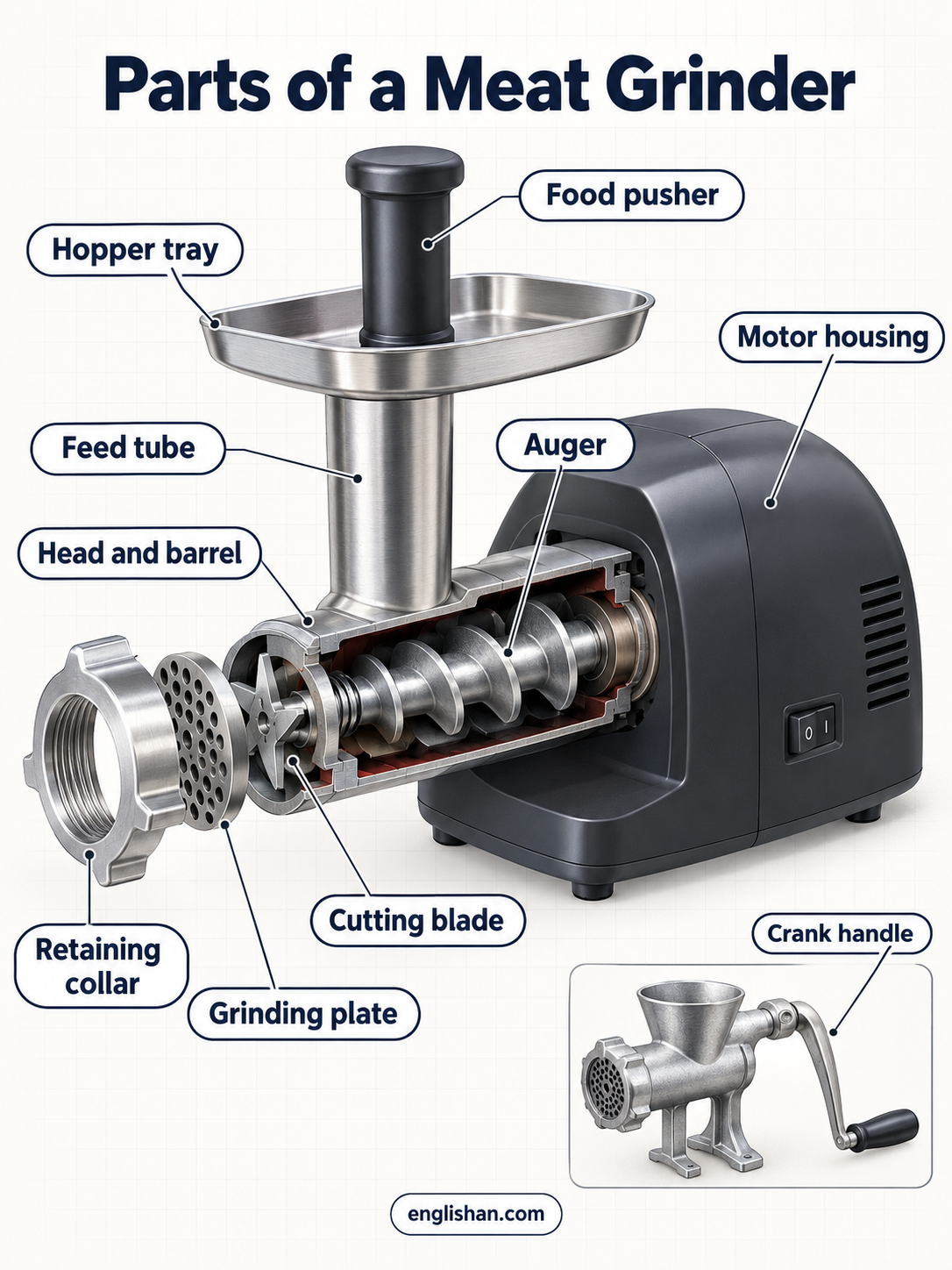
A meat grinder is a steel or aluminum head that bolts onto a motor housing, or clamps to a counter on hand-crank models. Ten of the parts of a grinder in this type run in a line. The line starts at the auger and ends at the motor or crank.
Auger
The auger is a spiral steel screw, about 6 to 8 inches long, fixed inside the barrel. It turns on a square-ended shaft and pushes the meat toward the plate. Its thread is wider at the feed tube and narrower at the front.
Cutting Blade
The cutting blade is a flat steel knife with four arms, about 2.5 inches across, pressed against the grinding plate. Its edges face the plate holes and shear the meat as the auger turns it. The blade is fitted over the front end of the auger.
Grinding Plate
The grinding plate is a round steel disc, about 2.5 inches wide, drilled with holes. Coarse plates have holes of 3/8 inch, and fine plates have holes of 1/8 inch. A notch on the rim locks the plate in the barrel.
Retaining Collar
The retaining collar is a threaded ring of steel or aluminum at the front of the barrel. It screws on over the plate and presses the blade against it. Hand tightening is enough.
Head and Barrel
The head and barrel form one cast aluminum or stainless steel tube, about 8 inches long. The bore is a smooth cylinder where the auger turns. A wide flange at the rear fastens the head to the motor housing.
Feed Tube
The feed tube is a short round opening, about 2 inches wide, on top of the barrel. Among the parts of a grinder, it is the opening that drops the meat onto the auger. It is cast in one piece with the head.
Hopper Tray
The hopper tray is a flat pan of stainless steel or plastic, fixed around the base of the feed tube. It has a raised rim of about half an inch. Cubed meat is stacked on it before grinding.
Food Pusher
The food pusher is a plastic plunger about 6 inches long, with a flat head and a molded grip. It fits the feed tube and presses the meat down. Some models add a finger guard at the top.
Motor Housing
The motor housing is a rounded body of plastic or painted metal, 8 to 10 inches across, behind the head. Electric models are rated from 300 to 800 watts. A rocker switch marked On, Off, and Reverse is set into the front.
Crank Handle
The crank handle is a curved steel arm with a wooden or plastic grip, fitted to the rear of a manual grinder. It turns the auger by hand. A screw clamp on the base fastens the body to a counter edge.
Parts of a Mixer Grinder
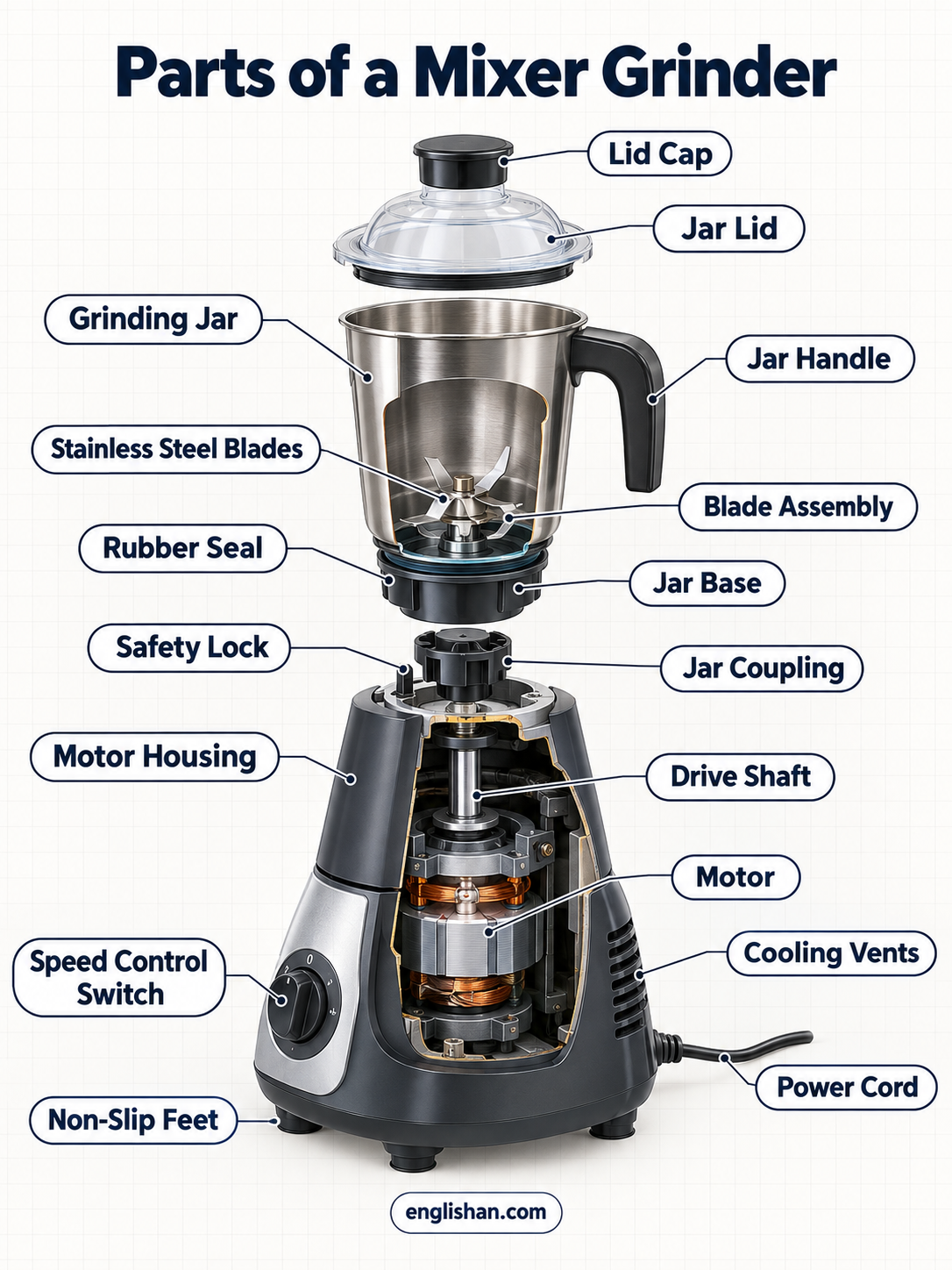
A mixer grinder is the South Asian name for a multi-jar blender: one motor base with three or four steel jars. Nine of the parts of a grinder in this type are visible from the counter.
Grinding Blades
Each jar has its own blade, screwed onto a spindle in the jar floor. The wet blade has four rounded wings and measures about 3 inches across. The dry blade has two sharp wings, and the chutney blade is short with three or four small wings.
Wet Grinding Jar
The wet grinding jar is the largest, a stainless steel jar of about 50 ounces (1.5 liters) with a wide mouth. A handle is riveted to its side. The four-wing blade is fixed in its floor.
Dry Grinding Jar
The dry grinding jar is a medium jar of about 34 ounces (1 liter) with a narrower, straighter wall. Its floor is thicker than the wet jar floor. The two-wing blade is fixed in it.
Chutney Jar
The chutney jar is the smallest, about 14 ounces (0.4 liter), short and wide. A handle is fixed to its side. Its short blade is set low in the floor.
Jar Lid
The jar lid is a domed cover of transparent polycarbonate or stainless steel, with a silicone gasket in its rim. A small vent cap is set in the center. Two lugs lock the lid to the jar mouth.
Juicer Jar
A juicer model adds a wide jar of about 25 ounces (0.75 liter) with a spout on one side. A perforated steel strainer basket is fitted inside it. A plastic pusher slides through the feed chute in the cover.
Motor Base
The motor base is a rounded housing of ABS plastic or die-cast aluminum, about 7 to 9 inches wide. A rubber-toothed coupler on top meets each jar, and four rubber feet grip the counter. The motor is rated at 500 to 750 watts. Imported units run on 230 volts and need a step-up transformer on a 120-volt US outlet.
Speed Knob
The speed knob is a ribbed round dial on the front of the base, about 2 inches across. Its ring is marked 0, 1, 2, and 3, with Pulse on many models. Among the parts of a grinder in this type, it is the one you touch most.
Overload Button
The overload button is a red reset button, about half an inch across, on the back or underside of the base. It cuts power when the motor overheats. Pressing it after the motor cools restores power.
Parts of a Coffee Grinder
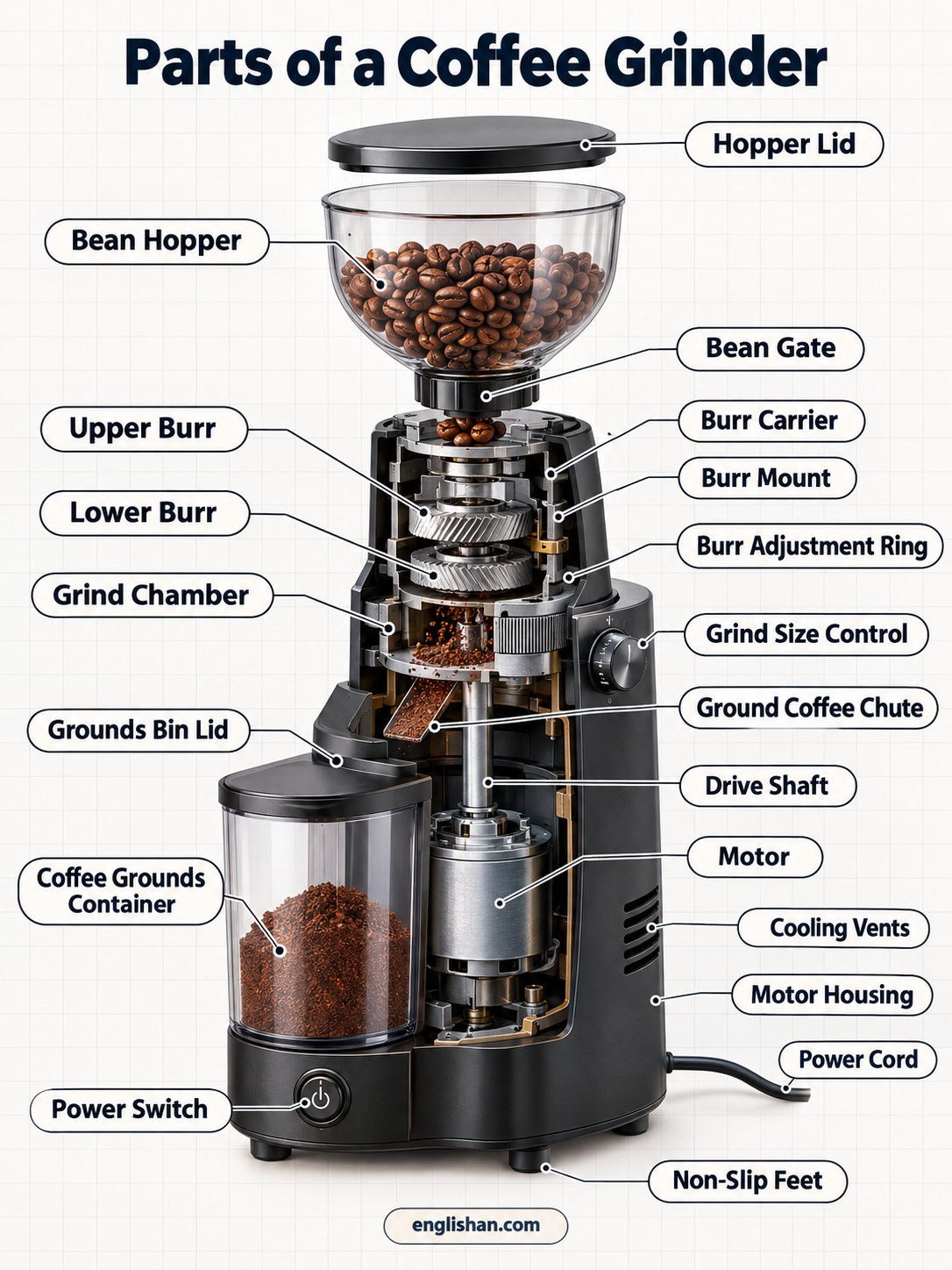
A coffee grinder is a countertop or hand-held tool with a bean funnel on top and a bin at the bottom. The parts of a grinder for coffee vary with the version: burr, blade, espresso, or hand.
Burrs
Burrs are two ridged rings of steel or ceramic at the center of the grinder, one fixed and one turning. The beans are crushed between them. Conical burrs are a cone inside a ring, and flat burrs are two parallel discs.
Grind Size Dial
The grind size dial is a numbered ring or knob near the burrs, marked from fine to coarse. Turning it moves one burr closer to the other or farther away. Most models have 15 to 40 steps.
Bean Hopper
The bean hopper is a funnel of tinted plastic or glass on top of the grinder, with a lid. Its capacity runs from 8 ounces to 1 pound. A slide gate at its base stops the beans when the hopper is removed.
Grounds Bin
The grounds bin is a plastic or glass container under the burrs that catches the ground coffee. It slides out at the front and has a small lip for pouring. Its capacity is 4 to 12 ounces.
Blade and Lid
A blade grinder replaces the burrs with a two-wing steel blade at the bottom of a lidded chamber. The lid presses a safety switch, so the motor runs only while it is closed. The blade spins at 20,000 rpm or more.
Portafilter Fork
An espresso grinder adds a metal fork on the front, a cradle that catches the portafilter, the handled basket used in an espresso machine. A dosing chamber or a timer button is set beside it.
Crank Handle
A hand coffee grinder replaces the motor with a crank handle of steel or wood on top. Its body is a cylinder of wood, steel, or ceramic, about 6 inches tall. The crank arm folds or unscrews for travel.
Parts of a Pepper Grinder
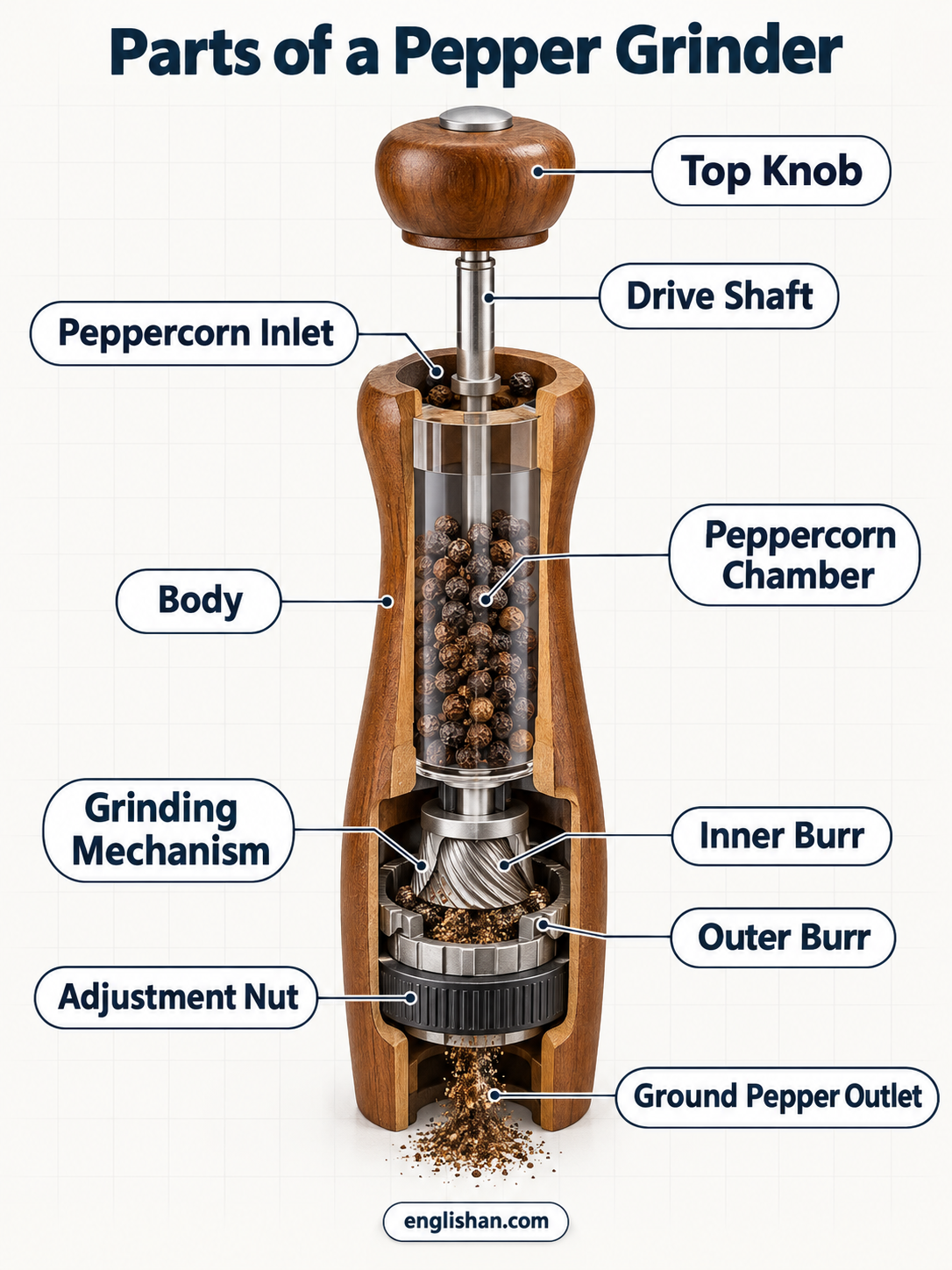
A pepper grinder, also called a pepper mill, is a hand-held column of wood, acrylic, or steel, about 6 to 8 inches tall. Five parts of a grinder of this type make up the column, from the burr set at the bottom to the knob on top.
Grinding Mechanism
The grinding mechanism is a burr set at the bottom of the column, made of a ridged outer ring and a ridged inner core. Steel sets are harder than ceramic ones. The peppercorns are crushed between the two rings.
Adjustment Nut
The adjustment nut is a threaded knob or dial on the bottom or top of the body. Tightening it narrows the gap between the burrs for a finer grind. Loosening it gives a coarse grind.
Peppercorn Chamber
The peppercorn chamber is the hollow center of the body, about 1.5 inches wide. The peppercorns drop in through the top opening. A transparent window on acrylic models shows the level.
Body
The body is a turned wood, acrylic, or brushed steel column, straight or tapered. Its wall is 1/8 to 1/4 inch thick. Electric models add a battery cap and a small motor in the top.
Top Knob
The top knob is a rotating cap of wood or metal fixed to the drive shaft. Twisting it turns the inner burr. Battery models replace it with a push button.
FAQs
Q1. What are the parts of a grinder?
The parts of a grinder are a feeding opening, a grinding part, a drive, and a collecting container. The grinding part is a blade in a mixer grinder and a burr in a coffee or pepper grinder. A meat grinder uses an auger with a plate. The drive is a motor or a hand crank.
Q2. What are the parts of a meat grinder?
The parts of a meat grinder are the auger, blade, plate, collar, head, feed tube, hopper tray, pusher, and motor or crank. The auger pushes the meat to the blade. The plate sets the size of the ground meat.
Q3. What are the parts of a coffee grinder?
A coffee grinder has a bean hopper, burrs or a blade, a grind size dial, a grounds bin, and a motor or crank. Burr models add the dial. Espresso models add a portafilter fork.
Q4. What are the parts of a mixer grinder?
A mixer grinder has a motor base, a speed knob, an overload button, and three or four jars. Each jar has a lid and its own blade. A juicer model adds a juicer jar with a strainer.
Q5. What are the parts of a pepper grinder?
A pepper grinder has a body, a top knob, a peppercorn chamber, a burr set, and an adjustment nut. The knob turns the burrs. The nut sets the coarseness.
Q6. What are the parts of a burr grinder?
A burr grinder has a hopper, two burrs, a grind size dial, a motor, and a catch bin. One burr is fixed and the other turns. The dial sets the gap between them, and the gap sets the grind size.
Q7. What are the parts of a hand grinder?
A hand grinder has a crank handle, a body, burrs, a grind adjustment, and a catch container. Coffee versions add a bean hopper on top. Pepper versions turn a knob instead of a crank.
You May Also Like
- Parts of a Blender
- Parts of a Kitchen
- Parts of a Kettle
- Parts of a Toaster
- Parts of a Microwave Oven