A pop-up toaster looks like nothing more than a steel box with two slots on top, and most mornings that is all a cook needs it to be. Push the lever, wait, and the toast jumps back up. Inside that quiet box, though, a set of parts works in a fixed order every time: three flat heating boards line the toasting chamber, a sprung cradle carries the bread down between them, and a small electromagnet keeps the cradle there until the timer decides the toast is ready.
The whole process takes about two minutes, and every part of a toaster has one job inside it — the lever drops the bread, the nichrome ribbon glows, the timer counts, the magnet releases, and the spring throws the slice back into the air. Once the sequence is visible, every named part below falls into a place along it.
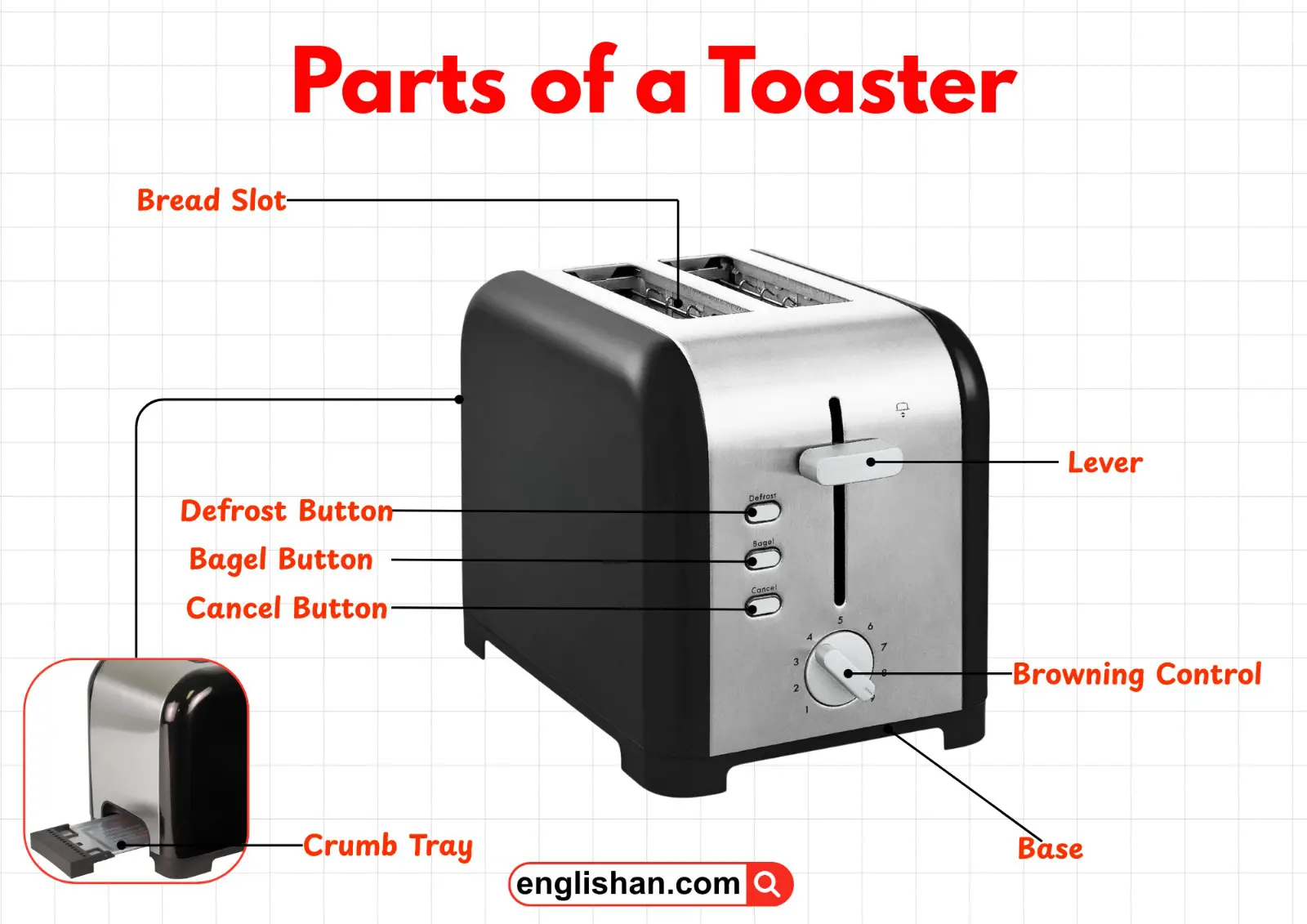
Parts of a Toaster Labeled
The full set of parts is easier to hold together after one pass through the cycle. Bread drops through the slots onto a carriage, which the lever then lowers against its spring. Reaching the bottom closes the power contacts and presses a steel plate against an electromagnet. Nichrome ribbon on mica boards glows on both sides of each slice while the browning control times the cycle. Crumbs shaken loose by the bread fall through to a tray at the bottom, and everything named in the table below fits somewhere in that sequence.
| Part | Where you find it |
|---|---|
| 1. Slots | Openings across the top |
| 2. Outer shell | The body enclosing everything |
| 3. Lever | Handle on the front or side |
| 4. Carriage | Cradle the bread travels down on |
| 5. Bread rack | Wire guides keeping a slice upright |
| 6. Carriage spring | Coil that lifts the carriage |
| 7. Guide rod | Rail the carriage runs along |
| 8. Heating element | Nichrome ribbon that glows red |
| 9. Mica board | Flat sheet the ribbon wraps around |
| 10. Element frame | Cage clamping the boards apart |
| 11. Reflector | Bright inner panel throwing heat back |
| 12. Electromagnet | Coil gripping the carriage down |
| 13. Armature | Steel plate the magnet grips |
| 14. Power contacts | Switch closed by the lever |
| 15. Browning dial | Dial for the shade of toast |
| 16. Timer circuit | Board counting the cycle |
| 17. Bimetallic strip | Curling strip timing older models |
| 18. Cancel button | Switch ending the cycle early |
| 19. Function buttons | Bagel, defrost, and reheat controls |
| 20. Crumb tray | Pull-out tray under the slots |
| 21. Thermal fuse | Safety device inside the wiring |
| 22. Cord | Mains lead into the back |
| 23. Cord grommet | Rubber collar where the cord enters |
| 24. Feet | Rubber pads under the base |
| 25. Warming rack | Fold-out shelf over the slots |
External Parts of a Toaster
Before opening the shell, it is worth walking round the parts a cook actually touches. All of them stay cool enough to handle while the inside reaches several hundred degrees, and each one either lets the bread in, sets the toast level, or catches what falls out.
Slots
The obvious place to start is the top. Two slots open across it, each a little over an inch wide and long enough for a slice of sandwich bread. Wider slots came in later for bagels, muffins, and thick slices, and a long-slot toaster takes that idea further by opening one gap the full width instead of two short ones. Slot width, more than watts or dial settings, decides what a toaster will take.
Outer Shell
Around those slots sits the outer shell, made of steel or plastic and wrapping everything inside. Brushed stainless resists fingerprints better than polished chrome, and plastic shells are moulded from heat-proof plastic with fire-stopping additives mixed in. Either way, a gap between the shell and the elements keeps the outside touchable while the nichrome glows within.
Lever
The only moving part on the outside is the lever, set on the front or the side. Pushing it down starts the toasting by driving the carriage to the bottom against its spring. Some newer models replace the lever with a small motor; a button then lowers the bread, and the same motor raises it again at the end.
Browning Dial
Next to that lever is the browning dial, marked from one to six or from light to dark. Turning it does not change the heat, since the elements burn at full power whatever the setting. It changes how long the timer keeps them on, which is why a low number toasts pale rather than gently.
Function Buttons
Set beside the dial on most modern toasters are the function buttons, labelled bagel, defrost, reheat, and cancel. Bagel powers only the inner elements, browning the cut face while the crust stays soft. Defrost works the other way, adding time at the start to thaw a frozen slice. Reheat gives a short burst that warms toast without browning it further.
Crumb Tray
The one part that lives underneath rather than up top is the crumb tray, a shallow metal drawer that slides out from the base. Crumbs that fall off the bread land in it rather than on the elements, where they would scorch and smoke. Emptying it every few weeks is the only care a toaster needs, and a full tray is the usual cause of a burning smell.
Warming Rack
On some models a warming rack folds up over the slots, a small wire shelf that adds a second job to the machine. Croissants and rolls warm on it without toasting, since they sit above the slots rather than inside them. A lever or knob on the side raises and lowers the rack when it is needed.
Heating Assembly of a Toaster
Move past the outer parts and the first thing inside the shell is the heating assembly. Three flat boards do the browning: one is fixed against each outer wall, and the third divides the two slots. Bread toasts between them, one face against each board, which is why a single slice still browns on both sides.
Heating Element
The part that actually gets hot is the heating element, a ribbon of nichrome wire that glows orange when current flows through it. Nichrome is a mix of nickel and chromium that resists electricity strongly, so even a short length heats fast. It also survives the heat inside a toaster without rusting, which is why iron wire was dropped for it in 1905.
Mica Board
That ribbon needs something to sit on, and the something is a mica board — a flat sheet of stone-like mineral that takes the heat without burning. Mica warms quickly, spreads the heat evenly across its face, and cools again fast once the power stops. The nichrome ribbon zigzags across the sheet, which is the pattern visible through the slot when the toaster is running.
Element Frame
Holding those boards upright is the element frame, a light cage that clamps them about an inch apart. That spacing fixes the slot width; let one board bend inward and it would touch the bread, scorching a stripe into the slice. The same spacing keeps the live nichrome away from the metal shell.
Reflector
Fitted behind the outer elements is a bright metal reflector, and its job is to bounce heat back toward the bread. Without it, half the radiation from an outer board would warm the shell instead of the slice. Polished aluminium and stainless steel both serve as the reflecting surface.
Pop-Up Mechanism of a Toaster
The heating assembly supplies the heat, but nothing browns until the bread is held in front of it long enough. That is the job of the pop-up mechanism — the linked parts that clamp the bread down, time the toasting, and throw the slice back up when the run ends. Each one acts in turn rather than all at once, and following them in order is the easiest way to see how the machine works.
Carriage
The first link in that chain is the carriage, a metal frame that lowers the bread into the slots and lifts it out again. Wire racks on the carriage keep each slice upright and centred between the boards. Cheap toasters carry it on one rod, and better ones on two, so that it cannot tilt and jam partway down.
Carriage Spring
Underneath the carriage sits the carriage spring, which compresses as the lever travels down and stores the energy that will pop the toast up later. It stays compressed for the whole of the cycle, waiting on the magnet above to release. A weak spring lifts the toast only halfway, which is the fault behind burnt fingers on an old machine.
Power Contacts
At the bottom of the carriage’s travel, two copper strips close together as it lands, and these are the power contacts. Closing them sends mains current through the three heating elements at once, which is why the wires start glowing the instant the lever bottoms out. Pitted contacts, worn from years of that spark, are why an old toaster needs its lever pressed twice.
Electromagnet
Once the current is flowing, the carriage still has to be held down, and that job falls to the electromagnet — a coil of wire wound on a bobbin. Current through the coil turns the bobbin into a magnet, which then grips a steel plate on the carriage called the armature. Breaking that current is what lets the toast go, so the electromagnet is the part that decides when toasting ends.
Timer Circuit
Deciding when to break the current is the timer circuit, a small board sitting off to one side in modern toasters. The dial sets how fast a small store of charge builds up inside that board, and once the store fills, the circuit drops power to the electromagnet. Chip-controlled toasters count the time in a different way, and they shorten the second round because the machine is already hot.
Bimetallic Strip
Older toasters, and a few premium ones still made today, use no circuit board at all — the timing comes from a bimetallic strip, two metals joined together that grow at different rates when warmed. As it heats, the strip curls, and the curl breaks the circuit at the chosen point. A small element beside the strip warms it in step with the toasting, and a Dualit still times its cycle this way.
Thermal Fuse
Guarding all of it is the thermal fuse, a one-shot safety device that sits quietly inside the wiring. Melting at a fixed temperature, it kills the power for good if the toaster overheats or the carriage jams down. A toaster that has died completely, with no warning and no lever action at all, has almost always blown this fuse rather than anything else.
Cord and Base of a Toaster
Two parts of a toaster are hidden underneath, and they carry the current in and hold the machine still while it works. Neither is much to look at, but both matter more than their size suggests.
Cord and Plug
The cord delivers 800 to 1,500 watts into the toaster, one of the heaviest draws of any small kitchen appliance. For that reason its flex is thicker than a lamp cord, and on many models the unused length winds onto lugs under the base rather than trailing across the counter.
Cord Grommet
Where the cord passes through the shell, a rubber grommet lines the hole. Without it, bending the cord at that point would wear it through against a metal edge; the grommet spreads that bend over a much wider curve. A cracked one is the point where a worn toaster turns dangerous, and it is worth checking on any machine more than a few years old.
Feet
At the four corners of the base sit the feet, small rubber pads that finish the job. They lift the shell far enough for air to move underneath, and they keep the toaster from creeping across the counter as its spring works.
FAQs
Q1. What are the parts of a toaster called?
The parts of a toaster begin with the slots and shell outside, then the lever and carriage that lower the bread. Nichrome elements wound on mica boards supply the heat from both sides. An electromagnet holds the carriage down, a timer circuit or bimetallic strip ends the cycle, and a spring lifts the toast. A crumb tray pulls out of the base below the slots.
Q2. What are the internal parts of a toaster?
Inside a toaster are three heating boards of nichrome ribbon wound on mica, and a sprung carriage riding on rods between them. The electromagnet and its armature, the power contacts, a timer circuit or curling strip, and a thermal fuse finish the set. The crumb tray fits into the base below all of it.
Q3. What is the lever on a toaster called?
The lever is also called the carriage lever or lift lever, since pressing it lowers the bread carriage. On the way down it closes the power contacts and brings the armature against the electromagnet that pins the bread in place.
Q4. What part of a toaster catches the crumbs?
The crumb tray catches the crumbs, sliding out from the base below the slots. Emptying it stops old crumbs scorching on the elements, which is what makes a toaster smoke. Cheaper models leave the tray out and use a hinged base panel instead.
Q5. What makes the wires in a toaster glow?
The wires glow because they are nichrome, an alloy of nickel and chromium with high resistance to electricity. Current pushed through that resistance heats the ribbon until it glows orange, and the metal survives that heat year after year without rusting through.
Q6. What makes toast pop up?
An electromagnet grips the carriage down while the bread toasts. At the end of the run, the timer cuts power to that magnet. Releasing the armature frees the carriage, and the compressed spring throws it back up. Pressing the cancel button ends the same run early, before the timer finishes.
Q7. How does the browning control work?
The browning control changes how long the elements stay on rather than how hot they burn. On an electronic toaster the dial changes a setting on the circuit board. On a mechanical one it moves the contact that the curling strip has to reach.
You May Also Like