

The parts of a refrigerator divide between a fresh food compartment and a freezer, both inside one insulated cabinet. A sealed cooling system mounted on the back and bottom of that cabinet chills them both.
Both compartments open at the front, and every other part is fitted behind, beneath, or inside them.
Parts of a Refrigerator Labeled
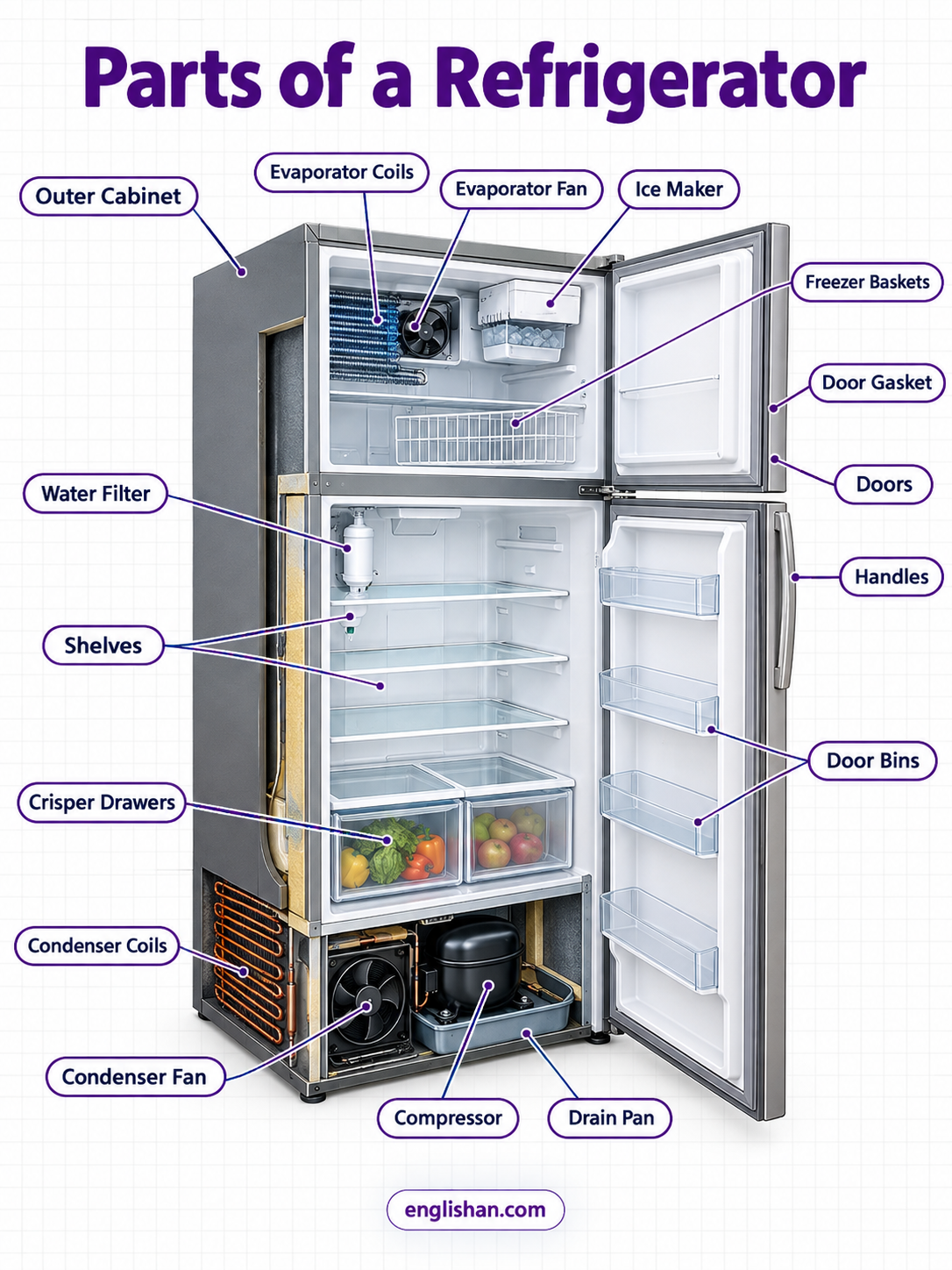
Working from the outside in, the parts of a refrigerator begin at the front, where doors close the fresh food compartment and the freezer. Inside, shelves and drawers fill the fresh food compartment, while baskets and an ice bin fill the freezer. Behind the freezer wall are the evaporator coils and a fan. At the back and bottom, a compressor, condenser coils, and a drain pan complete the cooling system.
| Part | Where you find it |
|---|---|
| 1. Outer cabinet | Painted steel box forming the sides, top, and back |
| 2. Inner liner | Molded plastic shell lining both compartments |
| 3. Insulation | Foam filling the walls between cabinet and liner |
| 4. Doors | Hinged panels closing each compartment |
| 5. Door gasket | Flexible seal around the inside edge of each door |
| 6. Hinges | Metal brackets at the top and bottom of each door |
| 7. Handles | Bars or recessed grips on the door fronts |
| 8. Door bins | Molded plastic shelves on the inside of the doors |
| 9. Door switch | Small plunger or magnetic switch in the door frame |
| 10. Leveling feet | Adjustable screw feet under the front corners |
| 11. Shelves | Glass or wire panels across the fresh food compartment |
| 12. Crisper drawers | Slide-out bins at the bottom of the fresh food compartment |
| 13. Deli drawer | Shallow full-width drawer for meat and cheese |
| 14. Interior light | LED or bulb behind a plastic lens |
| 15. Air damper | Plastic flap in the duct at the top of the fresh food compartment |
| 16. Freezer baskets | Slide-out wire or plastic bins in the freezer |
| 17. Evaporator cover | Slotted panel on the freezer’s back wall |
| 18. Evaporator coils | Finned tubing behind the evaporator cover |
| 19. Evaporator fan | Small fan next to the coils |
| 20. Defrost heater | Tube heater clipped under the coils |
| 21. Defrost thermostat | Small disc clipped to the evaporator tubing |
| 22. Defrost drain tube | Plastic tube running down the back wall |
| 23. Compressor | Black steel dome at the bottom rear |
| 24. Start relay | Small plastic box plugged onto the compressor |
| 25. Condenser coils | Tubing on the back panel or under the cabinet |
| 26. Condenser fan | Small fan beside the compressor |
| 27. Filter drier | Short copper cylinder in the refrigerant line |
| 28. Capillary tube | Thin coiled copper tube leading to the evaporator |
| 29. Drain pan | Shallow plastic pan under the cabinet |
| 30. Temperature control | Dial, slider, or keypad in the fresh food compartment |
| 31. Control board | Circuit board behind a rear panel |
| 32. Thermistor | Small sensor clipped to a compartment wall |
| 33. Display panel | Buttons and readout on the door or inside wall |
| 34. Ice maker | Mold and ejector unit at the top of the freezer |
| 35. Ice bin | Removable tub under the ice maker |
| 36. Water inlet valve | Brass-fitted valve at the bottom rear |
| 37. Water filter | Twist-in cartridge in the fresh food compartment or base grille |
| 38. Dispenser paddle | Pad on the door front that triggers ice and water |
Refrigerator Cabinet and Door Parts
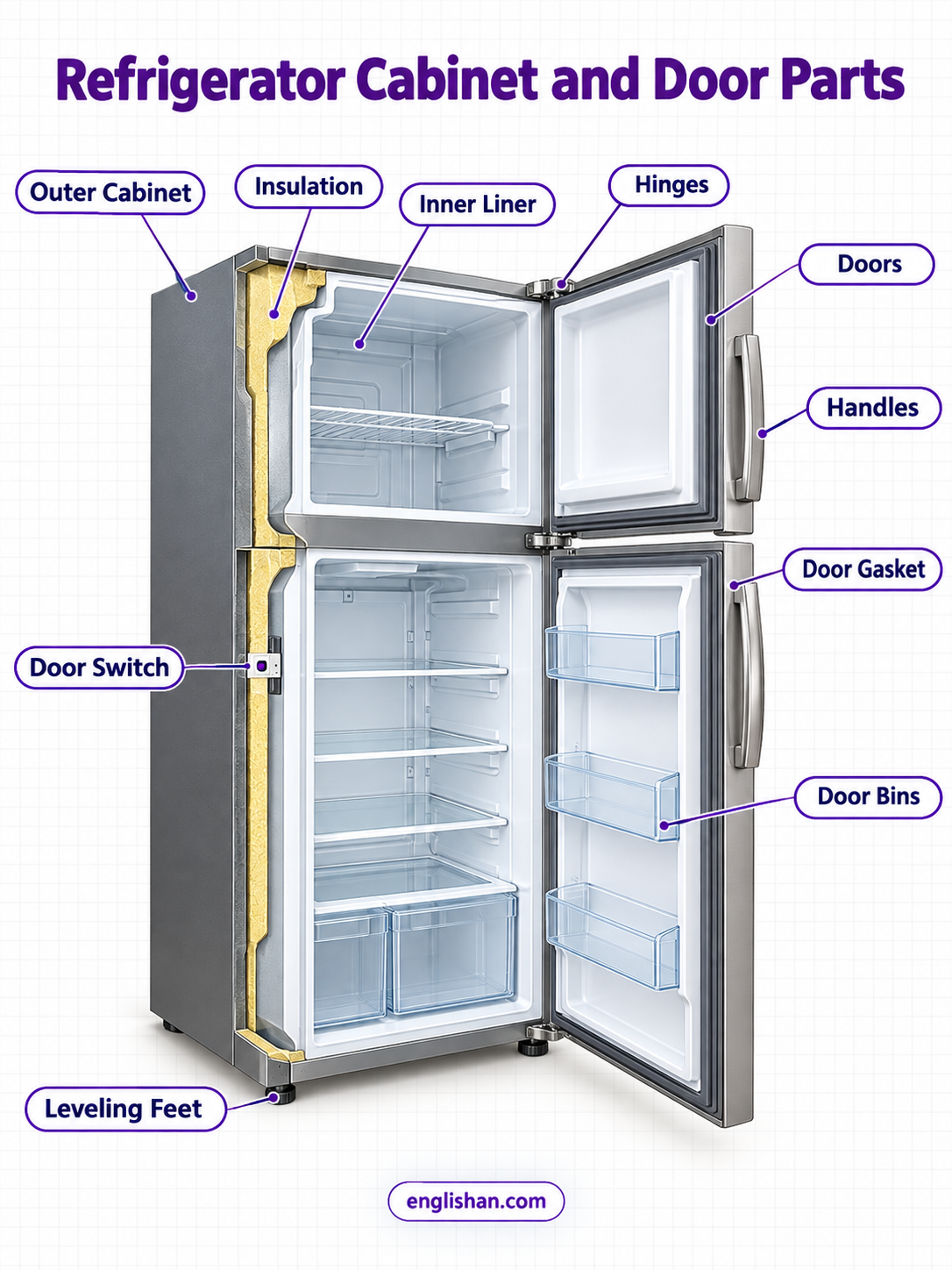
Ten of the parts of a refrigerator form its shell: the cabinet, the doors, and the hardware that hangs and seals them. A top-freezer model measures about 28 to 33 inches wide.
Outer Cabinet
The outer cabinet is a box of painted or coated sheet steel that forms the sides, top, and back. Stainless models add a thin stainless skin over the front and doors. A steel back panel provides the mounts for the cooling parts.
Inner Liner
Molded from ABS or high-impact polystyrene plastic, the inner liner is the white or transparent shell that lines both compartments. Ribs molded into its side walls form the supports for shelves and drawers. Its smooth surface resists stains and wipes off easily.
Insulation
Polyurethane foam fills the walls between the cabinet and the liner, about 2 inches thick on a full-size unit. Once the foam cures, it bonds the two shells into one rigid box. The doors are filled with the same foam.
Doors
Doors are the parts of a refrigerator that change most by model type. Each is a hollow panel of steel or glass-and-steel, filled with foam and finished to match the cabinet. A top-freezer model has two doors, one per compartment. A side-by-side model has two tall doors, and a French-door model has two upper doors over a freezer drawer.
Door Gasket
A flexible vinyl strip with a hollow, pleated profile runs around the inside edge of each door. That strip is the door gasket, and a magnetic strip is embedded in it. The magnet pulls the gasket against the steel cabinet frame.
Hinges
Metal hinge brackets bolt each door to the cabinet at its top and bottom corners. A steel pin in the bottom hinge bears the door’s weight. Cam surfaces in the hinge raise the door slightly as it opens, so it swings shut on its own.
Handles
Handles are metal or plastic bars bolted to the door front, in stainless, black, white, or panel-matched finishes. Handle-free models use a recessed grip cut into the door edge instead. Screws under the end caps fasten each bar.
Door Bins
Door bins are molded plastic shelves that snap or clip into rails on the inside of the door. Deep bins are sized for gallon jugs, and shallow ones fit jars and condiment bottles. Each bin lifts out of its rails for washing.
Door Switch
The door switch is a small plunger or magnetic switch fitted in the cabinet frame beside the door opening. It turns the interior light on when the door opens and off when the door closes.
Leveling Feet
Two adjustable screw feet are fitted under the front corners of the cabinet, with small rollers at the rear. Turning a foot raises or lowers that corner, which tilts the cabinet slightly backward so the doors swing shut.
Fresh Food Compartment Parts
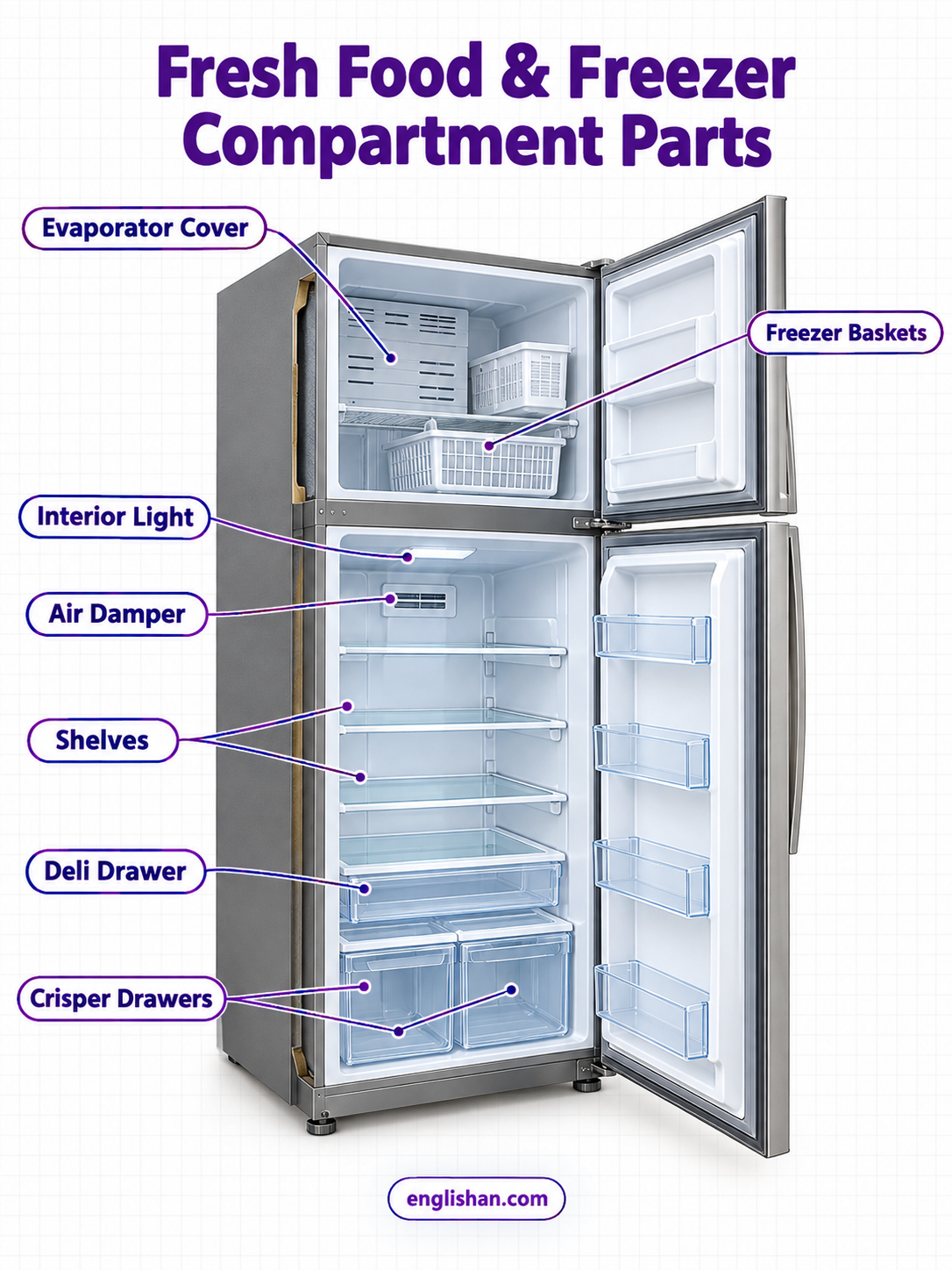
The fresh food compartment is the larger of the two compartments in most models. Five of the parts of a refrigerator are fitted inside it.
Shelves
Shelves are tempered glass panels in plastic frames, or wire racks, that rest on the ribs of the inner liner. Spillproof glass shelves have a raised rim around the edge. Most shelves slide out and reposition to different heights.
Crisper Drawers
Two transparent plastic bins slide on rails at the bottom of the compartment, under the lowest shelf. These crisper drawers each have a slider on the front. The slider opens or closes a small air vent, which sets the humidity level.
Deli Drawer
On models that have one, a shallow full-width drawer called the deli drawer runs across the bottom or the middle of the compartment. It is sized for meat and cheese, and some versions have their own temperature slider.
Interior Light
Interior lights are LED strips or bulbs behind translucent plastic lens covers, mounted at the top and along the side walls. Older models use a 40-watt appliance bulb in a socket at the top of the compartment.
Air Damper
An air damper is a plastic flap in the duct that links the freezer and the fresh food compartment. Cold air from the freezer enters the compartment through it. Electronic models use a motorized damper, and older ones use a thermostat-driven flap.
Freezer Compartment Parts
The freezer compartment has two of the parts of a refrigerator that a user handles, the baskets. It has one that stays out of sight, the evaporator cover.
Freezer Baskets
Wire or plastic baskets slide on rails inside the freezer. A top-freezer has a wire shelf and one or two baskets, while a bottom-freezer has a pull-out drawer basket on full-extension slides. Wire dividers separate the packages by type.
Evaporator Cover
The evaporator cover is a removable plastic panel across the back wall of the freezer, held by screws or clips. Slotted openings let air pass through it, and removing it exposes the evaporator coils and the fan behind.
Evaporator and Defrost Parts
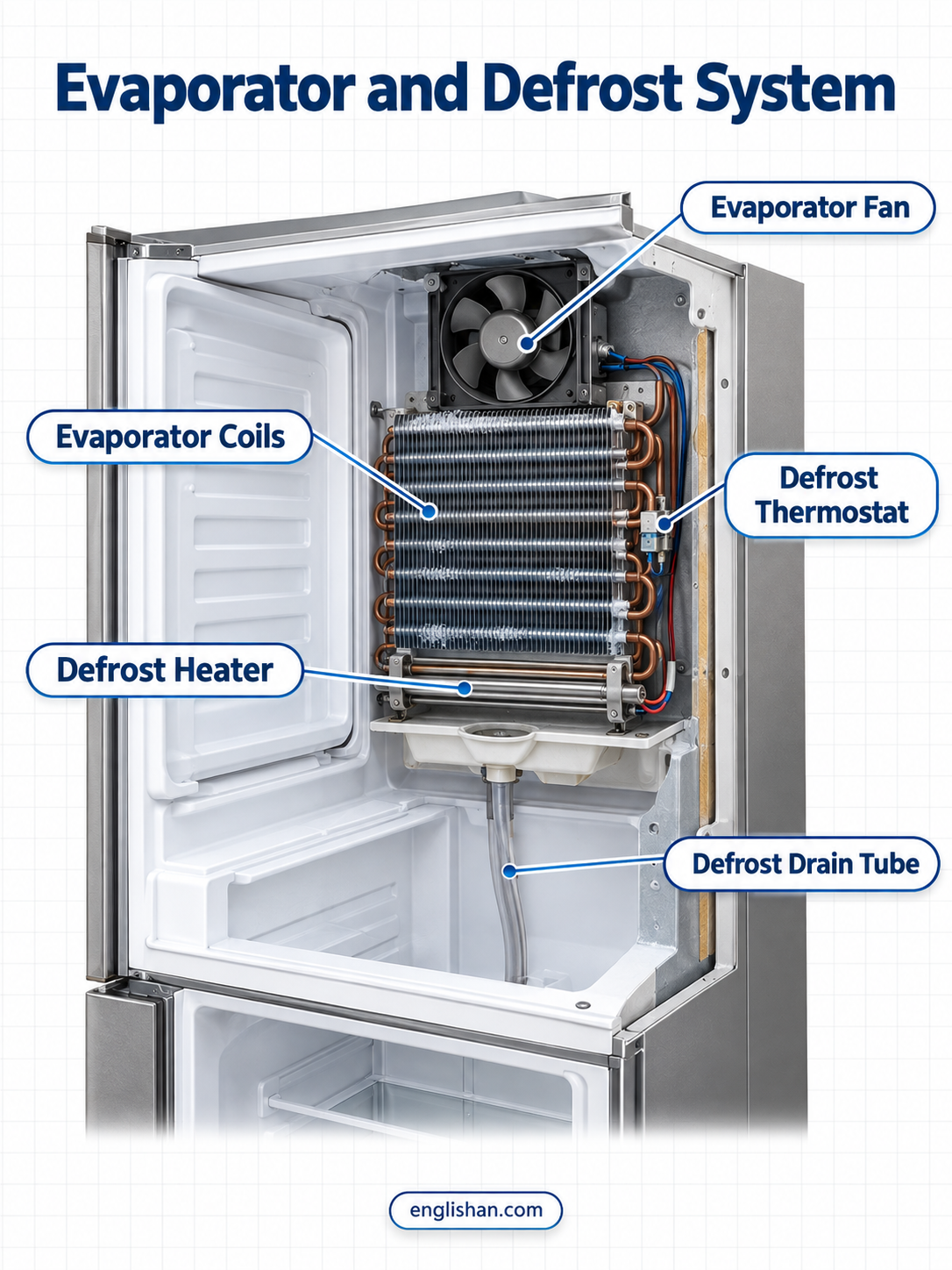
Behind the freezer’s back wall, five of the parts of a refrigerator fill a narrow cavity. None is visible until the evaporator cover comes off.
Evaporator Coils
The evaporator coils are aluminum or copper tubing snaked through thin aluminum fins. They are mounted on the freezer’s back wall, directly behind the evaporator cover. Frost builds on the fins over time, which is why a heater is mounted beside the coils.
Evaporator Fan
A small motor with a plastic blade, the evaporator fan, is fastened behind the cover next to the coils. A rubber grommet cushions the motor mount, and ice on the blade is the common cause of a scraping noise from the freezer.
Defrost Heater
The defrost heater is a glass or metal tube, bent into a hairpin or a straight rod, clipped under or across the evaporator coils. Its two wire leads plug into the wiring harness, and it draws several hundred watts when energized.
Defrost Thermostat
The defrost thermostat is a small metal disc in a plastic housing, clipped directly to the evaporator tubing, with two wire leads. It is a bimetal switch, which means two joined metals bend as the coil temperature changes.
Defrost Drain Tube
A plastic or rubber tube runs from a trough under the evaporator down the back wall of the cabinet. That tube is the defrost drain tube, and it ends over the drain pan under the cabinet.
Refrigerator Cooling System Parts
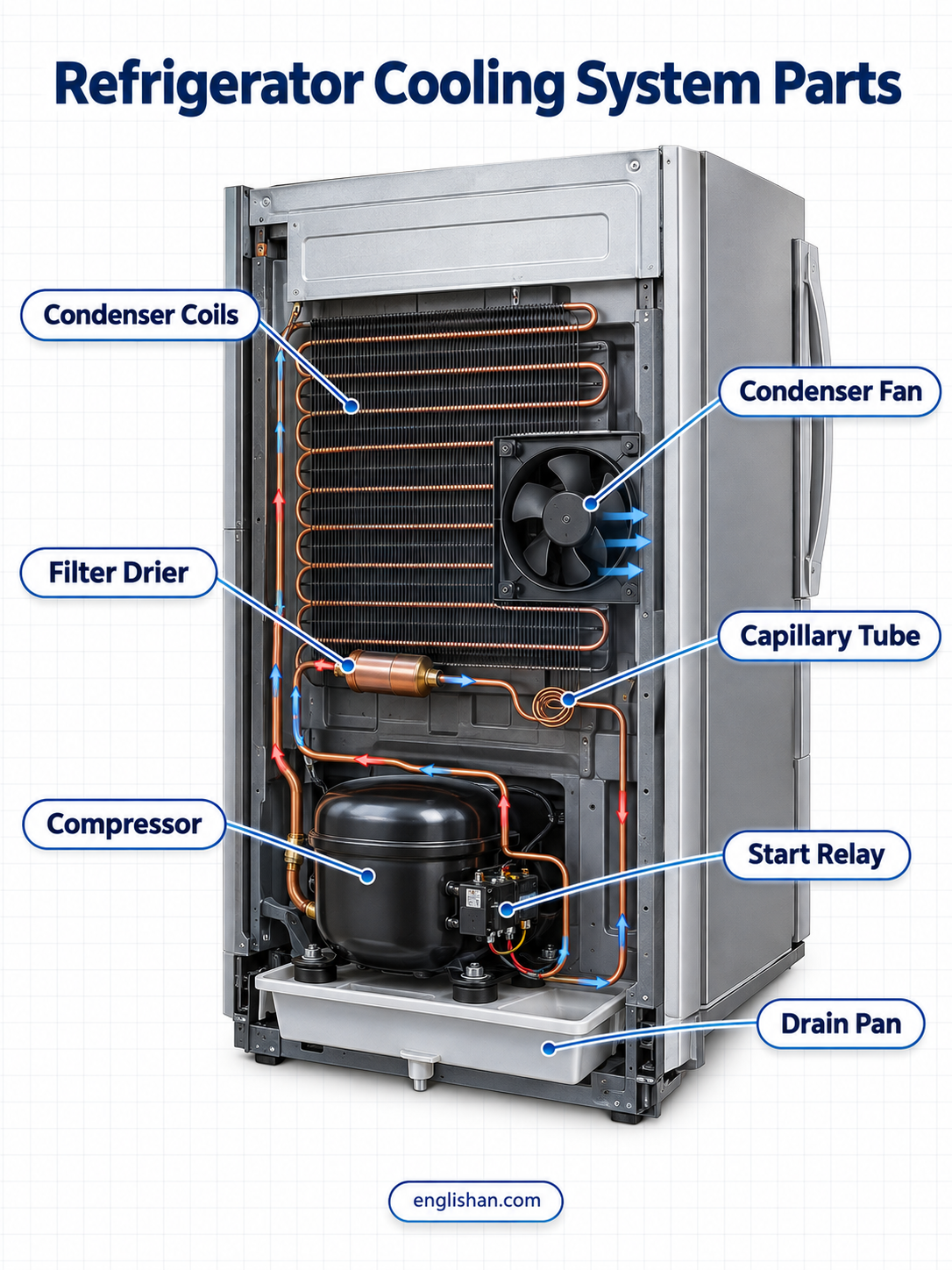
Most cooling system parts of a refrigerator are mounted at the bottom rear of the cabinet, behind a removable access panel. Seven parts belong to this group, and one of them, the capillary tube, runs up to the freezer.
Compressor
At the bottom rear, bolted on rubber mounts, the compressor is a black steel dome about 8 inches tall. Two or three copper tubes are brazed into its shell, and a cluster of wiring terminals is on its side. It is the heaviest single part in the cabinet.
Start Relay
The start relay is a small plastic box that plugs directly onto the compressor’s terminal pins. An overload protector, a flat black disc, clips beside it on the compressor shell. Both are wired into the compressor’s power leads.
Condenser Coils
Of all the parts of a refrigerator, the condenser coils collect the most dust. They are tubing of steel or copper, bent into a flat grid or a serpentine shape. Older models mount them on the back panel, and current models mount them under the cabinet behind the front grille.
Condenser Fan
The condenser fan is a small motor with a four- or five-inch plastic blade, fastened beside the compressor at the bottom rear. Mounting brackets place it in the air path over the coils and compressor, and a shroud surrounds the blade.
Filter Drier
A short copper or brass cylinder about 4 inches long, the filter drier, joins two lengths of the refrigerant line. It is fitted between the condenser and the capillary tube. Desiccant beads inside it absorb moisture.
Capillary Tube
The capillary tube is a thin coiled copper tube, under a tenth of an inch across, that joins the filter drier to the evaporator. It is the expansion device in most household models. Part of its length is soldered alongside the suction line.
Drain Pan
A shallow plastic pan, the drain pan, is fitted under the cabinet near the compressor. It catches the water from the defrost drain tube, and warmth from the compressor evaporates it.
Refrigerator Control Parts
Four of the parts of a refrigerator make up the electronics, and each is small next to the parts around it.
Temperature Control
Near the top of the fresh food compartment, the temperature control is a dial or slider marked from 1 to 9. Digital models replace it with a keypad and a readout.
Control Board
The control board is a green circuit board in a plastic housing. It is mounted behind a rear panel at the top of the cabinet or near the compressor. Ribbon connectors link it to the sensors, fans, defrost heater, and compressor relay.
Thermistor
A thermistor is a small sensor, a bead or short cylinder with two thin wires, clipped to the wall of the fresh food compartment. A second one is fixed to the evaporator. The wires run back to the control board.
Display Panel
On the door front or the inside wall, the display panel is a set of buttons with LED indicators or a temperature readout. Premium models use a touchscreen set into the door. Its ribbon cable runs through the door hinge to the control board.
Ice Maker and Water Dispenser Parts
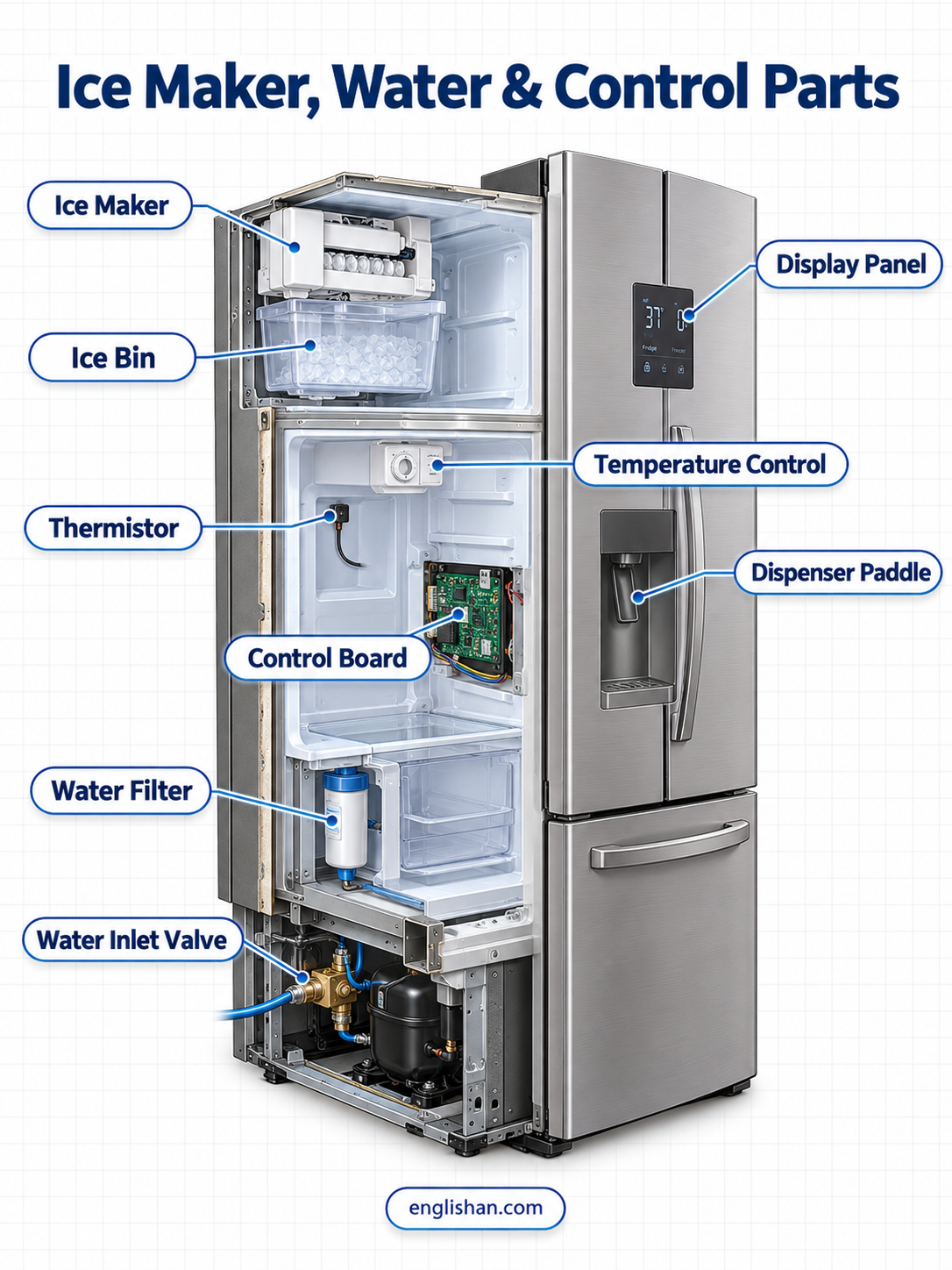
Models with an ice maker or a dispenser add five more parts of a refrigerator, spread from the freezer to the door front.
Ice Maker
Mounted at the top of the freezer, the ice maker is a plastic or metal unit. It has a mold tray, an ejector arm, and a small heater. Bottom-freezer models mount it inside the fresh food door or on the upper wall of that compartment.
Ice Bin
The ice bin is a removable plastic tub directly under the ice maker. On dispenser models, a motor-driven auger inside the tub moves ice toward the chute in the door.
Water Inlet Valve
A small plastic valve with a brass fitting, bolted to the bottom rear of the cabinet, forms the water inlet valve. A quarter-inch copper or plastic line connects it to the household water supply. Two or three electric coils control its outlets.
Water Filter
The water filter is a twist-in cartridge about 6 inches long. It is fitted in the upper corner of the fresh food compartment, in the base grille, or inside a door. Manufacturers call for a replacement about every six months.
Dispenser Paddle
The dispenser paddle is a lever or pad set in a recess in the door front. Behind the recess are the ice chute and a small light, and a drip tray at the bottom of the recess catches spills.
FAQs
Q1. What are the parts of a refrigerator and their functions?
The doors and gaskets close the two compartments, and the shelves and drawers store food. The compressor pumps refrigerant, the condenser coils release heat, and the evaporator coils absorb it. A thermostat or control board reads the temperature and switches the compressor on and off.
Q2. What are the two parts of a refrigerator called?
The two parts of a refrigerator are the fresh food compartment and the freezer. The fresh food compartment has shelves, drawers, and door bins, and the freezer has baskets and, on models with a dispenser, an ice maker.
Q3. What are the main parts of a refrigerator?
The main parts of a refrigerator are the compressor, the condenser coils, the expansion device, and the evaporator coils. Together they form the sealed cooling system, and the cabinet, doors, gaskets, and control board complete the working set.
Q4. What are the parts of a refrigerator cooling system?
The cooling system has a compressor, condenser coils, a condenser fan, a filter drier, a capillary tube, and evaporator coils with their fan. The start relay and overload protector switch the compressor, and a drain pan collects defrost water.
Q5. What are the internal parts of a refrigerator?
Inside the cabinet are the shelves, crisper drawers, deli drawer, door bins, interior light, air damper, and freezer baskets. Behind the freezer wall are the evaporator coils, the evaporator fan, and the defrost heater.
Q6. What are the parts on the back of a refrigerator?
At the back of a refrigerator are the compressor, the condenser fan, the start relay, and the water inlet valve. Older models show the condenser coils on the back panel, and the power cord and water line also connect there.
Q7. What are the parts of a refrigerator door?
A refrigerator door has an outer steel or glass panel, foam insulation, a gasket, hinges, a handle, and door bins. Dispenser doors add a paddle, an ice chute, and a display panel.
You May Also Like
