

A bridge is a flat road surface held over a gap by long beams running underneath it. Those beams rest on tall columns in the middle of the crossing and on solid blocks at each bank. The blocks themselves are founded on piles or footings driven deep into the ground.
Every part of it moves weight downward. A truck rolling onto the deck presses its load into the beams, and each part of a bridge beneath passes that load on until the ground receives it.
Parts of a Bridge Labeled
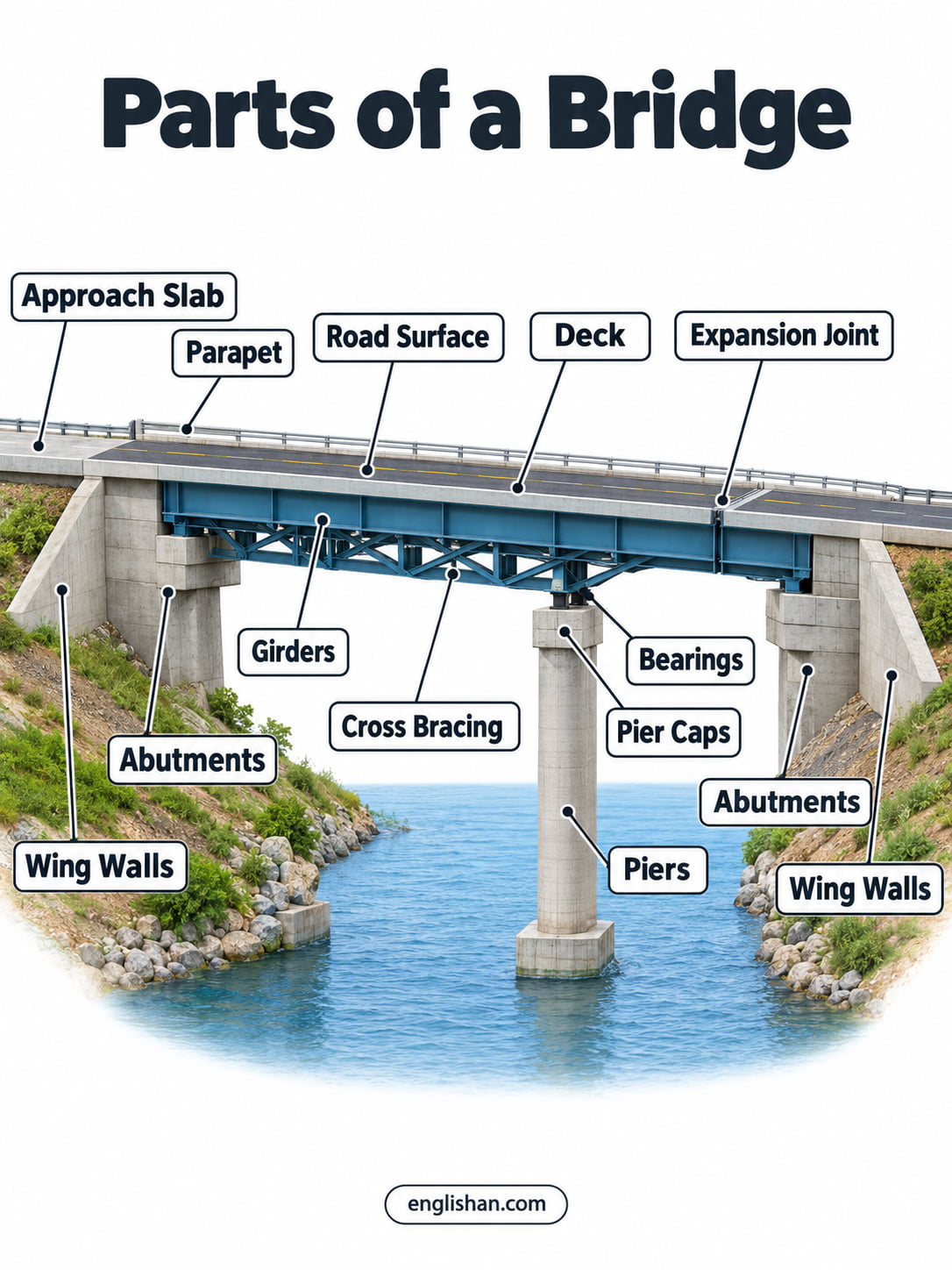
A bridge divides at the bearings into two halves with separate names. Above them, the superstructure crosses the opening: the deck, the beams, and the railings. Below them, the substructure reaches from the piers and abutments down into the foundations. Bearings are fitted at that join and pass the weight from the deck into the pier.
| Part | Where you find it |
|---|---|
| 1. Deck | The surface traffic drives on |
| 2. Girders | Long beams under the deck |
| 3. Cross bracing | Struts tying the girders together |
| 4. Expansion joint | Gap across the deck at each end |
| 5. Parapet | Solid wall along the deck edge |
| 6. Railing | Barrier above or instead of a parapet |
| 7. Drainage scupper | Hole draining water off the deck |
| 8. Bearing | Pad between deck and support |
| 9. Pier | Tall support at mid-span |
| 10. Pier cap | Beam across the top of a pier |
| 11. Abutment | End support at each bank |
| 12. Wing wall | Wall keeping back the earth beside it |
| 13. Backwall | Face of the abutment behind the deck |
| 14. Approach slab | Short slab joining road to bridge |
| 15. Pile | Column driven deep into the ground |
| 16. Pile cap | Slab tying a group of piles together |
| 17. Footing | Wide concrete base under a pier |
| 18. Span | Gap between one pier and the next |
| 19. Arch ring | Curved band of an arch bridge |
| 20. Keystone | Wedge at the top of an arch |
| 21. Spandrel | Wall between the arch and the deck |
| 22. Pylon | Tower on a cable bridge |
| 23. Main cable | Heavy cable slung between pylons |
| 24. Suspender | Vertical rope from cable to deck |
| 25. Stay cable | Straight cable from pylon to deck |
Parts of a Bridge Deck
The deck is the part you see and drive on. Everything in this group is at road level or a little below it.
Deck
The deck carries the traffic on a flat surface, built as a concrete slab with a layer of asphalt on top for grip. On a railway bridge it carries the track instead, and on a footbridge a walkway.
Road Surface
A layer of asphalt is laid over the concrete deck as the road surface. It wears out faster than the bridge under it, so crews strip and relay it every few years. A waterproof sheet is spread under that asphalt to keep water off the concrete.
Parapet
A parapet walls in each edge of the deck, stopping a vehicle from leaving the bridge and shielding anyone crossing on foot. Concrete parapets on a motorway bridge are shaped so a car rides up the slope and drops back into its lane.
Railing
Metal railings guard the deck edge, on their own or on top of a parapet. Footbridges carry a tall railing with narrow gaps so a child cannot slip through. The gaps also let wind through, and that counts on a long span.
Drainage Scupper
A scupper drains rainwater through a hole in the deck. Rain left standing there freezes in winter and soaks into the concrete. Each scupper is covered by a grate and drained by a pipe, and leaves choke both.
Expansion Joint
An expansion joint leaves a gap where the deck meets the road at each end. Concrete and steel grow in heat and shrink in cold, and the joint absorbs that movement. A metal comb or a rubber seal bridges the gap, and the bump you feel driving onto a bridge is this joint.
Approach Slab
The approach slab bridges the short stretch between the road and the bridge itself. Soil behind an abutment settles over time, while the bridge does not, so the slab bridges that small step. Without one, a dip forms at each end of the bridge within a few years.
Parts That Span the Gap
These parts of a bridge cross the opening itself, in beams and frames. On most bridges they hide under the deck and show only from a boat or a riverbank.
Girders
Girders reach under the deck as long beams, from one pier to the next. Steel I-beams and concrete box beams are the two common kinds. They bend a little under a heavy load and spring back once it passes, and that small flex is designed in rather than a fault.
Cross Bracing
Cross bracing ties one girder to the next with short struts. Without it a tall thin beam twists sideways under load. The braces also spread a heavy wheel load across several girders instead of leaving one to bear it alone.
Truss
A truss frames straight steel members into a row of triangles, and a triangle holds its shape under load in a way that no other shape does. That stiffness is what lets a truss reach further than a plain beam. Some trusses are slung under the deck and some rise on both sides, with traffic passing through the middle.
Arch Ring
The arch ring curves under an arch bridge in a band of stone, brick, or concrete. Weight on the arch pushes outward as well as down, so the ends need solid rock or heavy abutments to push against. The wedge-shaped stones in the ring are voussoirs, and the one at the very top is the keystone.
Spandrel
A spandrel fills the space between the curve of the arch and the flat deck above. Solid spandrels are packed with rubble behind them, while open ones are carried on small columns to save weight. Cracks here are the first sign that an old arch is moving.
Parts of a Bridge Substructure
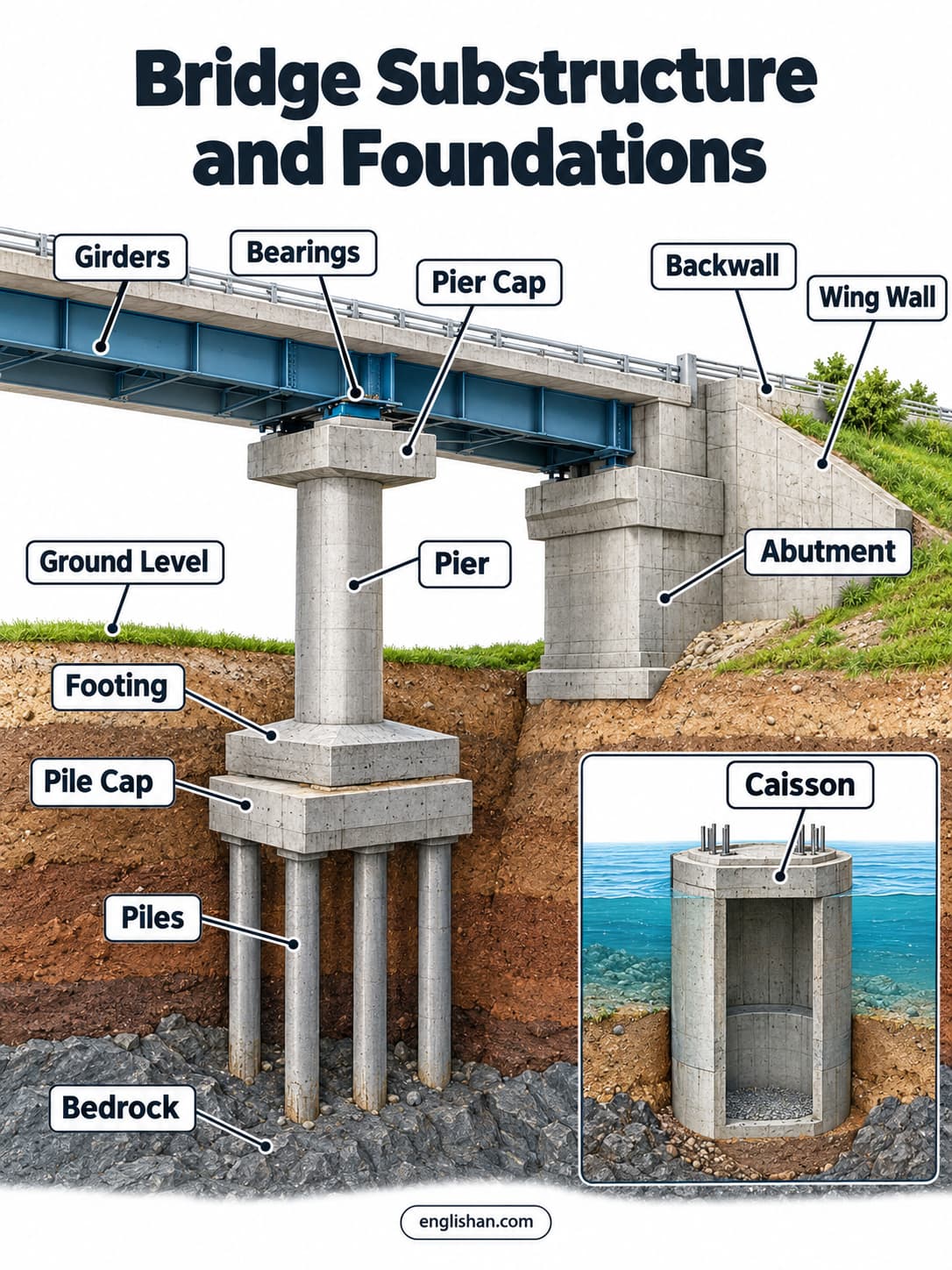
Below the deck, the weight gathers into a few places. Each part in this group passes it to fewer and fewer places, until the ground receives it.
Bearing
A bearing pad is set between the end of a girder and the pier below. It passes the weight down, and it lets the deck slide and tilt a few millimetres as the temperature changes. Rubber pads do this on small bridges, and steel and rubber assemblies on large ones.
Pier
Piers rise between the two ends of a bridge, out of the river or the valley floor. A pier is one thick column, a row of columns, or a solid wall. Piers in a river are built with a pointed nose upstream, so water and ice slip past instead of piling up.
Pier Cap
The pier cap tops each pier with a wide beam, known also as a headstock. Girders land on it through their bearings, and its width seats every one of them while passing their weight into the column below.
Abutment
An abutment ends the bridge at each bank, where the deck meets solid ground. It receives the end of the deck on its front face and holds back the earth of the road embankment on its back. Loaded from two directions at once, most abutments are built as thick concrete walls.
Wing Wall
Wing walls angle back from an abutment, one on each side, and they stop the earth of the embankment spilling out sideways. On a bridge over a river it also steers the water past the bank without washing it away.
Backwall
The backwall is the upper face of an abutment, right behind the ends of the girders. Soil presses against one side of it and the deck rests against the other. A leaking expansion joint drops water straight down this face, and abutments are wet and stained for that reason.
Foundations of a Bridge
None of the parts of a bridge above stay up if the ground beneath settles. These parts reach down to soil or rock strong enough for the load.
Footing
A footing spreads a wide slab of concrete under a pier or abutment. Spreading the load across a wider patch of ground stops the pier sinking. Shallow footings suit ground that is firm near the surface.
Pile
Piles are long columns driven or bored deep into the ground. Piles are driven where the soft ground near the surface cannot bear the weight. Some grip the soil along their whole length, and others drive down until they rest on rock.
Pile Cap
The pile cap is poured across the tops of a group of piles as a thick concrete slab. It ties the piles together and shares the load between them. The pier or abutment is then built on top of that cap.
Caisson
A caisson sinks into the riverbed as a large watertight box, then fills with concrete. Workers dug out the mud inside it while air pressure kept the water back. Bridges over deep water were founded this way long before modern piling machines existed.
Parts of a Cable Bridge
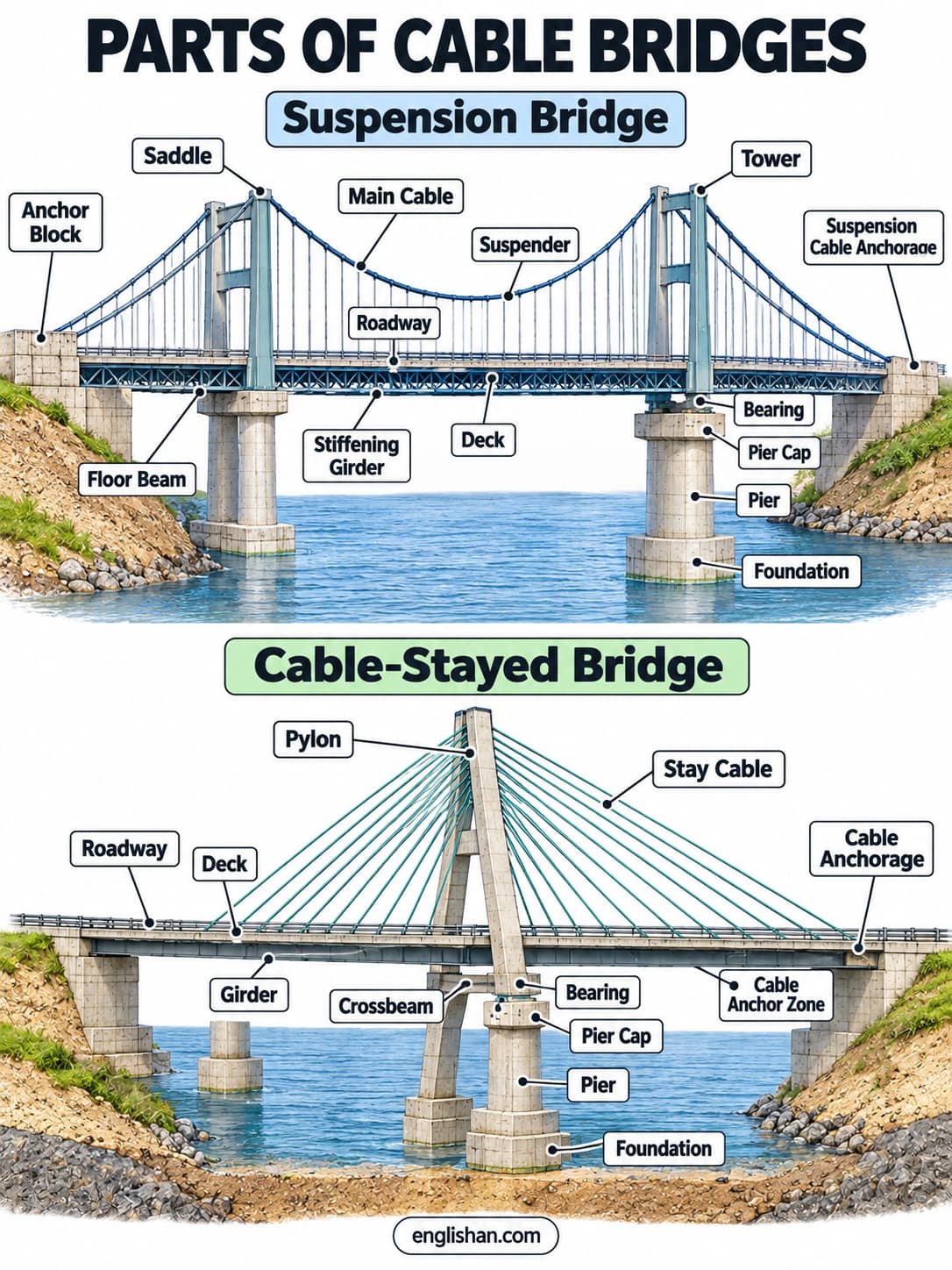
Two bridge types hang the deck instead of resting it on piers, and the parts of a bridge built this way are different again. Both need far fewer piers, which is how they cross wide water.
Pylon
Pylons are the tall towers the cables run over or from, known also as bridge towers. All the weight of the deck ends up in them and travels straight down to the foundations, which is why they rise higher than anything else on a cable bridge.
Main Cable
The main cable hangs in a curve between the pylons of a suspension bridge. It is spun on site from thousands of thin steel wires bundled together. Each end is buried in a huge concrete block called an anchorage, which stops the cable pulling the towers over.
Suspender
Suspenders drop from the main cable to the deck as vertical ropes, also called hangers. A row of them supports the deck the whole way across. Each one stretches and frays in time, and crews replace them one at a time on an old suspension bridge.
Stay Cable
Stay cables run straight from a pylon down to the deck, with no main cable above them. Bridges built this way are cable-stayed, and the cables fan out or hang parallel from the tower. This design suits medium spans, where a full suspension bridge would cost more than it needs to.
FAQs
Q1. What are the parts of a bridge called?
The parts of a bridge begin with the deck that traffic crosses and the girders beneath it. Bearings, piers, and abutments then carry that weight down to the foundations. Foundations of piles or footings lie below the whole thing. Parapets and railings guard the deck edges, and expansion joints close the gaps at each end.
Q2. What are the main parts of a bridge?
The main parts of a bridge are the superstructure and the substructure. The superstructure is the deck and the beams crossing the gap. The substructure is the piers, the abutments, and the foundations under them, and bearings join the two halves.
Q3. What is the part of a bridge at each end called?
The part at each end of a bridge is the abutment. It receives the end of the deck and holds back the earth of the road behind it. Wing walls run back from it on both sides to keep that earth in place.
Q4. What are the parts of an arch bridge?
An arch bridge is built from an arch ring, the spandrel walls above it, and the deck on top. The wedge stones in the ring are voussoirs, and the keystone locks the very top. Abutments at each end resist the outward push of the arch.
Q5. What are the parts of a suspension bridge?
A suspension bridge is built from two pylons, a main cable curving between them, and suspenders hanging from that cable down to the deck. Anchorages at each end bury the cable ends in solid concrete, and the deck between them is stiffened so that wind cannot twist it.
Q6. What is the middle support of a bridge called?
The support between the two ends of a bridge is a pier. A long bridge carries several of them, each built on its own foundation. The wide beam across the top of one is the pier cap.
Q7. What is a bridge bearing for?
A bearing passes the weight of the deck down into the pier or abutment, and it lets the deck move a little as the temperature changes. Without it, a deck expanding in summer heat would push hard enough to crack the concrete at each end.
You May Also Like
