

A classical column divides into three parts: a base at the bottom, a shaft up the middle, and a capital at the top. Each of those divides again into mouldings and carvings with names of their own, fixed since Greek builders first cut them.
Learn those names and an architectural drawing opens up, since the five classical orders differ mainly in how they treat each part. The terms below describe the columns of Greek and Roman architecture, with the parts of a modern concrete column covered at the end.
Parts of a Column Diagram With Names
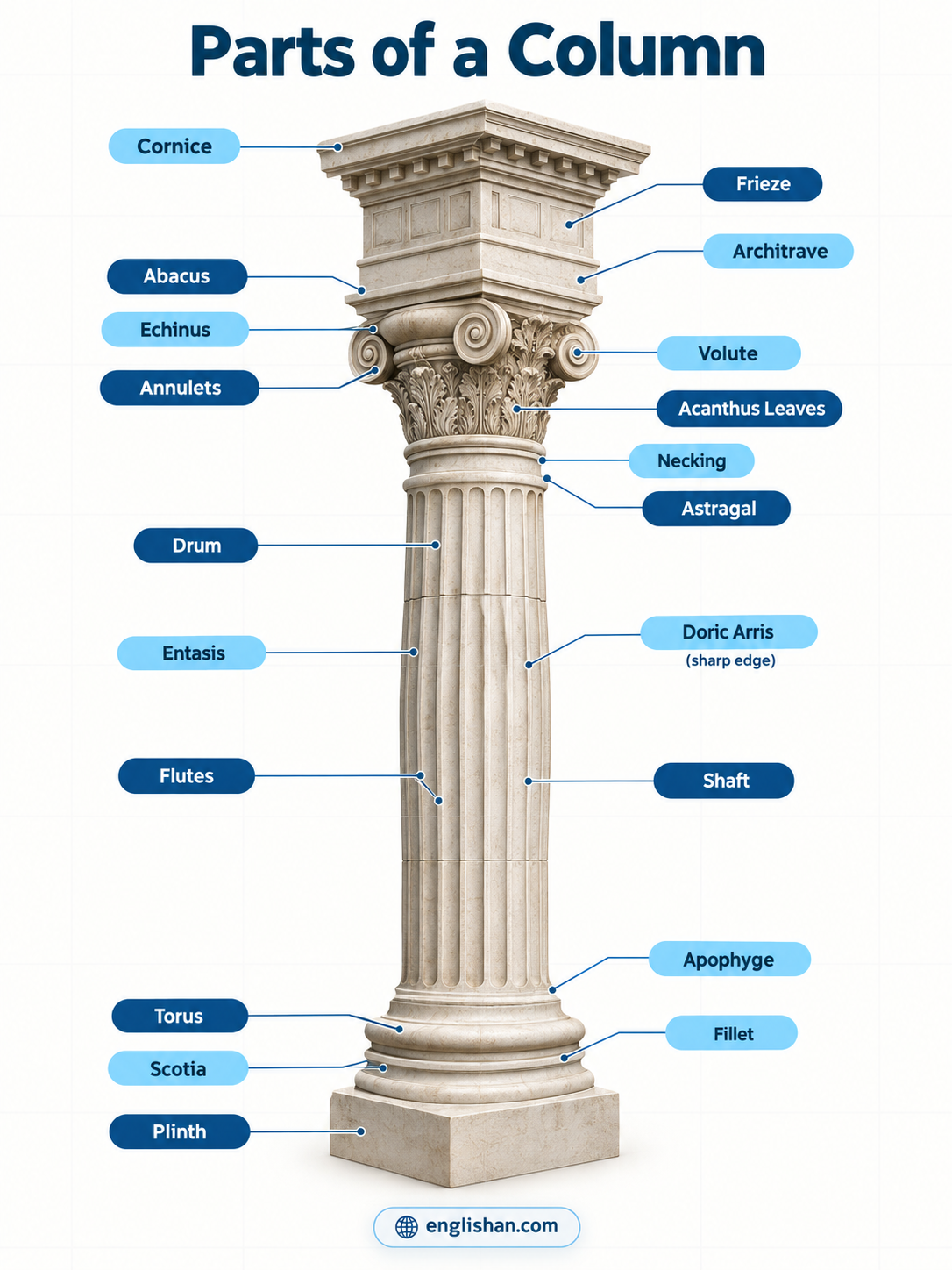
What are the parts of a column called? The three main parts are the base, the shaft, and the capital. The base spreads the load onto the floor, and the shaft rises as the tall body of the column. The capital crowns the shaft and meets whatever the column supports. A pedestal raises the whole column on some buildings, and an entablature spans the tops of several columns.
| Part | Location |
|---|---|
| 1. Plinth | Square block at the very bottom |
| 2. Torus | Rounded moulding above the plinth |
| 3. Scotia | Hollow moulding between two tori |
| 4. Fillet | Narrow flat band between mouldings |
| 5. Apophyge | Flare where the shaft meets the base |
| 6. Shaft | Tall body of the column |
| 7. Flutes | Vertical grooves down the shaft |
| 8. Arris | Sharp edge between two Doric flutes |
| 9. Entasis | Slight swelling in the shaft profile |
| 10. Drum | One stone block of a built-up shaft |
| 11. Astragal | Ring moulding at the top of the shaft |
| 12. Necking | Plain band below the capital |
| 13. Echinus | Cushion moulding under the abacus |
| 14. Annulets | Small rings under a Doric echinus |
| 15. Volute | Spiral scroll on an Ionic capital |
| 16. Acanthus leaves | Carved foliage on a Corinthian capital |
| 17. Abacus | Flat slab crowning the capital |
| 18. Architrave | Lowest band of the entablature above |
| 19. Frieze | Middle band of the entablature |
| 20. Cornice | Projecting top band of the entablature |
Parts of a Column Base
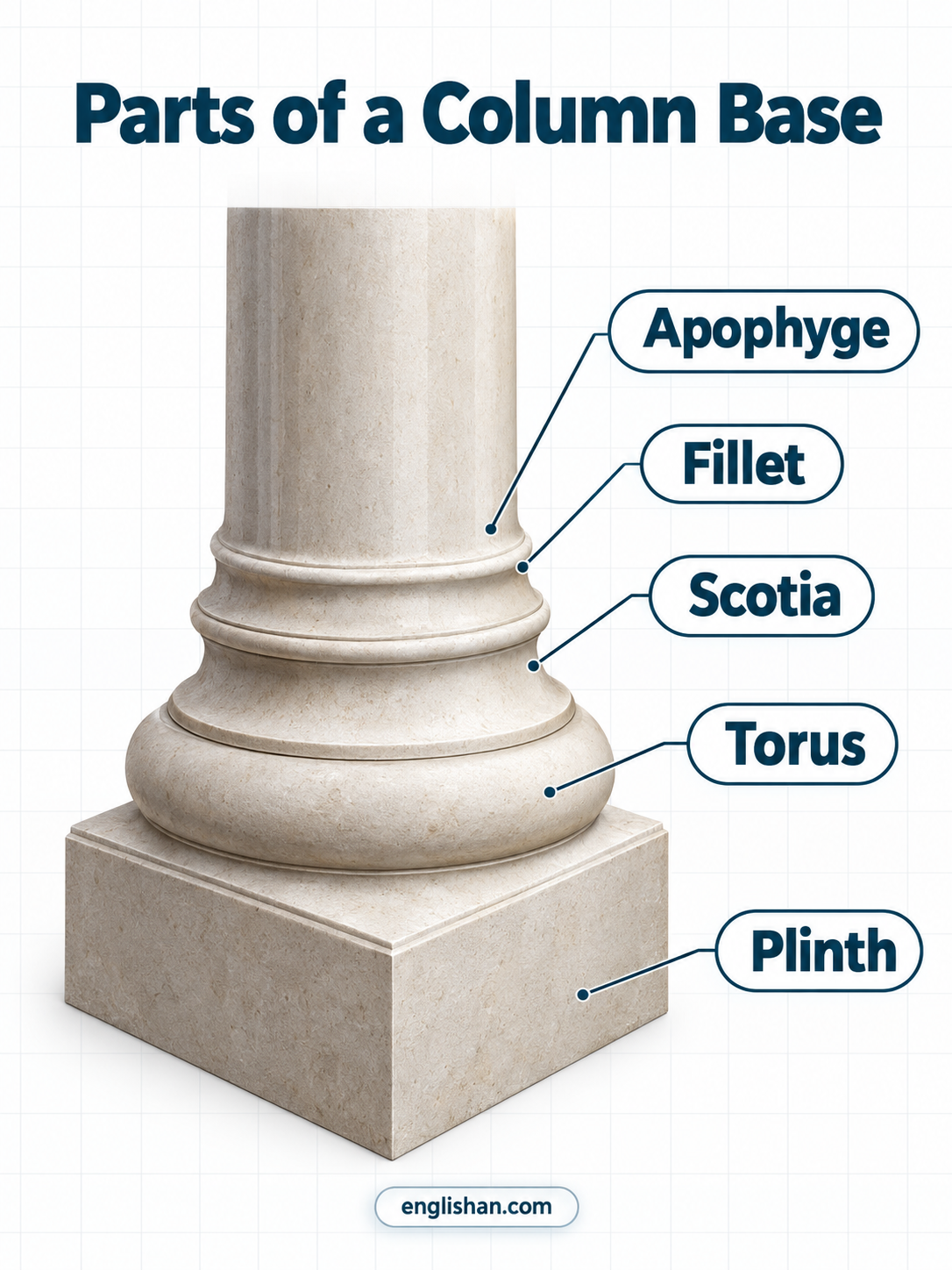
The base spreads the weight of the column across the floor below it. Greek Doric columns have no base at all and stand straight on the temple platform, while every other order has one.
Plinth
The plinth forms the plain square block at the very bottom of a column, and crossword setters mean this part when they ask for the lowest one. Its flat sides offer the round mouldings above a square footprint to stand on. Tuscan and Doric plinths stay unornamented, and Renaissance architects also drew the Tuscan plinth round.
Torus
A torus bulges outward above the plinth as a fat convex moulding. Its half-round profile pushes the eye outward at the foot of the column. An Attic base, the most widely copied of all, stacks two tori with a hollow between them.
Scotia
Between the two tori of an Attic base, the scotia cuts a deep hollow. Its hollow throws a dark shadow that separates the two rounded mouldings above and below. Greek masons hollowed the scotia deeper than Roman ones did.
Fillet
A fillet separates one curved moulding from the next as a narrow flat band. Fillets appear all through a column, above and below the scotia, at the top of the shaft, and around the capital. Each one offers the eye a stopping point between two curves.
Apophyge
The apophyge flares gently at each end of the shaft, where the straight body curves out to meet the base below or the necking above. Masons also name it the congé or the scape. Without it the shaft would end in a hard edge against the moulding beside it.
Parts of a Column Shaft
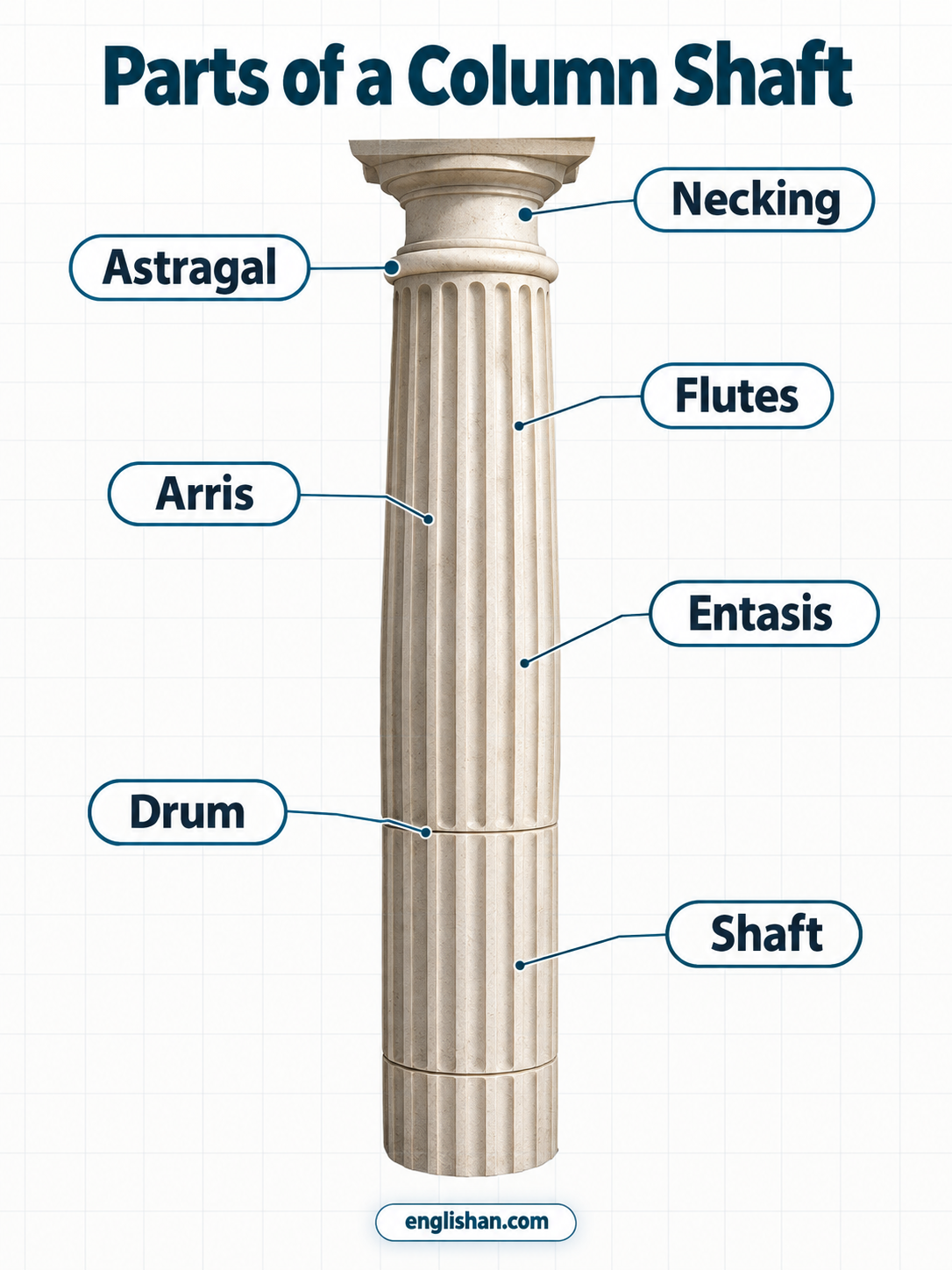
The shaft is the tall cylindrical body between base and capital, and it makes up most of the height. Its surface, its taper, and its curve all follow rules the Greeks worked out by eye.
Shaft
The shaft narrows as it rises, so its diameter at the top measures less than at the foot. Greek builders called that narrowing the diminution. It makes a tall column look upright rather than top-heavy. A shaft cut from one stone is monolithic, and the rest are built up in sections.
Flutes
Flutes run as vertical grooves down the face of the shaft. A Greek Doric shaft has 20 of them, and Ionic and Corinthian shafts have 24. Each groove catches light on one side and shadow on the other, and from a distance that pattern reads as vertical lift.
Arris and Fillet
An arris is the sharp edge where two Doric flutes meet directly, with no flat band between them. Ionic and Corinthian flutes are separated by a narrow fillet instead, which softens the surface and strengthens the stone edge. Tell the two apart by looking for that flat strip.
Entasis
Entasis swells the profile of the shaft slightly, reaching its widest about a third of the way up. A shaft with perfectly straight sides looks pinched at the middle, and the swelling corrects that illusion. The Parthenon columns bulge by only a few centimetres over their full height.
Drum
A drum makes up one cylindrical block of stone in a shaft built from several pieces. Masons stacked the drums, then turned them against each other until the joints disappeared. A metal dowel pinned through the centre of each joint held the stack in line.
Astragal
The astragal encircles the shaft below the capital as a small convex ring. Carvers regularly cut it as a row of beads and reels. On Doric columns the astragal marks where the shaft ends and the necking begins.
Necking
Between the astragal and the capital proper lies a plain band, the necking. Masons know it also as the collarino or trachelion. Greek Doric columns mark its lower edge with one to three cut grooves, together called the hypotrachelion. That plain surface offers the eye a pause before the carved capital.
Parts of a Column Capital
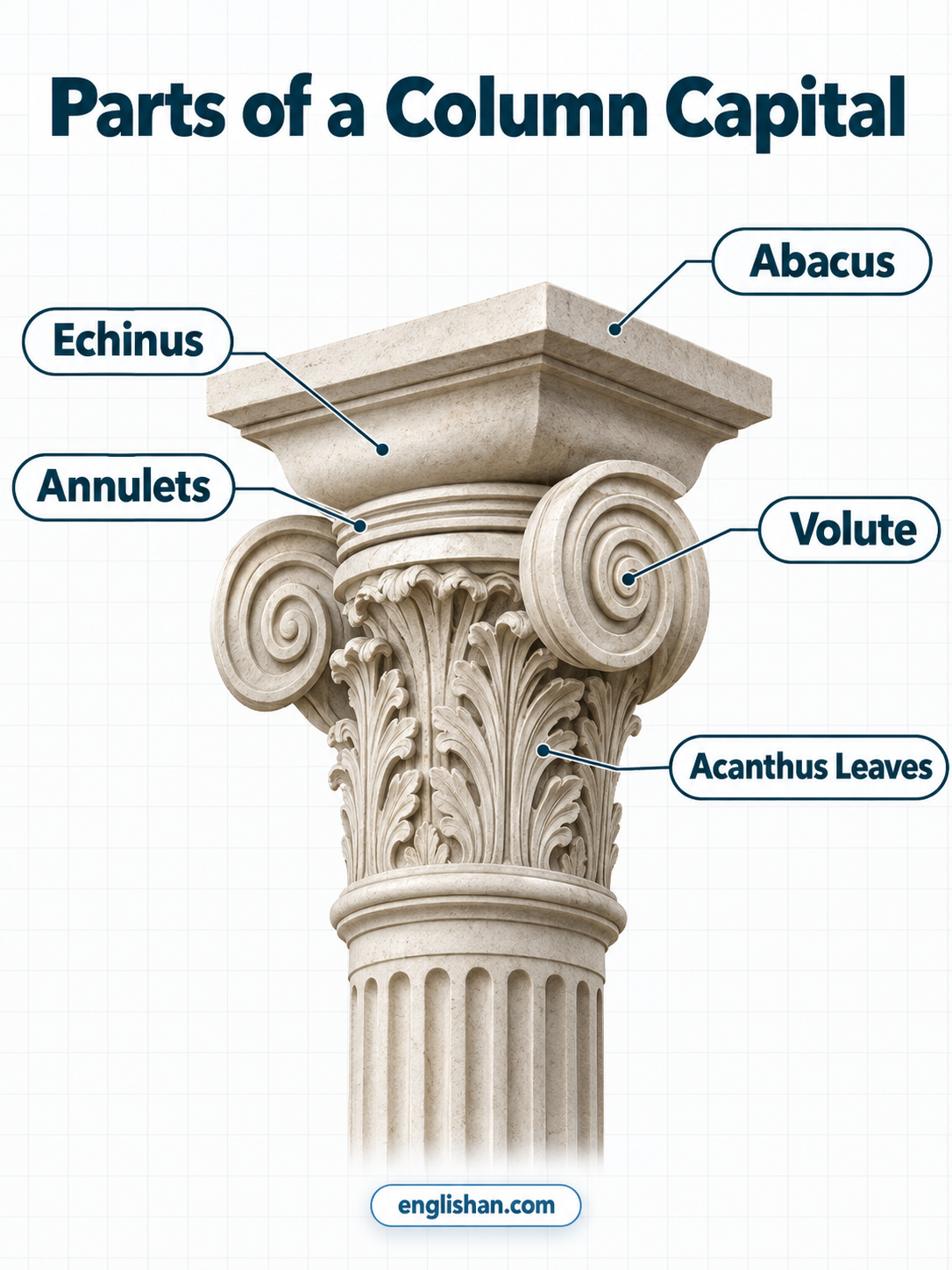
The capital crowns the shaft and widens the top of the column to meet the load above. Of the three main parts, this one changes most between the orders. Naming a column starts with reading its capital.
Abacus
The abacus caps the column as a flat slab, taking the weight of the beam above. A Doric abacus stays plain and square. An Ionic one grows thinner and carved, and a Corinthian one curves inward on all four sides, with a rosette at each corner. Its width spreads the load over more of the column than the shaft alone would.
Echinus
Directly under the abacus, the echinus swells outward as a convex cushion moulding. On Doric capitals it swells out in a broad curve with no ornament, and Ionic examples carry an egg-and-dart pattern along it. Early Greek examples flare far wider than later ones, which pulled in towards a straighter line.
Annulets
Annulets ring a Doric capital below the echinus, small and horizontal. Three to five of them are usual. They mark the join between the necking and the capital with a set of crisp shadow lines.
Volute
A volute spirals into a scroll at each side of an Ionic capital, and it identifies the order at a glance. The spiral winds inward to a small disc at its centre, called the eye. Between the two volutes runs a hollow channel, the canalis. Corner capitals turn one volute out on the diagonal so the scroll reads the same from both directions.
Acanthus Leaves
Acanthus leaves wrap a Corinthian capital in carved foliage, copied from a spiny Mediterranean plant. Two rows of eight leaves ring the bell, and the upper row stands over the gaps in the lower. Roman carvers cut those tips deep enough to stand free of the stone behind them.
Bell
Behind the leaves of a Corinthian capital hides its cone-shaped core, the bell. Its flared shape gives the leaves and scrolls a surface to climb. Strip the carving away and an inverted bell remains.
Cauliculus and Helix
Cauliculi are the short carved stalks rising from the upper row of acanthus leaves. Each one splits into a pair of small scrolls called helices. The outer helices prop the corners of the abacus, and the inner pair meets at the centre under the rosette. Both names come from Vitruvius, the Roman architect who first wrote the orders down.
Column Parts by Classical Order
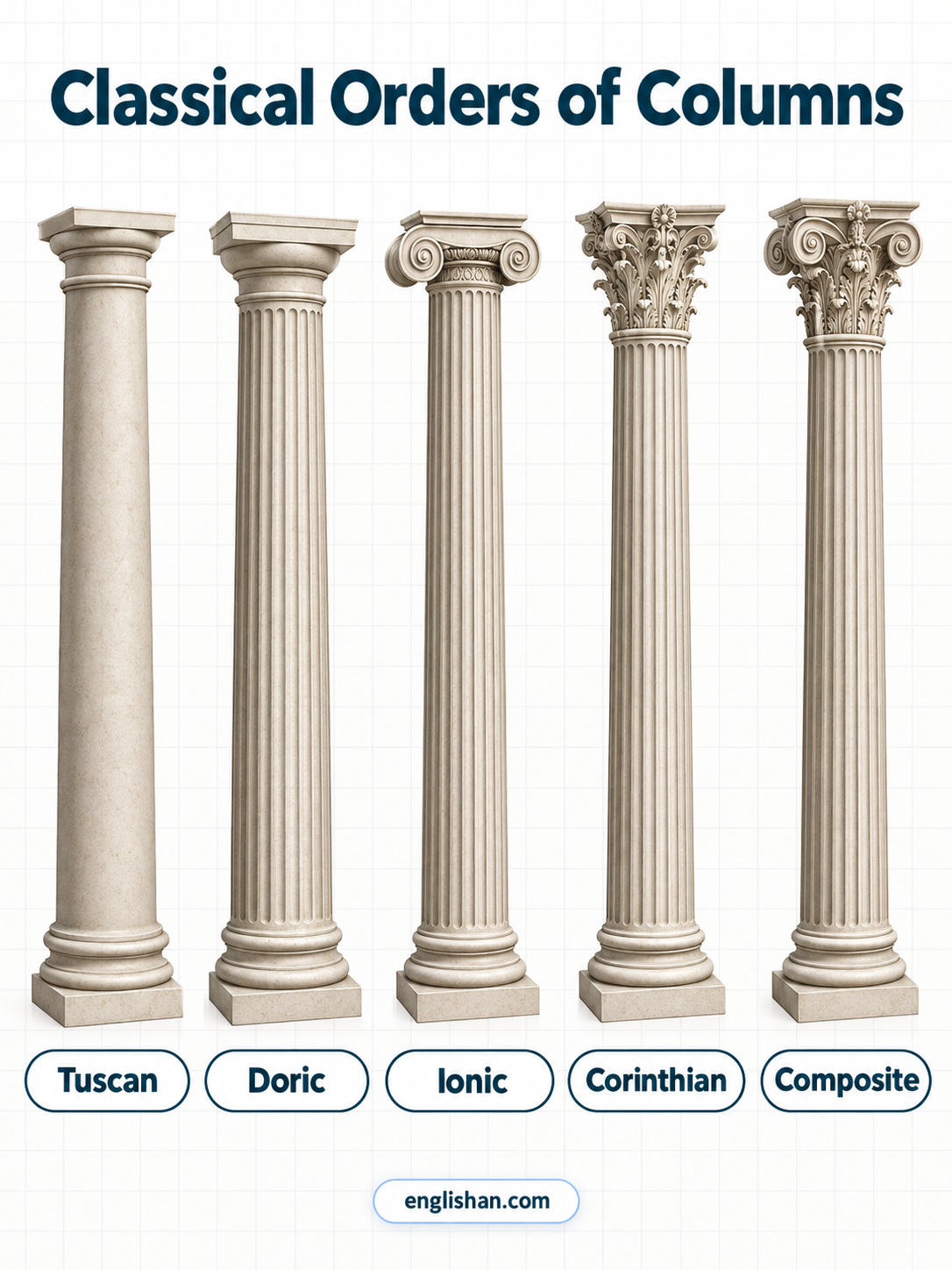
Five orders divide classical architecture, and the parts of a column change with each one.
- Tuscan: The plainest order has a smooth unfluted shaft, a round echinus under a square abacus, and a base of one torus on a plinth.
- Doric: A Greek Doric column meets the platform without any base. Its shaft has 20 flutes meeting at sharp arrises, under a capital of echinus and plain abacus. Roman Doric versions add a base.
- Ionic: The Ionic column has an Attic base and a shaft of 24 flutes divided by fillets, under the volute capital that names the order.
- Corinthian: The tallest and richest order joins the Ionic base and fluted shaft to a bell capital of acanthus leaves, cauliculi, and helices.
- Composite: Roman architects merged the two richest capitals, setting full Ionic volutes above the acanthus leaves of a Corinthian capital.
Pedestal Parts
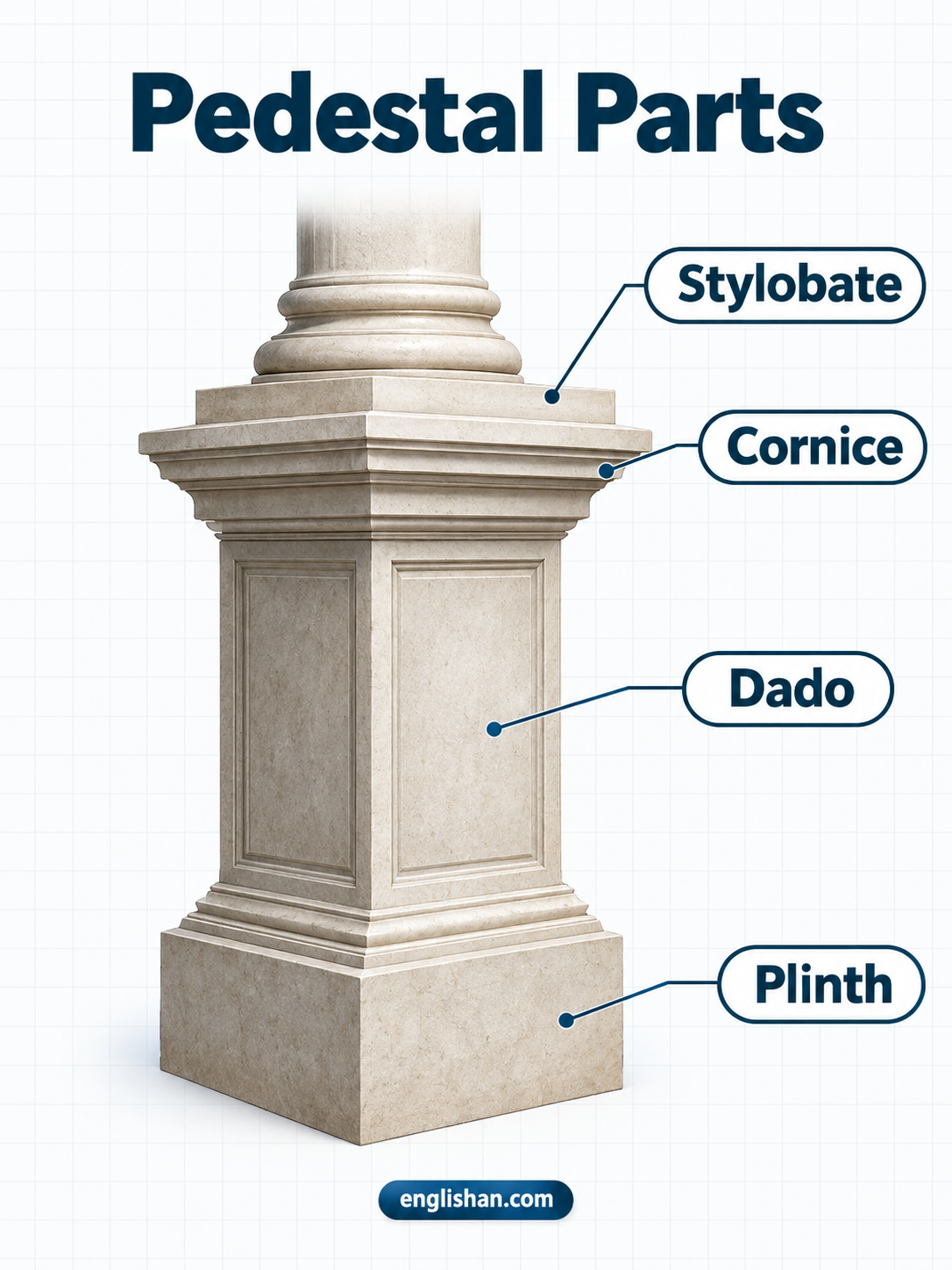
A pedestal lifts the parts of a column above floor level, and Renaissance buildings employ one far more than Greek temples did.
Pedestal Plinth
The pedestal plinth spreads out at the foot of the pedestal, wider than everything above it. It puts the whole assembly on a broad footing and lifts the mouldings above the ground.
Dado
A dado forms the plain upright body of a pedestal, known also as the die. Its faces stay flat, though carved panels appear on grander examples. Height here sets how far the column rises above the floor.
Pedestal Cornice
A moulded cap, the pedestal cornice, projects over the dado, and the column base stands directly on it. Its overhang throws rain away from the dado face outdoors.
Stylobate
The stylobate makes the top step of the platform a Greek temple occupies, and Doric columns meet it without any base between. Builders curved it upward slightly at the centre, which drained rainwater and kept the long line from looking as though it sagged.
Parts Above the Column
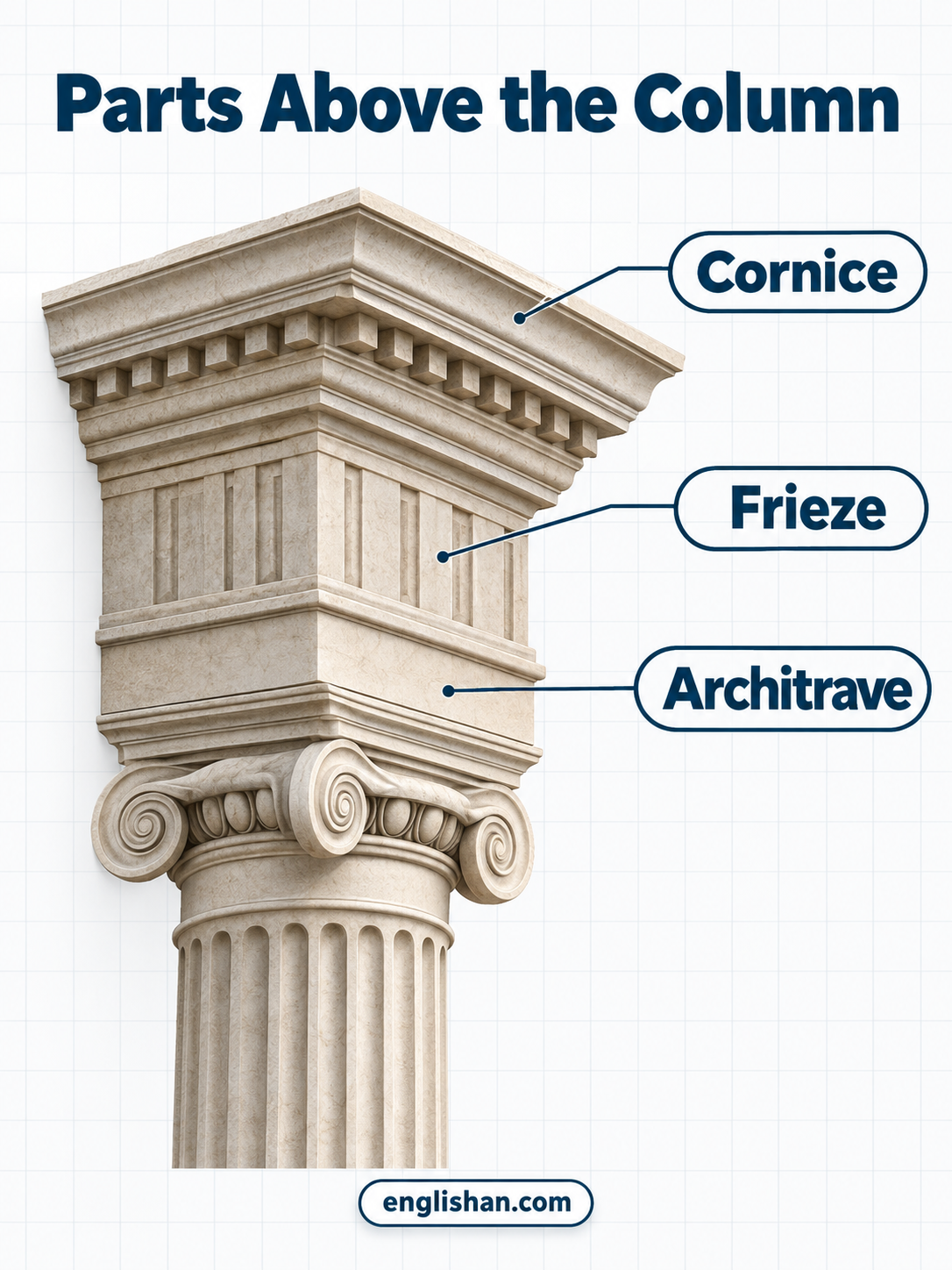
The entablature is the horizontal band a row of columns holds up. It is not one of the parts of a column, though every drawing of an order shows it alongside them, and its three bands have fixed names.
- Architrave: The lowest band spans directly from one capital to the next as the beam of the whole system.
- Frieze: The middle band takes the decoration, whether the alternating triglyphs and metopes of the Doric order or the continuous carved strip of the Ionic.
- Cornice: The top band projects forward over the frieze, throwing rainwater away from the wall below.
Parts of a Concrete Column
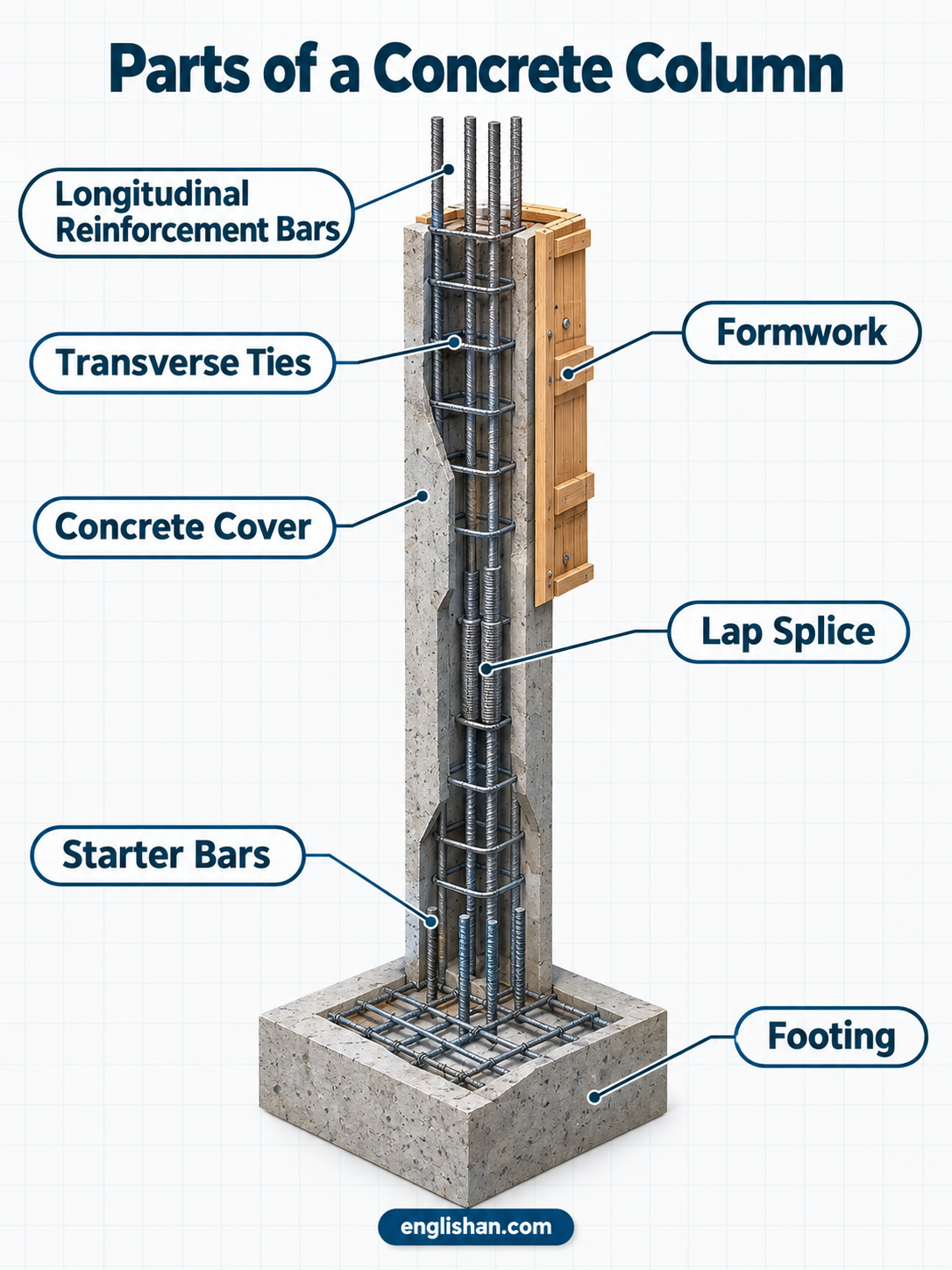
The parts of a column poured in reinforced concrete take their load the same way, though their names describe what they do rather than how they look.
- Footing: The reinforced concrete pad beneath the column spreads its load onto the soil.
- Longitudinal bars: These vertical steel bars run the full height of the column and share the compression with the concrete.
- Lateral ties: Steel hoops or spirals wrap the vertical bars at regular intervals, pinning them in position and stopping them buckling outward.
- Concrete cover: The layer of concrete outside the steel shields the bars from rust and fire, and codes fix its thickness.
- Lap splice: Where one bar ends and the next begins, the two overlap by a fixed length, which passes the load between them.
- Starter bars: Short bars cast into the footing project upward, and the column bars tie onto them.
- Formwork: The timber or steel mould holds wet concrete to the column shape until it hardens.
FAQs
Q1. What are the parts of a column called?
The parts of a column are the base at the bottom, the shaft in the middle, and the capital on top. The base holds the plinth, torus, and scotia. The shaft shows flutes, an astragal, and a necking. The capital holds the echinus and abacus, with volutes or acanthus leaves added according to the order.
Q2. What are the three main parts of a column?
The three main parts of a column are the base, the shaft, and the capital. The base spreads the weight onto the floor, and the shaft forms the tall body. The capital widens the top to meet the beam above. Greek Doric columns skip the base and stand straight on the temple platform.
Q3. What are the parts of a column capital called?
A capital is built from a necking at the bottom, an echinus above it, and a flat abacus across the top. Ionic capitals bring volutes, the spiral scrolls at each side, and Corinthian capitals bring acanthus leaves, cauliculi, and helices around a bell-shaped core.
Q4. What is the lowest part of an architectural column?
The plinth is the lowest part of an architectural column, a plain square block under the round mouldings of the base. On a column without a base, the shaft meets the stylobate directly.
Q5. What are the parts of a Greek column?
A Greek column is built from a shaft and a capital, with a base on Ionic and Corinthian examples. Doric shafts show 20 flutes meeting at sharp arrises, and Ionic and Corinthian shafts show 24 flutes divided by fillets. The capital tells the orders apart: a plain cushion for Doric, volutes for Ionic, acanthus leaves for Corinthian.
Q6. Is a pillar the same as a column?
A column is round in plan and follows the proportions of a classical order, while a pillar is any upright support of any shape. Every column is a pillar, and a square brick support is a pillar but never a column.
Q7. What are the parts of a concrete column?
A reinforced concrete column is built from longitudinal steel bars, lateral ties wrapped around them, and concrete cover outside the steel. A footing spreads its load underneath. Starter bars cast into the footing connect the column to it, and lap splices join one length of bar to the next.
You May Also Like