

Posts, rails, and pickets make a fence. The posts go into the ground, the rails span from post to post, and the pickets cover the rails to form the face. Everything else caps the posts, grips the boards, hangs the gate, or keeps the bottom of the fence out of the mud.
Fencing is sold by the part, not by the panel, so a lumberyard order comes back right only when the names on it are right. The names below follow a wood privacy fence, with the chain link, vinyl, and aluminum names covered further down.
Parts of a Fence Diagram With Names
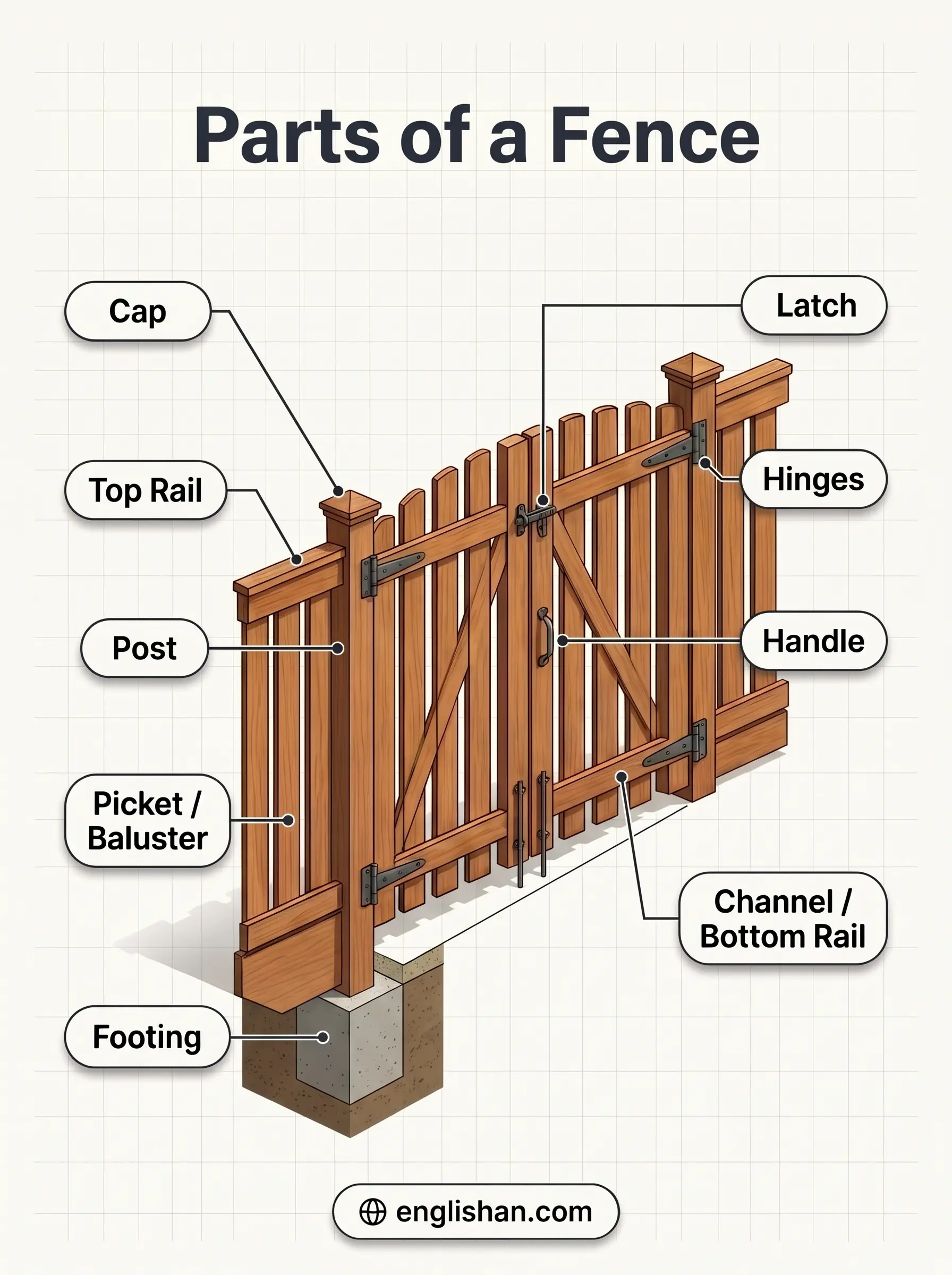
What are the parts of a fence called? The vertical members set in the ground are posts, the horizontal members between them are rails, and the boards fastened across the rails are pickets. Post caps finish the tops, a kickboard closes the base, and the gate brings its own hinges and latch.
| Part | Location |
|---|---|
| 1. Line post | Set in the ground between corners |
| 2. Corner post | Where the fence changes direction |
| 3. End post | Where the fence line stops |
| 4. Gate post | Either side of the gate opening |
| 5. Post cap | On top of each post |
| 6. Concrete footing | Around the buried length of the post |
| 7. Top rail | Between posts, near the top |
| 8. Middle rail | Between posts, at mid-height |
| 9. Bottom rail | Between posts, near the ground |
| 10. Pickets | Across the face of the rails |
| 11. Cap board | Flat across the tops of the pickets |
| 12. Trim board | Under the cap board, along the top edge |
| 13. Kickboard | Along the base, above the soil line |
| 14. Lattice topper | Above the pickets, in an open panel |
| 15. Fasteners | Through every picket and rail joint |
| 16. Gate frame | Inside the gate, behind the pickets |
| 17. Diagonal brace | Corner to corner across the gate |
| 18. Hinges | Gate edge, against the gate post |
| 19. Latch | Gate edge, opposite the hinges |
| 20. Drop rod | On the passive leaf of a double gate |
Fence Post Parts
Posts bear the entire weight of a fence and every load the wind puts on it. Of all the parts of a fence, these are the ones sunk into the ground, and the names below separate them by the job each post does.
Line Posts
Line posts fill the space between the corners and hold up a straight stretch of fence. On a wood fence they are milled from 4×4 lumber and spaced 6 or 8 feet apart, which matches the standard lengths rails come in. Each one supports the panel on either side of it and nothing more, which makes a line post the lightest on the fence.
Corner Posts
A corner post stands where the fence changes direction, with two runs of fence pulling on it at once. Builders set it deeper than a line post for that reason, and many crews size it larger as well. A corner post that starts to lean is the first sign that its footing has failed.
End Posts
End posts mark the point where a fence line stops, against a house wall, a garage, or the neighboring property. Rails land on one side only, which pulls the post sideways over time. Terminal post is the trade name for corner posts, end posts, and gate posts together.
Gate Posts
Gate posts flank the gate opening and receive the hinges and the latch. Every swing of the gate works against the hinge post, which is why it goes deeper into the ground and is built from 6×6 lumber or steel. A sagging gate traces back to this post more readily than to the gate itself.
Post Cap
The post cap is the small cover capping each post, in wood, copper, black metal, or a solar light version. Its job is to shed rain off the end grain, the exposed face where the wood fibers end. End grain soaks up water faster than any other surface, and an uncapped post rots from the top down.
Concrete Footing
A concrete footing is the collar of concrete poured around the buried length of a post. The working rule sends a third of the post length underground, which leaves an 8-foot post standing 6 feet above grade. In cold regions the hole is dug past the frost line, the depth at which the ground freezes in winter. Frozen soil lifts a shallow footing and pushes the post out of line.
Parts of a Fence Panel
A panel is one length of fence between two posts, and fence crews know it as a bay. These wood fence parts fill it. These are the parts that fill it.
Fence Rails
Rails are the horizontal members spanning from post to post, known to carpenters as stringers or backer rails. A 6-foot privacy fence uses three of them: one near the top, one at mid-height, and one near the base.
Cut from 2×4 lumber, the rails receive every fastener that grips the pickets. Most crews run them on the inside face, which leaves the smooth side of the fence toward the street.
Fence Pickets
Pickets are the vertical boards fastened across the rails, and they form the face of the fence. In supplier catalogs, a picket is the narrower board, shaped to a point or a dog-ear at the top, while a fence board is wider and squared off. Spacing between them decides the style: tight together for a privacy fence, evenly gapped for a picket fence, and overlapped for a board-on-board.
Cap Board
A cap board lies flat along the top of the pickets, the full length of the fence. It shields the sawn ends of the pickets and turns rain away from them. Wood fence catalogs list this board as the top rail, a different part from the top rail on a chain link fence.
Trim Board
A trim board fits under the cap board, along the top edge of the pickets. It conceals the joint where the pickets meet the cap and finishes that edge. Trim boards also frame gate openings and the point where one fence style meets another.
Fence Kickboard
The kickboard closes the base of the fence, a wide board stood on edge between the posts. It lifts the pickets off wet soil, blocks a dog from digging under, and absorbs the damage from a string trimmer. Some regions say mud board and others say gravel board, and all three names mean one board.
Lattice Topper
A lattice topper adds an open panel of crossed wood slats above the pickets. It raises the height of a fence without a solid wall of boards, and it lets air and light through. Most toppers stand 12 to 24 inches tall, fitted between posts left long for the purpose.
Fence Fasteners
Fasteners hold every other part together, and the wrong type shortens the life of the whole fence. Exterior screws and hot-dipped galvanized ring-shank nails are the standard, since the rings around the shank grip the wood as it swells and shrinks.
Smooth nails work loose through those seasonal cycles and back out of the rails. Nails without the galvanized coating fail differently: they rust, streak dark stains down the pickets, and give way long before the wood does.
Parts of a Fence Gate
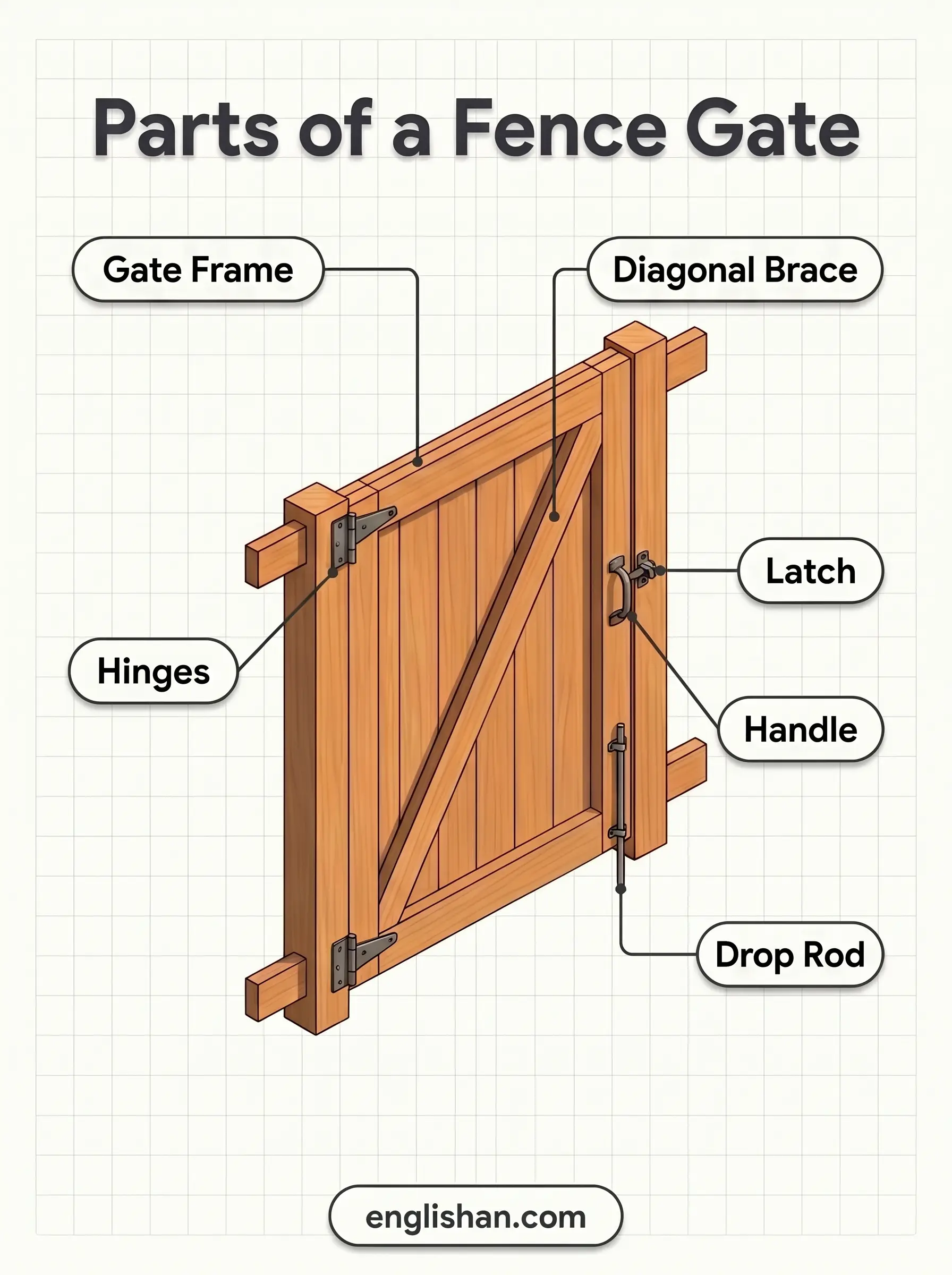
The gate is the only moving assembly on a fence, with parts that appear nowhere else along the line.
Gate Frame
The gate frame keeps the gate square, a rectangle of lumber behind the pickets. Its vertical members are stiles, running down the hinge and latch edges, and its horizontal members are rails across the top and bottom. Pickets screw to that rectangle rather than to each other.
Diagonal Brace
A diagonal brace crosses the gate corner to corner, either as a board or as a steel cable. On a wooden gate it travels from the bottom hinge corner up to the top latch corner, which puts the wood in compression. A brace fitted the other way pulls at the joints and lets the gate drop.
Gate Hinges
Hinges join the gate to the hinge post and bear its full weight. Strap hinges spread that load across the gate frame with long arms, and a heavy gate takes three of them rather than two. Pool gates require self-closing hinges under most local codes.
Gate Latch
The latch keeps the gate shut against the latch post. A gravity latch drops a bar into a catch as the gate swings closed, and a ring latch lifts that bar by hand from either side. Pool and child-safety codes fix a minimum mounting height for the latch and require it to catch by itself.
Drop Rod
A drop rod, known in catalogs as a cane bolt, is the vertical rod on a double gate. It drops into a sleeve or a hole in the ground and pins the passive leaf, the half that stays shut. The active leaf then latches against the pinned one.
Anti-Sag Kit
An anti-sag kit adds a steel cable and turnbuckle across the back of a gate. Turning the buckle shortens the cable and lifts the latch corner back into line. One kit straightens a dropped gate without any rebuilding.
Parts of a Chain Link Fence
The parts of a fence built from chain link have their own names, and almost none of them match the wood ones. The mesh hangs from a steel frame and is pulled tight at each end rather than fastened board by board.
Terminal Posts
Terminal posts mark every corner, end, and gate opening of a chain link fence, heavier than the rest. They run a larger diameter than line posts and go deeper into the ground, since the stretched mesh pulls against them. All the tension hardware bolts to these posts.
Line Posts
Line posts stand between the terminal posts, spaced about 10 feet apart along a residential run. They support the mesh at the correct height and hold the fence line straight. Tie wires fasten the mesh to them rather than bolts, which leaves them under far less pull than a terminal post.
Top Rail
The top rail is a length of steel tube along the top of the fence. It slides through the loop caps on the line posts, then locks into the cupped rail ends bolted to the terminal posts. Short sections join with a rail sleeve, a collar that slips over both pipe ends to make one continuous rail.
Post Caps and Loop Caps
A post cap is the dome capping a terminal post to keep rain out of the pipe. Loop caps go on the line posts instead, each with an eye that the top rail passes through. Fit the wrong cap, and the top rail has nothing to run through.
Chain Link Fabric
Chain link fabric forms the barrier itself, a woven steel mesh known in the trade as fabric rather than wire. Galvanized or vinyl-coated wire is woven into the diamond pattern and delivered in rolls. Each roll fastens to the terminal posts with tension bars and to the line posts with tie wires.
Tension Bar
A tension bar threads vertically through the end diamonds of the mesh, flat and made of steel. Bolted to the terminal post, it grips the whole height of the fabric at once and spreads the pull evenly. Without it the mesh would tear wherever the few fasteners gripped.
Tension Bands
Tension bands are the shaped metal straps that clamp a tension bar to a terminal post. One carriage bolt closes each band around the pipe. Installers use one band fewer than the fence height in feet, so a 4-foot fence needs three bands per bar.
Brace Bands
Brace bands look like tension bands but hold the rail ends and the tension wire instead of the fabric. Each one wraps the terminal post and bolts the fitting in place. Ordering tension bands in place of brace bands leaves the rail ends with nothing to clamp them.
Tie Wires
Tie wires fasten the fabric to the line posts and the top rail, each one a short length of aluminum or steel wire. Installers twist them every 12 inches along a post and every 18 inches along the rail. Each tie wire is cut and replaced during a repair, which is how a damaged run of fabric comes out.
Tension Wire
Tension wire stretches along the bottom of the fabric as a heavy galvanized strand. It stops the mesh being pushed up and away from the ground. A fence without one leaves a gap at the base that an animal works under.
Parts of a Vinyl Fence and an Aluminum Fence
Vinyl and aluminum fence parts follow the post, rail, and picket layout of a wood fence, sized at the factory.
Routed Posts
Routed posts arrive with slots cut into their sides at the factory, hollow in vinyl or aluminum. Rails slide straight into those slots, which removes the need for brackets on the face of the post. A routed post is set in concrete like any other, and taller ones accept a steel insert for stiffness.
Rail Brackets
Rail brackets clamp a rail against an unrouted post, in metal or moulded plastic. Each bracket screws to the post and cups the rail end. Aluminum fences need them at corners and wherever a panel meets a wall or column.
Vinyl Post Cap
A vinyl post cap presses or glues into the open top of a hollow post. Water left standing inside a hollow post freezes and splits the wall, which makes the cap more than a finishing touch. Styles range from flat and gothic to the external cap that overhangs the post.
Picket Inserts
Picket inserts drop into punched holes in the rails, one vinyl or aluminum picket per hole. Each picket is trapped at the top and bottom rather than screwed, which lets the panel expand and contract with temperature.
Fence Line and Layout Terms
These words describe how the parts of a fence meet the ground and the property line, and they turn up in every quote and permit.
Fence Line
The fence line traces the path the fence follows across the property. Most local codes set it back from the property line, and a survey establishes where that line actually runs.
Grade Line
Grade is the ground level along the fence, and the grade line is the band where each post enters the soil. Wood posts rot at the grade line first, since that band stays damp and reaches air at the same time.
Stepping and Racking
Stepping and racking are the two ways a fence crosses a slope. A stepped fence keeps each panel level and drops it down at every post, which leaves a triangular gap underneath. A racked fence tilts the rails to follow the ground, and the pickets stay vertical while the gap closes.
FAQs
Q1. What are the parts of a fence called?
The main parts of a fence are the posts, the rails, and the pickets, plus the post caps, kickboard, fasteners, and gate hardware. Posts are sunk into the ground, rails span between them, and pickets cover the rails to form the face of the fence.
Q2. What are the vertical parts of a fence called?
The vertical parts of a fence are the posts and the pickets. Posts are the structural members sunk into the ground, cut from 4×4 lumber or steel pipe, and they bear the weight of the fence. Pickets are the narrower boards fastened across the rails, and they bear no structural load on their own.
Q3. What are the horizontal parts of a fence called?
The horizontal parts of a fence are the rails, known also as stringers or backer rails. A 6-foot privacy fence has three of them between each pair of posts. The kickboard at the base and the cap board along the top lie horizontally as well.
Q4. What are the parts of a chain link fence called?
A chain link fence is built from terminal posts, line posts, a top rail, and chain link fabric, held together by tension bars, tension bands, brace bands, and tie wires. Post caps close the terminal posts, loop caps guide the top rail along the line posts, and a tension wire stretches along the bottom of the fabric.
Q5. What is the board at the bottom of a fence called?
The board at the bottom of a fence is the kickboard, known regionally as a mud board or a gravel board. It sits on edge between the posts and keeps the pickets off wet soil. It also blocks digging under the fence and absorbs the wear from mowers and trimmers along the base.
Q6. What are the parts of a fence panel called?
A fence panel is made of rails and pickets, with a cap board, a trim board, or a lattice topper added in some styles. One panel reaches from one post to the next, a length fence crews know as a bay.
Q7. Can you replace part of a fence?
Yes, most parts of a fence are replaced on their own. A cracked picket, a rotted rail, a split kickboard, or a sagging gate comes out without touching the rest of the line. Replacing the whole fence becomes the practical choice once several posts have rotted at the grade line.
You May Also Like
- Parts of a Lawn Mower
- Parts of a Grill
- Parts of a Fountain
- Parts of a Microphone
- Parts of Headphones