

A lighthouse is a tapering tower of stone, brick, or iron with a glazed iron cage bolted to its top. Inside that cage stands a lens taller than the keeper who once cleaned it. The parts of a lighthouse carry names that have barely changed since the 1800s, so the same words describe a Scottish rock tower and a Great Lakes brick one. Two of those parts are not physical at all: the paint pattern that names the tower by day, and the flash code that names it by night.
Every Part of a Lighthouse Named
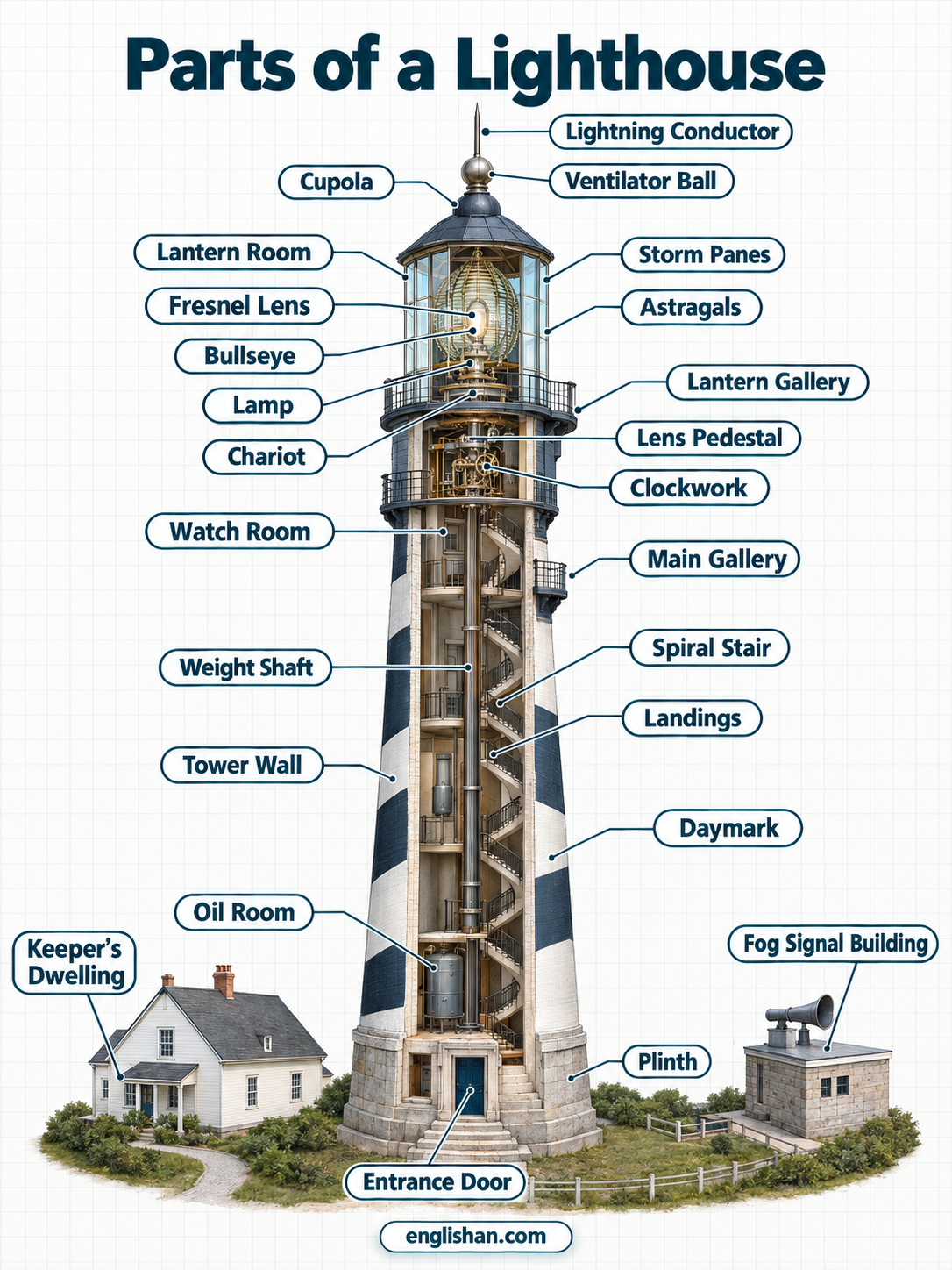
Every part of a lighthouse answers to the tower, the shaft that lifts the light high enough to be seen. At its top is the lantern room, a glazed cage around the lens, ringed by a gallery. The watch room below it once contained the clockwork and the keeper on duty. Below all of it, at ground level, are the dwellings and workshops that together made up the station.
| Part | Where you find it |
|---|---|
| 1. Cupola | Domed roof over the lantern |
| 2. Ventilator ball | Vent at the summit of the cupola |
| 3. Lightning conductor | Rod above the ventilator |
| 4. Lantern room | Glazed chamber holding the lens |
| 5. Storm panes | Glass panels of the lantern |
| 6. Astragals | Metal bars between the panes |
| 7. Lantern gallery | Balcony outside the lantern room |
| 8. Fresnel lens | The optic itself, inside the glass |
| 9. Bullseye | Thickened centre of a lens panel |
| 10. Lamp | Light source at the lens centre |
| 11. Lens pedestal | Cast iron base beneath the lens |
| 12. Chariot | Wheeled carriage that turns the lens |
| 13. Clockwork | Weight-driven drive for rotation |
| 14. Weight shaft | Hollow drop down the tower centre |
| 15. Watch room | Room directly below the lantern |
| 16. Main gallery | Balcony outside the watch room |
| 17. Spiral stair | Staircase winding up the shaft |
| 18. Landings | Platforms breaking the climb |
| 19. Tower wall | The shaft itself, tapering upward |
| 20. Entrance door | Doorway at the base |
| 21. Oil room | Fuel store low in the tower |
| 22. Plinth | Widened footing at ground level |
| 23. Daymark | Paint pattern on the outside |
| 24. Keeper’s dwelling | House beside the tower |
| 25. Fog signal building | Housing for the horn or bell |
Parts of a Lighthouse Lantern Room
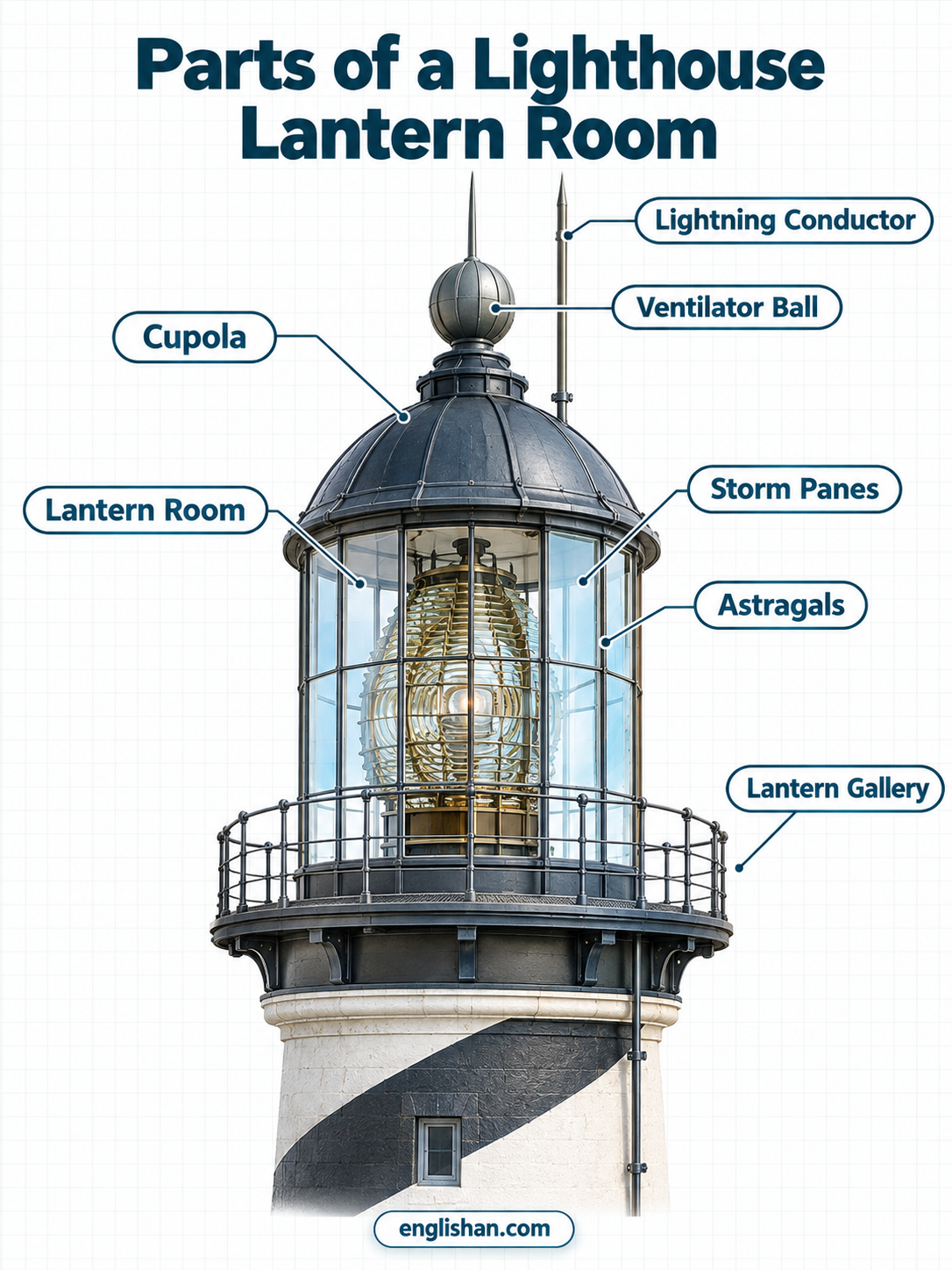
These parts of a lighthouse form a greenhouse built to survive a gale. The lantern must hold glass to the weather on every side while leaving the beam an unobstructed way out.
Lantern Room
A glazed chamber at the top of the tower encloses the lens, and that chamber is the lantern room. Its frame is cast iron or bronze rather than timber, since the structure must bear heavy glass and a rotating optic without flexing in wind. The older spelling of the word was lanthorn, and it has always named the whole chamber rather than the light inside it.
Storm Panes
Storm panes glaze the lantern frame in thick glass panels. Each one is cut to survive hurricane wind and the birds that strike a lit tower at night. Even so, a pane is meant to break before anything reaches the lens behind it. A cracked pane is replaced in a day, while a shattered lens never is.
Astragals
Astragals grip those panes in place, the metal glazing bars between one pane and the next. Every bar casts a shadow across the beam, which is why many lanterns run them diagonally. A sloping bar spreads its shadow thinly rather than throwing one dark spoke out to sea. Because those bars also had to be cleaned from outside, hand grips were bolted to their outer faces for a keeper working from a ladder.
Cupola and Ventilator
A cupola crowns the lantern in domed copper or iron. Being the highest point inside, it collects the heat from the lamp and the moisture off the sea air. A ventilator ball at its apex draws them out before they fog the glass from inside. A lightning conductor rises from that ball and runs down the outside of the tower to earth.
Lantern Gallery
The lantern gallery encircles that room as a railed balcony. From it keepers cleaned the outside of the storm panes, in whatever weather the night had left behind. It is also where a visiting climb ends, since the lantern itself stays closed to the public in working towers.
Parts of a Lighthouse Light
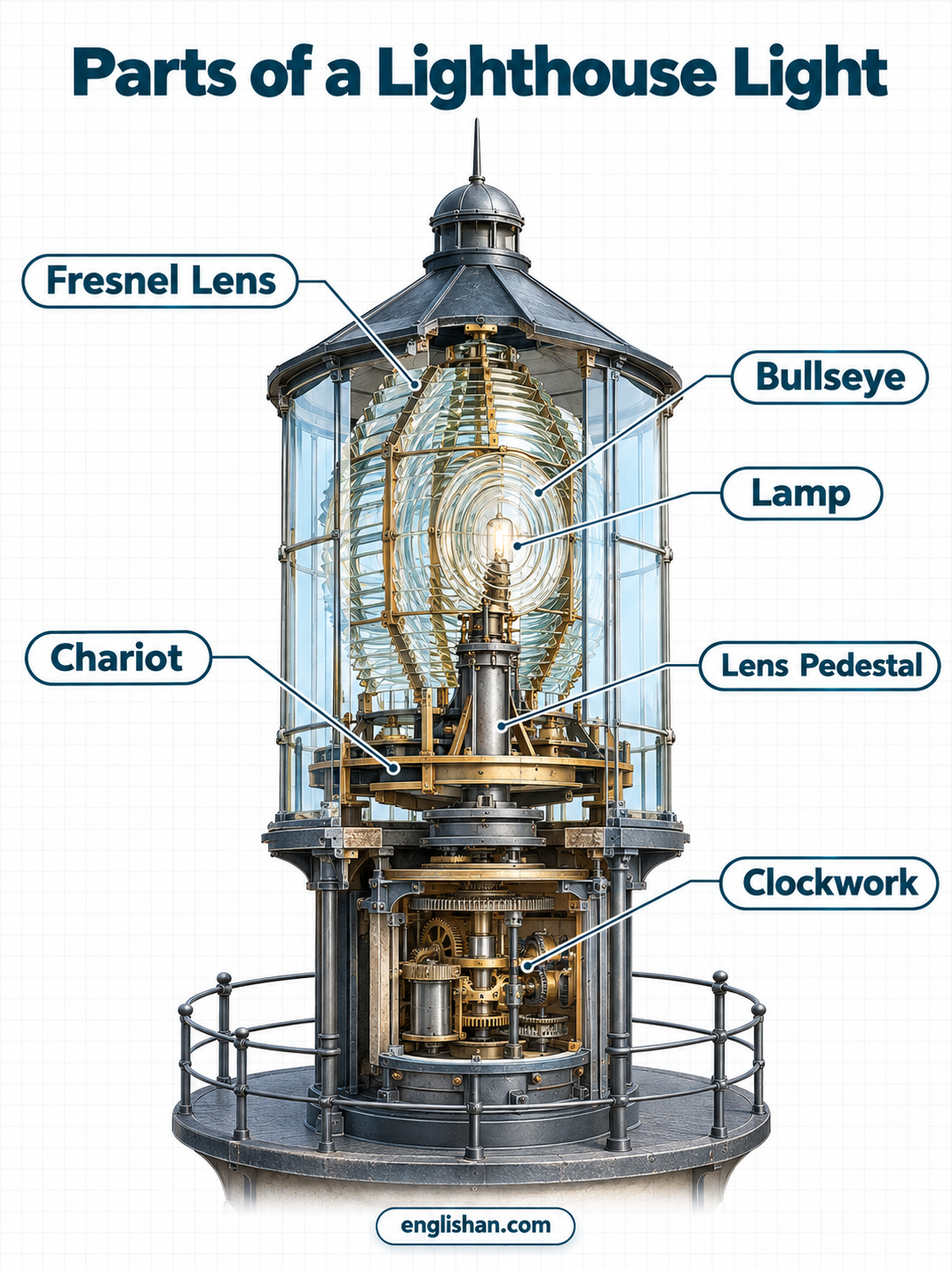
The optic is the reason for everything below it. Its purpose is to take light thrown in every direction by one flame and send it out as a flat beam along the horizon.
Fresnel Lens
A Fresnel lens surrounds the lamp with a barrel of glass rings and prisms, invented by Augustin Fresnel in 1822. Rather than one thick lens, it uses concentric rings that bend light toward the horizontal and prisms above and below that catch the rays a plain lens would waste. The result throws a beam many miles further than the polished reflectors it replaced.
Lens Orders
Lenses are classed by order, from first down to sixth. A first-order lens rises taller than a person and lights an ocean coast, while a sixth-order lens fits on a harbour pier. The order sets the size, the brightness, and the distance the beam reaches.
Bullseye
A bullseye thickens the centre of each lens panel, shaped to gather the rings into one concentrated beam. Each panel of a rotating lens throws its own beam, and the flash a mariner sees is one of those beams sweeping past. How many bullseyes the lens carries, and how far apart they are spaced, therefore sets the rhythm of the flashes.
Lamp
The lamp burns at the exact centre of the lens, and every ring is ground to focus on that point. Wicks fed by whale oil, lard oil, and kerosene filled that position before electricity, and a bulb or an LED occupies it now. Whatever the source, moving it even slightly off centre scatters the beam.
Lens Pedestal and Chariot
A cast iron pedestal raises the lens above the lantern floor. Beneath the lens runs the chariot, a ring of wheels on a circular iron track, on which a lens weighing several tonnes turns under one hand. Where even that friction was too much, the heaviest lenses floated on a bath of mercury instead.
Clockwork
Clockwork turned the lens before electric motors arrived, driven by a falling weight. A weight descended a shaft through the middle of the tower, exactly as in a grandfather clock. The keeper rewound it every few hours through the night. Its speed set the flash interval, so a slow clock made a lighthouse show the wrong signal.
Inside the Lighthouse Tower
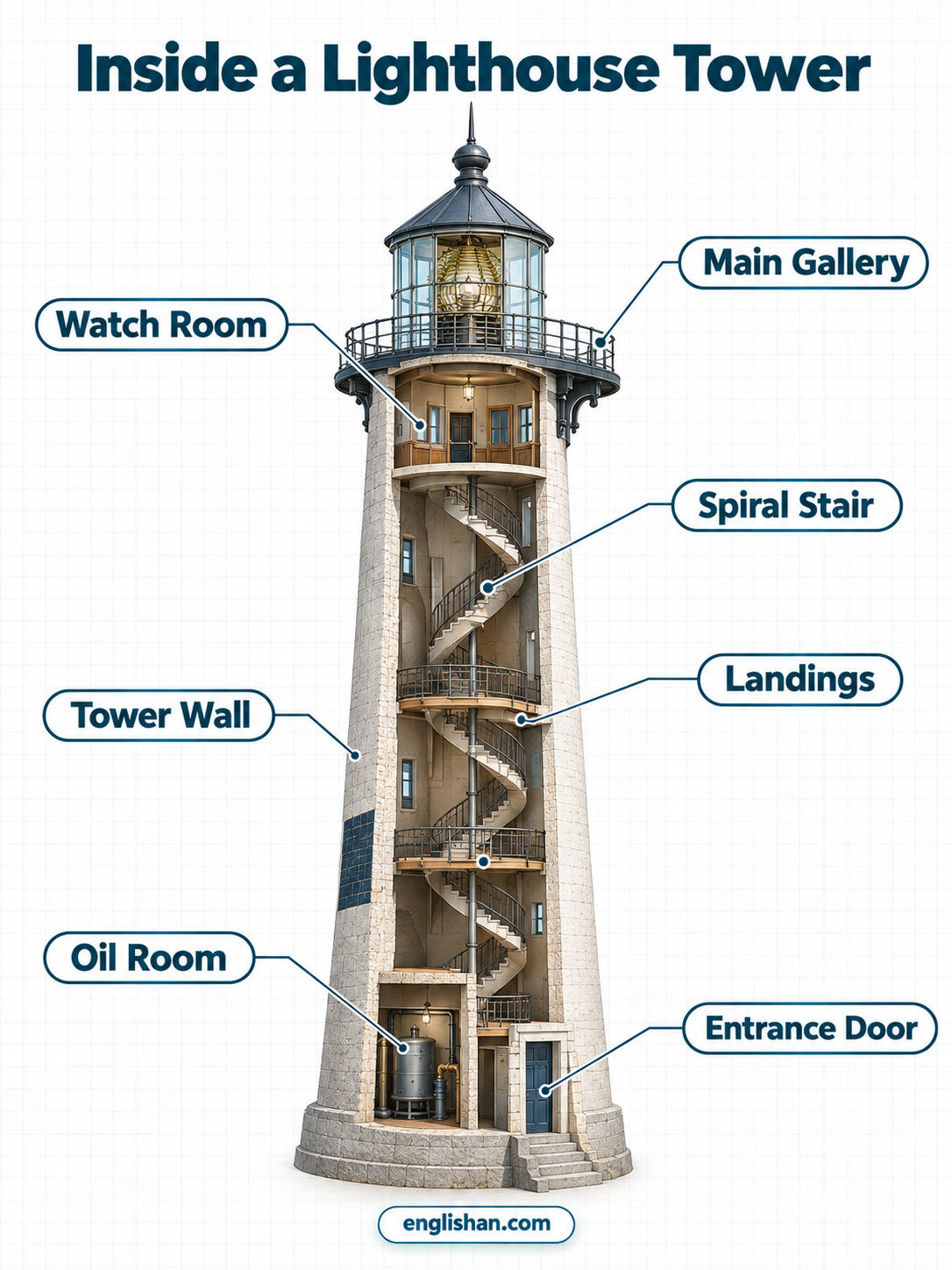
Below the lantern, the parts of a lighthouse are mostly stair. What rooms the shaft holds are stacked in the order the work needed them.
Watch Room
Directly below the lantern is the watch room, also called the service room. A keeper prepared lamps, trimmed wicks, and stood his watch here, with the clockwork running beside him. Many towers ring this level with a main gallery, giving a second balcony below the lantern one.
Spiral Stair
A spiral stair winds up the inside of the shaft on cast iron treads cantilevered from the wall. A tall coastal tower puts a few hundred steps between the door and the lantern, so landings break the climb at intervals. Each landing carries a window, so the stairwell is lit and a keeper carrying oil had somewhere to rest.
Tower Wall
The tower wall tapers as it rises, thick at the base and thinner at the top, which lowers the centre of gravity and gives the wind less to push against. Rock towers take the taper to its extreme, built from interlocking granite blocks dovetailed into each other and into the reef below. Brick towers on soft ground achieve the same stability through a wider base and a deep foundation.
Entrance Door
An entrance door opens at the base of the tower, or several feet above it where waves reach the wall. Towers on exposed rock put the door at the top of a ladder for exactly that reason. Its frame is set into the masonry rather than into a timber lining, since a door that fails in a storm floods the stair.
Oil Room
Low in the tower, the oil room stored fuel behind a metal lining, vented to the outside. Whale oil, lard oil, and kerosene each brought their own fire risk. Later stations moved the fuel into a separate oil house away from the tower for that reason. Emptied of its purpose, the room survives in many towers as a storeroom or a display.
Lighthouse Base and Foundation
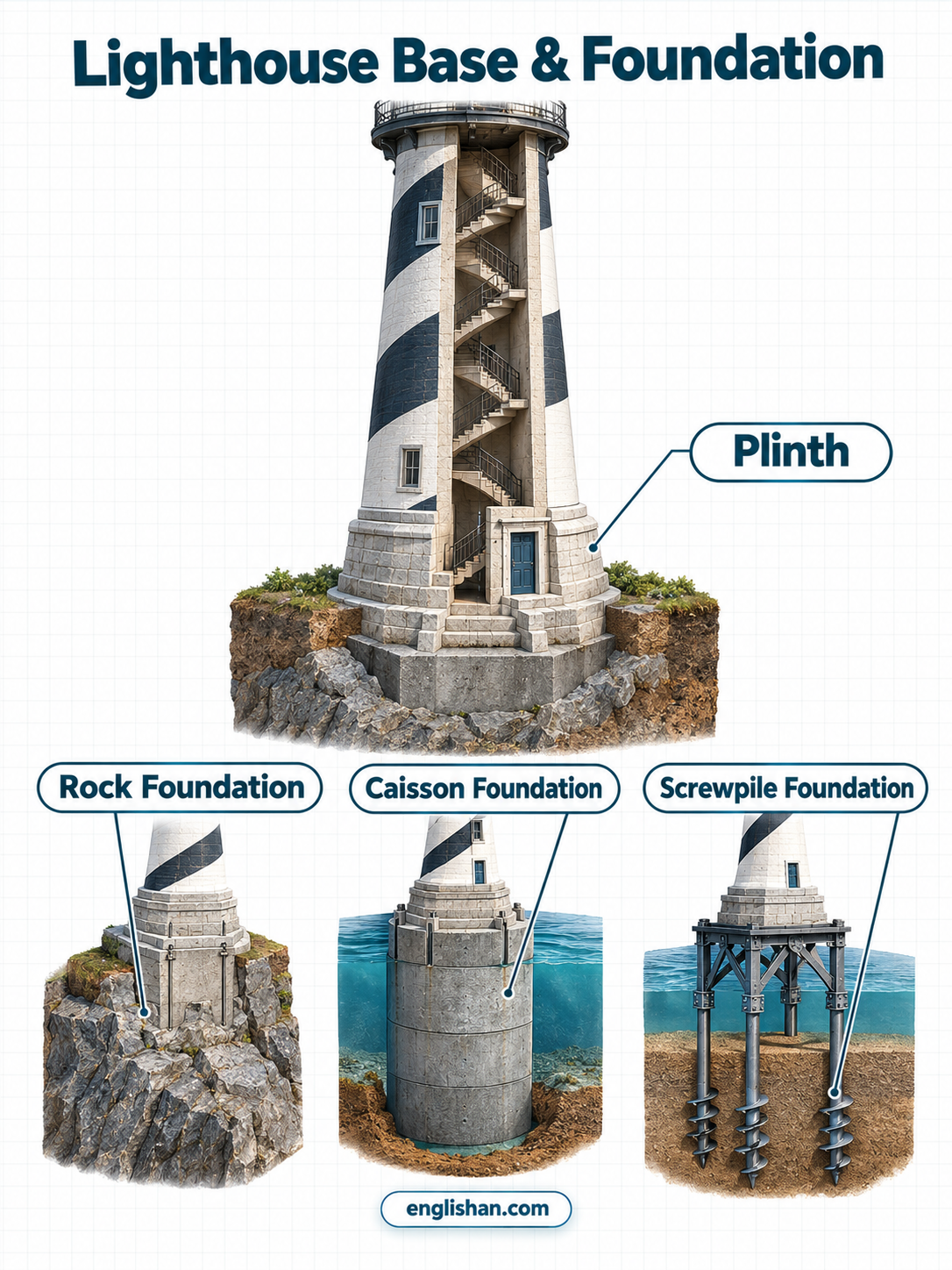
Every other part of a lighthouse depends on what the tower is founded on, and the foundation type separates one class of lighthouse from another.
Plinth
A plinth widens the footing at the bottom of the tower, stepping outward from the shaft. It spreads the tower’s weight across the ground and lifts the door above splash level. On rock stations it also breaks the force of waves before they climb the wall.
Foundation Types
Foundation decides where a lighthouse is built at all. A rock tower is keyed directly into bedrock. A caisson lighthouse rests on a sunken iron cylinder filled with concrete, and a screwpile lighthouse balances on iron legs augered into a sandy seabed. Skeletal towers exchange solid walls for a braced iron frame, which suits high winds and soft ground.
Lighthouse Markings and Signals
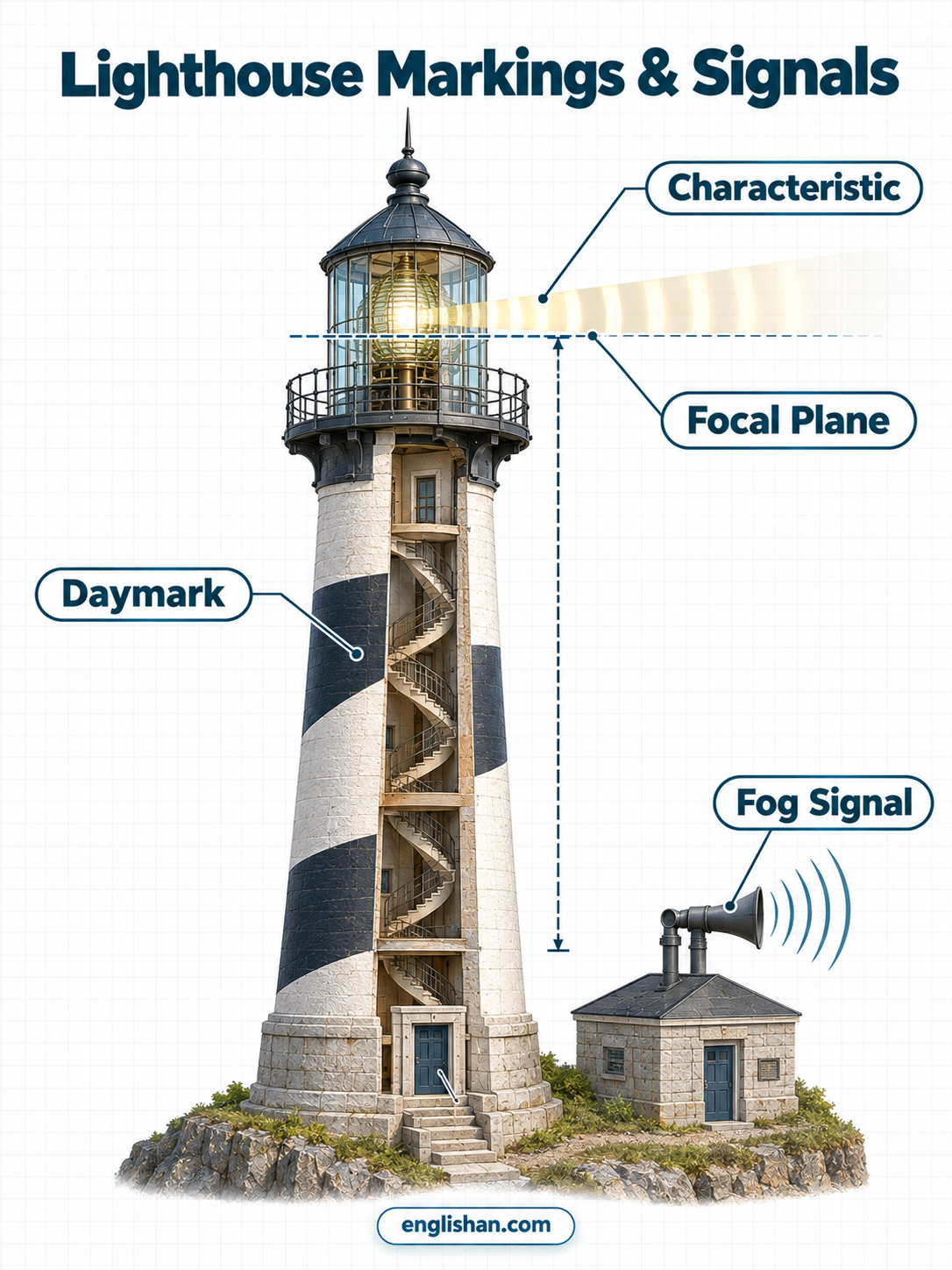
Two parts of a lighthouse are not physical at all. Both exist so that a mariner names which lighthouse is in sight, since an unidentified light is worse than none.
Daymark
A daymark identifies a lighthouse in daylight through its paint pattern or its shape. Black and white spirals, red bands, and checkerboards all serve one purpose: separating a tower from its neighbours along the same coast. That is why colour on a lighthouse is a signal rather than decoration.
Characteristic
The characteristic is the flash pattern shown at night, written in charts as a code such as Fl WR 20s. Read out, it gives the colour, the flash, and the seconds in the cycle. A mariner with a watch therefore identifies the light from its rhythm alone. Two lighthouses within sight of each other never share a characteristic.
Focal Plane
Focal plane names the height of the lens above sea level, which is not the height of the tower. A short tower on a high cliff out-reaches a tall tower at the water’s edge, since the curve of the earth decides how far a light is seen. Charts list the focal height alongside the tower height for that reason.
Fog Signal
A fog signal takes over when the light cannot be seen, sounding through a horn, a bell, or a siren. Each station sounds its own pattern of blasts and silences, the audible version of a characteristic. Compressed air replaced striking bells, and an automatic detector now starts most signals.
Buildings of a Light Station
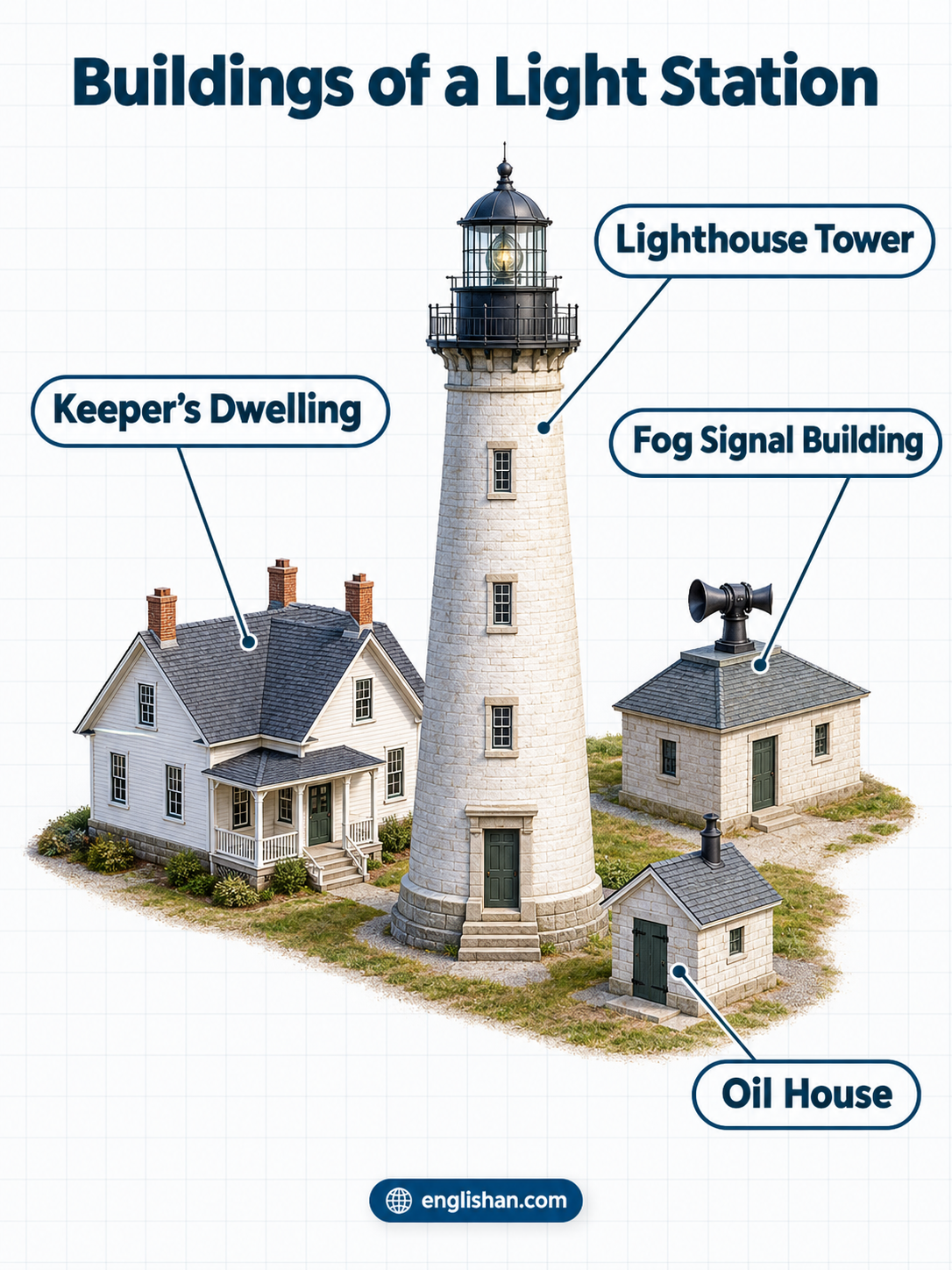
The parts of a lighthouse extend past the tower itself, since keeping the light burning was a full-time job for families who had to live where they worked. The whole group of buildings is the light station.
Keeper’s Dwelling
The keeper’s dwelling stands beside the tower or attaches directly to it. Head keepers and assistants had separate quarters at larger stations, and remote rock stations replaced houses with bunks inside the tower itself. Automation emptied these buildings from the 1960s onward.
Fog Signal Building
A separate building houses the machinery driving the horn, set apart from the dwelling because the engines are loud. Coal or oil ran the compressors that fed the horn. Its trumpet aims seaward from the wall facing the shipping lane.
Oil House
The oil house keeps the fuel in a small brick or stone outbuilding, at a distance from everything else. Kerosene arriving in the 1880s burned far more readily than whale oil, so keeping it outside the tower became standard practice.
FAQs
Q1. What are the parts of a lighthouse called?
The parts of a lighthouse are the tower, the lantern room at its top, and the gallery around that room. The lens and lamp are housed inside the lantern. Below the lantern come the watch room, the spiral stair, and the entrance at the base. The daymark on the outside and the characteristic of the light identify the tower by day and by night.
Q2. What is the top of a lighthouse called?
The top of a lighthouse is the lantern room, the glazed chamber holding the lens. A domed cupola roofs it, with a ventilator ball and a lightning conductor above that. The balcony encircling it is the lantern gallery.
Q3. What are the parts of a lighthouse light called?
The light is made up of the lamp at the centre and the Fresnel lens of rings and prisms around it. Each lens panel carries a bullseye at its centre. The lens turns on a chariot of wheels above a cast iron pedestal, driven by clockwork in older towers.
Q4. What does the inside of a lighthouse look like?
Inside a lighthouse is a hollow shaft with a spiral stair winding up the wall, lit by small windows at each landing. The watch room closes the top of the climb, below the lantern room with its lens. Older towers also hold an oil room low down for fuel.
Q5. What is the balcony on a lighthouse called?
The balcony on a lighthouse is a gallery. The lantern gallery rings the lantern room at the very top, and a main gallery rings the watch room a level below it on many towers.
Q6. What is a daymark on a lighthouse?
A daymark is the paint pattern or distinctive shape that identifies a lighthouse in daylight, when its beam is invisible. Spirals, bands, and checkerboards are all daymarks. Neighbouring lighthouses are given different patterns so that a mariner tells them apart.
Q7. How many steps are in a lighthouse?
A tall coastal lighthouse runs to a few hundred steps, and a short harbour light to a few dozen. The number follows the height of the tower rather than any standard. Landings break the climb at intervals in the taller towers.
You May Also Like