

An anchor secures a vessel to the seabed so that it does not drift, and the parts of an anchor fall into two sets. The anchor body has a ring, a shank, a crown, arms, and flukes, with a stock on older and some modern designs. The anchor system on a ship adds the chain cable, the hawse pipe, the windlass, and the chain locker.
The anchor body comes first, then the stock, the main designs, the rode, and the ship fittings. The names follow Britannica, Marine Insight, Sailing Issues, and Wikipedia. The text states where these sources describe a part differently.
Parts of an Anchor Labeled Diagram
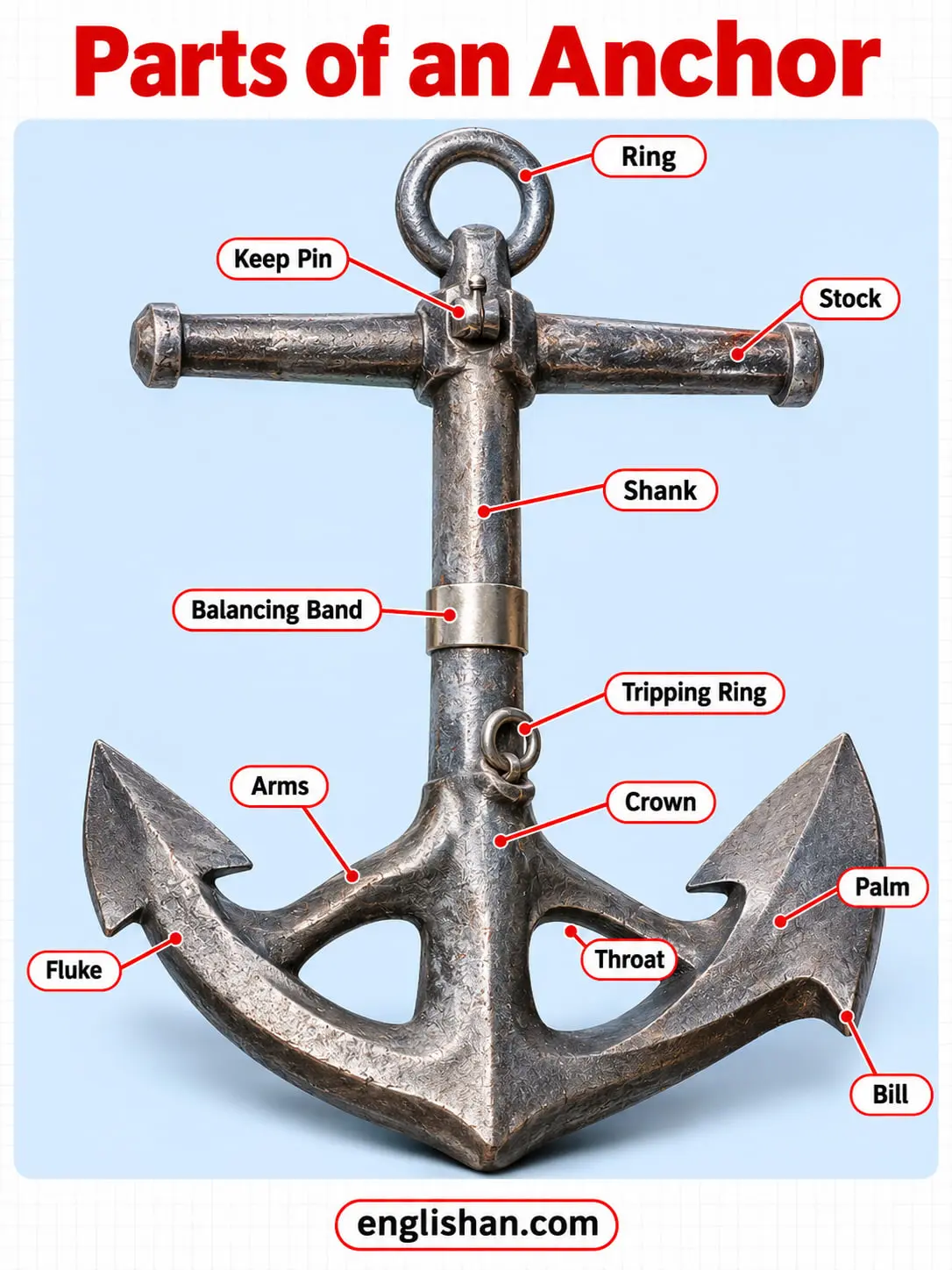
In a labeled diagram, the ring is at the top of the shank and the crown is at the bottom, where the arms join. Each arm ends in a fluke. On a stock anchor, a crossbar runs through the shank at the ring end, at right angles to the arms.
| Part | Position | Role |
|---|---|---|
| 1. Ring | Top of the shank | Connects the anchor to the chain or cable |
| 2. Shank | Central shaft between the ring and the crown | Transmits the pull of the rode to the flukes, and a pull on it sets the anchor |
| 3. Stock | Crossbar at the top of the shank | Tilts the anchor so that one fluke digs into the seabed |
| 4. Crown | Bottom of the shank | Joins the shank to the arms |
| 5. Arms | Extend from the crown | Hold the flukes and provide most of the grip |
| 6. Fluke | End of each arm | Penetrates and grips the seabed |
| 7. Palm | Face of the fluke | Flat, triangular surface that presses into the bottom |
| 8. Bill | Tip of the fluke | Pierces the surface layer of sand, mud, or clay |
| 9. Throat | Inner curve where an arm meets the shank | Lets material pass so the anchor buries deeper |
| 10. Balancing band | Shank, at the center of gravity | Keeps the anchor level when it is lifted |
| 11. Tripping ring | Crown | Holds a tripping line used to free a fouled anchor |
| 12. Keep pin | Head of the anchor | Holds the stock in place, and removing it detaches the stock for stowing |
Shank and Crown With Ring and Balancing Band
The ring, shank, and crown form the body of the anchor, and the balancing band is the fitting on the shank that keeps it level.
Ring
The ring is the attachment point at the top of the shank, where the chain or cable connects to the anchor. Wikipedia names galvanized or stainless steel for eyes and shackles.
Shank
The shank is the central shaft that runs from the ring to the crown. Pulling on it sets the anchor into the seabed, and its length provides leverage. Many designs use high-tensile steel for it, and Wikipedia names the Mantus and Knox anchors among them.
Crown
The crown is the joint at the bottom of the shank where the arms meet it. Brainbound notes that in many designs the crown lets the flukes tilt toward the bottom and adds weight low on the anchor. Marine Insight adds that some anchors join the shank to the crown with a ball-and-socket joint that rotates 30 or 45 degrees.
Balancing band
The balancing band is a fitting on the shank at the center of gravity. Marine Insight describes it as a sleeve-like structure near the middle of the shank. It keeps the anchor level when it is lifted.
Among the parts of an anchor, the shank is high-tensile steel in many designs, and the eyes and shackles are galvanized or stainless steel. Many modern anchor bodies are stainless steel.
Arms and Flukes
Arms
The arms extend from the crown and end in the flukes. Marine Insight credits them with most of the grip. Curved arms began to replace straight arms in the early 19th century.
Fluke
The fluke is the digging tip at the end of each arm. Fluke tips are sharp so that they penetrate the bottom, and a pull on the shank buries them. A Danforth anchor has two triangular flukes.
Palm
The palm is the flat, triangular face of the fluke, according to Britannica. Wikipedia describes the palms on the Herreshoff anchor as small and diamond-shaped.
Bill
The bill is the pointed tip of the fluke. It pierces the surface layer of sand, mud, or clay.
Throat
The throat is the curved inner extension of an arm where it meets the shank. Brainbound states that a wider throat lets more material pass, which helps the anchor bury deeper.
Stock and Tripping Palms
The stock and the tripping fittings are the parts of an anchor that set the flukes.
Stock
The stock is a crossbar set at right angles to the arms and flukes. It keeps the arms lying flat on the seabed so that one fluke digs in, according to Britannica. On an Admiralty anchor, Wikipedia places it at the shackle end of the shank, and a Danforth anchor reverses the layout with a stock hinged at the crown.
Head
The head is the part of the anchor where the stock attaches, according to Britannica.
Keep pin
The keep pin holds the stock in place on the head. Removing it detaches the stock for stowing.
Tripping palms
Tripping palms are projections on the crown of stockless and Danforth anchors. They drag on the bottom and force the flukes to dig in.
Tripping ring
The tripping ring is the attachment point at the crown for a tripping line. The line runs to a buoy on the surface, and pulling it draws the anchor backward and upward to break it free.
Early stocks were wood, replaced by iron in the late 1830s and early 1840s.
Stock and Stockless Anchor Parts
Britannica groups anchors into stock, curved-arm, stockless, lightweight, mushroom, and ancient types. Marine Insight lists nine designs, so no fixed count of types exists. Each design changes which parts of an anchor are present.
| Type | Distinguishing parts | Use named by the sources |
|---|---|---|
| Stock (Admiralty) | Stock at right angles to two arms with flukes | Long the standard design, called the fisherman’s anchor in the United Kingdom |
| Stockless | Crown, arms, and flukes cast as one piece, with shoulders at the base of the flukes | Large ships |
| Danforth | Hinged stock at the crown and two triangular flukes | Yachts and small craft, with strong holding in soft seabeds |
| Plow (CQR and Delta) | Plow-shaped front ahead of the shank, fixed shank on the Delta | Yachts, on soft and hard bottoms |
| Grapnel | Vertical shank with four or more tines | Small craft on uneven bottoms |
| Mushroom | Inverted bulbous weight with no flukes | Permanent moorings for lightships, dredges, and lighters |
| Claw (Bruce) | Claw-shaped front that grips the bottom | Yachts, with quick setting and limited penetration |
Sailing Issues names four anchors for a sailboat: Bruce, CQR, Delta, and Danforth.
Anchor Rode Parts
The rode connects the anchor to the vessel. It is rope, chain, or a combination of both, and large ships use chain only. The chain cable, the shackle, the swivel, and the line are the parts of an anchor rode. Wikipedia states that every rode should include chain at least equal in length to the boat.
Chain cable
Chain cable is made of studded or interlocked steel links reinforced with locking pins. It raises and lowers the anchor and holds the vessel in position. Its weight lets the anchor lie flat on the seabed, which gives the maximum hold. On a ship, Merchant Navy Decoded measures chain length in shackles, and one shackle is 27.5 meters, 15 fathoms, or 90 feet.
Shackle
The shackle is a high-tensile connector that joins the anchor to the rode. Its load rating should exceed the breaking strength of the chain.
Swivel
The swivel lets the anchor rotate independently of the chain, which reduces twisting.
Anchor line
Nylon is the most suitable rope for a rode. Polyester is stronger but less elastic, and polypropylene is not suited to rodes. Natural fibers such as manila or hemp absorb water and rot.
The parts of an anchor rode are steel chain cable and nylon or polyester line.
Parts of an Anchor System on a Ship
The anchor system is at the bow, in the forecastle, which is the most exposed part of the ship. A ship has three anchors, two on the forecastle at port and starboard and one spare.
| Part | Location | Role |
|---|---|---|
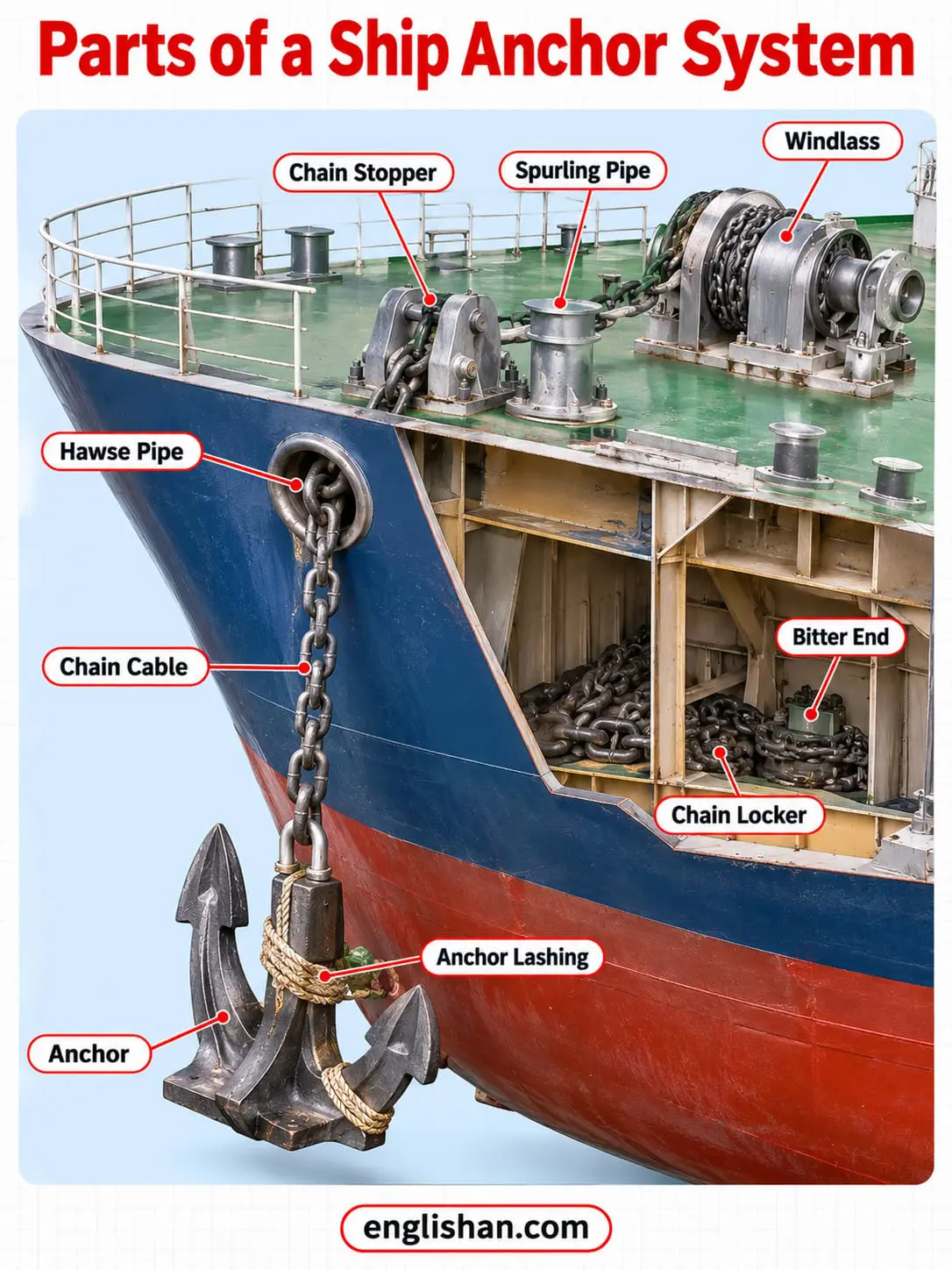
| Chain cable | Between the anchor and the windlass | Lowers and raises the anchor and adds weight so that it lies flat |
| Hawse pipe | Through the hull plating at the bow | Guides the chain from the deck to the outside of the hull and stows the anchor |
| Anchor lashing | Around the stowed anchor | Secures the anchor so that it does not bang against or penetrate the hull |
| Chain stopper | Between the windlass and the hawse pipe | Holds the chain and transfers its load to the ship, rated for 80 percent of the chain’s minimum breaking load |
| Windlass | Forecastle deck | Raises and lowers the anchor |
| Spurling pipe | Opening in the forecastle deck | Leads the chain from the gypsy to the chain locker |
| Chain locker | Bow, under the windlass and the forecastle deck | Stores the chain and drains through airing holes |
| Bitter end | End of the chain, in the chain locker | Secured to the locker or the collision bulkhead with a quick-release system |
| Anchor pocket | Recess in the side shell | Stows the anchor with its point kept over the draft line |
Hawse pipe
The hawse pipe is a pipe through the hull plating at the bow. It guides the chain from the deck to the outside of the shell plating and stows the anchor. A stockless anchor is hauled up until its shank is inside the hawse pipe and its flukes rest against the hull.
Anchor lashing
The anchor lashing secures the stowed anchor so that it does not bang against or penetrate the hull. Merchant Navy Decoded describes an arrangement of wires and a bottlescrew called the Devil’s Claw.
Chain stopper
The chain stopper supports and guides the chain between the windlass and the hawse pipe. When closed, it transfers the chain load to the ship’s structure, and it is rated for 80 percent of the chain’s minimum breaking load. It comes in rolling and guillotine types.
Spurling pipe
The spurling pipe is an opening in the forecastle deck. It leads the chain from the gypsy to the chain locker.
Chain locker
The chain locker is a compartment at the bow, under the windlass and the forecastle deck, that stores the unused chain. It drains through airing holes.
Bitter end
The bitter end is the end of the chain. It is secured in the chain locker or to the collision bulkhead with a quick-release system, and a sludge hammer is kept there for emergency release.
Anchor pocket
The anchor pocket is a recess in the side shell where the anchor is stowed. The point of the anchor is kept over the draft line.
Parts of an Anchor Windlass
The windlass is the main lifting machine of the anchor system. Marine Insight lists a cable wheel or barrel, a gearbox, and a motor among its parts. Wikipedia describes a windlass as a horizontal cylinder and notes that boats use it as an alternative to a vertical capstan.
Cable lifter
The cable lifter, also called the gypsy, is a deeply grooved drum. Its grooves engage the links of the chain and pull it in or let it out.
Gearbox
Marine Insight lists the gearbox among the three main parts of the windlass, with the cable wheel and the motor.
Motor
The motor is electric or hydraulic on modern units, according to Marine Insight.
Brake
The brake stops the cable from running out. Applying it to stop the run-out is called snubbing the cable.
Capstan
A capstan is similar to a windlass but turns on a vertical axis.
Anchor Parts by Position on the Ship
Merchant Navy Decoded defines a set of terms that describe where the anchor and its cable are in relation to the ship.
| Term | Meaning |
|---|---|
| Anchor cockbill | The anchor hangs vertically from the hawse pipe, flukes toward the ship’s side, ready to drop |
| Anchor coming home | The anchor is being hauled toward the ship by the windlass |
| Anchor aweigh | The anchor has left the bottom |
| Short stay | The cable is taut and close to the ship’s side |
| Long stay | The cable is taut, extends well from the hawse pipe, and enters the water at a shallow angle |
| Foul hawse | The cables cross when both anchors are used |
| Weighing anchor | The cable is heaved in until the anchor breaks free of the bottom |
Anchor Parts in Setting Order
The parts of an anchor work in sequence once the anchor reaches the bottom.
- The stock is a lever and tilts the anchor so that the flukes point downward.
- A pull on the shank sets the flukes into the seabed.
- The bills pierce the surface layer, and the arms provide most of the grip.
- On stockless and Danforth anchors, the tripping palms drag on the bottom and force the flukes to dig in.
- The weight of the chain cable keeps the anchor flat on the seabed.
Weight and fluke size both affect holding. Wikipedia states that a mushroom anchor holds about twice its weight in soft bottoms before it buries and up to ten times its weight once buried. The manufacturer of the Knox anchor claims a holding power of about 40 times the anchor weight.
A stockless anchor has a lower holding-power-to-weight ratio than an Admiralty anchor. Its ease of handling and stowage led to almost universal adoption on large ships, according to Wikipedia.
FAQs
The parts of an anchor are the ring, shank, stock, crown, arms, flukes, palm, bill, throat, balancing band, tripping ring, and keep pin. The ring, shank, and crown form the body, and the arms and flukes grip the seabed. The stock, balancing band, and tripping ring vary by design.
The main parts are the shank, crown, arms, flukes, stock, and ring. Britannica names these six for the stock anchor. A stockless anchor has the same parts without the stock.
The anchor system of a ship has the anchor, chain cable, hawse pipe, anchor lashing, chain stopper, windlass, spurling pipe, chain locker, and bitter end. Merchant Navy Decoded describes these nine as the parts of the anchor system. The chain cable runs from the anchor through the hawse pipe to the windlass and then down to the chain locker.
An anchor windlass has a cable lifter (gypsy), a gearbox, a motor, and a brake. The motor is electric or hydraulic on modern units. The cable lifter is a deeply grooved drum that engages the chain links, and the brake stops the cable from running out.
Scope is the ratio of rode length to water depth. The ratio is 4:1 in moderate conditions and up to 8:1 in rougher conditions, according to Wikipedia. Merchant Navy Decoded applies the rule of depth times four, so 10 meters of water calls for at least 40 meters of chain.
Modern anchors are made of steel, with high-tensile steel in many shanks and galvanized or stainless steel in shackles and eyes. Some anchors, such as the Rocna and Vulcan, are made of stainless steel. Ancient anchors were large stones, baskets of stones, sand-filled sacks, or lead-loaded wooden logs.
A Danforth anchor has a shank, a crown, two triangular flukes, and a stock hinged at the crown. Tripping palms on the crown force the flukes to dig in as the anchor is dragged. The design dates to the 1940s and holds well in soft seabeds.
A stockless anchor has a shank, a crown, two arms, and two flukes. The crown, arms, and flukes are cast as one piece that pivots slightly on the shank. Shoulders at the base of the flukes catch the seabed and push the flukes down as drag increases.
A ship stows its anchor in the hawse pipe or in an anchor pocket in the side shell. The chain runs from the hawse pipe through the spurling pipe to the chain locker under the forecastle deck. A ship has three anchors, two on the forecastle and one spare.
Related: