

The parts of a submarine fall into three groups: the hulls that resist water pressure, the tanks and planes that control depth, and the compartments where the crew, weapons, and machinery operate. Most submarines have two hulls. The inner pressure hull protects the crew and equipment, and the outer hull gives the vessel its streamlined shape and encloses the ballast tanks.
A submarine shares its bow, stern, and hull vocabulary with the parts of a ship and the parts of a boat. It adds ballast tanks, diving planes, and a sail. The names here follow US Navy, museum, and encyclopedia usage for modern nuclear boats and for a World War II diesel-electric boat.
Parts of a Submarine Labeled Diagram
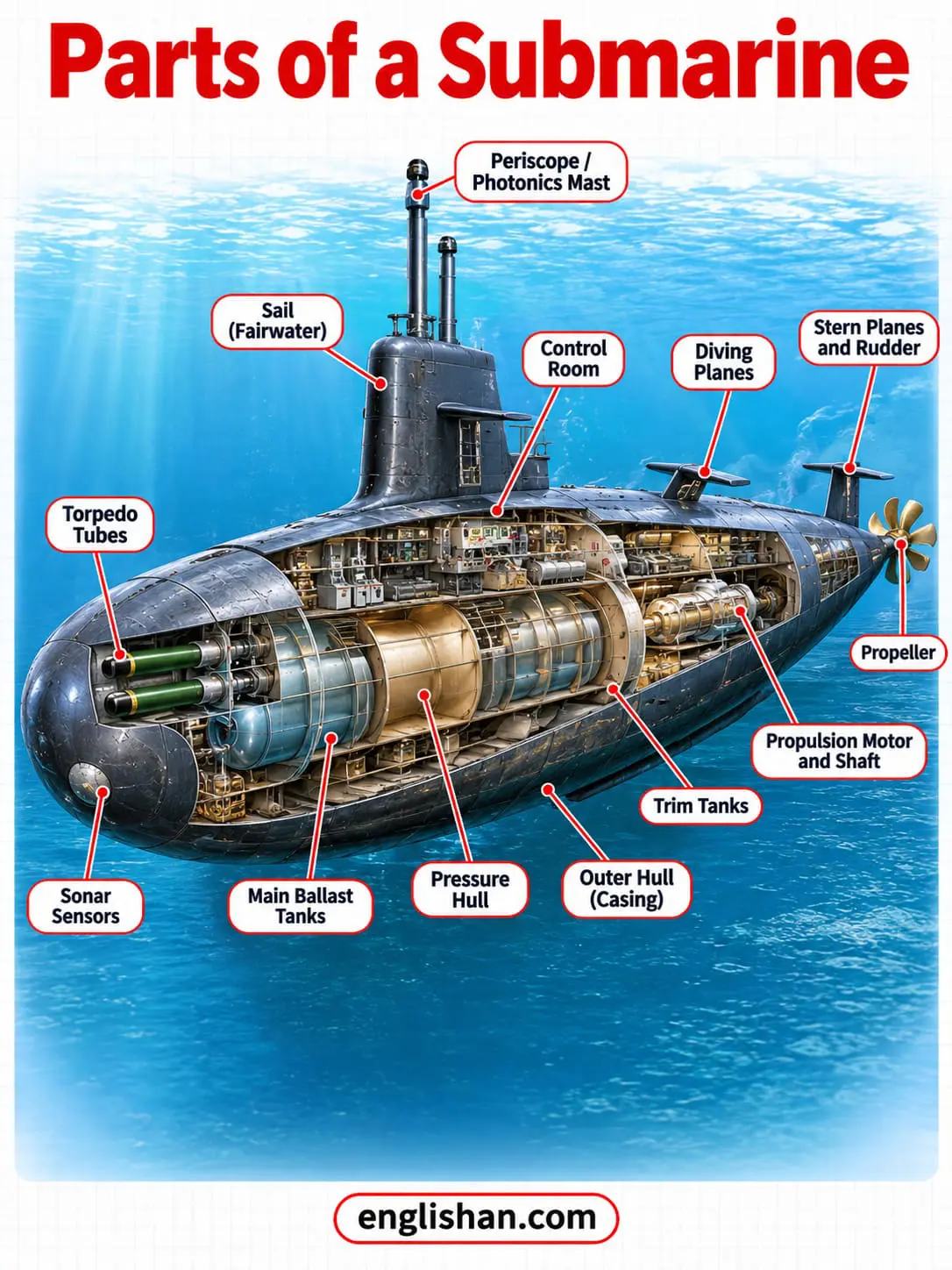
In a labeled diagram of a submarine, the torpedo tubes and sonar sensors are at the bow, and the sail rises from the top of the hull. The propeller, rudder, and stern planes are at the rear. The ballast tanks fill the space between the pressure hull and the outer hull. The numbers run from bow to stern.
| Part | Position | Role |
|---|---|---|
| 1. Torpedo tubes | Front of the submarine | Launch self-propelled torpedoes |
| 2. Sonar sensors | Forward, between the hulls | Detect sound underwater, away from machinery noise at the stern |
| 3. Main ballast tanks | Between the inner and outer hulls | Fill with water to dive and with air to surface |
| 4. Pressure hull | Inner hull | Resists water pressure and protects the crew |
| 5. Outer hull or casing | Around the pressure hull | Streamlines the vessel and floods when submerged |
| 6. Control room | Mid-hull | Holds the navigation, sonar, propulsion, and weapons controls |
| 7. Sail or fairwater | Top of the hull | Supports the masts and is a vertical stabilizer |
| 8. Periscope or photonics mast | Raised through the sail | Gives a view of the surface |
| 9. Diving planes | Bow or sail | Control depth while the submarine moves forward |
| 10. Trim tanks | Forward and aft | Keep the weight balanced along the hull |
| 11. Propulsion motor and shaft | Aft compartment | Turn the propeller |
| 12. Stern planes and rudder | Stern | Control pitch and course |
| 13. Propeller | Stern | Drives the submarine through the water |
Parts of a Submarine Hull
Two hulls define the parts of a submarine that face the sea.
Pressure hull
The pressure hull is the inner hull that holds the people and the pressure-sensitive systems. It has a circular shape, because a circle resists external pressure best. A deviation of one inch (25 mm) from perfect roundness reduces the hydrostatic load capacity by over 30 percent.
Outer hull or casing
The outer hull is called the casing in British usage and the light hull in some designs. It is free-flooding, so it does not resist sea pressure. It does set the hydrodynamic performance, which sets how much power the vessel needs. Anechoic tiles or a synthetic skin cover some outer hulls to reduce the sonar signature and radiated noise.
Pressure rises by 44 psi for every 100 feet of depth, so the hull steel sets the maximum dive depth. US submarines use HY-80 and HY-100 steels, and some Russian submarines use titanium. World War I submarines had a test depth of no more than 100 meters (330 feet), and World War II submarines reached 200 meters (660 feet). The Soviet submarine Komsomolets, built with a titanium hull, had a test depth of 1,000 meters (3,300 feet). The US Los Angeles class has a test depth of 450 meters (1,480 feet). These figures describe the pressure hull, the part of a submarine that bears the hydrostatic load.
Single Hull and Double Hull Design
Hull layout is the main difference in the parts of a submarine built in the United States and in the Soviet Union. Small modern submarines, submersibles, and the oldest submarines have a single hull. Most American submarines are single-hulled, and their main cylindrical body has one layer of plating. In that design the light hull is discontinuous and exists mainly at the bow and stern, where it houses the main ballast tanks.
All Soviet heavy submarines have a double hull. The gap between the hulls holds ring stiffeners and longitudinals, which saves space inside the pressure hull. The light hull also takes part of any damage, and the vessel stays intact as long as the pressure hull holds.
Ballast Tanks and Trim Tanks
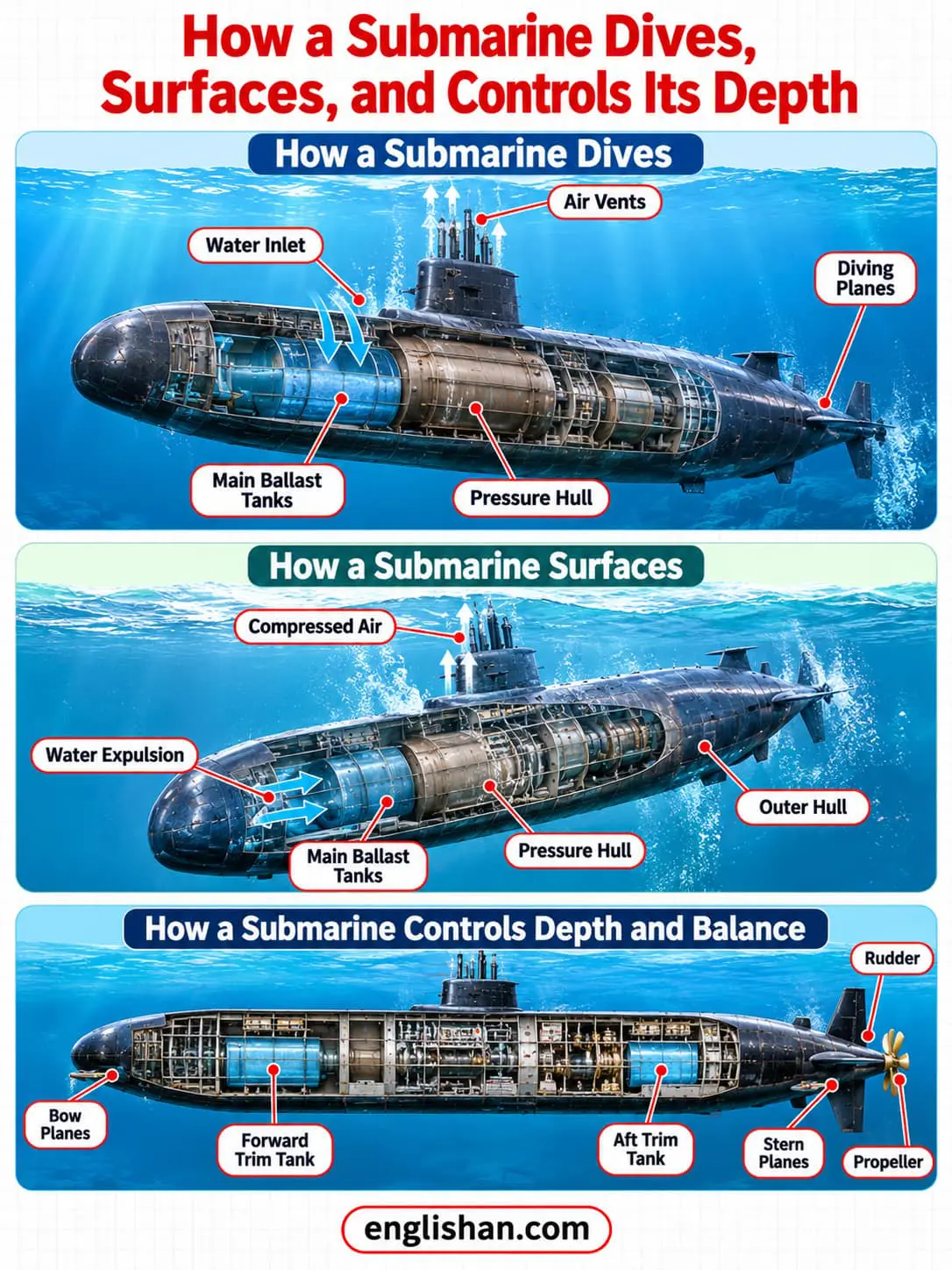
A surfaced submarine is positively buoyant, so it must become negatively buoyant to submerge. Three kinds of tank set that balance, and they are the parts of a submarine that control its buoyancy.
Main ballast tanks
These are the largest tanks on the vessel. They fill with water to submerge and with air to surface. A double-hull submarine has them between the hulls, and an American single-hull submarine has them in the bow and stern ends of the light hull.
Depth control tank
This is a variable buoyancy pressure vessel, also called a hard tank. It is pressurized to submergence pressure, and it restores neutral buoyancy and gives finer depth control.
Trim tanks
Two trim tanks, one forward and one aft, keep the weight balanced along the length of the hull. Pumps move water between them to pitch the submarine up or down. Burning fuel and using supplies shift the weight distribution, so the crew keeps adjusting trim throughout a patrol.
Submarine Diving Planes and Rudder
Diving planes
Diving planes, also called hydroplanes, are the control surfaces that pitch the submarine and hold its depth. They generate lift as the submarine moves forward, as airplane wings do, and the lift depends on the tilt angle of the planes and the speed of the vessel. The same principle applies to the parts of an airplane.
Submarines use up to three sets of planes:
- Bow planes: Fitted at the front of the hull. Starting with the third-flight Los Angeles class (688i), US boats dropped sail planes and rely on bow planes, which are retractable.
- Sail planes: Also called fairwater planes on US Navy boats. They do not pitch the boat. They make it rise or sink on a level plane. From the Sturgeon class onward, they rotate to vertical so polar ice does not damage them when the boat surfaces.
- Stern planes: Fitted at the rear, like an aircraft elevator. They are mounted far from the center of buoyancy, so they have a larger effect on pitch, and they are the preferred depth control at higher speeds.
Rudder
The rudder controls the course of the submarine, which is called yaw, and it is mounted at the stern beside the propeller.
In the cruciform stern layout, the horizontal planes control trim and the vertical planes control yaw. Some submarines use an X-stern, with four control surfaces rotated 45 degrees from the cross shape. USS Albacore tried the X-stern in the early 1960s, and Sweden’s Sjöormen class, launched in 1967, was the first to use it in standard operation.
Parts of a Submarine Sail and Periscope
Sail or fairwater
The sail is the tall structure on the top of the hull. American usage calls it the sail or the fairwater, and British and Commonwealth usage calls it the fin. It once housed the conning tower, the command and communications center, and it still holds the periscopes, radar, and communications masts. Among the parts of a submarine, the sail is the structure that rises from the top of the hull.
The sail has four more roles. At the surface it is an observation platform and as an entrance with enough freeboard to keep the submarine from being swamped. Modern sails are not pressure vessels, so they flood when the submarine submerges. Underwater the sail is a vertical stabilizer. Its airfoil profile also reduces drag.
Periscope
A periscope lets a submerged submarine see the surface through a retractable tube that uses mirrors and lenses, or prisms, to bring the image down to the viewer. Only the end of the tube has to break the water, a position called periscope depth. Submarines traditionally had two periscopes: a wide-angle observation periscope and a higher-magnification attack periscope for torpedo targeting.
Photonics mast
Modern boats use periscopes only occasionally, mainly for position fixes and to verify contacts. The Virginia and Astute classes replaced hull-penetrating optical periscopes with photonics masts. The Virginia class has two redundant sets of sensors on two AN/BVS-1 photonics masts outside the pressure hull. Their cables pass through a much smaller hull opening, which is easier to seal.
Submarine Compartments From Bow to Stern
The inside of a submarine divides into watertight compartments, and these parts of a submarine differ between nuclear and diesel-electric designs. A US nuclear submarine has a torpedo room, crew living quarters, a control room, a reactor compartment, an engine room, a sonar room, and a navigation room. In a diesel-electric design the accommodation is mid-hull, directly under the sail, which provides an escape route.
Control Room
The control room is the main station for navigation, sonar, propulsion, and weapons controls. The command center within it is where officers make decisions and monitor the status of the vessel. On USS Silversides, the control room holds the steering wheel, the dive station, the bow and stern plane wheels, the periscope wells, and the ladder to the conning tower. The conning tower over it was the attack center, where the captain and officers worked during battle.
Torpedo Room
Torpedo tubes
Torpedo tubes launch self-propelled torpedoes from the front of the vessel. A Los Angeles class boat has four 21-inch (533 mm) tubes, and a Virginia class boat has four as well.
Torpedo room
USS Silversides had six tubes in the forward torpedo room, racks for 22-foot Mark XIV torpedoes, and space for 16 men. Its after torpedo room had four tubes and space for 8 torpedoes.
Crew Quarters and Galley
Crew spaces include sleeping bunks in shared compartments, a galley, and a mess hall. On USS Silversides, the forward battery compartment held the officers’ staterooms, the wardroom, and one of two 126-cell batteries. The after battery compartment held the crew’s mess, which seated 24, a main berthing space for 36 men, and the second battery.
Reactor and Engine Rooms
A nuclear submarine has a reactor compartment, which provides power for propulsion and onboard systems. A conventional submarine has diesel engines and battery banks. Main and auxiliary machinery together make up about 30 percent of the total weight. USS Silversides had four Fairbanks Morse diesel engines of 1,600 horsepower each in its engine rooms, and a maneuvering room with the propulsion control panel. The maneuvering room was the smallest compartment on the boat.
Parts of a Submarine Propulsion System
Most non-nuclear submarines use diesel-electric propulsion. The diesel engine runs a generator that charges large batteries, and the batteries power the electric motors. Once the batteries are charged, the submarine dives and runs on battery power alone.
Propulsion motor and shaft
The main electric propulsion motor, the main propulsion shaft, the tail shaft, and the glands are in the aft propulsion compartment, with a reduction gearbox on diesel-electric designs. On the Los Angeles class, turbines drive the single shaft through a reduction gear.
Propeller
The propeller is at the stern with the rudder. Nuclear submarines use small reactors and need no air, so they power their propellers at any depth. The Los Angeles class has one S6G reactor of 150 to 165 megawatts. Some submarines, including the British Vanguard class, use a pump-jet propulsor in place of a propeller, which is quieter but heavier, more expensive, and less efficient.
Nuclear power allows submerged operation for weeks or months. Air-independent propulsion is a third option. It includes Stirling engines on Sweden’s Gotland class and hydrogen fuel cells on Germany’s Type 212.
Navigation and Life Support Systems
Light does not travel well through water, so a submarine sees little underwater. Periscopes work near the surface but are useless at depth. Submarines navigate with GPS, sonar, and inertial guidance, and the gyroscopes of an inertial system need periodic correction.
Sonar sensors
Sonar is short for Sound Navigation and Ranging. The sensors are placed forward, between the hulls, away from the turbulence and machinery noise at the stern. The sonar arrays are mounted on the hull to detect sound.
These parts of a submarine form a sealed environment. Electrolysis makes oxygen from water, scrubbers remove carbon dioxide from the air, and the desalination of seawater supplies drinking water. Trash is compacted into steel cans and ejected through an airlock.
FAQs
The parts of a submarine are the pressure hull, the outer hull or casing, the main ballast tanks, the trim tanks, the sail, the periscope, the diving planes, the rudder, and the propeller. The compartments inside the hull complete the set. Each part has a fixed position from bow to stern in the numbered diagram.
The main parts of a submarine are the pressure hull, the ballast tanks, the diving planes, the engine, the sail, the navigation systems, and the life-support systems. A science explainer on submarines names the same seven as its core set.
The outer parts of a submarine are the outer hull or casing, the sail, the diving planes, the rudder, and the propeller. The sail rises from the top of the hull, the planes and rudder control depth and course, and the propeller is at the stern.
The inside of a submarine is a series of watertight compartments: torpedo rooms at the front and rear on a World War II boat, officers’ and crew quarters, a control room, and engine rooms. A nuclear submarine adds a reactor compartment, a sonar room, and a navigation room. The parts of a submarine inside the hull are all watertight compartments.
The front of a submarine is the bow. The torpedo tubes and the forward torpedo room are there, and the sonar sensors are forward between the hulls. The bow planes are also fitted at the front on boats that use them.
The sail is the tall structure on the top of the hull, also called the fairwater in American usage and the fin in British usage. It supports the periscope, radar, and communications masts, and on some boats it supports the diving planes.
The con in conning tower names the station that directs the submarine. Older submarines called the tower a conning tower because it held the controls. On USS Silversides it was the attack center over the control room, where the captain and officers worked during battle.
No source gives one fixed count. One science explainer names seven core parts, and an engineering explainer describes eleven. The count depends on whether it includes the compartments, the sensors, and the battery banks.
A submarine going down is diving, or submerging. It dives when the main ballast tanks fill with water and the diving planes set the pitch. It surfaces when the tanks fill with air.
A submarine finds its position with GPS, sonar, and inertial guidance. Inertial guidance uses gyroscopes and needs periodic correction. The periscope or photonics mast supports position fixes near the surface.
Related: