

A vacuum cleaner is a motorized appliance with a floor head, a wheeled body, and a hose or wand. It draws dirt into a bin or bag by suction. The parts of a vacuum cleaner fall into three groups: the fixed body, the floor head, and the tools you swap.
Cordless, robot, and wet-dry models rearrange the same three groups.
Labeled Diagram of a Vacuum Cleaner
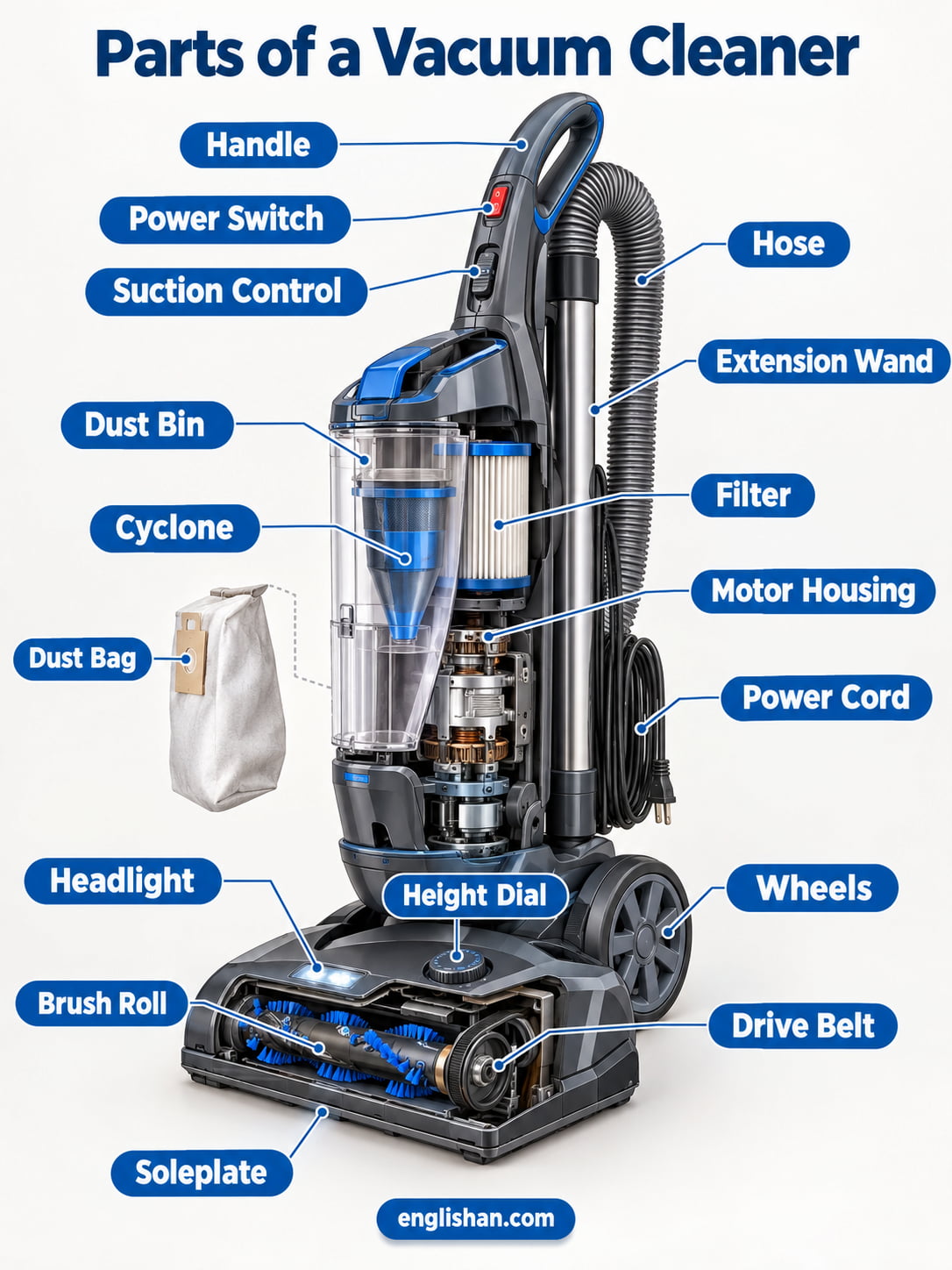
An upright vacuum cleaner has a wide floor head at the bottom and a tall body rising from it. A bin or bag is fixed in the body, and a hose and wand clip to the back. The power switch is on the handle, and the cord wraps around hooks behind the bin. A brush roll spins inside the floor head, and two rear wheels tilt the body back. This diagram of the parts of a vacuum cleaner is numbered from the body down to the tools.
| Part | Where you find it |
|---|---|
| 1. Dust bin | Transparent cup or canister in the body |
| 2. Cyclone | Cone-shaped chamber inside the bin of a bagless model |
| 3. Dust bag | Paper or cloth sack in the bag compartment |
| 4. Filter | Foam or pleated cartridge next to the bin |
| 5. Motor housing | Molded shell behind the bin |
| 6. Power cord | Cable on hooks at the back of the body |
| 7. Power switch | Rocker, button, or foot pedal on the body |
| 8. Suction control | Slider or dial on the handle or hose |
| 9. Wheels | Two large rear wheels under the body |
| 10. Handle | Molded grip at the top of the body |
| 11. Brush roll | Bristled cylinder inside the floor head |
| 12. Drive belt | Rubber loop around the brush roll |
| 13. Soleplate | Flat underside of the floor head |
| 14. Headlight | LED on the front edge of the floor head |
| 15. Height dial | Knob on the floor head |
| 16. Hose | Ribbed flexible tube behind the body |
| 17. Extension wand | Rigid tube between the hose and the floor head |
| 18. Crevice tool | Slim nozzle clipped to the body |
| 19. Dusting brush | Round soft-bristle head clipped to the body |
| 20. Upholstery tool | Wide flat nozzle clipped to the body |
| 21. Battery pack | Slide-in block on a cordless handle |
| 22. Charging dock | Base station for a robot vacuum |
Main Parts of a Vacuum Cleaner
Five of the parts of a vacuum cleaner do the work of suction and collection. The rest position them or extend their reach.
- Motor: A sealed electric motor in the body, rated at 8 to 12 amps on a corded model.
- Filter: The foam or pleated sheet that stops fine dust before the motor.
- Dust bin or bag: The container that collects the dirt, from 1 to 4 quarts.
- Brush roll: The bristled cylinder in the floor head that loosens dirt from carpet.
- Hose and wand: The tubes that draw air from the floor head to the body.
Vacuum Cleaner Body Parts
Ten of the parts of a vacuum cleaner make up the fixed body. Its shell is molded plastic in gray, black, red, or white, and it does not change between floors or jobs.
Dust Bin
The dust bin is a transparent plastic cup or canister at the front of the body, with a release latch at the top. Its capacity is 1 to 3 quarts on a bagless model. A hinged flap under the bin opens to empty the dirt.
Cyclone
The cyclone is a cone-shaped plastic chamber, 3 to 5 inches tall, fixed inside the bin of a bagless model. Air enters it at an angle and spins, which throws the dirt down into the bin. Stick models group several small cyclones in a ring around the top.
Dust Bag
The dust bag is a sack of paper or synthetic fabric, 3 to 4 quarts, fitted over a cardboard collar. It clips into a compartment in the body. A bagged model has this part in place of the bin.
Filter
The filter is a foam sheet or a pleated paper cartridge, 4 to 6 inches wide, next to the bin. A HEPA filter is white and pleated, and it traps 99.97 percent of particles as small as 0.3 microns. A second, thinner filter covers the exhaust.
Motor Housing
The motor housing is a molded plastic shell behind the bin, with slotted vents on its sides. The fan inside works like a small electric fan turned to pull air. Corded motors draw 1,000 to 1,500 watts on a 120-volt outlet.
Power Cord
The power cord is a 25 to 35 foot cable of rubber or vinyl, in black, gray, or yellow. It wraps around two hooks on the back of the body. The upper hook swivels so the cord unwinds in a single pull. A polarized plug ends it. Among the parts of a vacuum cleaner, the cord sets how far the machine reaches from the outlet.
Power Switch
The power switch is a rocker or a push button on the handle. Uprights add a foot pedal, a flat lever at the base of the body. It has On and Off positions, and some models add a second speed.
Suction Control
The suction control is a slider or dial on the handle or the hose. It opens a small vent in the airway, which lowers suction for curtains and rugs. Its face is marked with a plus and a minus, or with low and high.
Wheels
Two large wheels, 4 to 6 inches across, are set at the rear of an upright body. They are hard rubber or plastic, and a steel axle joins them. A canister has two side wheels and a swivel wheel at the front.
Handle
The handle is a molded grip of plastic with a rubber overlay at the top of the body. It has a cutout for the hand. A release pedal on an upright body tilts the handle back for use.
Vacuum Cleaner Floor Head Parts
The floor head is the part of a vacuum cleaner that meets the floor. It is a wide, low nozzle, 12 to 15 inches across, and five of the parts of a vacuum cleaner change with the floor.
Brush Roll
The brush roll is a cylinder, 10 to 14 inches long, with rows of nylon bristles and rubber flaps in a spiral. It is fixed across the inside of the head and spins on two end caps. Carpet models use stiff bristles, and hard floor models use soft fabric.
Drive Belt
The drive belt is a flat rubber loop about half an inch wide, fitted around the brush roll and a motor spindle. It is black or gray, and its inner face is ribbed. Some newer models replace it with a direct-drive motor.
Soleplate
The soleplate is the flat plastic underside of the floor head. It has a wide slot that opens to the brush roll. Small runners or felt strips along its edges glide over the floor.
Headlight
The headlight is a white LED on the front edge of the floor head, in a small lens. It lights the floor ahead of the head. A switch on the head or the handle turns it on.
Height Dial
The height dial is a knob or a slider on the floor head, marked with hard floor, low carpet, and high carpet. Turning it raises or lowers the brush roll. Its ring is plastic, with a small pointer.
Vacuum Cleaner Attachments
Five of the parts of a vacuum cleaner are tools, and each fits the end of the wand or the hose. None is fixed to the body.
Hose
The hose is a ribbed flexible tube of plastic, 5 to 7 feet long and 1.25 to 1.5 inches wide. A plastic cuff joins each end. On a canister it runs to the wand, and on an upright it clips behind the body. The round cuff at the floor end is the suction inlet.
Extension Wand
The extension wand is a rigid tube of plastic or steel, 24 to 36 inches long. Two sections slide into each other and lock with a push button. It joins the hose to the floor head or a tool.
Crevice Tool
The crevice tool is a slim plastic nozzle, about 10 inches long, that tapers to a narrow slot. It is black or gray. It reaches into corners, along baseboards, and between seat cushions.
Dusting Brush
The dusting brush is a round plastic head, 2 inches across, ringed with soft bristles. A collar in the center fits the wand. It sweeps dust from shelves, blinds, and vents.
Upholstery Tool
The upholstery tool is a wide flat nozzle, about 4 inches across, with a strip of fabric or bristles on its lower edge. A short neck fits the hose. It is made for sofas, mattresses, and stairs.
Vacuum Cleaner Types and Their Parts
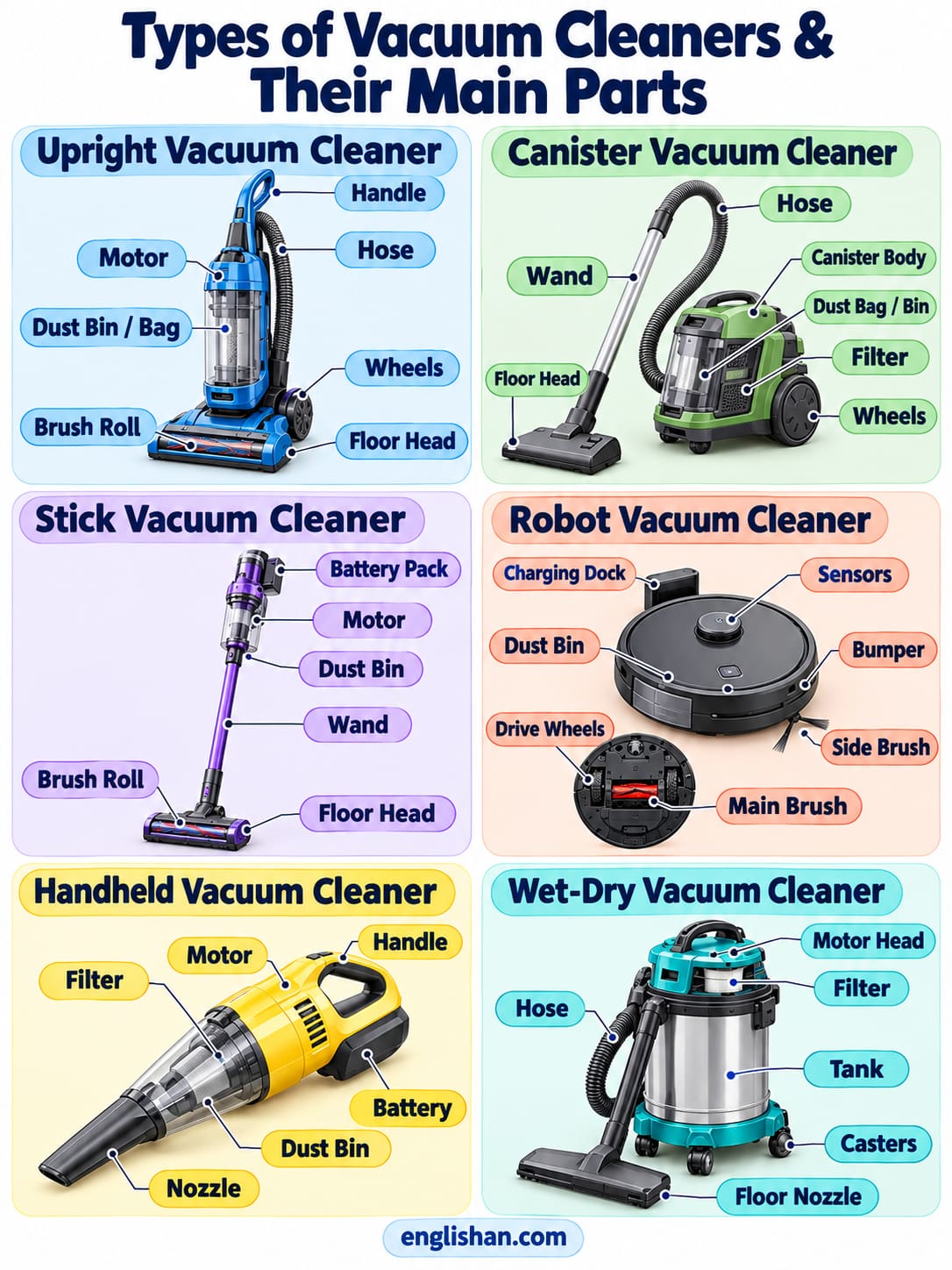
The parts of a vacuum cleaner change with the type, and six types are common in US homes and shops.
Upright Vacuum Cleaner
The upright vacuum cleaner is a tall body on a wide floor head, 40 to 48 inches high. The bin or bag, motor, handle, and cord are all in the body. The brush roll is in the head, and the hose and wand clip to the back.
Canister Vacuum Cleaner
The canister vacuum cleaner is a wheeled drum, about 12 inches long, with a long hose and a wand. The motor, bin or bag, and filter are inside the drum. A separate floor head plugs into the wand.
Stick Vacuum Cleaner
The stick vacuum cleaner is a slim cordless body that weighs 5 to 8 pounds. A battery pack of 18 to 25 volts clips to the handle, and a small bin is set at the top. The floor head is at the bottom of a long wand.
Robot Vacuum Cleaner
The robot vacuum cleaner is a round disc, about 13 inches wide and 3 inches tall. It has a main brush, a side brush, a bumper, a small bin, and two drive wheels. A charging dock is the base station.
Handheld Vacuum Cleaner
The handheld vacuum cleaner is a compact unit, 12 to 16 inches long, with a pistol grip. A nozzle, a small bin, and a filter are in the front, and a battery or cord is at the rear. It reaches car seats, stairs, and shelves.
Wet-Dry Vacuum Cleaner
The wet-dry vacuum cleaner is a round tank of 5 to 16 gallons on casters, with a motor head on top. Its hose is 1.25 to 2.5 inches wide, and a foam sleeve or cartridge filter covers the intake. It handles spills on garage and kitchen floors.
FAQs
Q1. What are the parts of a vacuum cleaner called?
The parts of a vacuum cleaner are called the motor, dust bin, filter, brush roll, drive belt, hose, wand, wheels, cord, and switch. The body has the motor, bin, filter, and cord. The floor head has the brush roll, and the hose, wand, and tools are the swappable parts.
Q2. What are the parts of a vacuum cleaner and their functions?
The motor creates suction, the filter stops fine dust, and the dust bin or bag collects the dirt. The brush roll loosens dirt from carpet, and the drive belt turns it. The hose and wand reach tight spots. The switch and suction control set the power.
Q3. What are the parts of an upright vacuum cleaner?
An upright vacuum cleaner has a floor head with a brush roll and a tall body. The body has a bin or bag, motor, filter, handle, cord, and wheels. The hose and wand clip to the back, and the tools clip to the body.
Q4. What are the parts of a canister vacuum cleaner?
A canister vacuum cleaner has a wheeled drum with the motor, bin or bag, and filter. A hose runs from the drum to a wand, and a floor head plugs into the wand. The tools store on the drum or on the wand.
Q5. What are the parts of a cordless vacuum cleaner?
A cordless vacuum cleaner has a battery pack, a motor, a small dust bin, a filter, and a wand. The wand ends in a floor head with a brush roll. The battery clips to the handle, and a charging dock or wall bracket stores the vacuum.
Q6. What are the parts of a vacuum cleaner hose?
A vacuum cleaner hose has a ribbed flexible tube, a cuff at each end, and a wand connector. Some hoses add a handle with a suction control. A crevice tool, dusting brush, or upholstery tool fits the far end.
Q7. What part of a vacuum cleaner collects dirt?
The dust bin or the dust bag collects the dirt. A bagless model has a transparent bin that empties from the bottom, and a bagged model has a sack that is replaced when full. The filter next to it stops the fine dust.
You May Also Like
- Parts of an Air Cooler
- Parts of an Air Conditioner
- Parts of an Electric Fan
- Parts of a Kitchen
- Parts of a Lawn Mower