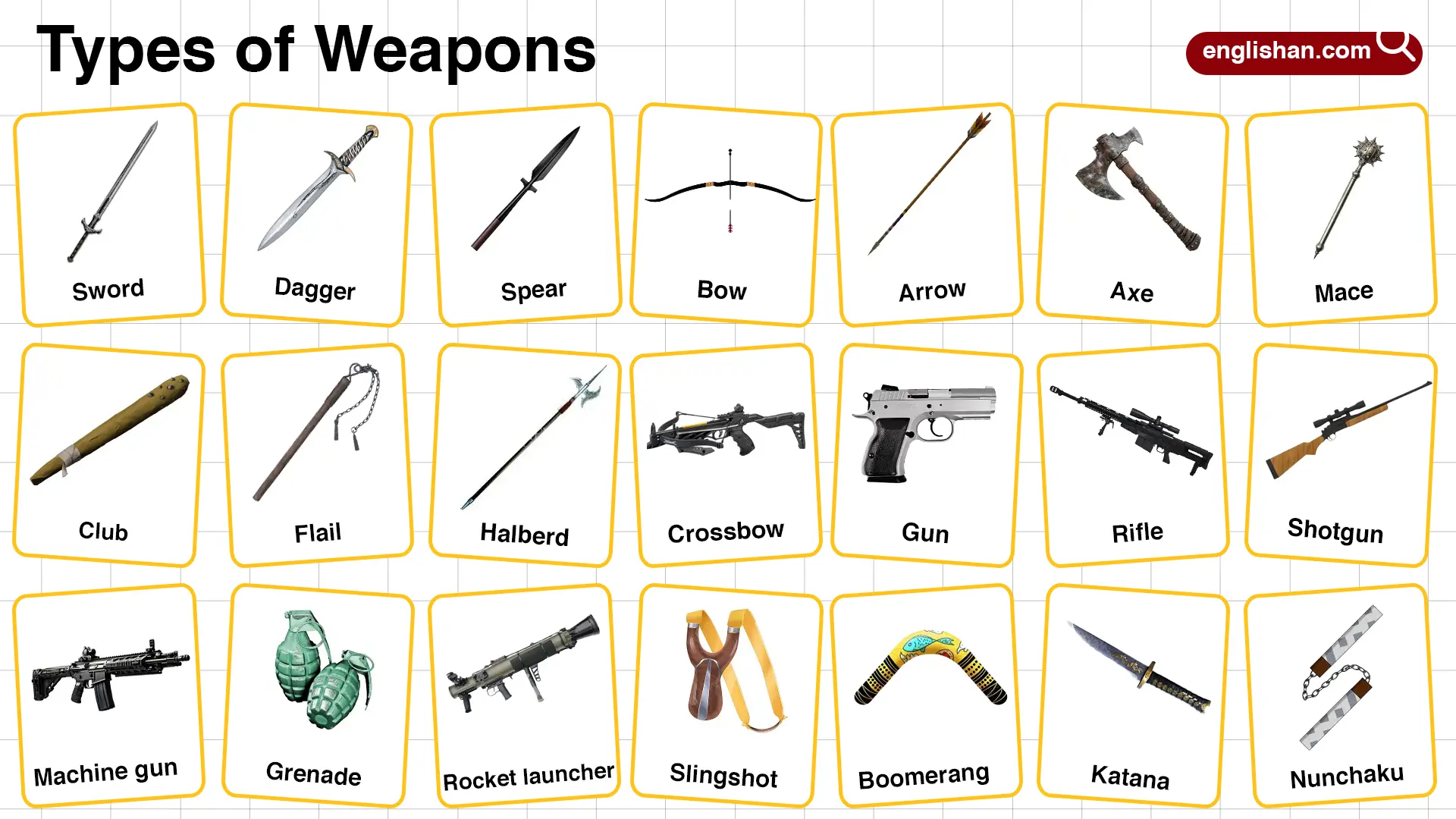
Types of weapons vary by how they work, how far they reach, and the damage they cause. Some are used in close combat like swords, knives, or clubs. Others attack from a distance, like bows, rifles, or missiles. Newer ones include laser-based or shock weapons used in games and defense systems.
Knowing these names helps you describe gear in history, action scenes, or military topics. You’ll also build stronger vocabulary by learning how different types of weapons are named and grouped.
List of Types of Weapons
Understanding the types of weapons helps you learn the different names used in English for combat tools. Below is a categorized list of common weapon types based on how they work and how they are used.
- Sword
- Dagger
- Spear
- Bow
- Arrow
- Axe
- Mace
- Club
- Flail
- Halberd
- Crossbow
- Gun
- Rifle
- Pistol
- Shotgun
- Machine gun
- Grenade
- Rocket launcher
- Slingshot
- Boomerang
- Katana
- Nunchaku
- Baton
- Taser
- Whip
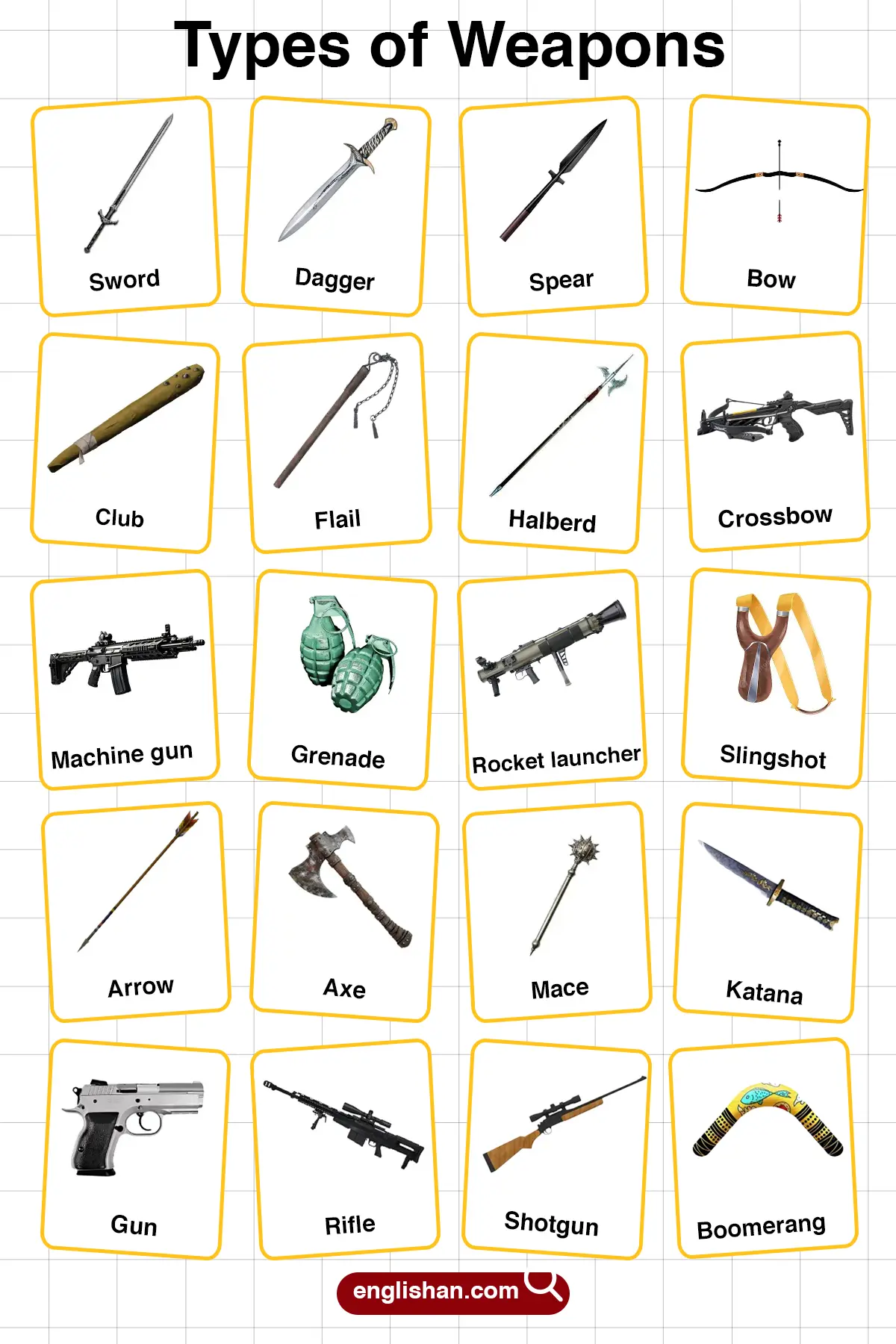
Melee Weapons
Melee weapons are used in close combat without the need for projectiles. Below is a list of weapons you strike or thrust with directly.
- Sword: A long, sharp blade used for slashing and thrusting.
- Dagger: A small pointed knife designed for stabbing.
- Club: A blunt weapon made of wood or metal for heavy strikes.
- Axe: A weapon with a sharp blade for chopping, sometimes used in battle.
- Mace: A heavy club with a metal head, used to crush armor.
- Flail: A spiked ball attached to a handle by a chain, swung in circular motion.
- Halberd: A pole weapon with an axe blade and a pointed spike at the top.
- Nunchaku: Two sticks connected by a chain, swung skillfully for striking.
- Whip: A long flexible weapon used for striking with speed and precision.
Ranged Weapons
Ranged weapons are used to attack from a distance. Below is a list of tools that launch or throw objects toward a target.
- Bow: A curved wood or composite weapon that shoots arrows.
- Arrow: A pointed shaft shot from a bow to hit targets at a distance.
- Crossbow: A mechanical version of the bow that holds and shoots bolts.
- Slingshot: A Y-shaped tool with rubber bands to launch small projectiles.
- Boomerang: A curved throwing tool that can return to the thrower.
Explosive Weapons
Explosive weapons cause damage through a blast. Below is a list of weapons that explode on impact or after a delay.
- Grenade: A hand-thrown bomb that explodes after a few seconds.
- Rocket Launcher: Fires explosive rockets for destroying large targets.
- Landmine: An explosive device placed on the ground and triggered by pressure.
- Plastic Explosives: Soft and moldable bombs used for controlled demolition.
Energy Weapons
Energy weapons use focused energy instead of bullets or blades. Below is a list of advanced tools that rely on directed force.
- Laser Gun: Fires a beam of concentrated light that burns or cuts.
- Plasma Rifle: Uses ionized gas to deal damage with heat and force.
- Directed Energy Weapon: Emits energy beams to disable or destroy targets without projectiles.
Chemical and Biological Weapons
These weapons use toxins, gases, or viruses to harm large groups. Below is a list of harmful substances used in warfare.
- Tear Gas: Causes eye pain and tears, used for crowd control.
- Mustard Gas: A chemical that causes blisters and breathing issues.
- Bioweapon: Uses bacteria or viruses to spread illness in a targeted area.
Types of Handheld Weapons
Handheld weapons are easy to carry and use directly. Below is a list of commonly used short-range weapons.
- Swords
- Knives
- Clubs
- Axes
- Maces
- Daggers
- Nunchaku
- Baton
- Whip
Projectile Weapons
Projectile weapons launch objects toward a target. Below is a list of weapons that use physical force to propel items.
- Bows
- Crossbows
- Slingshots
- Blowguns
- Boomerangs
Firearms
Firearms are guns that shoot bullets using gunpowder. Below is a list of firearms sorted by type and firing power.
- Pistols: Small handguns used at close range.
- Rifles: Long guns used for aiming at distant targets.
- Shotguns: Fire shells that spread pellets over a wide area.
- Machine Guns: Automatic guns that shoot rapidly without needing to reload often.
- Submachine Guns: Compact automatic weapons used in close combat.
Types of Heavy Weapons
Heavy weapons are large and powerful, often used in war or defense. Below is a list of large-scale weapons.
- Cannons: Large guns that fire heavy shells.
- Rocket Launchers: Weapons that shoot explosive rockets at armored targets.
- Mortars: Fire shells in a curved arc, useful for hitting enemies behind cover.
Explosive Devices
These weapons explode to cause damage in an area. Below is a list of common explosive devices used in modern warfare.
- Grenades
- Landmines
- Plastic Explosives
Laser and Directed Energy Weapons
This category includes futuristic tools that use energy beams. Below is a list of directed energy weapons.
- Laser Guns
- Plasma Cannons
- Microwave Weapons
Non-Lethal Weapons
These weapons are used to stop someone without killing them. Below is a list of tools designed for control and defense.
- Stun Guns: Electric shock weapons used to stop an attacker.
- Pepper Spray: Causes burning in the eyes and skin.
- Rubber Bullets: Fired to hurt but not kill, used by police.
- Batons: Used by security forces for striking or blocking.
Historic Weapons
Historic weapons were used in ancient times. Below is a list of weapons used in early battles and wars.
- Spears: Long pointed weapons for throwing or stabbing.
- Halberds: Polearms combining axe and spear functions.
- Flails: Swinging weapons that strike with force from a chain.
Conclusion on Types of Weapons
Learning the types of weapons in English helps you understand important vocabulary used in safety, history, and combat. From melee to modern firearms, each weapon has a specific name and use. Reviewing categorized lists makes learning easier and supports better word recall for everyday reading, watching, or classroom use.
FAQs About Types of Weapons
A melee weapon is used up close, like a sword or axe. A ranged weapon attacks from far, like a bow or gun.
Both are explosive weapons, but grenades are thrown by hand, while landmines are placed and explode when stepped on.
Non-lethal weapons like pepper spray, stun guns, and batons are used to protect without causing death.
You May Also Like