EOD meaning often lands in a work email right before a deadline, and you have to read it the right way. In office talk it means end of day, tied to a report, a client, a time zone, and a due time in Slack, Microsoft Teams, or a calendar note.
In this article, we cover the meaning first, then how people use it at work, since the due time can depend on who is sending it. We also cover Explosive Ordnance Disposal in police and military talk, linked to a bomb squad. Next come short examples so you pick the right sense before you reply.
What Does EOD Mean?
The acronym EOD functions as a common deadline marker indicating the conclusion of the workday. In professional settings, it sets a specific time by which a task must be completed or a document submitted. Writers use it to create a clear boundary for deliverables without specifying an exact hour like “5:00 PM.”
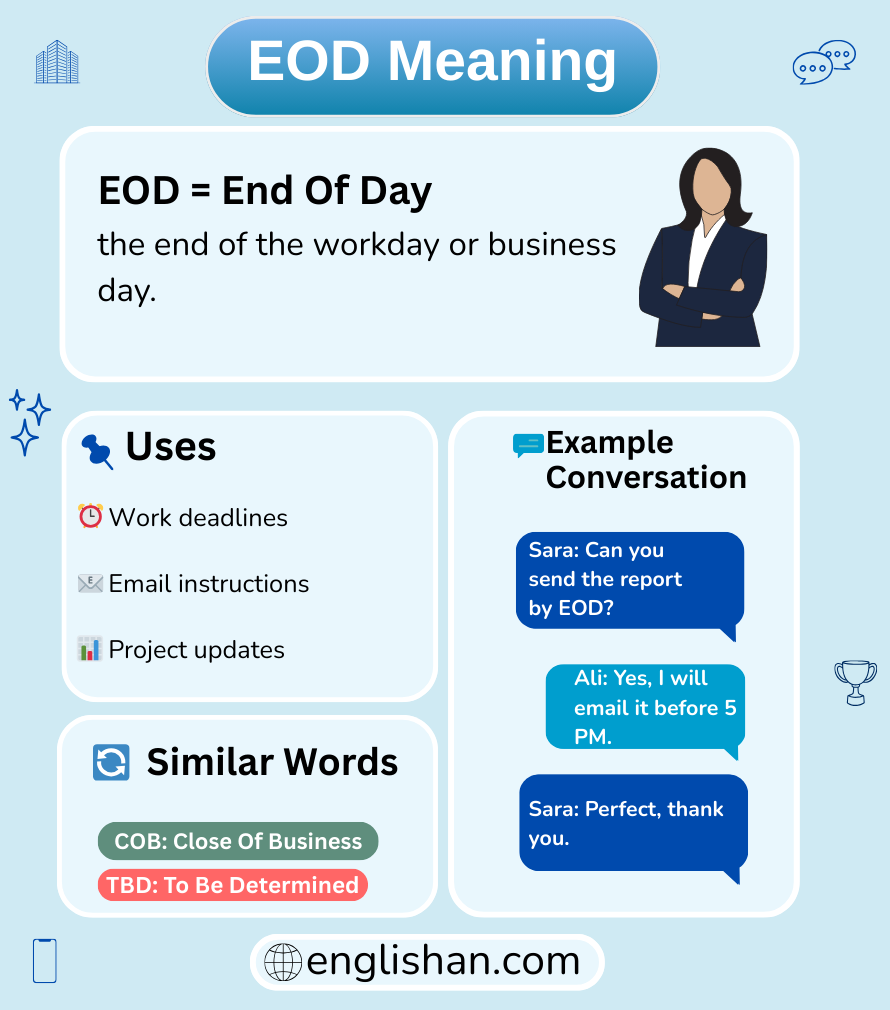
What Does EOD Stand For?
This three-letter abbreviation stands directly for End Of Day. It grammatically acts as a noun phrase referring to the time when business operations cease or when a person stops working. While typically associated with corporate deadlines, it is also standard shorthand in financial markets.
How EOD Is Used
People use this term to establish expectations regarding when they will finish a project. It appears frequently in status updates to assure a manager that work will be done before the employee logs off. It offers slightly more flexibility than a fixed hour, often implying “before tomorrow morning.”
EOD In Work Communication
In the corporate world, this acronym is standard vocabulary for assigning tasks. A manager might write, “Please submit the report by EOD,” which tells the employee they have until the evening to finish. It is a polite yet firm way to request same-day turnaround.
EOD In Casual Messages
In casual digital messages, friends use EOD to describe their personal availability. A user might text, “I am free after EOD,” meaning they are busy until their work or school shift finishes. It serves as a clear marker between professional time and personal time.
EOD In Deadline Statements
Project managers use this label to mark a cutoff time for group contributions. It is used when multiple people need to submit information or votes before a decision can be made. It ensures that everyone knows the final opportunity for their input to be counted is the end of that specific day.
EOD Example Conversations
These dialogues demonstrate how colleagues and friends use the term to set professional deadlines and manage personal availability.
Jason: When do you need the quarterly review finished?
Mike: If you can get it to me by EOD, I can review it first thing tomorrow.
Jason: Okay, I will stay a bit late to wrap it up.
Sarah: Are you free to grab dinner tonight?
Emily: I am slammed right now, but I should be free after EOD.
Sarah: Perfect, text me when you log off.
David: Did the client approve the budget yet?
Jessica: Not yet, they said they would send the signed contract by EOD Friday.
David: I hope they don’t forget, we need to start on Monday.
Origin Of EOD
The term originated in the financial sector and trading floors to mark the official close of the market day. It was crucial for settling accounts before the next trading session began. From there, it drifted into general corporate language and eventually into casual slang as a synonym for “after work.”
Common Confusions With EOD
A frequent mix-up occurs with the military acronym EOD (Explosive Ordnance Disposal). In a war zone or news report, EOD refers to the bomb squad, not a deadline. Context is vital; if the conversation is about deadlines, it means End Of Day; if it is about defusing bombs, it refers to the specialized unit.
End Of Day Vs End Of Discussion
In heated internet arguments, some users re-purpose EOD to mean End Of Discussion. This is a way to shut down a debate aggressively. However, this is a niche slang usage; the vast majority of the time, EOD refers to time.
EOD Vs COB
The distinction lies in the exact timing. COB (Close of Business) strictly implies the end of the traditional workday, usually 5:00 PM. EOD (End Of Day) is looser and can extend to midnight or whenever the specific individual stops working for the night.
Other Related Words
These acronyms also define corporate timing and deadlines.
- COB: Close Of Business. Refers to 5:00 PM.
- EOM: End Of Message. Used when the email body is empty.
- EOW: End Of Week. A deadline for Friday.
- ETA: Estimated Time of Arrival. When a task will be finished.
Key Takeaway
We define this acronym as a standard deadline marker standing for “End Of Day.” It serves as a professional shorthand to indicate that a task must be completed before the workday finishes, typically implying 5:00 PM or midnight depending on the company culture. While primarily a business term, it is distinct from “COB” (Close of Business) which is more rigid. Readers must be careful to distinguish it from the military term for the bomb squad (“Explosive Ordnance Disposal”) and check time zones when working with remote teams.
FAQs
It varies, but usually implies 5:00 PM or midnight.
Yes, it is highly common in business emails.
Only in casual arguments, not in business.
It stands for Explosive Ordnance Disposal (bomb squad).
Always write it as EOD in all caps.
You May Also Like