Scrolling through social feeds, TFW often sits at the start of a sentence that describes a shared moment. In everyday use, it means that feeling when, a phrase that sets up an emotion people recognize right away. You will see it in a text message, DM, group chat, Instagram caption, TikTok clip, or meme, usually followed by a short situation or reaction.
In this article, we explain TFW meaning first, then how people use it to frame reactions and shared moods. We cover casual chat use and public captions, followed by short examples that show emotional setup and help you use it naturally.
What Does TFW Mean
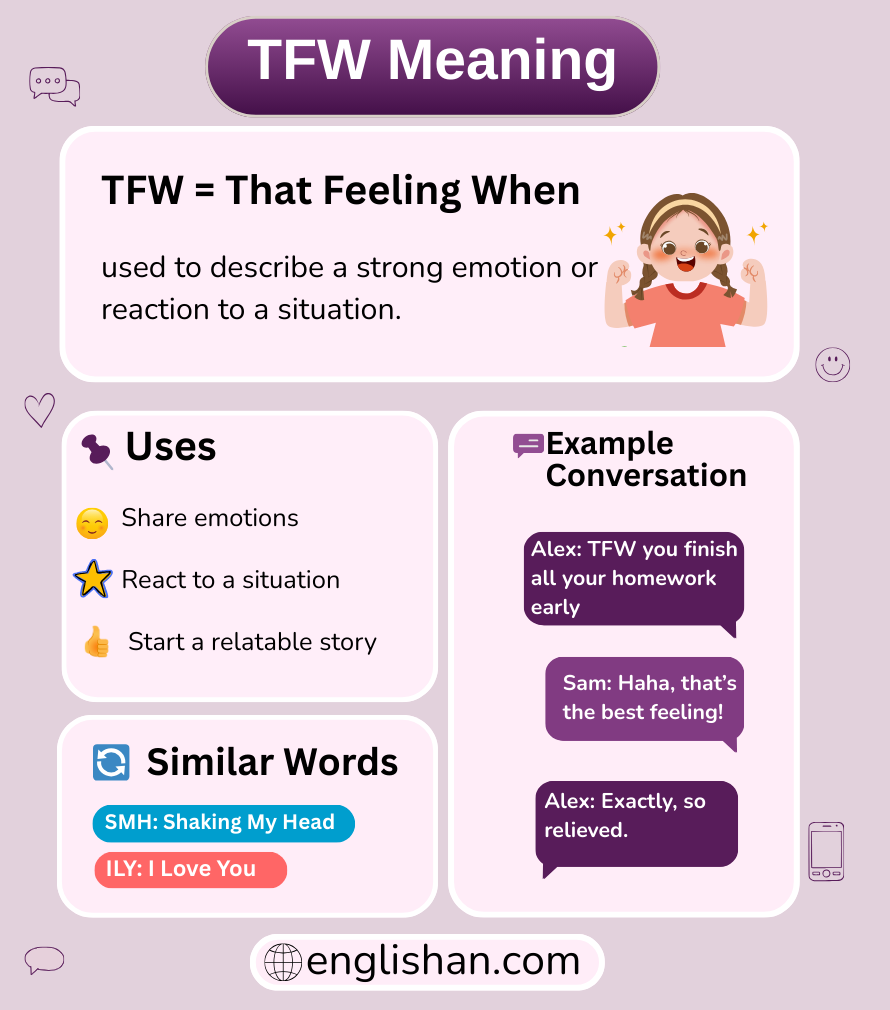
The acronym TFW signals that the writer is about to describe a relatable emotional experience. It introduces a specific scenario that the audience is expected to recognize and empathize with immediately. Users typically place it at the beginning of a sentence to set the stage for a shared feeling.
What Does TFW Stand For
This three-letter abbreviation stands for the phrase That Feeling When. It grammatically functions as a sentence starter that leads into a description of an event or situation. While it originally meant “That Face When” in some early internet circles, the emotional definition is now the standard usage.
How TFW Is Used With Examples
People type this term to create a sense of shared understanding about daily life. It is almost always followed by a description of a specific, often humorous or frustrating, event. The goal is to make the reader nod their head and think, “I know exactly what that feels like.”
- Relief: “TFW you finally find your lost keys.”
- Annoyance: “TFW the WiFi stops working during a movie.”
- Awkwardness: “TFW you wave at someone who wasn’t waving at you.”
TFW In Memes And Captions
In visual internet culture, this acronym serves as the setup for a reaction image. A user posts a funny or exaggerated picture of a face alongside a caption starting with TFW. The text describes the situation, and the image visually represents the specific emotion felt in that moment.
How To Write A TFW Post
To create a proper post using this slang, you must start the sentence with TFW. Follow it immediately with a present-tense verb and a scenario that many people experience, such as “TFW you verify your password.” Finally, pair the text with an image or emoji that perfectly captures the mood.
TFW Origin
The specific phrase “that feeling when” evolved from early internet image boards like 4chan in the late 2000s and early 2010s. It developed alongside similar acronyms like MFW (My Face When) as a way to categorize reaction images. It gained mainstream popularity on Twitter and Instagram as a format for relatable comedy.
Common TFW Confusions
A frequent mistake is using TFW to introduce a physical action rather than an emotion. While closely related, saying “TFW I run” is grammatically weak; it is better to say “TFW you finish a run.” Additionally, some new users confuse it with FTW (For The Win) because the letters are simply rearranged.
TFW Vs MFW
The distinction lies in the focus: TFW highlights the internal emotion, while MFW (My Face When) highlights the physical facial expression. You use MFW when the image is the most important part of the joke. You use TFW when the relatable situation itself is the main point.
TFW Vs FML
FML (F*** My Life) is strictly for negative situations and bad luck. TFW is neutral and versatile; it can describe joy, sadness, anger, or confusion. You can use TFW to describe a good day, but you would never use FML for positive news.
TFW Vs IKR
IKR (I Know Right) is a response used to agree with someone else’s statement. TFW is a statement used to start a new topic or share a personal thought. You might reply with “IKR” after reading a friend’s funny TFW post.
Other Related Slang Words
These acronyms also help categorize reactions and stories online.
- MFW: My Face When. Used with a reaction image.
- MRW: My Reaction When. Used with a GIF or video.
- REL: Relatable. A short tag for something you understand.
- Me IRL: Me In Real Life. Used for self-deprecating humor.
TFW Key Takeaways
We identify this acronym as a popular internet slang term standing for “That Feeling When,” used to share relatable experiences. It serves as a prompt that invites the reader to empathize with a specific emotion, often accompanied by a funny image or meme. While it originally shared ground with “That Face When,” it now distinctly focuses on the internal vibe of a situation. Remember to use TFW to build connection through shared humor, but ensure your scenario is broad enough for others to understand.
TFW FAQs
It is a sentence fragment. It usually lacks a main subject because “I” is implied.
Yes, historically it did. However, That Feeling When is the dominant meaning today.
No, usually you go straight into the text. For example: “TFW you sleep in.”
It is fine for casual team chats. It is too informal for official reports or client emails.
You say the letters T-F-W. You rarely say the full phrase aloud in conversation.
The term is not rude, but it can be considered cringe if used incorrectly. If a user describes a situation that is too specific or clearly made up just to brag, the post will fail to connect with others. To avoid being cringe, the “feeling” must be genuine and widely understood by the audience.
You May Also Like