Someone shares a very personal detail during a normal conversation, and it goes further than expected. The reaction is not confusion, just a sense that the line was crossed and the information did not need to be shared. Sometimes it is a shield raised before speaking, sometimes a flag raised after.
Online, TMI is used to label that situation. It comes from too much information and appears when someone overshares or when a speaker warns others before saying something personal. It can sound joking, embarrassed, or lightly corrective, depending on tone and setting. It can be aimed at yourself or someone else, and the right response depends on who said it and why.
This guide will teach you exactly what tmi means and how people use it in chats, comments, and replies. You will see examples that show it aimed at yourself and at others. By the end, you will know exactly what it signals and how to react to it. You will also know when it fits without making the moment uncomfortable.
What Does TMI Mean
The acronym TMI signals that a person has shared details that are too personal or graphic for the current conversation. It functions as a verbal stop sign to let the speaker know they have crossed a boundary of comfort. Listeners usually say it when hearing about bodily functions, medical issues, or intimate relationships.
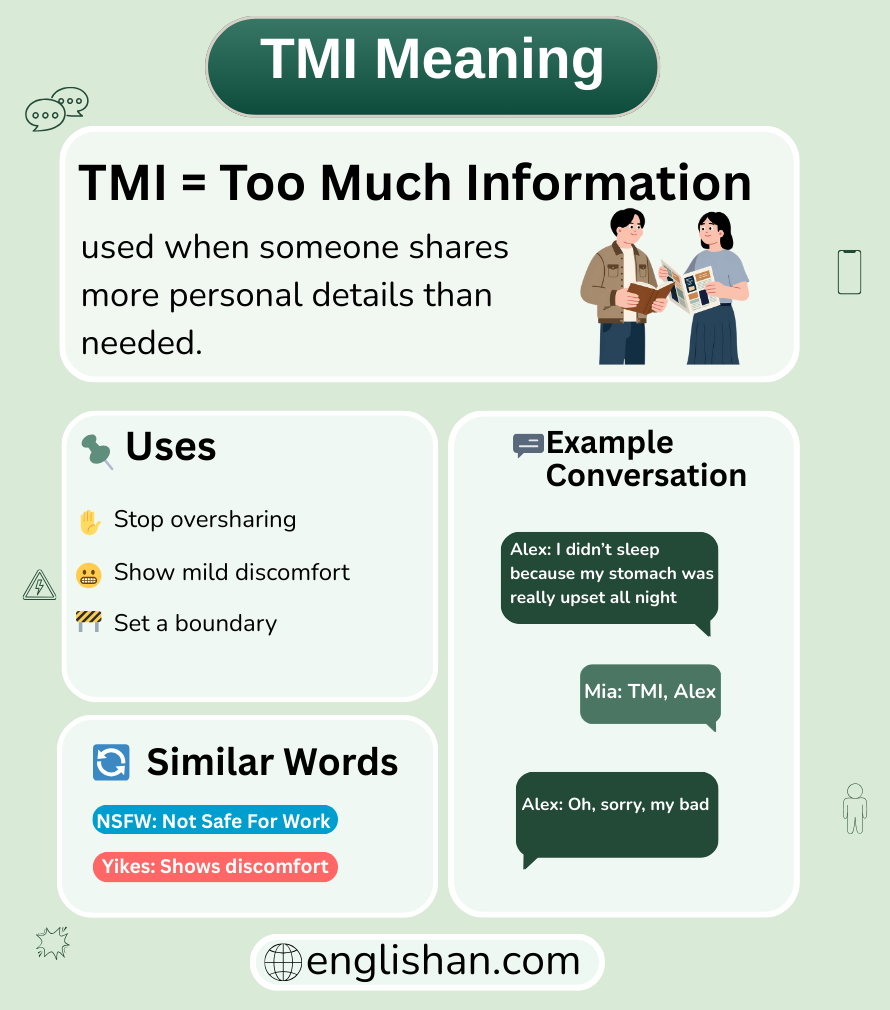
What Does TMI Stand For
The three-letter abbreviation stands strictly for the phrase Too Much Information. It acts as a direct statement that the previous comment contained unnecessary or gross details. While the letters are simple, they carry a clear message to change the subject immediately.
How TMI Is Used In Texting And Chat
People type this term to react quickly when a friend sends a message that is overly detailed or gross. It serves as a humorous or serious way to tell the sender to stop sharing private matters. You will often see it sent as a standalone reply to cut off a story before it gets worse.
In Text Messages
In direct messages, friends use this shorthand to express playful disgust at a story. It often appears when someone describes a sickness or a bad date in vivid detail. The recipient sends it to maintain a boundary while keeping the tone light and friendly.
On Social Media
Users often add this tag to their own posts as a warning label before sharing a gross story. It alerts followers that the content might be uncomfortable or graphic so they can scroll past if they choose. It creates a buffer between the poster and the audience.
In Face To Face Talk
People say the letters T-M-I aloud during real conversations to interrupt a speaker who is oversharing. It is a common verbal cue used to steer the discussion back to safe topics. The tone can range from joking to genuinely annoyed depending on the situation.
When TMI Is Rude Vs When It Is A Joke
Using this term is usually a joke among close friends who are comfortable with light teasing. However, it becomes rude if used to shame someone who is being vulnerable about a serious problem. Context determines whether it is a friendly check or a dismissive insult.
How To Respond To TMI
If someone says this to you, the best response is to apologize briefly and change the topic. You can laugh it off if you were joking, but you should respect their comfort level. Arguing that the details were necessary usually makes the situation more awkward.
TMI Example Conversations
These dialogues demonstrate how friends use the term to stop uncomfortable conversations.
Jason: My stomach has been making the weirdest noises since I ate that cheese.
Mike: Please stop right there, that is TMI. I am trying to eat lunch.
Jason: Sorry, I just thought you should know not to eat it.
Sarah: I can show you the pictures of my surgery if you want.
Emily: No thanks! That is definitely TMI for me.
Sarah: Okay, I will keep them to myself then.
David: I think I stepped in something really gross outside. It looks like…
Jessica: TMI, David! Just go clean your shoes.
David: Good point, I’ll be right back.
TMI Origin
The phrase “too much information” gained traction in popular culture and movies during the late 1990s. As text messaging became common in the early 2000s, users shortened the phrase to an acronym for speed. It has since become a standard part of English vocabulary both online and offline.
Related Slang Words Like TMI
These terms also help manage boundaries and comfort levels in conversation.
- NSFW: Not Safe For Work. Used for inappropriate content.
- OOF: A sound used to react to painful situations.
- Cringe: Used when a situation causes secondhand embarrassment.
- Gross: A simple adjective used to describe disgusting things.
Common Confusions About TMI
A frequent mistake is confusing TMI with TIL (Today I Learned) because the acronyms look similar. TMI is for uncomfortable personal details, while TIL is for interesting general facts. Mixing them up can lead to awkward moments where someone expects a fun fact but hears something gross instead.
Key Takeaway
We define this acronym as a verbal boundary that stands for “Too Much Information,” used to stop oversharing. It serves as a quick tool to signal that a topic has become too graphic, personal, or uncomfortable for the listener. While often used humorously among friends to react to gross stories, it can also function as a polite request for privacy in public settings. Remember to respect the TMI signal by changing the subject to something more appropriate.
FAQs
It is usually a playful warning. However, it can be rude if used to dismiss someone’s feelings.
Yes, it is useful to stop unprofessional conversations. Just say it politely.
You say the individual letters T-M-I. You do not pronounce it as a single word.
Not exactly. It is used for gross details, not necessarily confidential secrets.
No, a doctor needs detailed information. TMI does not apply in medical settings.
You May Also Like