Action verbs are words that show actions, either physical or mental, performed by the subject of a sentence. These actions could be:
- Things we do → run, read, eat.
- Things that happen → grow, fall, analyze.
Action verbs bring life to sentences by describing what is happening. They are essential for clear and effective communication. In this blog, you’ll learn what action verbs are, their types, and how to use them confidently with examples to improve your writing and speaking skills.
What Are Action Verbs?
Action verbs are words that express an action. This action could be physical, like “jump,” or mental, like “think.” They tell us what the subject of a sentence is doing. Moreover, these verbs are the backbone of English communication because they convey the main idea of any sentence. Without action verbs, our sentences would be incomplete or meaningless.
For example:
- She runs every morning. (Physical action)
- He thinks deeply about the problem. (Mental action)
In both sentences, the action verbs “runs” and “thinks” show what the subject is doing.
Types of Action Verbs
Action verbs can be grouped into two main types. Understanding these types will help you use them correctly in sentences and know when they need extra details to complete their meaning.
1. Transitive Verbs
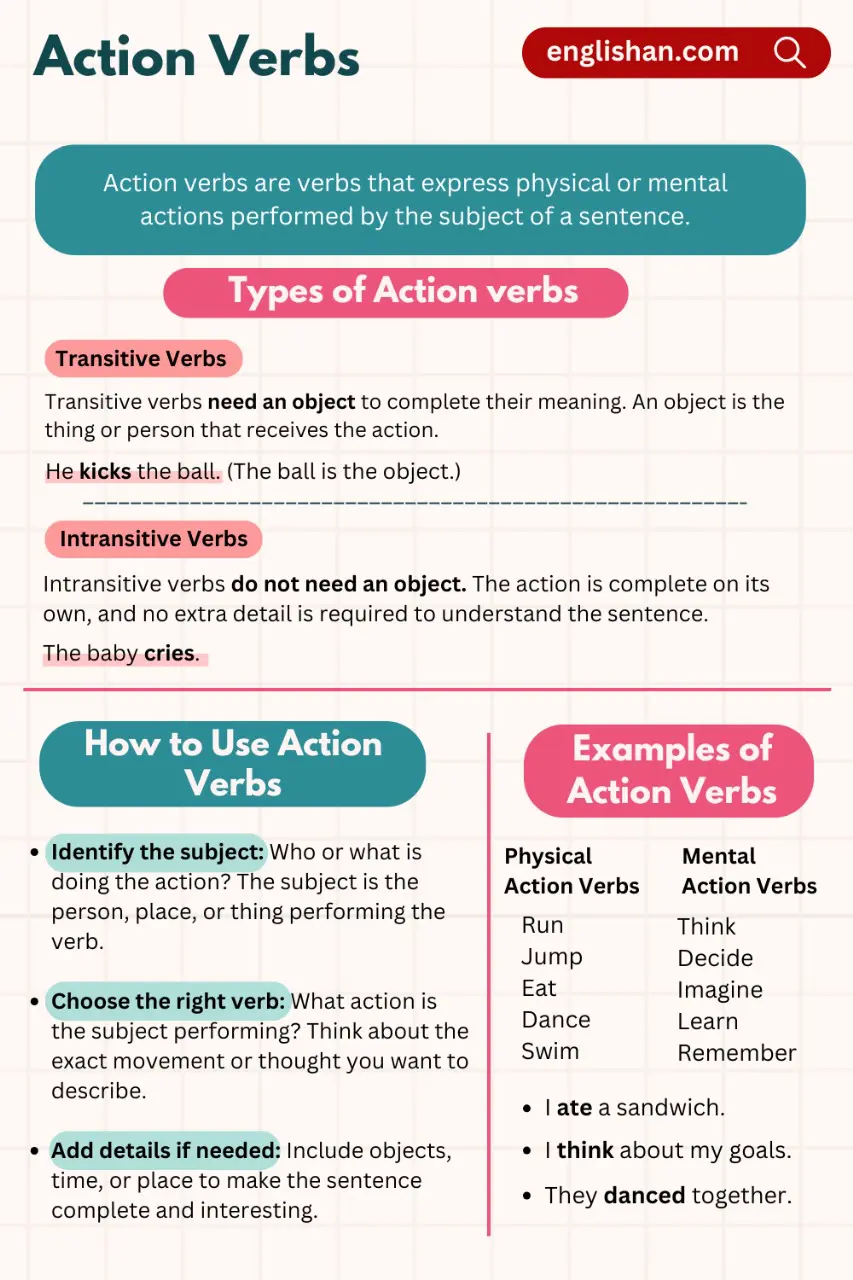
Transitive verbs need an object to complete their meaning. An object is the thing or person that receives the action. Without the object, the sentence might not make sense.
For example:
- He kicks the ball. (The ball is the object.)
- She wrote a letter. (A letter is the object.)
Here, the verbs “kicks” and “wrote” cannot stand alone; they need an object to complete their meaning.
2. Intransitive Verbs
Intransitive verbs do not need an object. The action is complete on its own, and no extra detail is required to understand the sentence. Additionally, these verbs are often used to describe actions that are general or happen naturally.
For example:
- The baby cries.
- Birds fly.
Here, there is no object because the action does not affect anything directly. It is because, intransitive verbs are useful for describing actions that stand alone, such as movements or emotions.
How to Use Action Verbs in Sentences?
Action verbs are used to describe what someone or something is doing. They are an essential part of creating meaningful sentences. So, if you want to use these verbs correctly, follow these steps:
- Identify the subject: Who or what is doing the action? The subject is the person, place, or thing performing the verb.
- Choose the right verb: What action is the subject performing? Think about the exact movement or thought you want to describe.
- Add details if needed: Include objects, time, or place to make the sentence complete and interesting.
For example:
- Subject: The dog
- Verb: barks
- Complete Sentence: The dog barks loudly at night.
Additionally, using these verbs properly helps you paint a clear picture of what is happening in your sentences.
Common Examples of Action Verbs
To make it easier for you to learn, here are some common action verbs that you can start using in your sentences right away. Some common examples include:
- Physical Action Verbs: Run, Jump, Eat, Dance, Swim.
- Mental Action Verbs: Think, Decide, Imagine, Learn, Remember.
Physical action verbs describe things you can see happening, like “run” or “dance,” while mental action verbs describe activities of the mind, like “think” or “imagine.”
Tips for Using Action Verbs
Action verbs are easy to use, but here are some tips to make your sentences even better:
- Keep it simple: Start with easy verbs like “run,” “eat,” or “play.” These are common and easy to remember.
- Practice with examples: Make your own sentences using action verbs. For example, “I play football” or “She cooks dinner.”
- Use them in conversations: Try using these verbs when you talk with others. For instance, say “I walked to the store” instead of “I went to the store.”
- Learn their forms: Many verbs change depending on the tense, like “run” (present) and “ran” (past). Practicing these forms will make it easier to communicate in different situations.
FAQs About Action Verbs
Action verbs often come with many questions, especially when you’re just starting to learn them. Below, we address some of the most common queries to help you get a clearer understanding.
Yes! Some verbs can be used both ways, depending on the sentence. These are called ambitransitive verbs.
Transitive: She reads a book. (Object: a book)
Intransitive: She reads before bedtime. (No object)
Write simple sentences using common verbs. For example, “I eat breakfast,” or “He runs in the park.” You can also try speaking sentences out loud to build confidence.
No. They can also describe mental actions, like “hope,” “believe,” or “understand.” These verbs are just as important as physical action verbs in English.
Conclusion
To sum up, we can say that Action verbs are an essential part of English Grammar. They describe actions, help us communicate clearly, and make sentences more interesting. Whether the action is physical or mental, using action verbs correctly will make your speech and writing more effective.
Moreover, by understanding the types of these verbs and practicing with examples, you can improve your grammar and feel more confident using English in everyday life. So, keep practicing, and soon you’ll be creating amazing sentences with action verbs effortlessly!
You May Also Like
- Regular Verbs in English Grammar
- Irregular Verbs in English with Examples
- Weak Verbs in English Grammar
- Linking Verbs