Capitalization may appear to be a minor element, but it has a major impact on clarity and refinement in your writing. If you are studying English grammar, knowing when to use capital letters can take your text from unclear to professional. Whether you’re working on an essay, sending an email, or typing a casual message, following capitalization rules makes your words readable and accurate.
In this article, we will explore the main capitalization rules, show many examples, and include a handy comparison chart to keep learning straightforward and enjoyable. Let’s begin!
What is Capitalization in English Grammar?
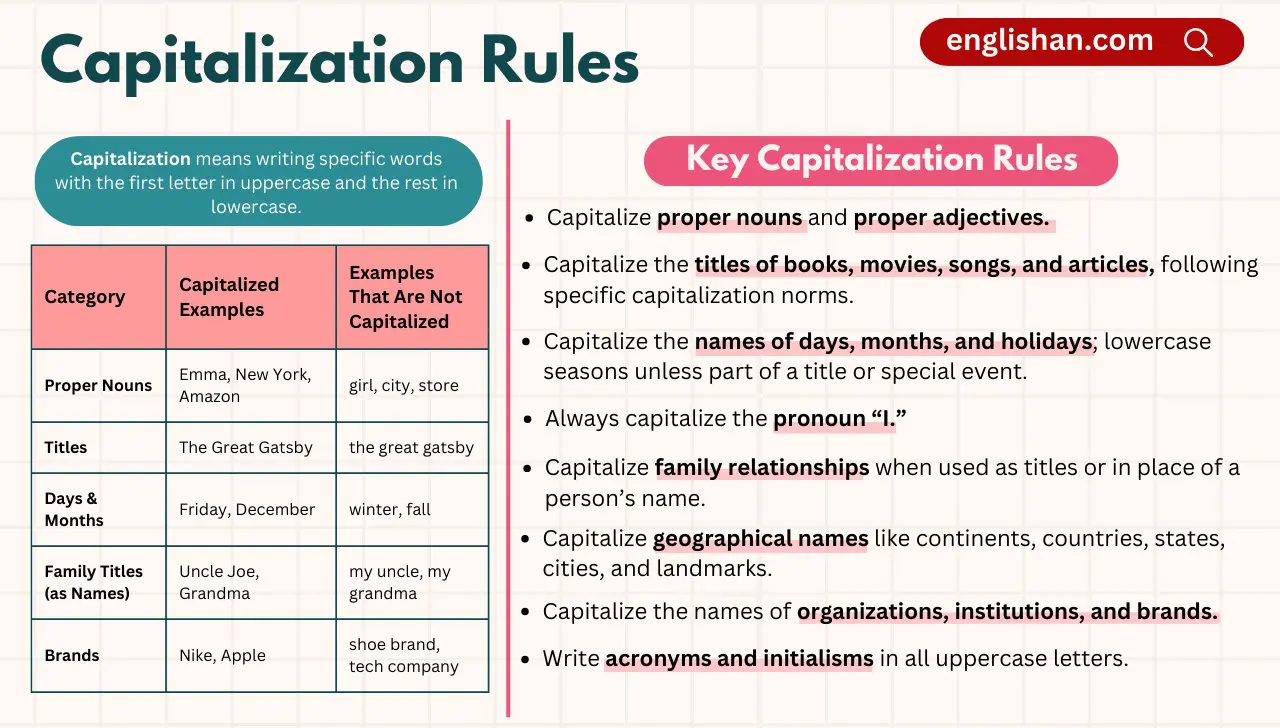
Capitalization means writing specific words with the first letter in uppercase and the rest in lowercase. It’s not just about appearance; it provides meaning and organization for your sentences. By using the right capitalization guidelines, you can make your writing look more organized and professional. For example:
- Correct: I’m meeting Sarah on Monday.
- Incorrect: i’m meeting sarah on monday.
Without capital letters in the right places, your text can look disorganized and hard to read. Proper capitalization clarifies meaning and shows respect for standard language usage. Let’s go through the capitalization rules in detail.
Key Capitalization Rules
Before diving into each guideline, remember that these rules will help you write more clearly and professionally. Knowing proper capitalization rules can also make a strong impression on your readers, whether it’s for academic, personal, or business purposes.
1. Proper Nouns and Proper Adjectives
Proper nouns refer to exact names of people, places, or objects, while proper adjectives come from those nouns. According to the capitalization rules, these terms must always have a capital letter because they represent unique names or features.
- Capitalize: Names of individuals, cities, nations, groups, and landmarks
For example: Emma, Paris, Microsoft, Eiffel Tower
- Capitalize proper adjectives
For example: French cuisine, Shakespearean plays
If it is a specific name or comes from one, it needs an uppercase letter.
2. The First Word of a Sentence
Every sentence begins with a capital letter. This standard applies no matter the part of speech or if a quotation starts the sentence.
For example:
- The dog is barking.
- “Is it raining?” she asked.
This guideline allows readers to spot the start of new statements quickly.
3. Titles of Books, Movies, Songs, and Articles
Titles have specific capitalization norms to emphasize their significance. Capitalize the first word, the final word, and all primary words. Still, small articles (a, an, the), linking words (and, but, or), and prepositions (in, on, at) stay lowercase unless they are the first or last word of the title.
For example:
- To Kill a Mockingbird
- The Lord of the Rings
- A Walk in the Park
This approach ensures that titles look distinct and are simple to recognize.
4. Days of the Week, Months, and Holidays
Another important capitalization rule is to capitalize the names of days, months, and holidays. However, seasons are usually lowercase unless they appear in a title or special event name.
For example:
- Monday, July, Christmas
- I’ll visit you this summer.
This difference helps separate exact time frames from general references.
5. Pronoun “I”
Unlike other pronouns, “I” is always uppercase in English. This special rule points out its role as a personal reference.
For example:
- I love learning English.
- Am I late?
Always use a capital “I” in English grammar.
6. Family Relationships (When Used as Titles)
Terms such as “Mom,” “Dad,” “Grandma,” and “Uncle” get capital letters when they stand in for a person’s name or act as titles. If they are used in a general sense, they stay lowercase.
For example:
- I’ll ask Mom to help.
- My mom is a great cook.
This guideline avoids mix-ups by showing clear roles or titles.
7. Geographical Names
Geographical terms, such as continents, countries, states, cities, and landmarks, should always be capitalized to show they are unique.
For example:
- Africa, California, Mount Everest
- We visited the Grand Canyon last summer.
This habit maintains clarity when mentioning particular locations.
8. Organizations, Institutions, and Brands
Names of groups, schools, and product labels should be capitalized to show their formal identity. This is one of the basic capitalization rules used in English Grammar.
For example:
- Harvard University
- Coca-Cola
Using uppercase correctly here prevents confusion.
9. Acronyms and Initialisms
Acronyms and initialisms feature all uppercase letters to mark the first letters of a longer term or name.
For example:
- NASA
- USA
- ASAP
This layout helps people identify them quickly.
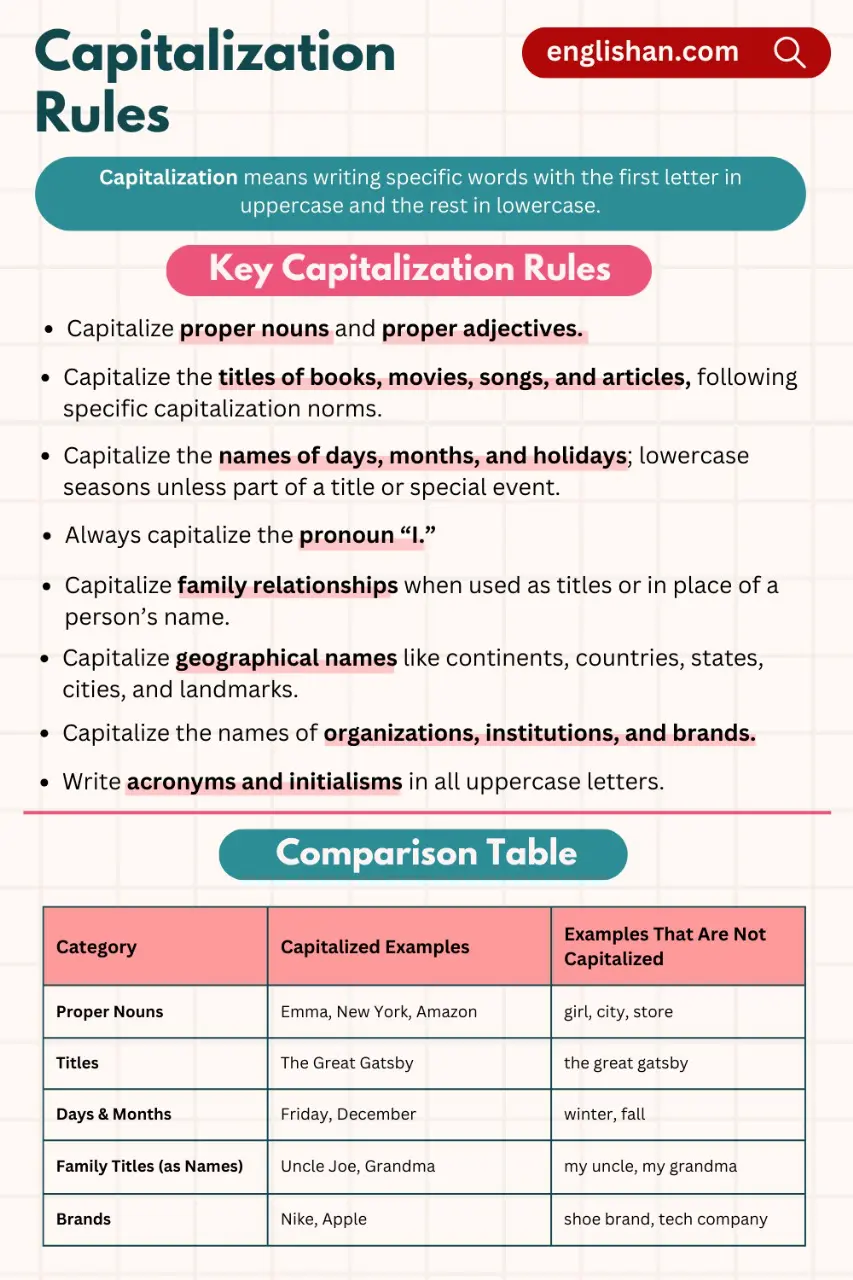
Comparison Table: Capitalization Guide
Use this table as a quick reference whenever you’re unsure about capitalizing certain words. By reviewing examples of correct and incorrect forms, you can solidify your understanding of the capitalization rules.
| Category | Capitalized Examples | Examples That Are Not Capitalized |
| Proper Nouns | Emma, New York, Amazon | girl, city, store |
| Titles | The Great Gatsby | the great gatsby |
| Days & Months | Friday, December | winter, fall |
| Family Titles (as Names) | Uncle Joe, Grandma | my uncle, my grandma |
| Brands | Nike, Apple | shoe brand, tech company |
Common Mistakes to Watch Out For
Even experienced writers can slip up. By knowing the most frequent capitalization errors, you’ll be better prepared to catch them and keep your text looking polished.
1 – Overcapitalization: Do not capitalize ordinary nouns or terms unnecessarily.
- Incorrect: I live in a Small Town.
- Correct: I live in a small town.
2 – Under-capitalization: Make sure to use capital letters for proper nouns or the first word of sentences.
- Incorrect: january is my favorite month.
- Correct: January is my favorite month.
3- Wrong Use of Titles: Apply capitalization properly based on context.
- Incorrect: Gone with The Wind
- Correct: Gone with the Wind
FAQs About Capitalization Rules
Still have questions? In this section, we cover a few issues that come up regularly, giving you extra clarity on how to handle capitalization in various situations.
A: Capitalize job titles when they appear before a name or when they’re part of an official title.
Examples: President Biden, Dr. Smith
A: No, unless they’re part of a title.
Example: I’m excited for spring.
A: Use title case for main words while ignoring small articles and prepositions.
Example: Meeting Tomorrow: Updates on the Project
Conclusion
Learning capitalization rules takes practice, but it’s a useful skill that improves your writing. By sticking to these simple guidelines and studying the examples, you can compose texts that are clear, professional, and confident. Proper capitalization clarifies meaning and shows you pay attention to details, which helps present you as a careful writer.
Try these principles in your everyday writing, whether it’s a text message, a formal email, or a short story, and they will quickly become a habit. Enjoy learning!
You May Also Like
- Punctuation Rules with Examples
- Action Verbs in English Grammar
- 500 New Good Morning Images
- Connectors in English with Examples
- Acronym Examples In Sentences