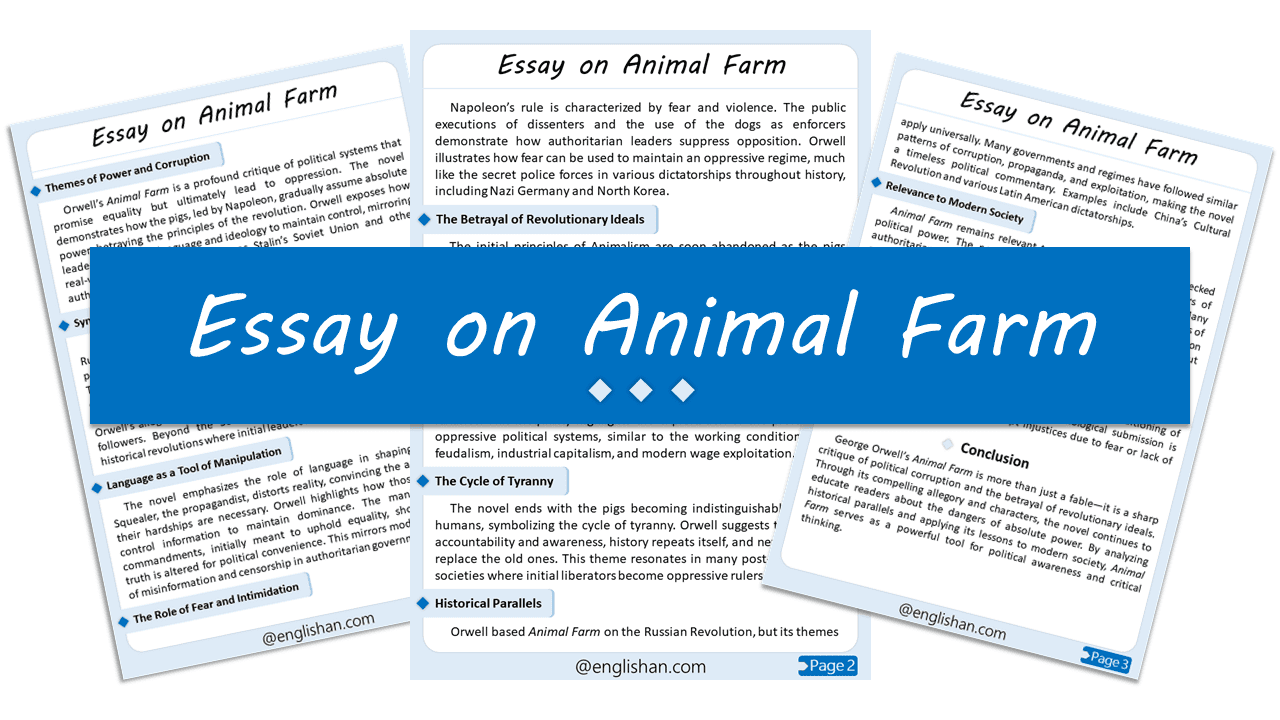
When writing about animal farms, it’s important to understand how animals live, work, and help people on farms. This essay on animal farms explains the different animals found on farms, their roles, and why caring for them is important. It’s written in 500 words to help students with homework, classwork, or exams. You can download this animal farm essay as a free PDF or image to read, study, or print.
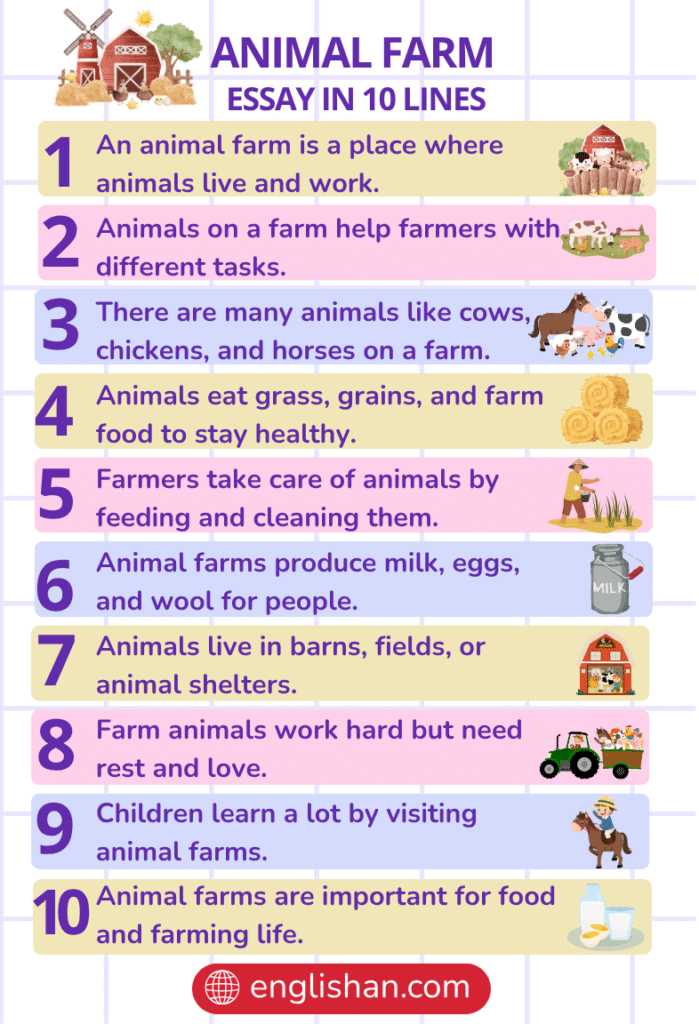
10 Lines Animal Farm Essay for Class 2 to Class 5
- An animal farm is a place where animals live and work.
- Animals on a farm help farmers with different tasks.
- There are many animals like cows, chickens, and horses on a farm.
- Animals eat grass, grains, and farm food to stay healthy.
- Farmers take care of animals by feeding and cleaning them.
- Animal farms produce milk, eggs, and wool for people.
- Animals live in barns, fields, or animal shelters.
- Farm animals work hard but need rest and love.
- Children learn a lot by visiting animal farms.
- Animal farms are important for food and farming life.
250 Words Essay on Animal Farm for Middle School
An animal farm is a place where many types of animals live and work together. Farmers raise animals such as cows, chickens, sheep, pigs, and horses. These animals provide important products like milk, eggs, wool, and meat, which help feed people and support daily life.
On the farm, animals have different roles. Cows give milk, chickens lay eggs, and sheep provide wool. Farmers take care of these animals by feeding them nutritious food, giving them clean water, and keeping their homes clean and safe. Animal farms need hard work and careful attention to keep the animals healthy.
Animal farms are also places where children and adults can learn about animals and farming. Visiting a farm can teach people how animals live, what they eat, and how they help humans. It helps us understand the importance of kindness and care for animals.
Besides providing food and products, animal farms play a big role in the economy and culture of many countries. Farming connects people to nature and teaches responsibility.
In conclusion, animal farms are important parts of our lives. They provide food, teach us about animals, and help support farmers and communities. Taking good care of farm animals is important for a healthy and happy farm.
500 Words Animal Farm Essay for Upper Primary and Lower Secondary
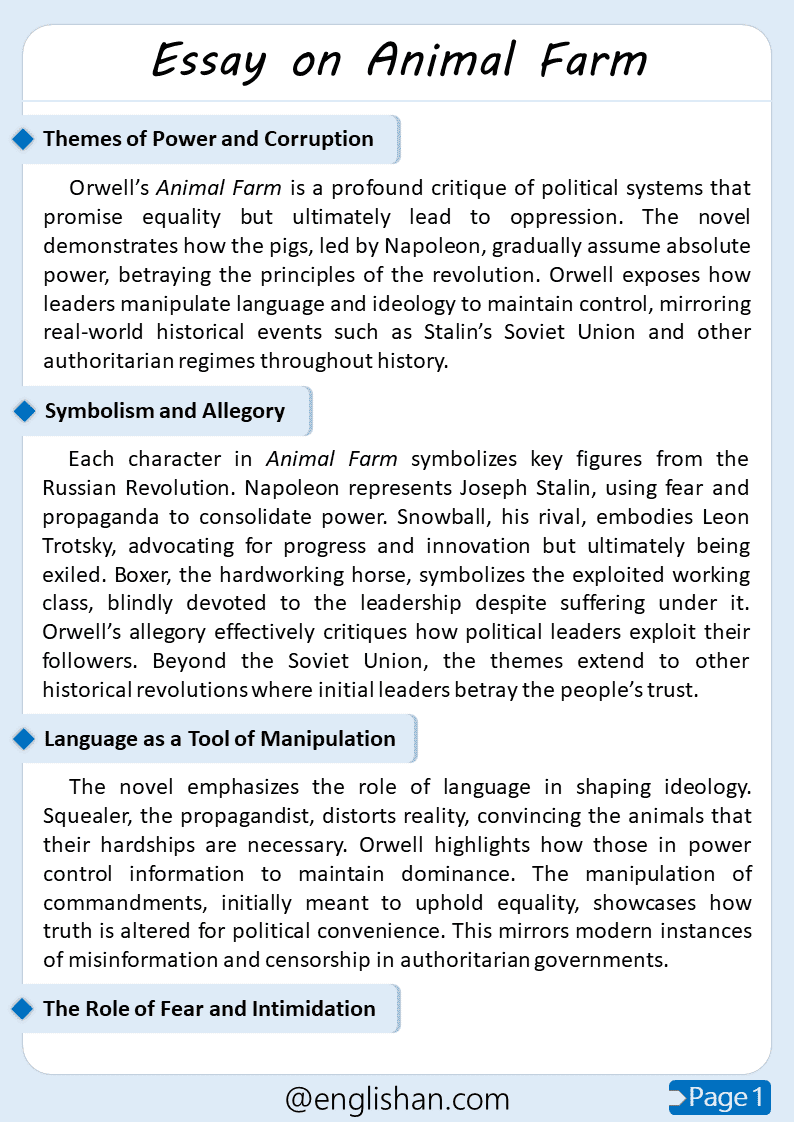
Themes of Power and Corruption
Orwell’s Animal Farm is a profound critique of political systems that promise equality but ultimately lead to oppression. The novel demonstrates how the pigs, led by Napoleon, gradually assume absolute power, betraying the principles of the revolution. Orwell exposes how leaders manipulate language and ideology to maintain control, mirroring real-world historical events such as Stalin’s Soviet Union and other authoritarian regimes throughout history.
Symbolism and Allegory
Each character in Animal Farm symbolizes key figures from the Russian Revolution. Napoleon represents Joseph Stalin, using fear and propaganda to consolidate power. Snowball, his rival, embodies Leon Trotsky, advocating for progress and innovation but ultimately being exiled. Boxer, the hardworking horse, symbolizes the exploited working class, blindly devoted to the leadership despite suffering under it. Orwell’s allegory effectively critiques how political leaders exploit their followers. Beyond the Soviet Union, the themes extend to other historical revolutions where initial leaders betray the people’s trust.
Language as a Tool of Manipulation
The novel emphasizes the role of language in shaping ideology. Squealer, the propagandist, distorts reality, convincing the animals that their hardships are necessary. Orwell highlights how those in power control information to maintain dominance. The manipulation of commandments, initially meant to uphold equality, showcases how truth is altered for political convenience. This mirrors modern instances of misinformation and censorship in authoritarian governments.
The Role of Fear and Intimidation
Napoleon’s rule is characterized by fear and violence. The public executions of dissenters and the use of the dogs as enforcers demonstrate how authoritarian leaders suppress opposition. Orwell illustrates how fear can be used to maintain an oppressive regime, much like the secret police forces in various dictatorships throughout history, including Nazi Germany and North Korea.
The Betrayal of Revolutionary Ideals
The initial principles of Animalism are soon abandoned as the pigs prioritize their own interests. The changing commandments reflect how revolutionary ideals can be manipulated and corrupted over time. This shift mirrors historical revolutions where leaders betray their original promises, such as the French Revolution’s descent into dictatorship under Napoleon Bonaparte.
Class Struggle and Exploitation
Orwell critiques the divide between the ruling elite and the working class. While the animals labor tirelessly, the pigs enjoy privileges and luxuries. This inequality highlights the exploitation of the proletariat in oppressive political systems, similar to the working conditions under feudalism, industrial capitalism, and modern wage exploitation.
The Cycle of Tyranny
The novel ends with the pigs becoming indistinguishable from the humans, symbolizing the cycle of tyranny. Orwell suggests that without accountability and awareness, history repeats itself, and new oppressors replace the old ones. This theme resonates in many post-revolutionary societies where initial liberators become oppressive rulers.
Historical Parallels
Orwell based Animal Farm on the Russian Revolution, but its themes apply universally. Many governments and regimes have followed similar patterns of corruption, propaganda, and exploitation, making the novel a timeless political commentary. Examples include China’s Cultural Revolution and various Latin American dictatorships.
Relevance to Modern Society
Animal Farm remains relevant today as it warns against unchecked political power. The novel serves as a reminder of the dangers of authoritarian rule and the importance of critical thinking. Many contemporary governments and organizations exhibit similar patterns of deception, making Orwell’s message timeless. The rise of disinformation in digital media further emphasizes the novel’s warnings about manipulation.
The Psychological Impact of Oppression
The novel also explores how prolonged oppression affects individuals. Boxer’s blind loyalty, despite his suffering, reflects the conditioning of people under authoritarian regimes. This psychological submission is seen in societies where citizens accept injustices due to fear or lack of alternatives.
Conclusion
George Orwell’s Animal Farm is more than just a fable—it is a sharp critique of political corruption and the betrayal of revolutionary ideals. Through its compelling allegory and characters, the novel continues to educate readers about the dangers of absolute power. By analyzing historical parallels and applying its lessons to modern society, Animal Farm serves as a powerful tool for political awareness and critical thinking./
Difficult Words Used in 500 Animal Farm Essay
| Word | Meaning |
|---|---|
| Allegory | A story that symbolizes real-life events or ideas |
| Totalitarianism | A system where the state has complete control |
| Propaganda | Misleading information used to influence opinion |
| Manipulation | Controlling or influencing someone dishonestly |
| Exiled | Forced to leave one’s home or country |
| Tyranny | Cruel and oppressive government rule |
| Proletariat | The working-class people in a society |
| Ideology | A system of beliefs that guides political decisions |
Animal Farm Essay PDF
You May Also Like