
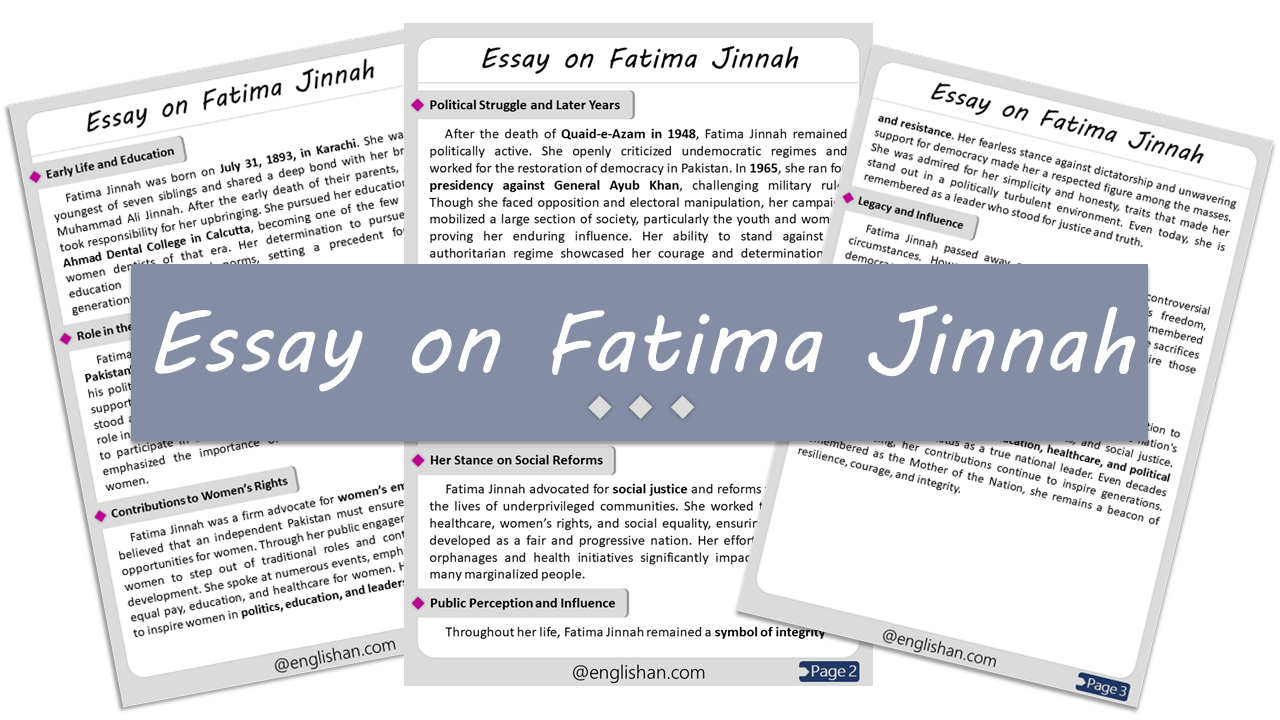
When writing about Fatima Jinnah, it’s important to understand how she supported her brother, Quaid-e-Azam, and became a symbol of strength in Pakistan’s history. This essay on Fatima Jinnah explains her early life, her role in the Pakistan Movement, her work for women’s rights, and her lasting impact. It’s written in 250 words to help students with homework or exams. You can download this Fatima Jinnah essay as a free PDF or image to study or print.
10 Lines Fatima Jinnah Essay for Class 2 to Class 5
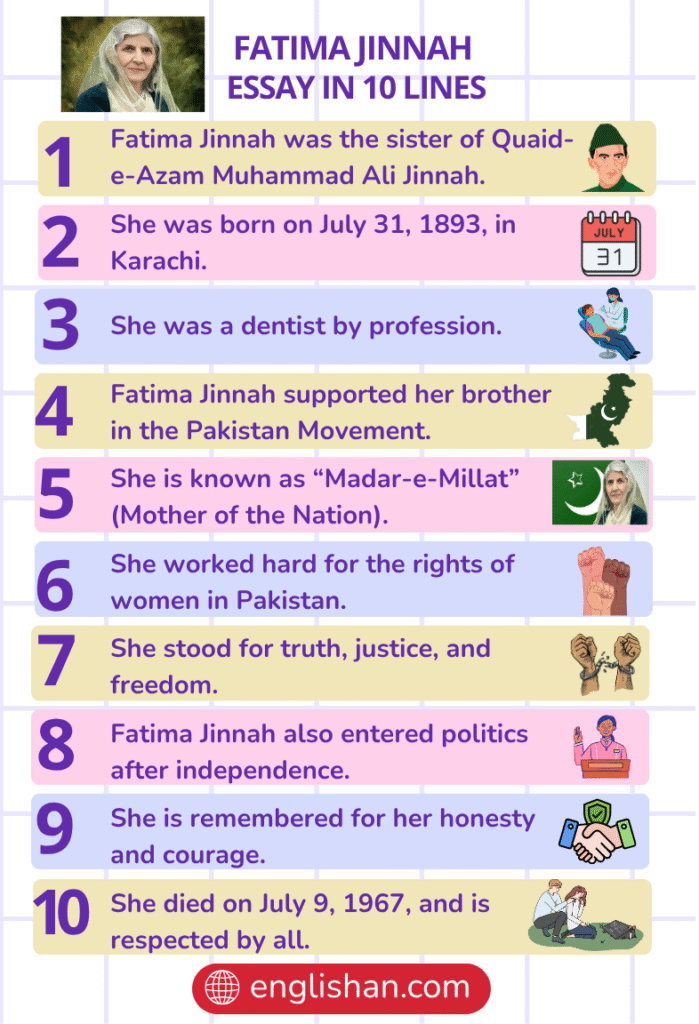
- Fatima Jinnah was the sister of Quaid-e-Azam Muhammad Ali Jinnah.
- She was born on July 31, 1893, in Karachi.
- She was a dentist by profession.
- Fatima Jinnah supported her brother in the Pakistan Movement.
- She is known as “Madar-e-Millat” (Mother of the Nation).
- She worked hard for the rights of women in Pakistan.
- She stood for truth, justice, and freedom.
- Fatima Jinnah also entered politics after independence.
- She is remembered for her honesty and courage.
- She died on July 9, 1967, and is respected by all.
250 Words Essay on Fatima Jinnah for Middle School
Fatima Jinnah is one of the most respected women in Pakistan’s history. She was born on July 31, 1893, in Karachi. She was the younger sister of Quaid-e-Azam Muhammad Ali Jinnah, the founder of Pakistan. Fatima Jinnah played a very important role in the struggle for Pakistan’s independence.
By profession, Fatima Jinnah was a dentist, but she left her career to support her brother in politics. She worked closely with him and stood by his side through many difficult times. Her dedication and loyalty made her a strong symbol of support for the Pakistan Movement.
After Pakistan was formed in 1947, she continued to serve the country. She became a voice for women’s rights and encouraged women to take part in national development. Fatima Jinnah also entered politics and ran for president in 1965. Although she did not win, her bravery and courage inspired many people.
Fatima Jinnah is remembered as “Madar-e-Millat,” which means the Mother of the Nation. She believed in hard work, honesty, and standing up for what is right. Her life teaches students the value of serving others and staying strong in tough times.
In conclusion, Fatima Jinnah’s efforts, leadership, and love for her country make her a role model for all generations, especially young girls who want to make a difference.
500 Words Fatima Jinnah Essay for Upper Primary and Lower Secondary
Early Life and Education
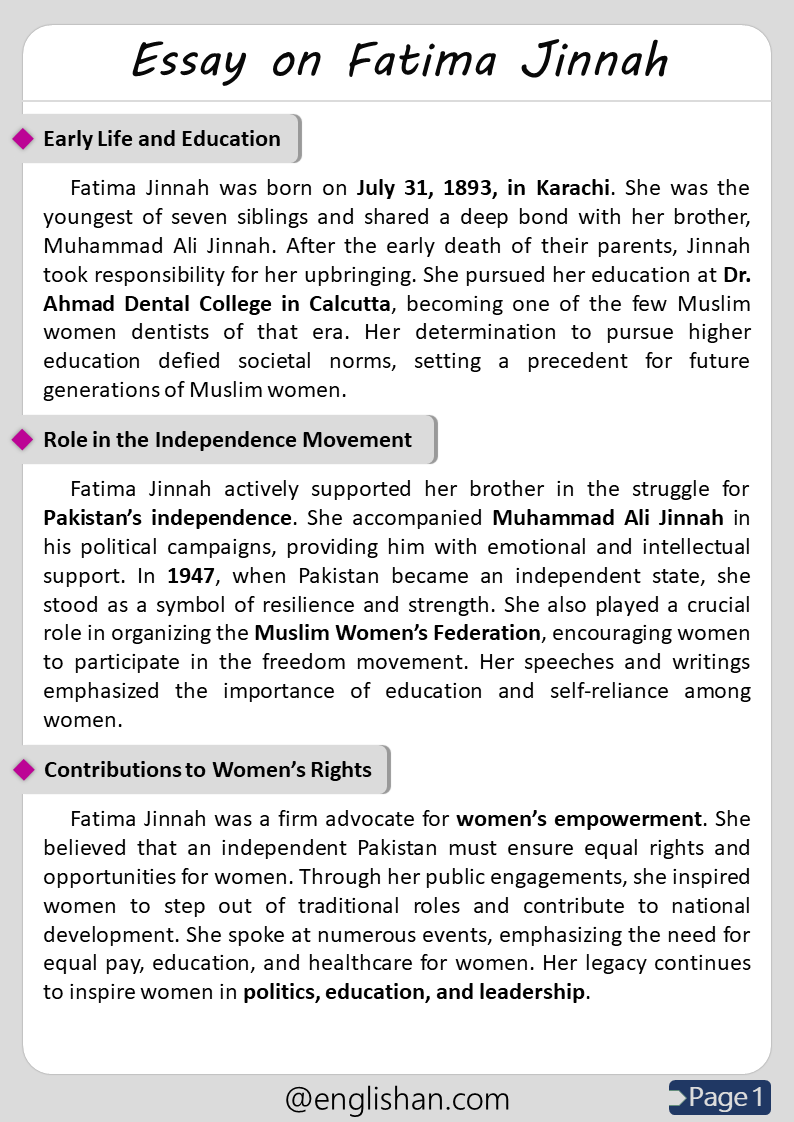
Fatima Jinnah was born on July 31, 1893, in Karachi. She was the youngest of seven siblings and shared a deep bond with her brother, Muhammad Ali Jinnah. After the early death of their parents, Jinnah took responsibility for her upbringing. She pursued her education at Dr. Ahmad Dental College in Calcutta, becoming one of the few Muslim women dentists of that era. Her determination to pursue higher education defied societal norms, setting a precedent for future generations of Muslim women.
Role in the Independence Movement
Fatima Jinnah actively supported her brother in the struggle for Pakistan’s independence. She accompanied Muhammad Ali Jinnah in his political campaigns, providing him with emotional and intellectual support. In 1947, when Pakistan became an independent state, she stood as a symbol of resilience and strength. She also played a crucial role in organizing the Muslim Women’s Federation, encouraging women to participate in the freedom movement. Her speeches and writings emphasized the importance of education and self-reliance among women.
Contributions to Women’s Rights
Fatima Jinnah was a firm advocate for women’s empowerment. She believed that an independent Pakistan must ensure equal rights and opportunities for women. Through her public engagements, she inspired women to step out of traditional roles and contribute to national development. She spoke at numerous events, emphasizing the need for equal pay, education, and healthcare for women. Her legacy continues to inspire women in politics, education, and leadership.
Political Struggle and Later Years
After the death of Quaid-e-Azam in 1948, Fatima Jinnah remained politically active. She openly criticized undemocratic regimes and worked for the restoration of democracy in Pakistan. In 1965, she ran for presidency against General Ayub Khan, challenging military rule. Though she faced opposition and electoral manipulation, her campaign mobilized a large section of society, particularly the youth and women, proving her enduring influence. Her ability to stand against an authoritarian regime showcased her courage and determination for democratic values.
Her Role in Education Development
Fatima Jinnah emphasized the importance of education for national progress. She supported initiatives that promoted literacy and higher education for women. She frequently advocated for the establishment of schools and colleges, particularly for girls, recognizing that education was essential for the country’s development. Her speeches often highlighted the need for an educated society to ensure a strong and independent Pakistan.
Her Stance on Social Reforms
Fatima Jinnah advocated for social justice and reforms that improved the lives of underprivileged communities. She worked towards better healthcare, women’s rights, and social equality, ensuring that Pakistan developed as a fair and progressive nation. Her efforts in supporting orphanages and health initiatives significantly impacted the lives of many marginalized people.
Public Perception and Influence
Throughout her life, Fatima Jinnah remained a symbol of integrity and resistance. Her fearless stance against dictatorship and unwavering support for democracy made her a respected figure among the masses. She was admired for her simplicity and honesty, traits that made her stand out in a politically turbulent environment. Even today, she is remembered as a leader who stood for justice and truth.
Legacy and Influence
Fatima Jinnah passed away on July 9, 1967, under controversial circumstances. However, her contributions to Pakistan’s freedom, democracy, and women’s rights remain significant. She is remembered as the Mother of the Nation, a title that reflects her immense sacrifices and dedication to Pakistan. Her legacy continues to inspire those advocating for justice, equality, and national progress.
Conclusion of Fatima Jinnah Essay
Fatima Jinnah’s life is a testament to her unwavering dedication to Pakistan and its people. She played a vital role in shaping the nation’s history, advocating for democracy, women’s rights, and social justice. Her relentless efforts in promoting education, healthcare, and political activism cemented her status as a true national leader. Even decades after her passing, her contributions continue to inspire generations. Remembered as the Mother of the Nation, she remains a beacon of resilience, courage, and integrity.
Difficult Words Used in 500 Fatima Jinnah Essay
| Word | Meaning |
|---|---|
| Resilience | The ability to recover from difficulties |
| Advocate | A person who supports or speaks for a cause |
| Progressive | Promoting change and innovation |
| Mobilized | Encouraged people to take action |
| Electoral | Related to elections and voting |
Fatima Jinnah Essay PDF
You May Also Like