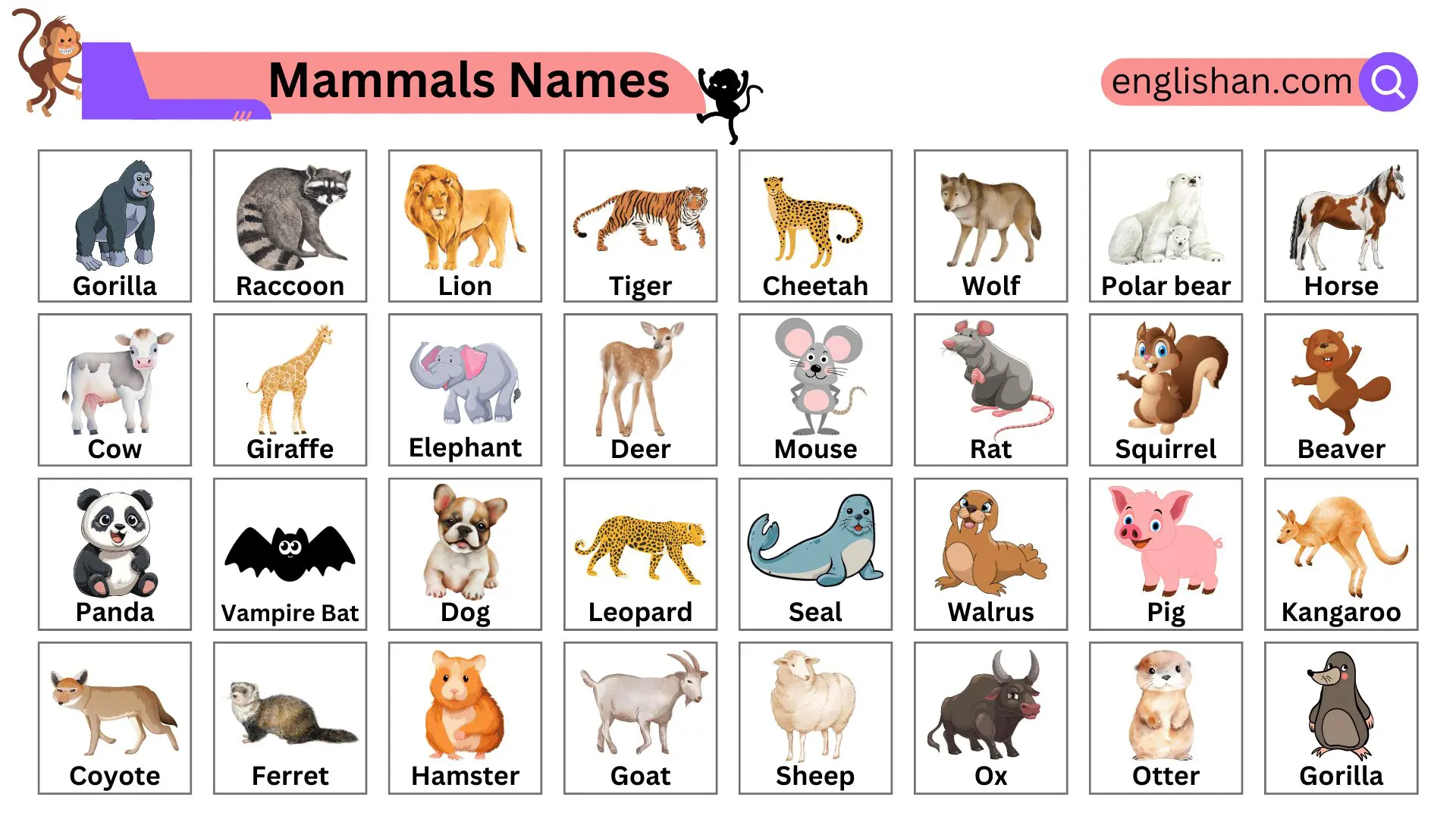
Learning mammals animals name helps you describe many animals you see in books, zoos, or nature. Whether it’s a flying mammal, a sea creature, or an egg-laying species, knowing their names strengthens your English and helps you explain what you see or read. Below, you’ll find grouped names, useful facts, and pictures that make each type easier to remember. Let’s explore some of the most interesting types of mammals and their names.
Common Mammals and Their English Names
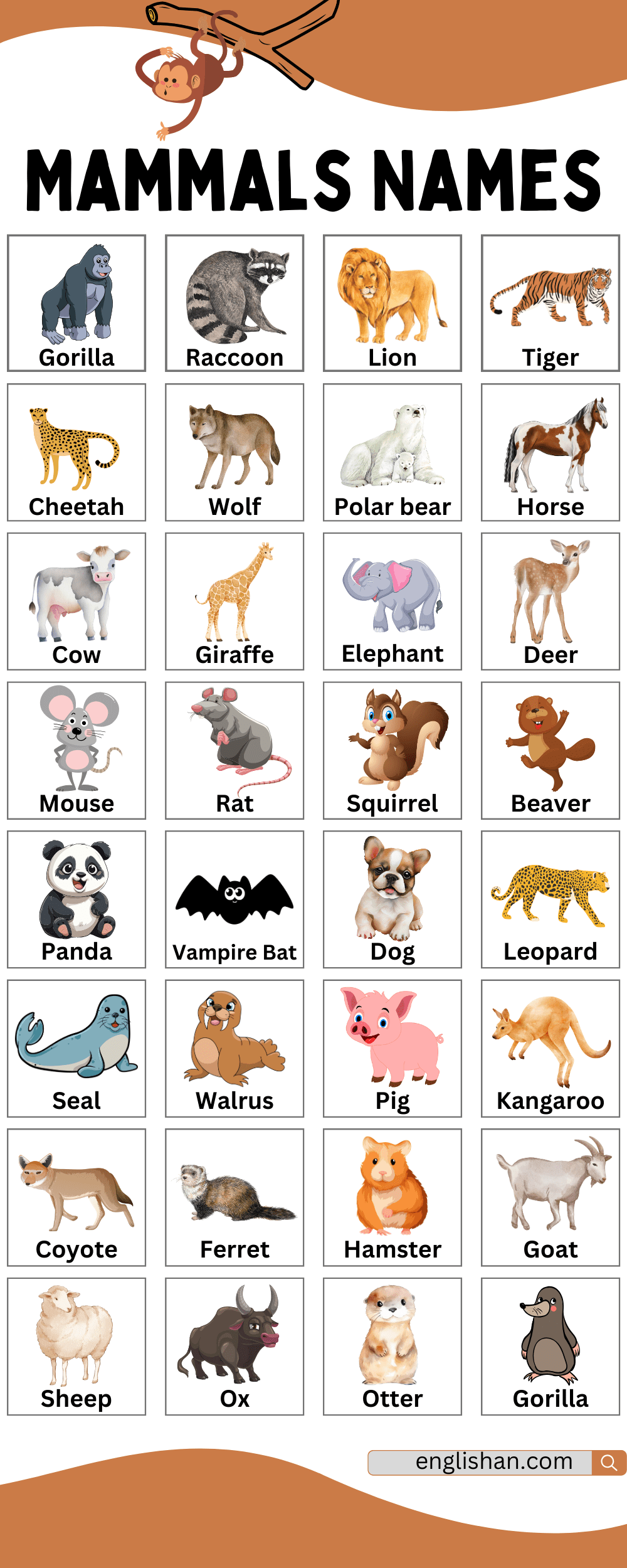
Basic Mammals Name for Kids and ESL Learners
This section helps beginners and kids learn names of easy-to-recognize mammals used in daily conversation. These mammals are often seen in homes, farms, or zoos. Some are wild, but many are domesticated.
- Cat
- Dog
- Cow
- Goat
- Pig
- Horse
- Donkey
- Sheep
- Buffalo
- Camel
- Rabbit
- Monkey
- Elephant
- Giraffe
- Lion
- Tiger
- Bear
- Fox
- Zebra
- Kangaroo
Types of Mammals and Their Traits
Below is a list showing different groups of mammals based on their characteristics. This helps learners understand how mammals behave and what they eat.
- Herbivores: Cow, Deer, Elephant, Giraffe — They eat only plants.
- Carnivores: Lion, Tiger, Leopard, Wolf — They hunt and eat meat.
- Omnivores: Bear, Pig, Human — They eat both plants and meat.
- Nocturnal mammals: Bat, Opossum — Most active at night.
- Social mammals: Dolphin, Elephant, Chimpanzee — They live in groups and interact a lot.
- Solitary mammals: Leopard, Koala — Prefer to live alone.
Scientific Name of Common Mammals
This chart provides the scientific names for some common mammals, useful for academic and scientific understanding.
| Common Name | Scientific Name |
|---|---|
| Dog | Canis lupus familiaris |
| Cat | Felis catus |
| Cow | Bos taurus |
| Horse | Equus ferus caballus |
| Elephant | Loxodonta africana |
| Lion | Panthera leo |
| Tiger | Panthera tigris |
| Bear | Ursus arctos |
| Dolphin | Delphinus delphis |
| Bat | Chiroptera (order name) |
Mammals by Reproductive Behavior
Egg Laying Mammals Name and Monotreme List
Monotremes are rare mammals that lay eggs. They are found mostly in Australia and New Guinea. Although they lay eggs, they still feed milk to their babies, which is a mammal trait.
- Platypus
- Echidna (Spiny anteater)
These animals are special because they combine birdlike traits with mammalian features.
Mammals That Lay Eggs (Oviparous Species)
The only known oviparous mammals are monotremes. They are different from reptiles because they do not have hard shells. Their eggs are soft, and they hatch their young in warm, protected spaces.
Mammals by Living Habitat
Aquatic Mammals Names and Water Adaptations
Aquatic mammals are those that live in or around water. They are good swimmers and have special features like flippers or thick fur to stay warm. Some spend all their lives in water, while others live on land and swim often.
- Dolphin
- Whale
- Seal
- Sea lion
- Manatee
- Walrus
- Otter
- Beaver
- Hippo (semi-aquatic)
Dolphins use sound to locate things. Whales can hold their breath for long periods. Otters float on their backs while they eat.
Sea-Dwelling Mammals and Their Types
Sea mammals are found in oceans and seas. They are fully adapted to life in saltwater. They breathe air but spend most of their time in water.
- Blue whale
- Orca (killer whale)
- Humpback whale
- Sperm whale
- Narwhal
- Beluga whale
- Dugong
- Sea otter
These mammals use blubber to stay warm and are excellent divers.
Forest and Desert Mammals Names
Mammals in forests and deserts must adjust to very different conditions. Forests are rich in plants and trees. Deserts are hot and dry, so animals there must survive with little water.
Forest mammals:
- Deer
- Monkey
- Gorilla
- Leopard
- Sloth
- Armadillo
Desert mammals:
- Camel
- Fennec fox
- Jerboa
- Meerkat
- Kangaroo rat
Desert mammals are usually active at night and have special ways to conserve water.
Unusual or Specialized Mammal Types
Flying Mammal Name and How They Navigate
Bats are the only mammals that truly fly. They have wings made of thin skin stretched across long fingers. They fly silently and hunt insects in the dark.
- Fruit bat
- Vampire bat
- Little brown bat
- Flying fox
Bats use echolocation. They send out sounds and listen to echoes to understand where things are, even in total darkness.
Birdlike Mammals and Overlapping Traits
Some mammals are often confused with birds because of their unusual body parts or habits. These special animals show that nature can be full of surprises.
- Bats: They fly like birds but have fur and give live birth.
- Platypus: Has a bill like a duck but lays eggs and feeds milk.
- Echidna: Has spines like a hedgehog but lays eggs and produces milk.
These mammals may look different, but they still belong to the mammal family because they are warm-blooded and nurse their young.
FAQs
Here are 12 examples of mammals:
1. Elephant
2. Lion
3. Tiger
4. Whale
5. Dolphin
6. Bat
7. Dog
8. Cat
9. Bear
10. Kangaroo
11. Monkey
12. Human
The largest mammal in Pakistan is the Asian Elephant.
While elephants aren’t found in the wild there, they can be seen in zoos. Other large mammals in Pakistan include the Indian Rhinoceros and Bengal Tiger.
Yes, a cow is a mammal.
Like all mammals, cows give birth to live young and feed their babies milk.
No, a hen is not a mammal.
A hen is a bird. Birds lay eggs, while mammals give birth to live young and feed them milk.
Yes, an ox is a mammal.
Like all mammals, oxen give birth to live young and nurse their babies with milk. They are also warm-blooded and have fur.
You May Also Like
Mammals Quiz
Mammals
Which animal does the picture show?
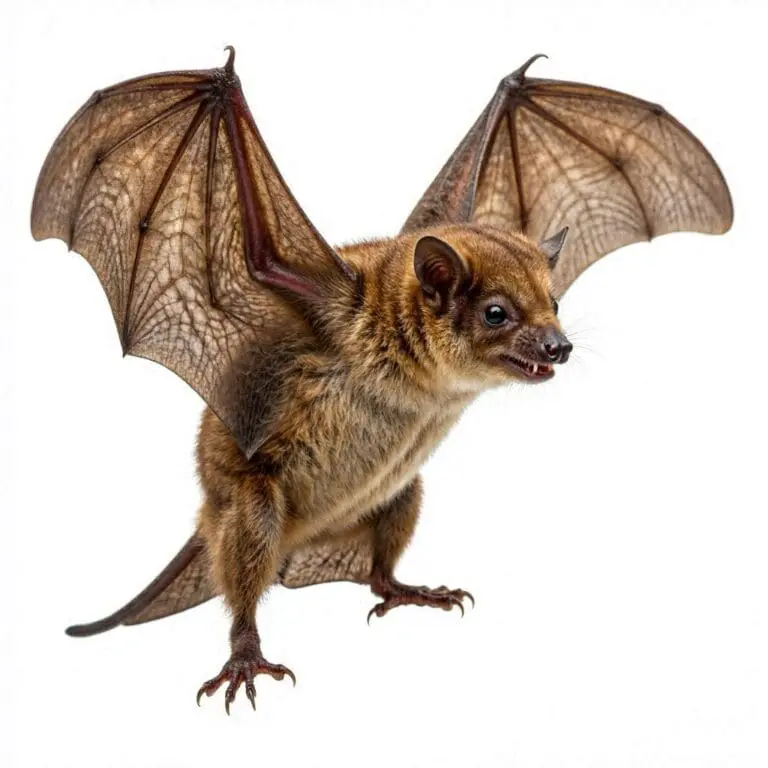
The picture shows a bat.
Read the picture before reading the options.
The picture shows a bat.
Which feature is found in every mammal?
Mammary glands give the class its name and appear in no other group.
Milk is the test; everything else has exceptions.
Even egg-laying mammals feed their young on milk.
What are egg-laying mammals called?
Only the platypus and the echidnas remain.
Three groups: monotreme, marsupial, placental.
The platypus is a monotreme, and lays leathery eggs.
Name the group.
Mammals that carry undeveloped young in a pouch are ___.
A kangaroo is born at the size of a bean and completes development attached to a teat.
Pouch means marsupial.
Kangaroos, koalas and wombats are all marsupials.
Three of these are mammals. Which is not?
A penguin is a bird — feathered, and it lays eggs without producing milk.
Living in water or flying says nothing about the class.
Dolphins and bats are mammals; penguins are birds.
What does it mean that mammals are endothermic?
Internal heat allows activity in cold conditions, at a high food cost.
Endothermic means heat from within.
An endothermic animal eats far more than a similar-sized reptile.
Which bones, unique to mammals, sit in the middle ear?
Hammer, anvil and stirrup transmit vibration, and they evolved from jaw bones.
Three ear bones is one of the clearest mammal markers in a fossil.
The three middle ear bones are found in no other class.
Turn on JavaScript for the interactive quiz. The full practice set is shown above.