A ceiling fan might seem like a simple appliance, but it has several important parts that work together to keep you cool. Knowing the parts of a ceiling fan and their functions can help you understand how it works and even make maintenance easier. In this article, we’ll break down each part and show you a labeled diagram so you can see exactly how everything fits together.
Complete List of Ceiling Fan Components
- Blades (Paddles)
- Blade Brackets or Blade Carrier or Blade Iron
- Blade Assembly Screws
- Motor and Motor Housing
- Capacitor (Run and Start)
- Downrod
- Canopy or Ceiling Plate
- Hanger Bracket
- Bearings (Ball Bearings)
- Set Screws and Finial Nut
- Lead Wires and Wire Connectors
- Light Kit or Light Fixture
- Reversing Switch
- Balancing Kit
Ceiling Fan Parts Diagram With Names
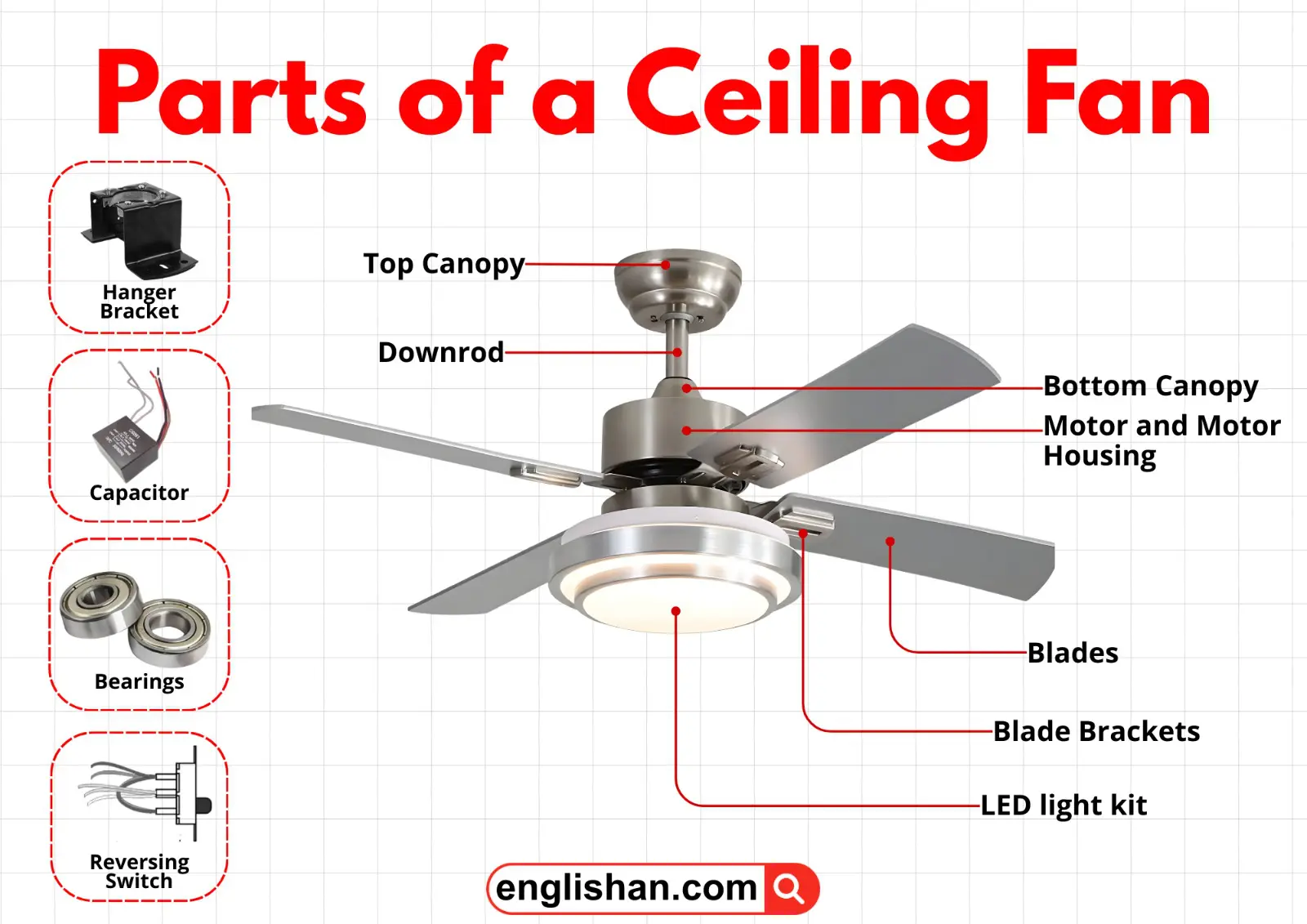
A ceiling fan is a rotating device where each visible section has a specific name and function. From the mounting at the ceiling down to the spinning blades, every part is designed to ensure smooth rotation, balanced airflow, and safe operation in a room.
Mounting Area (Ceiling Connection)
This area is what keeps the fan safely attached to the ceiling. It’s important because the fan is heavy, and these parts ensure it doesn’t fall or wobble.
Hanger Bracket
This is a strong metal bracket that screws into the ceiling. It holds the entire weight of the fan and acts as the main anchor, keeping it stable.
Ceiling Plate or Canopy
A decorative cover that hides the screws and wiring at the top of the fan. It gives the fan a clean, finished look while still letting you access the mounting points if needed.
Downrod
A metal rod that connects the fan motor to the hanger bracket. It determines how far the fan hangs from the ceiling, which affects airflow. Shorter rods are used for low ceilings, longer rods for high ceilings. Flush-mount fans skip this part.
Motor Area (Power and Rotation)
This is the heart of the fan. The motor turns electrical energy into motion, making the blades spin and circulate air.
Motor and Motor Housing
The motor is the core that powers the fan. The housing protects it from dust and damage while also holding some of the internal parts together. Without the motor, the fan cannot move.
Capacitor (Run and Start)
Small electrical components inside the motor that control how the fan starts and how fast it runs. The start capacitor gives it the push to begin spinning, and the run capacitor keeps it running efficiently at a steady speed.
Bearings (Ball Bearings)
Tiny round components inside the motor that reduce friction, allowing the motor shaft and blades to spin smoothly and quietly.
Reversing Switch
A small switch that changes the direction of the blades. Clockwise rotation pushes warm air down in winter, and counterclockwise rotation cools you in summer.
Set Screws and Finial Nut
Screws and nuts that hold the motor, downrod, and blades securely. They prevent loose parts, wobbling, or accidents.
Blade Area (Air Circulation)
The blades are what actually move the air. These parts connect the blades to the motor and ensure smooth, balanced rotation.
Blade Brackets or Blade Carrier or Blade Iron
Metal or plastic pieces that attach the blades to the motor. They keep the blades at the correct angle for proper airflow.
Blades (Paddles)
The flat, wide parts that push air around the room. Their shape and angle determine how much air moves with each rotation.
Blade Assembly Screws
Screws that secure the blades to the brackets. They ensure the blades don’t wobble or detach.
Balancing Kit
Small weights that attach to the blades to correct any imbalance. This reduces vibration and makes the fan spin smoothly.
Electrical and Light Area
These parts provide electricity to the fan and the light if it has one. They are important for safe operation and proper function.
Lead Wires and Wire Connectors
Wires carry electricity from your home wiring to the fan motor and light. Connectors join wires safely and prevent short circuits.
Light Kit or Light Fixture
If the fan comes with a built-in light, this part holds the bulb(s) and wiring. It usually attaches to the bottom of the motor housing.
Key Takeaway
A ceiling fan is made up of several essential parts that work together to ensure smooth rotation, proper airflow, and safe installation. The main components include the blades, motor, mounting hardware, and electrical connections, while optional parts like lights, balancing kits, and reversing switches enhance functionality and convenience.
You May Also Like
- Parts of a Car Door
- Parts of a Door Knob
- Bicycle Parts Names
- Parts of a Bike
- Parts of a Guitar
- Parts of a Bee