If you’ve ever been curious about how a shotgun works, understanding its parts is the first step. Every part of a shotgun, from the stock to the barrel, has a specific role that helps it function smoothly and safely. In this article, we’ll walk you through all the main components with a labeled diagram, so whether you’re a beginner or just want a clear overview, you’ll know exactly what each part does and where it’s located.
List of Shotgun Parts With Names
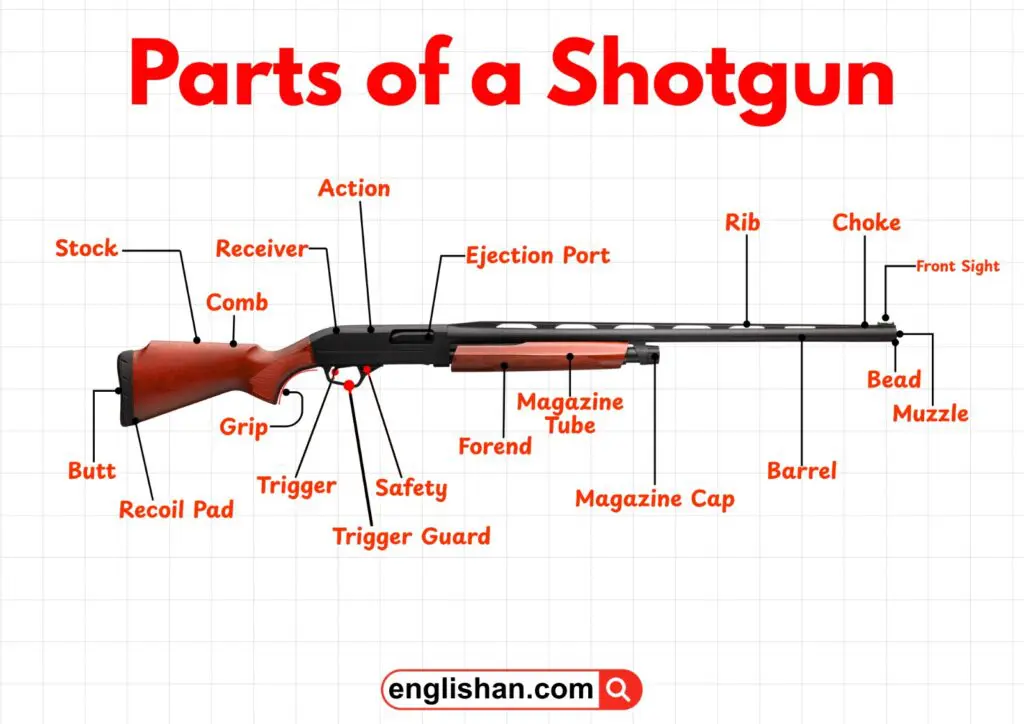
- Stock
- Action
- Barrel
- Muzzle
- Safety
- Trigger
- Trigger Guard
- Receiver
- Forcing Cone
- Forend
- Rib
- Bead
- Magazine Cap or Latch
- Choke
- Grip
- Comb
- Butt
- Recoil Pad
Structural Components (Main Body & Support)
These components form the primary framework of the firearm. They provide structural integrity, connect major assemblies, and ensure the entire system remains stable and properly aligned during operation.
Stock
The stock is the rear portion of the firearm, located behind the receiver. It extends backward and rests against the shooter’s shoulder during firing. The stock provides structural support, stability, and balance, allowing proper control and alignment. It also houses the grip and comb sections.
Receiver
The receiver is the central metal housing located between the stock and the barrel. It connects major components and contains the action. The barrel attaches to its front, and the stock attaches to its rear, making it the structural core of the firearm.
Forend
The forend (or forearm) is positioned beneath the barrel and forward of the receiver. It is held by the support hand. In pump-action shotguns, it slides back and forth to cycle the action. In other types, it primarily provides grip and balance.
Barrel
The barrel is the long cylindrical metal tube attached to the front of the receiver. It runs forward toward the muzzle and forms the pathway through which the shot travels after ignition. The barrel determines accuracy, velocity, and shot pattern behavior.
Barrel & Muzzle Components (Projectile Path System)
This group includes the parts that guide, control, and influence the shot as it travels through the barrel and exits the firearm. They directly affect accuracy, shot pattern, and ballistic performance.
Muzzle
The muzzle is the open front end of the barrel. It is the point from which the shot exits the firearm. The muzzle area may contain a choke and plays a key role in controlling shot spread.
Forcing Cone
The forcing cone is located inside the barrel, just forward of the chamber area near the receiver. It is a tapered section that guides the shot smoothly from the shell into the main bore of the barrel, reducing deformation and improving pattern consistency.
Rib
The rib is a raised strip running along the top surface of the barrel. It extends from near the receiver toward the muzzle. It assists with sight alignment and reduces visual distortion caused by barrel heat during extended shooting.
Bead
The bead is a small front sight mounted at the top front of the barrel or rib, near the muzzle. It provides a visual aiming reference point for quick target acquisition.
Choke
The choke is located at the muzzle end of the barrel, either built-in or as a removable insert. It slightly narrows the barrel opening to control the spread of the shot, allowing tighter or wider patterns depending on its design.
Operating & Firing Mechanism (Mechanical System)
These components make up the internal working system responsible for loading, chambering, firing, and ejecting ammunition. They control the mechanical function and overall operation of the firearm.
Action
The action is the internal mechanical system housed inside the receiver at the center of the firearm. It loads, chambers, locks, fires, and ejects ammunition. Depending on the shotgun type, the action may be pump-operated, semi-automatic, or break-action.
Trigger
The trigger is located inside the trigger guard beneath the receiver. When pulled, it releases the firing mechanism, causing the shell to discharge. It is the primary control for firing the firearm.
Safety
The safety is a control mechanism typically located near the trigger or on the receiver. It prevents accidental discharge by blocking the trigger or firing mechanism when engaged. It must be disengaged before firing.
Magazine Cap or Latch
The magazine cap is located at the front end of the magazine tube beneath the barrel. It secures the barrel and magazine assembly in place. In some designs, a latch mechanism assists in holding or releasing internal components.
Grip & Handling Components (Ergonomics System)
These parts are designed to enhance shooter comfort, control, and stability. They improve handling efficiency and help manage recoil during firing.
Grip
The grip is the curved portion of the stock located directly behind the trigger. It is held by the firing hand and provides control during aiming and shooting.
Comb
The comb is the upper rear section of the stock. It is where the shooter rests their cheek while aiming. Proper comb height ensures correct eye alignment with the rib and bead.
Butt
The butt is the rear-most end of the stock. It presses against the shooter’s shoulder and helps stabilize the firearm during firing.
Recoil Pad
The recoil pad is attached to the back of the butt. It is typically made of rubber or similar cushioning material. Its function is to absorb and reduce felt recoil, improving comfort and control.
Protective Component
This component provides safety by preventing accidental contact or unintended discharge, ensuring secure handling during use.
Trigger Guard
The trigger guard is a protective loop surrounding the trigger. It is located directly below the receiver. Its purpose is to prevent accidental contact with the trigger and protect it from external impact.
Types of Shotgun
Before exploring the individual components, it is important to understand that shotguns come in different types, and their design influences how certain parts function and operate.
Pump-Action Shotgun
A pump-action shotgun requires the shooter to manually cycle the action by sliding the fore-end (pump) backward and forward after each shot. This movement ejects the spent shell and chambers a new one from the magazine tube. Pump-action shotguns are widely used for hunting, sport shooting, and law enforcement because they are reliable, durable, and capable of handling various types of ammunition.
Parts of a Pump-Action Shotgun
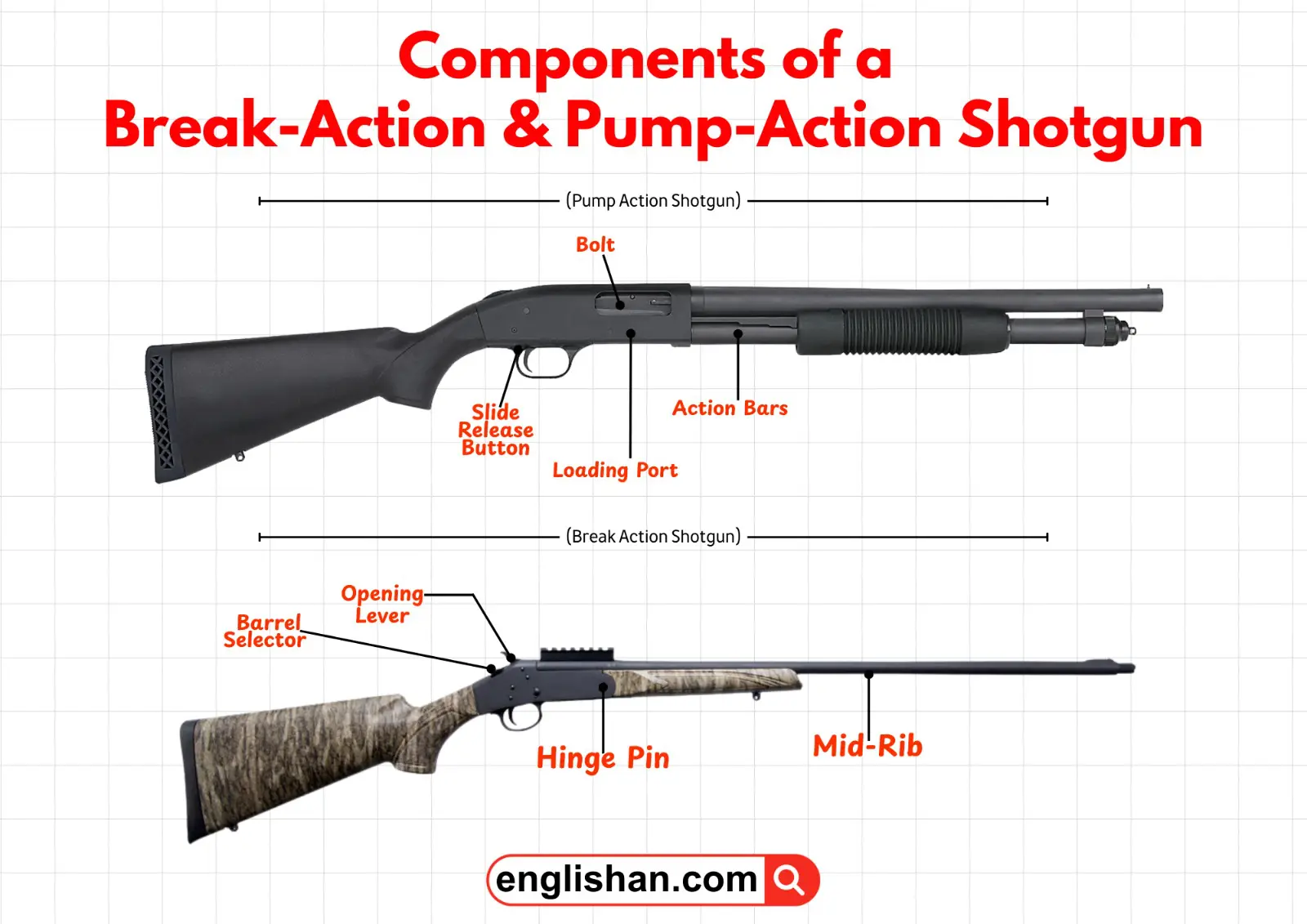
- Fore-End (Pump) — The movable front grip located beneath the barrel. The shooter slides it back and forth to eject a spent shell and load a new round into the chamber.
- Action Bars — Metal rods connected to the fore-end. They transfer the pumping motion to the bolt assembly, enabling the cycling of the action.
- Bolt — Located inside the receiver, the bolt locks into the barrel when firing. It moves backward and forward during pumping to extract, eject, and chamber shells.
- Extractor and Ejector — The extractor pulls the spent shell from the chamber when the fore-end is pulled back. The ejector then pushes the shell out of the ejection port.
- Magazine Tube — Positioned beneath the barrel, the magazine tube stores multiple shotgun shells and feeds them into the chamber during cycling.
- Shell Carrier (Lifter) — This component lifts a shell from the magazine tube and aligns it with the chamber as the action moves forward.
- Receiver — The main housing that contains the bolt and internal operating parts. It connects the barrel, stock, and magazine tube into a single functional unit.
Break Action Shotgun
A break action shotgun opens at the hinge between the barrel and receiver. The barrel tilts downward to load or remove shells manually. It is mechanically simple, reliable, and easy to maintain. Break action shotguns are often used for hunting and clay shooting.
Parts of a Break Action Shotgun
- Bolt — This is the part that moves back and forth inside the gun. It pushes a shell into place when firing and pulls the empty shell out after the shot.
- Ejection Port — This is the opening on the side where the empty shell pops out after you fire.
- Loading Port — This is the spot underneath where you insert the shells into the magazine tube.
- Action Bars — These connect the pump (the part you slide back and forward) to the bolt. When you pump it, these bars move and cycle the action.
- Magazine Tube — This long tube under the barrel holds the extra shells before they’re loaded into firing position.
- Slide Release Button — This button lets you unlock the pump so you can slide it back manually, especially if you haven’t fired a shot.
Key Takeaway
As we learned, a shotgun functions as an integrated mechanical and structural system where each component serves a specific purpose. The structural parts provide strength and alignment, the barrel and muzzle components guide and control the projectile, the operating mechanism manages loading and firing, ergonomic parts improve handling and recoil control, and protective elements enhance safety. All components work together to ensure stability, accuracy, controlled discharge, and safe operation.
You May Also Like
- Parts of a Steam Locomotive
- 11 Parts of a Lamp Labeled Diagram
- Parts Of A Pistol Diagram
- Parts Of A Knife Diagram
- 33 Parts Of A Sword