
Orthodontic braces are more than just metal on your teeth. They are carefully designed systems that work together to straighten teeth and improve your smile. From brackets and wires to elastics and hooks, each part has a specific role in moving teeth into the right position. In this article, we will take a close look at the parts of braces, their functions, and a clear diagram to make everything easy to understand.
List of Braces Parts With Names
- Archwire
- Power Chain
- Bonded Brackets
- Bracket Hook
- Buccal Tube
- Molar Band
- Elastic Ligature
- Coil Spring
- Self-Ligating Bracket
- Headgear Tube
- Elastics
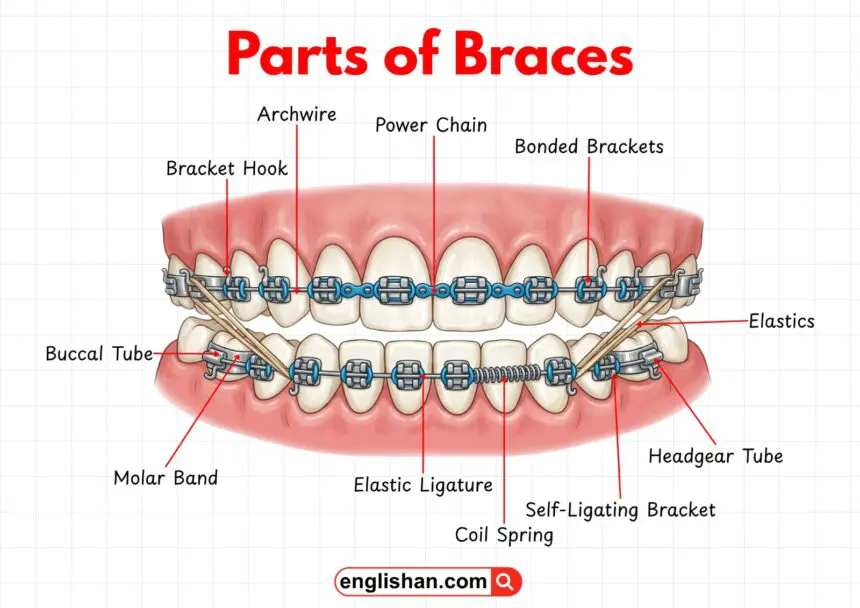
Parts of Braces Diagram With Names
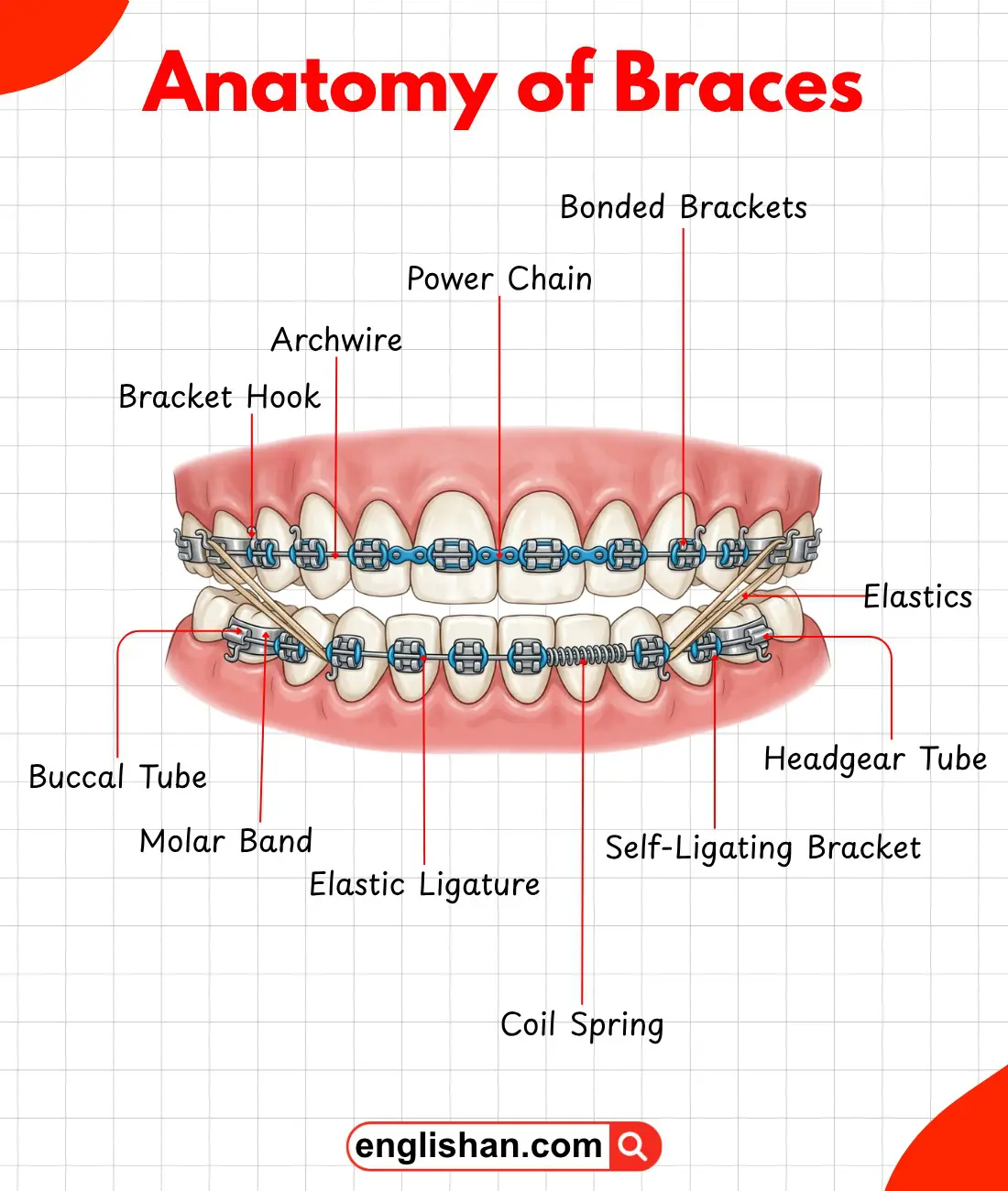
Braces are dental devices that help straighten teeth and improve your bite effectively. They are made up of several parts that work together to move teeth into the correct position. Brackets are attached to each tooth to hold the archwire, which guides the movement of the teeth. Elastic ligatures or O-rings secure the wire to the brackets, while coil springs and power chains provide additional force where needed. Hooks and attachments allow elastics to connect upper and lower teeth for proper alignment. Other components, such as headgear tubes and molar bands, support complex adjustments. Each part, from the brackets to the smallest hook, plays an important role in ensuring braces work efficiently and safely.
Main Structural Components
These parts form the foundation of the braces system and remain securely attached to the teeth throughout treatment.
Bonded Brackets
Bonded brackets are small square-shaped attachments that are glued directly onto the front surface of each tooth using special dental adhesive. They act as anchors for the braces system, holding the archwire in place and allowing orthodontists to control tooth movement precisely. Each bracket is carefully positioned to guide teeth into ideal alignment.
Self-Ligating Bracket
A self-ligating bracket looks similar to a regular bracket but includes a built-in sliding door or clip instead of elastic ties. This mechanism holds the archwire securely while allowing it to move more freely. Because of reduced friction, these brackets often make adjustments smoother and may require fewer orthodontic visits.
Molar Band
The molar band is a strong metal ring placed around the back molars. Since molars handle greater chewing forces, bands provide extra stability compared to bonded brackets. They serve as solid anchors that support wires, springs, and other orthodontic appliances.
Buccal Tube
The buccal tube is a small metal attachment fixed to the molar band. It acts as a holder or passageway for the archwire and sometimes elastics or headgear components. This tube helps stabilize the back portion of the braces and supports additional corrective forces.
Wires & Force-Applying Components
These parts are responsible for creating the pressure needed to move teeth gradually.
Archwire
The archwire is the main metal wire that runs across all brackets, connecting them together. It is shaped according to the ideal dental arch and applies gentle, continuous pressure on teeth. As the wire tries to return to its original shape, it slowly guides teeth into better alignment.
Coil Spring
A coil spring is a small spiral-shaped spring placed on the archwire between brackets. It is used to either create space between teeth or maintain spacing during treatment. By pushing teeth apart or holding them steady, it helps achieve proper tooth positioning.
Ligatures & Connecting Elements
These components secure and connect parts of the braces system.
Elastic Ligature
Elastic ligatures are tiny rubber bands placed around brackets to hold the archwire firmly in place. They come in different colors, allowing patients to customize their braces appearance. Despite their small size, they play an important role in maintaining consistent pressure on teeth.
Power Chain
A power chain looks like a connected series of elastic rings linked together. Unlike individual ligatures, it connects multiple brackets at once to apply stronger, continuous force. Orthodontists use power chains to close gaps between teeth and improve alignment efficiently.
Elastic & Auxiliary Components
These parts provide additional correction for bite and jaw alignment.
Elastics
Elastics, also called rubber bands, connect the upper and lower braces using hooks. They apply directional force to correct bite problems such as overbite, underbite, or crossbite. Patients usually attach and replace them daily as instructed by the orthodontist.
Bracket Hook
Bracket hooks are small extensions attached to certain brackets. They serve as attachment points for elastics or other orthodontic accessories. These hooks allow forces to be applied in specific directions for more precise bite correction.
Headgear Tube
The headgear tube is a special opening located on the molar band that allows orthodontic headgear to be attached when needed. Headgear provides extra external force to guide jaw growth or move molars backward in complex orthodontic cases.
Key Takeaway
As we learned, braces are not just simple wires on the teeth but a carefully designed system made up of multiple parts working together. Brackets and bands provide support, the archwire and springs apply controlled pressure to move teeth, while ligatures, power chains, and elastics help guide alignment and correct bite issues. Each component plays a specific role, and together they gradually shift teeth into healthier, straighter positions, improving both appearance and overall dental function over time.
You May Also Like