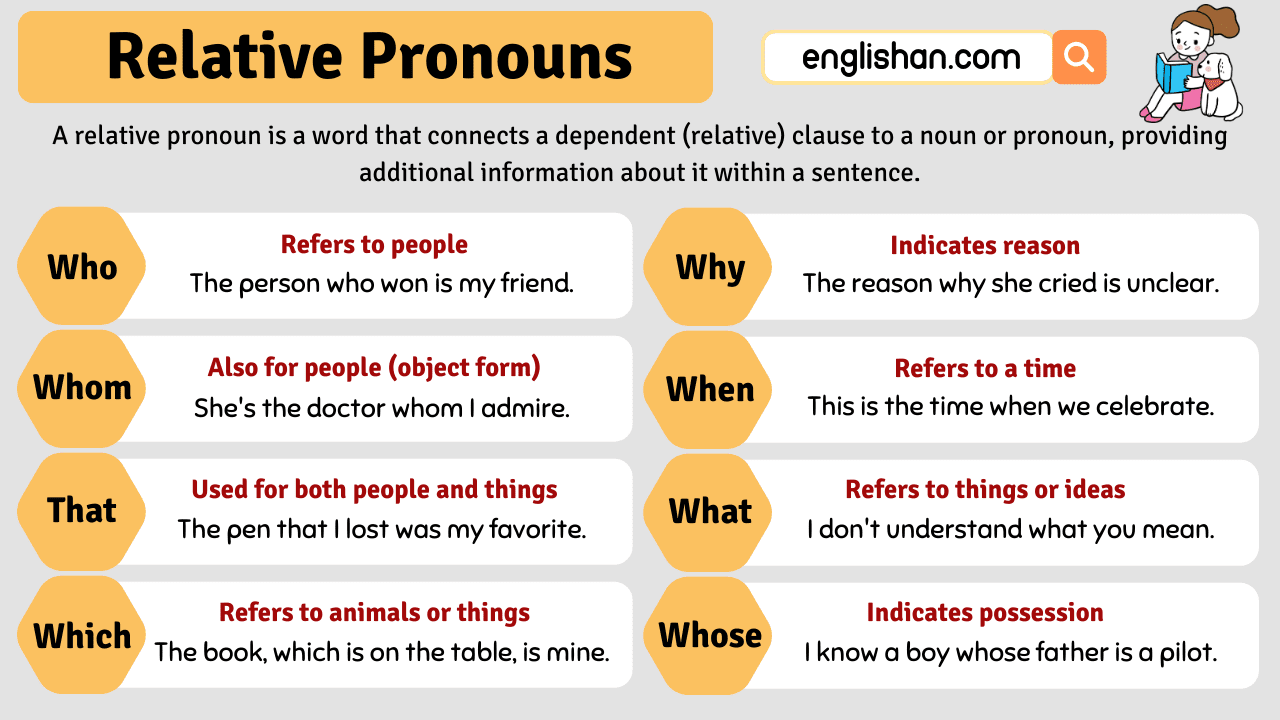
Relative pronouns are words like who, that, and which that act as a bridge between two ideas. They allow you to add important details to a person or thing you have already mentioned without starting a new sentence. As a teacher, I know how frustrating it feels when your writing sounds choppy. Using these connectors is the simplest way to make your English flow naturally.
I have created this guide to help you master these “bridge words” with confidence. To get started, here are the primary relative pronouns we will be using to build better sentences:
- Who & Whom: Used when we are talking about people.
- Which: Used for animals and objects.
- That: A versatile word used for people, animals, or things.
- Whose: Used to show who owns something.
In the sections below, I will show you exactly how to use each of these in a sentence and how to choose the right one every time. We will also clear up common points of confusion, such as when to use who versus whom.
What Are Relative Pronouns?
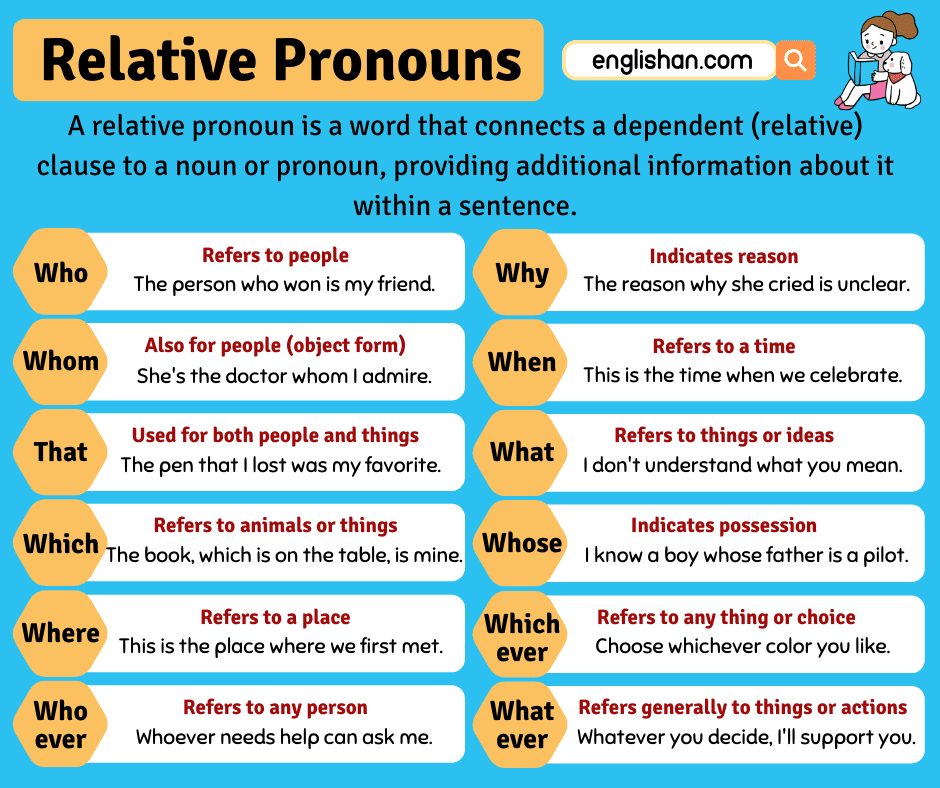
Relative pronouns connect a clause or phrase to a noun or pronoun in a sentence. They introduce a relative clause that describes or identifies it further. Common relative pronouns include “who,” “whom,” “whose,” “which,” and “that.” These pronouns make our sentences clearer and more informative by connecting related ideas.
Here are some simple example sentences:
- This is the house where I grew up.
- The girl who lives next door is my friend.
- I know a man whose car is blue.
- The book which is on the table is mine.
- Do you know anyone whom I can ask for help?
In each sentence, the relative pronoun introduces a clause that provides additional information about the noun or pronoun in the main clause. For example, in the first sentence, “where” connects the clause “I grow up” to the noun “house,” telling us more about the house.
Types of Relative Pronouns
Relative pronouns can be categorized into different types based on their usage and the information they provide.
- Personal Pronouns: These relative pronouns include “who,” “whom,” and “whose.” They refer to specific people or, in some cases, animals with names. Example: The woman who lives next door is a doctor.
- Demonstrative Pronouns: “Which” falls under this category. It refers to animals and things. Example: The book, which is on the table, is mine.
- Possessive Pronouns: “Whose” is the only relative pronoun in this category. It shows possession. Example: She is the girl, whose bag got stolen.
- Non-restrictive Pronouns: These relative pronouns provide additional, non-essential information. They are set off by commas and can be omitted without changing the meaning of the sentence. Example: Sarah, who is my neighbor, invited me to her party.
- Restrictive Pronouns: These pronouns provide essential information about the noun they modify and cannot be omitted without altering the sentence’s meaning. Example: The car that is parked in front of the house belongs to Asim.
Complete List of Relative Pronouns
Here is the list of common relative pronouns:
- Who
- Whom
- Whose
- Which
- That
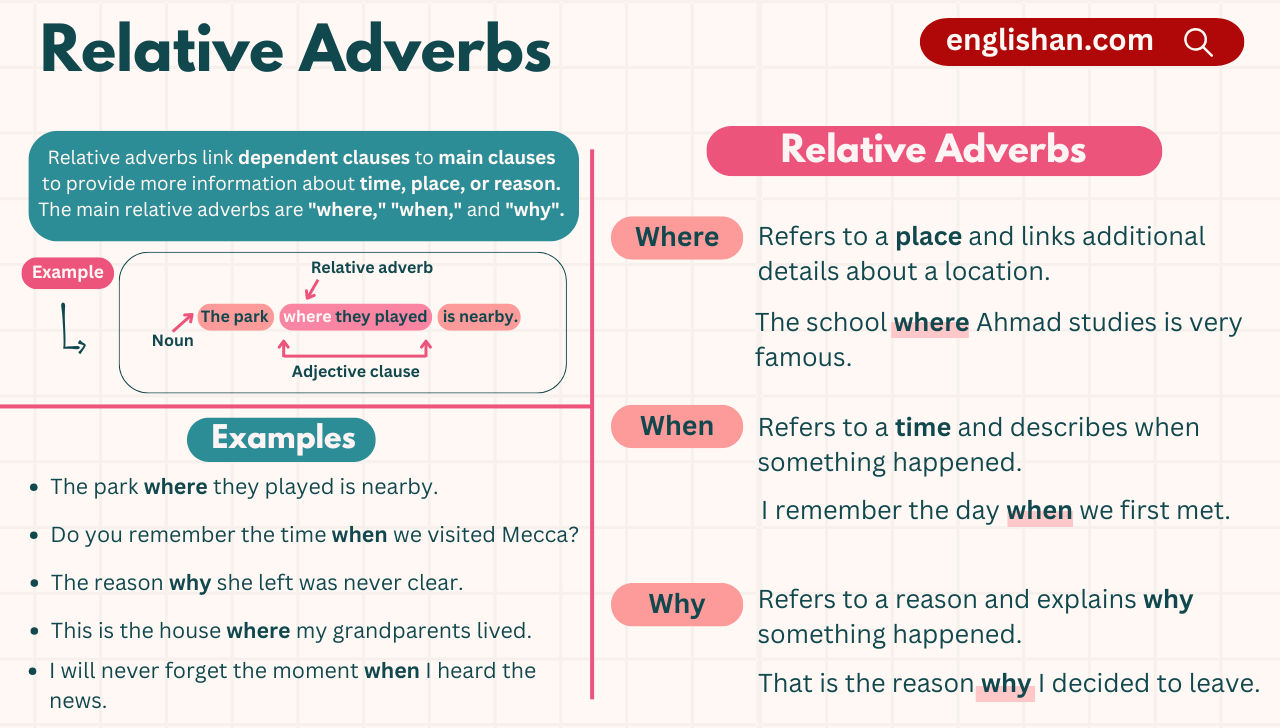
- Where
- When
- Why
- What
- Whoever
- Whomever
- Whichever
- Whatever
- Whosoever
Examples of Relative Pronouns in Sentences
- The book which I read is interesting.
- The car that I drive is fast.
- The park where we play is big.
- The day when we met was sunny.
- The reason why she cried is unclear.
- Whoever comes early gets a prize.
- She is the girl who won the race.
- The man whom I saw is a doctor.
- Whichever path you take, be careful.
- The reason why he left is unknown.
- The place where we met is special.
- Whatever you decide, I’ll support you.
- This is the tree that gives juicy fruits.
- She is the one who always helps.
- This is the bus which goes to the city.
- I’ll eat whatever you cook for dinner.
- He is the one who scored the highest.
- This is the pen whose ink is black.
- The girl whom I met is my cousin.
- The restaurant, which serves pizza, is nearby.
Which vs That
Which introduces added information about a noun that is already identified. The sentence remains complete without that clause, so the clause is non-essential.
- The laptop, which I bought last week, is already slow.
- My brother, which is not correct, should be: My brother, who lives in Dubai, visits in winter.
- The meeting, which ended late, delayed our dinner.
That introduces information needed to identify the noun. Removing that clause changes which person or thing you mean, so the clause is essential.
- The laptop that I bought last week is already slow.
- The student that scored highest will receive the prize.
- The restaurant that opened near my house is always crowded.
Who Versus Whom
Who is used for the subject of a verb. It matches he, she, they.
- Who called you last night?
- Do you know who broke the glass?
- Who is coming to the meeting?
Whom is used for the object of a verb or preposition. It matches him, her, them.
- Whom did you call last night?
- Do you know whom they invited?
- To whom should I send the email?
Relative Pronouns With Prepositions
Relative pronouns connect a noun to a clause that includes a preposition. The position of the preposition controls formality, not meaning. Fronting the preposition creates a formal pattern, while placing it at the end reflects common usage.
- Formal pattern (preposition before pronoun)
- The person to whom I spoke was helpful.
- The company for which she works is hiring.
- The topic about which we argued was minor.
- Common pattern (preposition at the end)
- The person who I spoke to was helpful.
- The company that she works for is hiring.
- The topic which we argued about was minor.
- Pronoun rules with fronted prepositions
- Use whom for people.
- Use which for things.
- Do not use that after a preposition.
- Key contrast
- Fronted preposition equals formal tone.
- End position equals everyday tone.
When To Omit Relative Pronouns
You can omit a relative pronoun when it is the object in the relative clause. You cannot omit it when it is the subject because the verb would have no subject.
- Object pronoun, omission allowed
- The book (that) I bought is expensive.
- The man (who) she met was polite.
- The laptop (which) we ordered arrived today.
- Subject pronoun, omission not allowed
- The book that costs a lot is on the desk.
- The man who lives next door is a doctor.
- The laptop which has a broken key is mine.
You usually keep the relative word in non-defining clauses with commas.
- Non-defining, keep the pronoun
- My phone, which I bought last year, is already slow.
- Ali, who I trust, gave me honest advice.
- This road, which was closed yesterday, is open now.
You also keep it when a preposition comes before the relative word.
- Preposition before, keep the pronoun
- The person to whom I spoke was helpful.
- The topic about which we argued was minor.
- The company for which she works is hiring.
FAQs
Relative pronouns are words used to introduce a subordinate clause (also called a relative clause) that gives more information about a noun in the main clause. They include “who,” “whom,” “whose,” “which,” “that,” and sometimes “what.”
Relative pronouns serve as connectors between different parts of a sentence. They link the main clause with a subordinate clause, providing additional details about the noun mentioned in the main clause.
Restrictive relative clauses provide essential information about the noun, and they are not set off by commas. Non-restrictive relative clauses provide additional, non-essential information and are set off by commas. For example, “The boy who is tall is my friend” (no commas), and “My sister, who is a doctor, is coming” (commas).
“That” is used in restrictive clauses, essential for the sentence’s meaning, while “which” is used in non-restrictive clauses, providing additional, non-essential information. For example:
1. The book that I read is interesting (restrictive).
2. The book, which I read, is interesting (non-restrictive).
Relative pronouns example sentences include:
1. This is the street where I live.
2. I will eat whatever you cook.
3. She is the girl who won the race.
4. The pen that I lost was my favorite.
5. She is the one whose phone rang.
Read More
- Relative Clauses
- 60 Examples of Pronouns in Sentences
- Noun Clauses
- Dependent Clauses
- Worksheets of Pronoun