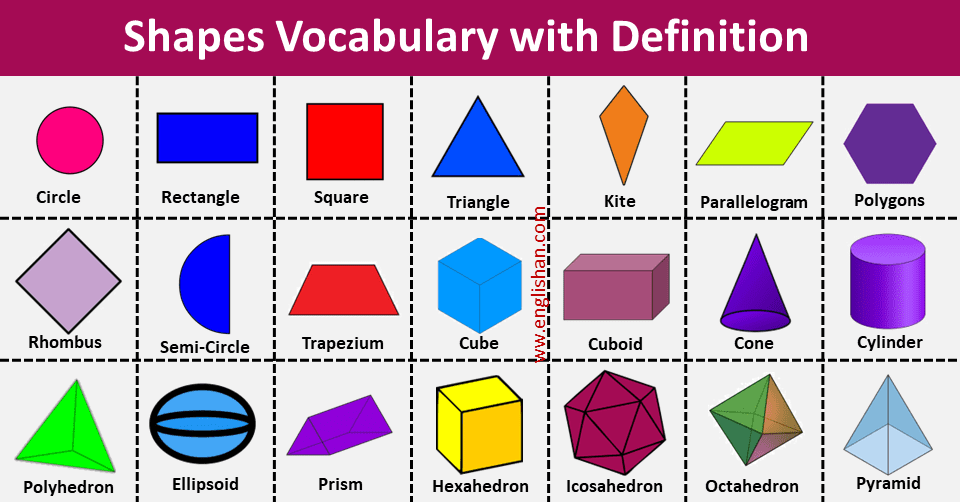
Is the sun a circle or a sphere? That small question is a great way for students and kids to learn shapes names, because geometry starts to change when flat shapes become solid shapes.
A circle is a 2D shape, while a sphere is a 3D shape with depth. The same difference helps learners understand squares, triangles, cubes, cones, and cylinders through sides, corners, faces, edges, and curves.
Students, teachers, and parents can use these shape names with pictures, examples, and worksheets to learn each geometry word clearly and remember the difference between 2D and 3D shapes.
Common Shape Names: Quick Answer
The most common shape names are circle, square, triangle, rectangle, oval, diamond, star, heart, pentagon, hexagon, octagon, cube, cuboid, sphere, cone, cylinder, pyramid, prism, torus, and hemisphere.
Flat shapes are 2D shapes. Solid shapes are 3D shapes.
All Shapes Names With Pictures
The fastest way to recognize a shape is to connect its form with a familiar object. A circle matches a plate, a rectangle matches a book, a sphere matches a ball, and a cylinder matches a can.
| Shape Name | Type | Real-Life Example |
|---|---|---|
| Circle | 2D curved shape | coin, clock, plate |
| Square | 2D polygon | tile, chessboard square, sticky note |
| Triangle | 2D polygon | pizza slice, warning sign, roof front |
| Rectangle | 2D polygon | door, book, phone screen |
| Oval | 2D curved shape | egg outline, mirror, face shape |
| Diamond | 2D quadrilateral | kite, road sign, playing card symbol |
| Pentagon | 2D polygon | badge, home plate shape |
| Hexagon | 2D polygon | honeycomb cell, bolt head |
| Octagon | 2D polygon | stop sign |
| Cube | 3D solid shape | dice, block, ice cube |
| Cuboid | 3D solid shape | book, brick, cereal box |
| Sphere | 3D curved solid | ball, globe, orange |
| Cone | 3D solid shape | traffic cone, party hat, ice cream cone |
| Cylinder | 3D curved solid | can, candle, drum |
| Pyramid | 3D solid shape | Egyptian pyramid, pyramid toy |
| Torus | 3D ring shape | donut, tire, swimming ring |
Basic Shape Names For Kids and Beginners
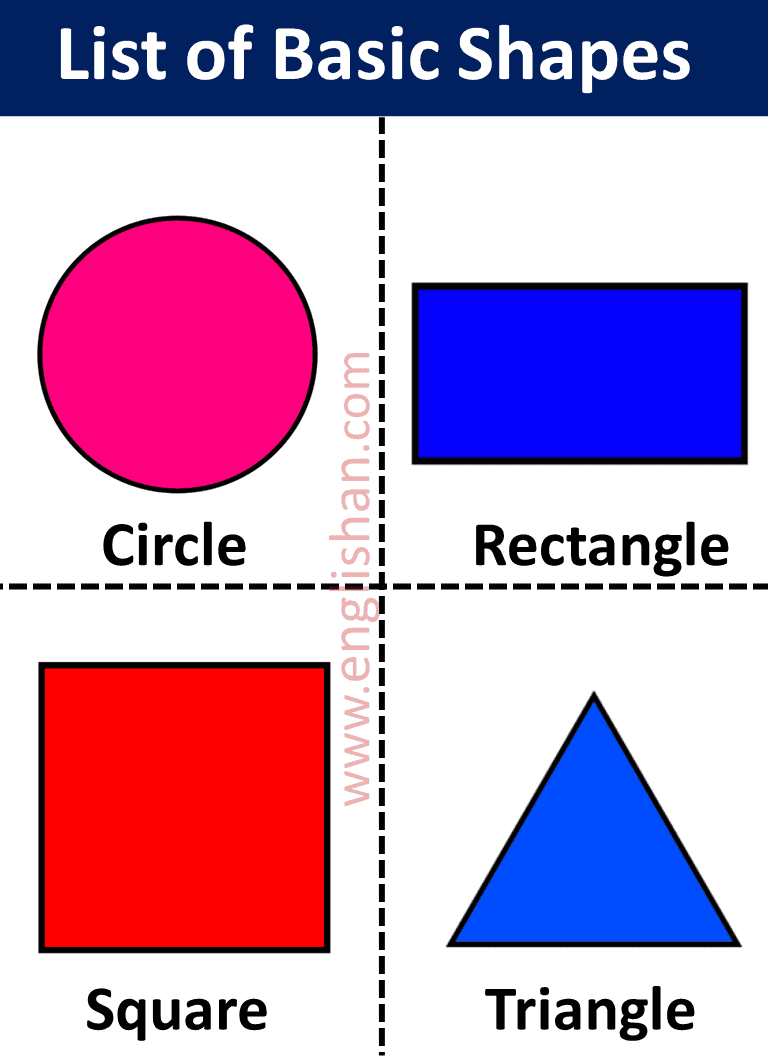
Basic shapes are the shapes people usually recognize first because they match common objects at home, on roads, in books, on screens, and in toys. These shapes also build the base for more advanced geometry.
- CircleA circle is a flat round shape with one smooth curved boundary and no corners. Coins, wall clocks, buttons, wheels, plates, and round logos use circular shapes. In geometry, every point on the edge of a circle stays the same distance from the center.
- SquareA square has four equal sides and four right corners. Floor tiles, sticky notes, chessboard boxes, and many app icons use square shapes because the sides match neatly. A square is also a special kind of rectangle because all four sides are equal.
- TriangleA triangle has three straight sides and three corners. It is the first true polygon because three sides are the minimum needed to close a flat shape. Roof fronts, warning signs, ramps, folded paper, and pizza slices often use triangle shapes.
- RectangleA rectangle has four right corners, with opposite sides equal. Doors, books, phones, tablets, picture frames, and screens often use rectangular shapes because the longer side gives more room. Most everyday screens are rectangles, not squares.
- OvalAn oval is a stretched round shape with no corners. Eggs, mirrors, balloons, face outlines, racetracks, and some tables have oval shapes. It feels round like a circle but longer in one direction.
- DiamondA diamond shape looks like a square turned onto one corner. Kites, road signs, jewelry symbols, and playing card icons often use this sharp four-sided form. In geometry, a diamond-like shape is often connected with a rhombus.
- StarA star shape has pointed arms reaching outward from the center. Badges, decorations, stickers, flags, medals, and rating icons often use star shapes. The five-point star is the most familiar version.
- HeartA heart shape has two rounded curves at the top and a point at the bottom. Cards, icons, decorations, jewelry, and symbols of love often use this shape. It is not a polygon because its outline is curved.
2D Shapes Names
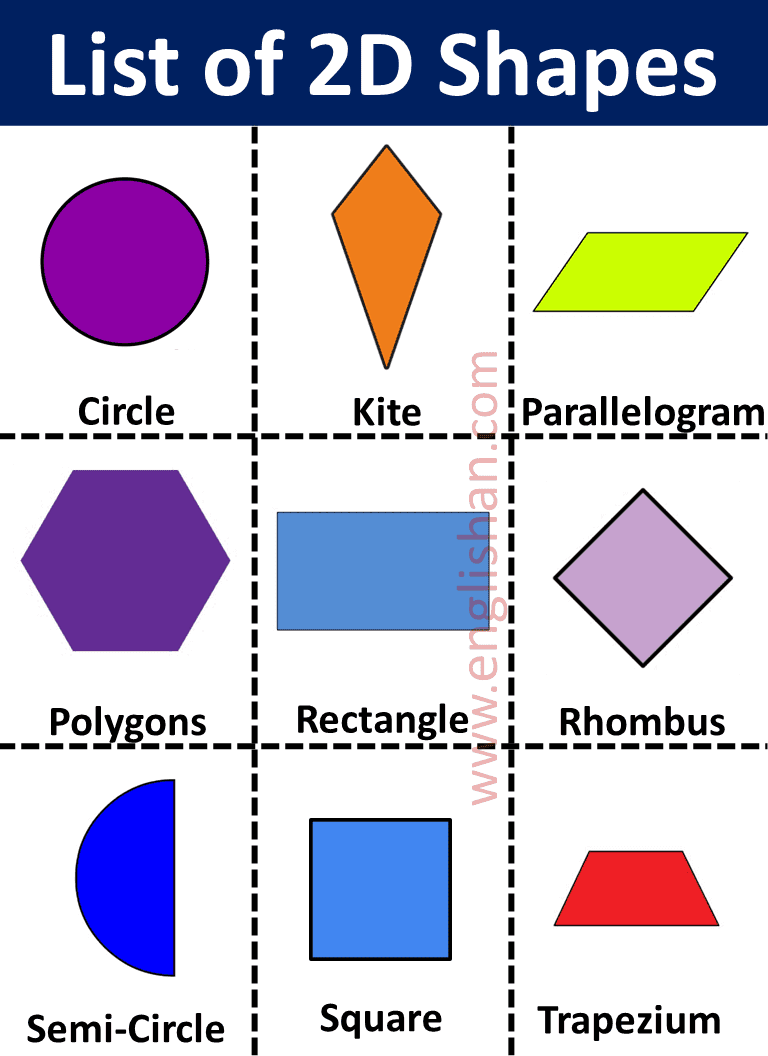
A 2D shape is flat. It has length and width, but no depth. You can draw it on paper, print it on a label, cut it from card, or place it inside a flat design.
Some 2D shapes use only straight sides, such as triangles, squares, pentagons, and hexagons. Others use curves, such as circles, ovals, crescents, rings, and semicircles.
Common 2D Shapes List
- CircleA circle has one continuous curved edge and no corners. It is one of the most important curved shapes because wheels, clocks, coins, plates, buttons, and round signs all carry its form.
- SquareA square has four equal sides and four right angles. Its equal sides make it one of the most balanced flat shapes in geometry and design.
- TriangleA triangle has three sides and three angles. Triangles can be narrow, wide, tall, slanted, equal-sided, or right-angled, but the three-side rule never changes.
- RectangleA rectangle has four right angles and two pairs of equal opposite sides. Doors, books, screens, and frames often use this shape because it gives more space in one direction.
- OvalAn oval is longer than a circle but still smooth and corner-free. Egg outlines, mirrors, balloons, and sports tracks often follow oval shapes.
- PentagonA pentagon has five straight sides. Badges, home plate shapes, building fronts, and icons often use pentagonal outlines.
- HexagonA hexagon has six straight sides. Honeycomb cells, bolt heads, tile patterns, and some nuts use this shape because six-sided shapes fit together tightly.
- HeptagonA heptagon has seven sides. It is less common in daily objects, but it belongs in a fuller geometric shapes set.
- OctagonAn octagon has eight sides. The stop sign is the best-known octagon, which makes this shape easy to recognize in road symbols.
- Semicircle
A semicircle is half of a circle. It has one curved edge and one straight edge, often found in arches, fan shapes, rainbow drawings, and rounded windows.
- Crescent
A crescent has two curved edges and a narrow moon-like form. Moon symbols, flags, jewelry, icons, and decorative patterns often use crescents.
- Ring
A ring is a circular shape with a hollow center. Donuts, washers, bangles, and some wheel parts show this form in real life.
Geometric Shapes Names
Geometric shapes are shapes that can be described through sides, corners, angles, curves, faces, edges, surfaces, symmetry, or depth. A circle, square, triangle, and hexagon are flat geometric shapes. A cube, sphere, cone, cylinder, prism, and pyramid are solid geometric shapes.
The shape family grows from basic shapes to more advanced ones. Start with common flat shapes, then move into polygons, quadrilaterals, triangle types, curved shapes, 3D solids, prisms, and special shapes such as ellipses, annuli, torus shapes, ellipsoids, and frustums.
Basic Geometric Shapes List
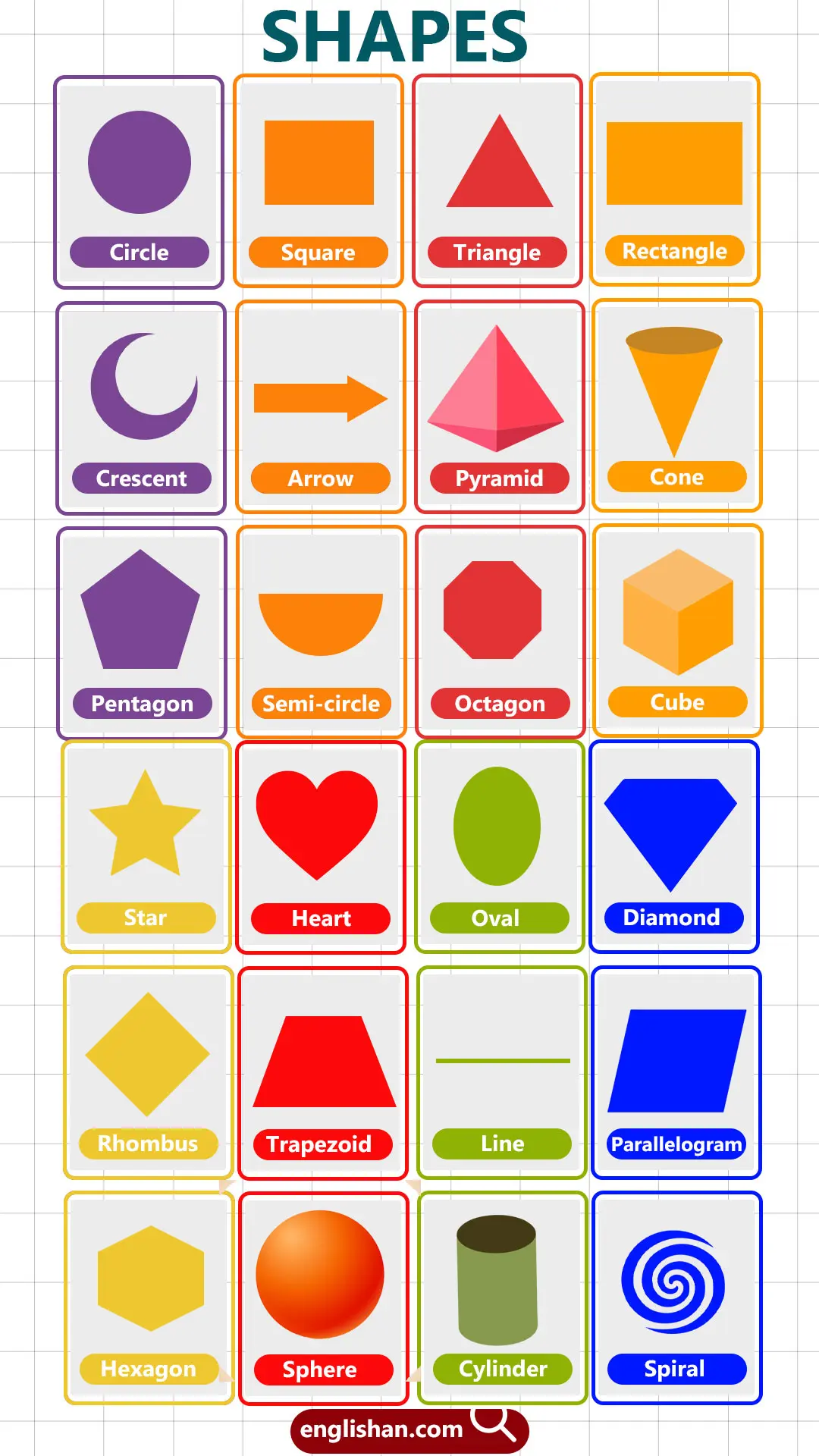
- CircleA circle is a fully round flat shape with no sides and no corners. It is built from one smooth boundary around a center point. Many related shapes, including semicircles, arcs, sectors, rings, and annuli, come from circle geometry.
- SquareA square has four equal sides and four right angles. Because every side and corner matches, it is a regular quadrilateral. Tiles, icons, grids, checkerboards, and pixel-style designs often rely on square geometry.
- TriangleA triangle has three sides and three angles. It is the smallest straight-sided closed shape in geometry. Triangles are common in roofs, bridges, warning signs, ramps, and folded paper because their form looks strong and direct.
- RectangleA rectangle has four right angles and two pairs of equal opposite sides. It is one of the most common shapes in built spaces, from doors and books to screens and tables. A square belongs to the rectangle family, but most rectangles are longer in one direction.
- OvalAn oval has a rounded outline that stretches more in one direction. It is common in mirrors, eggs, balloons, labels, and table designs. In formal geometry, an ellipse is the more exact curved form behind many ovals.
Polygon Shapes
A polygon is a closed flat shape made only with straight sides. Circles, ovals, crescents, and rings are not polygons because they use curves.
- TriangleA triangle has three straight sides. It is the first polygon because fewer than three straight sides cannot close a flat shape.
- QuadrilateralA quadrilateral has four sides. Squares, rectangles, rhombuses, parallelograms, trapezoids, and kites all belong to this group.
- PentagonA pentagon has five sides. It often shows up in badges, home-plate shapes, icons, and building designs.
- HexagonA hexagon has six sides. Honeycomb cells are the classic natural example, while bolt heads and tiles show the shape in design and construction.
- HeptagonA heptagon has seven sides. It is not as common in everyday objects, but it is part of the standard polygon family.
- OctagonAn octagon has eight sides. Stop signs use this outline because the shape stands apart from rectangles, circles, and triangles.
- NonagonA nonagon has nine sides. It is mainly found in geometry charts, diagrams, and decorative patterns.
- DecagonA decagon has ten sides. Regular decagons work well in badges, borders, icons, and pattern design.
- DodecagonA dodecagon has twelve sides. It is common in advanced shape charts and some decorative layouts where many straight sides create a near-round form.
Advanced 2D Geometric Shapes
- EllipseAn ellipse is a smooth stretched circle with a longer direction and a shorter direction. Oval tracks, mirror frames, orbit diagrams, and some design panels follow ellipse-like shapes.
- ArcAn arc is part of a curve, usually part of a circle. Bridges, rainbows, rounded windows, gauges, and clock marks often use arcs.
- SectorA sector is a slice of a circle formed by two radius lines and one curved edge. Pizza slices, pie charts, fan blades, and clock-angle diagrams often show sector shapes.
- SegmentA segment is a part of a circle cut off by a straight line. It looks like a curved cap. Lens shapes, rounded window tops, and some design panels use segment-like shapes.
- AnnulusAn annulus is the flat ring area between two circles with the same center. Washers, bangles, ring icons, donuts seen from above, and tire outlines often match this shape.
- RhombusA rhombus has four equal sides, usually with slanted angles. Diamond patterns, floor designs, fabric prints, and decorative tiles often use rhombus shapes.
- ParallelogramA parallelogram has two pairs of parallel opposite sides. It looks like a rectangle pushed sideways, which gives it a sense of movement in logos, tiles, and graphic layouts.
- TrapezoidA trapezoid has one pair of parallel sides. Lampshades, buckets from the side, bridge parts, and table side outlines often have trapezoid-like shapes.
- KiteA kite has two pairs of nearby equal sides. It often resembles the outline of a flying kite and is important in geometry because its diagonals and symmetry behave differently from rectangles and squares.
- Star Polygon
A star polygon uses crossing or pointed sides to form a star-like figure. The five-point star is the most familiar form, but geometry also includes more complex star polygons.
Quadrilateral Shapes Names
A quadrilateral is any flat shape with four straight sides. The family includes square, rectangle, rhombus, parallelogram, trapezoid, and kite. These shapes look related because all of them have four sides, but their side lengths, angles, and parallel sides change the shape.
| Quadrilateral | Main Feature | Real-Life Example |
|---|---|---|
| Square | Four equal sides and four right corners | floor tile |
| Rectangle | Opposite sides equal, four right corners | door |
| Rhombus | Four equal sides with slanted angles | diamond pattern |
| Parallelogram | Opposite sides are parallel | slanted tile design |
| Trapezoid | One pair of parallel sides | lampshade side outline |
| Kite | Two pairs of nearby equal sides | flying kite |
Important Quadrilateral Notes
- Every square is a rectangle, but not every rectangle is a square.
- Every square is a rhombus, because all four sides are equal.
- A parallelogram has opposite sides that stay parallel.
- A trapezoid has one pair of parallel sides in many school geometry systems.
- A kite is shaped by two pairs of nearby equal sides, not by parallel sides.
Triangle Shapes Names
All triangles have three sides, but they do not all have the same structure. Some are named by side length, while others are named by angle size.
Triangles By Side Length
- Equilateral TriangleAn equilateral triangle has three equal sides. It looks balanced because all sides and angles match.
- Isosceles TriangleAn isosceles triangle has two equal sides. Roof fronts, folded paper shapes, and many decorative triangle designs often use this form.
- Scalene TriangleA scalene triangle has three different side lengths. Its uneven shape makes it easy to separate from equilateral and isosceles triangles.
Triangles By Angle Type
- Right TriangleA right triangle has one 90-degree angle. Ramps, diagonal cuts, stairs, roof frames, and half-rectangle shapes often create right triangles.
- Acute TriangleAn acute triangle has three angles smaller than 90 degrees. It often looks sharp, compact, and evenly pulled toward its corners.
- Obtuse TriangleAn obtuse triangle has one angle greater than 90 degrees. It usually looks wider or stretched on one side.
Polygon Names By Number Of Sides
A polygon is easier to identify when you count its straight sides. A triangle has three, a pentagon has five, a hexagon has six, and an octagon has eight.
| Number of Sides | Polygon Name |
|---|---|
| 3 | Triangle |
| 4 | Quadrilateral |
| 5 | Pentagon |
| 6 | Hexagon |
| 7 | Heptagon |
| 8 | Octagon |
| 9 | Nonagon |
| 10 | Decagon |
| 11 | Hendecagon |
| 12 | Dodecagon |
Polygons only use straight sides. A circle may be round and closed, but it is not a polygon because it has a curved boundary.
Curved Shapes Names
Curved shapes use bent or rounded lines instead of only straight sides. Some are fully round, some are stretched, and others form symbolic or decorative outlines.
- Circle: A circle has one smooth curved edge and no corners. Wheels, clocks, coins, buttons, and plates often use this form.
- Oval: An oval looks like a stretched circle. Eggs, mirrors, balloons, and running tracks often have oval outlines.
- Ellipse: An ellipse is a more exact geometric form of a stretched circle. It has a long axis and a short axis, which gives it a balanced but elongated shape.
- Semicircle: A semicircle is half of a circle. Arched windows, rainbow drawings, fan shapes, and half-moon designs often use semicircles.
- Crescent: A crescent has a curved moon-like form. It often has two pointed ends and is common in symbols, flags, icons, and jewelry.
- Ring: A ring is a circle with a hollow center. Donuts, washers, bangles, and wheel parts often match this shape.
- Arc: An arc is a curved part of a circle or another curve. Bridge tops, rainbows, gauges, and clock marks often use arcs.
- Spiral: A spiral winds around a center while moving outward or inward. Shells, springs, whirlpools, and some decorative patterns show spiral shapes.
3D Shapes Names
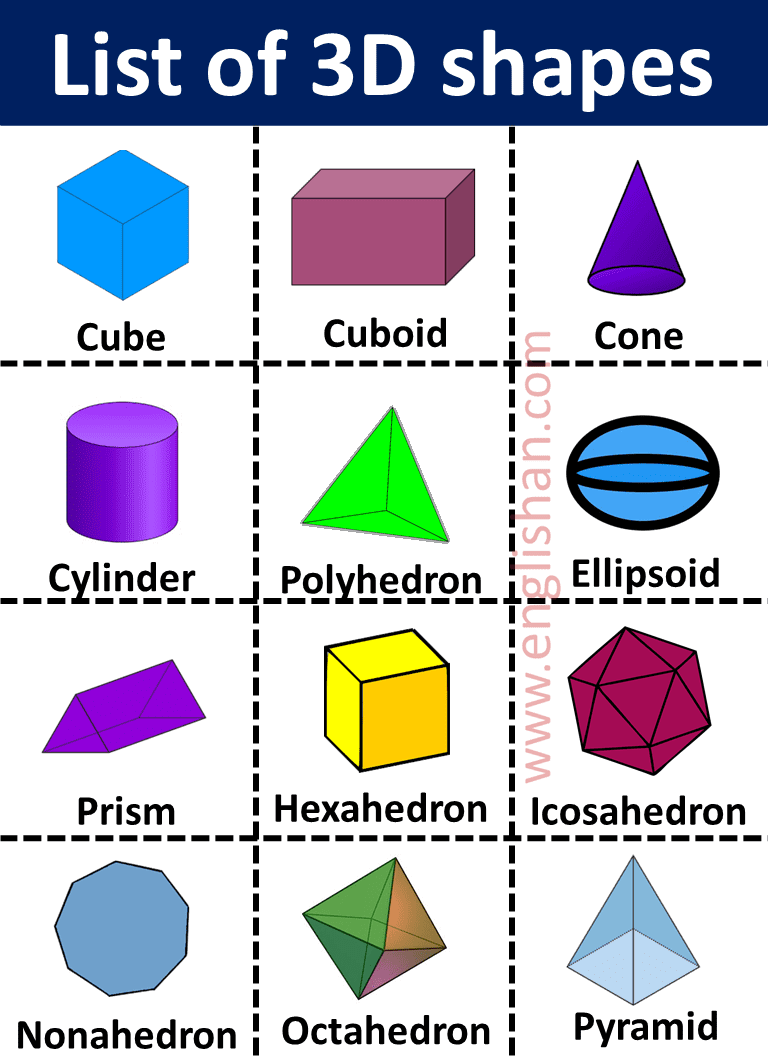
A 3D shape is solid. It has length, width, and depth, so it takes up space. Many 3D shapes can be held, stacked, rolled, filled, or placed on a surface.
The main parts of 3D shapes are faces, edges, and vertices. A face is a flat or curved surface, an edge is where two faces meet, and a vertex is a corner point.
Common 3D Shapes List
- Cube: A cube has six equal square faces, twelve equal edges, and eight vertices. Dice, toy blocks, ice cubes, and some storage boxes show cube shapes. Every edge of a cube has the same length.
- Cuboid: A cuboid has rectangular faces and a box-like body. Books, bricks, cereal boxes, parcels, cabinets, and many rooms have cuboid shapes. A cube is a special cuboid with all edges equal.
- Sphere: A sphere is round in every direction. Balls, globes, oranges, marbles, bubbles, and planets have sphere-like shapes. It has no edges, no corners, and no flat faces.
- Cone: A cone has one circular base and one pointed top. Traffic cones, party hats, ice cream cones, and some tree shapes show this tapered shape. The curved side narrows as it rises toward the point.
- Cylinder: A cylinder has two matching circular bases and one curved side. Cans, candles, pipes, drums, jars, and batteries often use cylinder shapes. It can stand on its flat bases and roll along its curved side.
- Pyramid: A pyramid has a polygon base and triangular faces that meet at one top point. Square pyramids are the most familiar, but pyramids can also have triangular, pentagonal, or hexagonal bases.
- Prism: A prism has two matching ends joined by flat side faces. Triangular prisms, rectangular prisms, pentagonal prisms, and hexagonal prisms are named by the shape of their matching ends.
- Torus: A torus is a solid ring shape with a hole through the center. Donuts, tires, swimming rings, and bangles are common torus examples.
- Hemisphere: A hemisphere is half of a sphere. Bowls, domes, lamp covers, half balls, and some building roofs have hemisphere-like shapes.
- Ellipsoid: An ellipsoid is a stretched sphere. Eggs, rugby balls, some stones, and several natural objects follow ellipsoid-like shapes.
3D Shape Examples In Real Life
Real objects show how 3D shapes work beyond a drawing. They reveal depth, surfaces, volume, and how a shape can stand, roll, stack, or taper.
| 3D Shape | Real-Life Examples |
|---|---|
| Cube | dice, block, ice cube |
| Cuboid | book, brick, cereal box |
| Sphere | football, globe, orange |
| Cone | traffic cone, party hat, ice cream cone |
| Cylinder | can, candle, pipe, drum |
| Pyramid | pyramid model, roof ornament |
| Triangular prism | tent, roof form, chocolate bar piece |
| Rectangular prism | shoebox, parcel, cabinet |
| Hexagonal prism | six-sided pencil, crystal form |
| Torus | donut, tire, ring float |
| Hemisphere | bowl, dome, half ball |
| Frustum | bucket, lampshade, flower pot |
Difference Between 2D And 3D Shapes
The main difference is depth. A 2D shape is flat, while a 3D shape is solid. A circle drawn on paper is 2D, but a real ball is 3D. A square drawn on a page is 2D, but a dice is 3D.
| Feature | 2D Shapes | 3D Shapes |
|---|---|---|
| Dimension | Length and width | Length, width, and depth |
| Form | Flat | Solid |
| Main parts | Sides and corners | Faces, edges, and vertices |
| Curved example | Circle | Sphere |
| Straight-edged example | Square | Cube |
| Real-life object | Drawing of a ball | Actual ball |
Final Words
Shapes are easier to recognize when each name connects with structure and real objects. A circle has a curved boundary like a clock, a rectangle has opposite equal sides like a door, a cube has six square faces like a dice, and a cylinder has circular bases like a can.
A strong shape names page should not stop at labels. It should show how each form is built, how flat shapes differ from solid shapes, and how geometric shapes move from basic shapes to more advanced shapes such as prisms, ellipses, annuli, torus shapes, and frustums.
FAQs
The basic shape names are circle, square, triangle, rectangle, oval, diamond, star, heart, pentagon, hexagon, cube, cone, cylinder, sphere, and pyramid. These shapes are common in homes, toys, roads, books, buildings, screens, and everyday objects.
2D shapes are flat shapes with length and width. Circle, square, triangle, rectangle, oval, pentagon, hexagon, and octagon are common 2D shapes. They can be drawn, printed, traced, or cut from a flat surface.
3D shapes are solid shapes with length, width, and depth. Cube, cuboid, sphere, cone, cylinder, pyramid, prism, torus, and hemisphere are common 3D shapes. Many 3D shapes can be held, stacked, rolled, or filled.
A 2D shape is flat, while a 3D shape is solid. A circle is 2D, but a ball is 3D. A square is 2D, but a cube is 3D. 2D shapes have sides and corners, while 3D shapes have faces, edges, and vertices.
No, a circle is not a polygon. A polygon must have straight sides, but a circle has one curved boundary and no corners.
Yes, a square is a special type of rectangle. Both shapes have four right corners, but a square has four equal sides, while a rectangle has two pairs of equal opposite sides.
A hexagon has 6 sides. Honeycomb cells, bolt heads, tile patterns, and some nuts use hexagon shapes.
An octagon has 8 sides. A stop sign is the most familiar octagon example.
Common curved shape names include circle, oval, ellipse, semicircle, crescent, ring, arc, spiral, and heart. These shapes use curves instead of only straight sides.
Geometric shapes are shapes described by sides, corners, curves, faces, edges, angles, surfaces, or depth. Circle, square, triangle, rectangle, cube, sphere, cylinder, cone, pyramid, and prism are common geometric shapes.
You May Also Like