The closest effective synonyms are efficacious and successful, and the right one depends on what you mean by effective.
English uses the word four ways, and only one of them is about something working. A rule that starts on Monday is effective too, and it takes a completely different replacement.
Pick the meaning first, then check how formal the sentence has to be, and the swap works in a lab report, a contract, or an email.
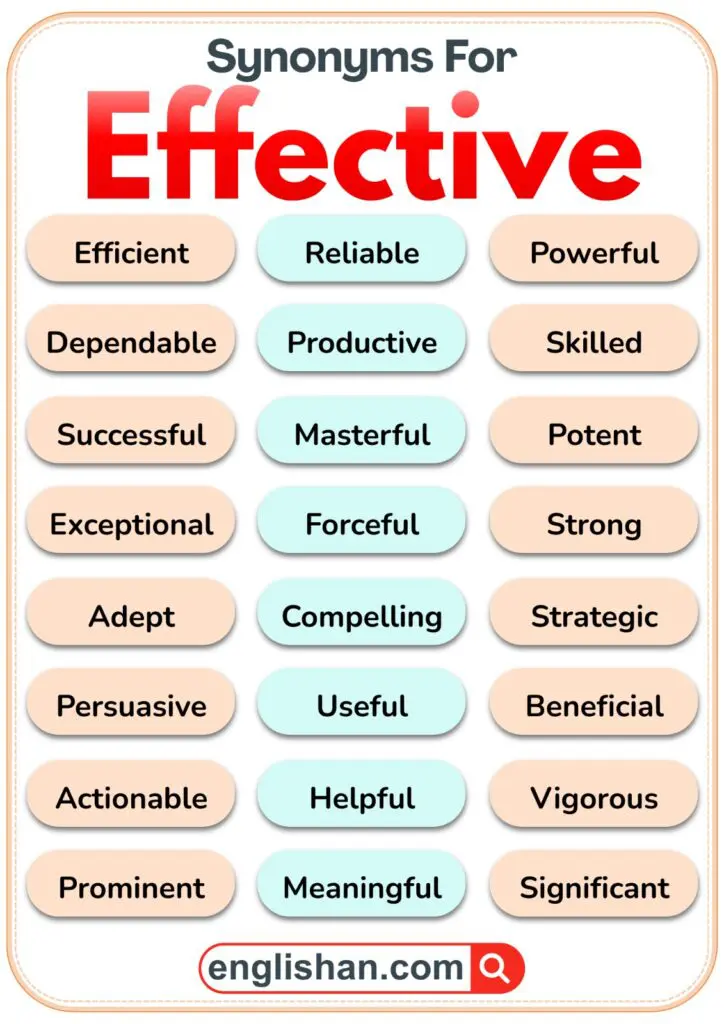
Another Word for Effective
The five strongest replacements for effective are efficacious, successful, efficient, potent, and compelling. Pick by what you mean: efficacious for a treatment that works, successful for a plan that reached its aim, efficient for a method that wastes nothing, potent for raw strength, and compelling for an argument that convinces.
Four unrelated meanings share this one word. A drug that cures is effective. An argument that persuades is effective. A tax rate that is real rather than quoted is effective. A policy that starts on Monday is effective. Work out which of the four you need before you swap anything, because a word from the wrong meaning breaks the sentence.
Effective Synonyms That Mean It Produces Results
This is the main meaning: something did what it was supposed to do. Some of these describe the thing, some describe the person doing it, and a few are locked to laboratories or contracts.
- Efficacious: has the particular power to produce the result, and medical writing prefers it for treatments. (formal)
- Effectual: judges the result after the fact, so it suits measures and actions already taken. (formal)
- Efficient: reaches the result without wasting time, money, or energy.
- Productive: yields a large amount, which counts output rather than success.
- Potent: brings raw strength to bear. Common for drugs, arguments, and mixtures.
- Powerful: the everyday form of potent, and the one speech prefers.
- Successful: reached the aim it set out to reach.
- Fruitful: produced something worth having, especially after long work.
- Profitable: returned more than it cost, in money or in value.
- Rewarding: paid off in satisfaction rather than in numbers.
- Worthwhile: justified the time it took.
- Beneficial: did good, without claiming it solved anything.
- Advantageous: put you ahead of where you were.
- Constructive: built something rather than only fixing a fault.
- Useful: helped, which is a weaker claim than effective and frequently the honest one.
- Helpful: useful and welcome, with warmth attached.
- Serviceable: does the job without impressing anyone.
- Practical: works in real conditions rather than on paper.
- Workable: capable of being made to work, so it describes plans before they run.
- Practicable: achievable with the resources available. (formal)
- Feasible: possible to carry out, judged before you start.
- Viable: capable of surviving on its own once started.
- Functional: performs its job, with no praise attached.
- Working: in operation and doing what it should. A working solution beat three elegant ones.
- Adequate: enough, and no more. Faint praise in a review.
- Sufficient: meets the requirement exactly. (formal)
- Capable: has what it takes, said of people and machines.
- Competent: meets the standard, which stops short of a compliment.
- Able: plain and short, and stronger than it looks in a reference.
- Proficient: trained to a good standard through practice.
- Adept: skilled and quick with it.
- Skilled: trained, and the word a job description uses.
- Expert: at the top of the trained range. Nearby strong words cover the force end of this range in more depth.
- Accomplished: has a record behind the skill.
- Masterly: so skilled it looks effortless. (formal)
- Reliable: works every time, which is a claim about consistency.
- Dependable: reliable, said more warmly and mostly of people.
- Sound: built on solid reasoning, with no weak point.
- Solid: dependable and unspectacular.
- Robust: keeps working under pressure. Standard in engineering and statistics. (technical)
- Strong: forceful enough to produce the result.
- Vigorous: applied with energy, said of campaigns and defences.
- Energetic: full of drive, describing the effort rather than the outcome.
- Dynamic: produces change by moving fast.
- Impactful: made a visible difference. Business writing loves it and editors resist it.
- Cost-effective: delivers the result at a price worth paying. Always hyphenated.
- Streamlined: stripped of everything that slowed it down.
- Economical: achieves the result with little spending.
- Optimal: the best available balance, not merely a good one. (technical)
- Performant: meets its speed and efficiency targets. Software writing only. (technical)
- Results-driven: written around the outcome. Standard on a CV.
- Time-saving: cuts the hours a task takes.
- Labour-saving: cuts the physical work, and the word appliance advertising built.
- Surefire: works every time, said with confidence and a little swagger. (casual)
- Foolproof: works even when handled badly.
- Proven: tested and shown to work, which is evidence rather than opinion.
- Tried and tested: proven over a long period, and the phrase speech prefers.
- Slick: works smoothly and looks good doing it. Faintly suspicious in British English. (casual)
Related:
Persuasive Words for Effective
An effective argument does not produce a result, it changes a mind. These describe writing, speaking, and evidence rather than methods or machines.
- Compelling: forces agreement by the strength of what it says.
- Convincing: leaves the listener believing it.
- Persuasive: moves people toward a position, whether or not it convinces them.
- Cogent: logically tight and hard to answer. (formal)
- Forceful: delivered with pressure behind it.
- Forcible: the older form of forceful, now mostly legal. (dated)
- Telling: lands a point that changes the balance. A telling detail ended the cross-examination.
- Trenchant: sharp, incisive, and uncomfortable with it. (formal)
- Weighty: brings enough substance to matter.
- Authoritative: backed by expertise the listener accepts.
- Conclusive: settles the question, so nothing further needs saying.
- Decisive: ends the matter by tipping it one way.
- Definitive: the version nobody needs to improve on.
- Valid: built on reasoning that survives inspection.
- Well-founded: survives inspection because evidence supports it, not assertion.
- Striking: noticeable enough to stay in the mind.
- Impressive: earns respect through scale or quality.
- Moving: works on feeling rather than logic.
- Emphatic: stated so firmly it discourages argument.
- Influential: changes what other people go on to think.
- Arresting: stops the reader mid-scroll.
- Hard-hitting: blunt and uncomfortable on purpose.
- Punchy: short, sharp, and memorable. (casual)
- Pertinent: relevant enough to matter to the case at hand. (formal)
- Resonant: stays with the audience after they leave.
- Incisive: cuts to the real point without ceremony.
- Pointed: aimed directly at one target, and everybody notices.
- Watertight: leaves no hole for an opponent to open.
Effective Synonyms That Mean Real Not Theoretical
Finance, law, and engineering use effective to separate what is actually true from what is written down. An effective tax rate is what you pay, not what the bracket says.
- Actual: true in fact, whatever the official figure claims.
- Real: the plainest form, and the one everyday speech uses.
- De facto: true in practice without legal recognition. From Latin. (formal)
- Virtual: amounts to the thing without formally being it. A virtual monopoly held 94 percent of the market.
- Substantive: real in content rather than in form. (formal)
- Genuine: authentic, so nothing about it is pretended.
- True: matches reality, judged against a claim.
- Factual: established by evidence rather than by argument.
- Concrete: solid enough to point at.
- Tangible: you can measure it, which is what separates it from a promise.
- Existing: already there, as opposed to planned.
- Net: what remains after everything is accounted for. Standard in finance. (technical)
- Realized: turned from potential into fact. (technical)
- Bona fide: genuine and made in good faith. Legal Latin. (formal)
- Palpable: obvious enough to feel. (formal)
- Demonstrated: shown to be true rather than asserted.
Words for Effective That Mean Currently In Force
Effective 1 January has nothing to do with whether the policy works. Contracts, laws, and notices use the word to mean the date something starts to apply.
- Operative: in force and having legal effect. (legal)
- In force: currently applying, said of laws and treaties.
- In effect: the same idea in plainer words.
- Current: applying now rather than previously.
- Active: switched on and running.
- Live: operating right now, common in systems and broadcasts.
- Standing: continuing until cancelled. A standing order runs until you stop it.
- Applicable: reaches this case rather than every case.
- Prevailing: the rate or rule holding at the time. (formal)
- Ruling: the price or standard governing the market. (formal)
- Extant: still in existence, said of documents and laws. (formal)
- Subsisting: continuing to exist in law. (legal)
- Operational: ready and functioning, standard in the military and in engineering.
- Binding: carrying obligation that cannot be ignored. (legal)
- Enforceable: capable of being made to stick in court. (legal)
- Governing: the rule that overrides the others. (legal)
- In operation: running, said of systems and services.
- In place: set up and working, the plainest of these.
Formal Synonyms for Effective in Academic Writing
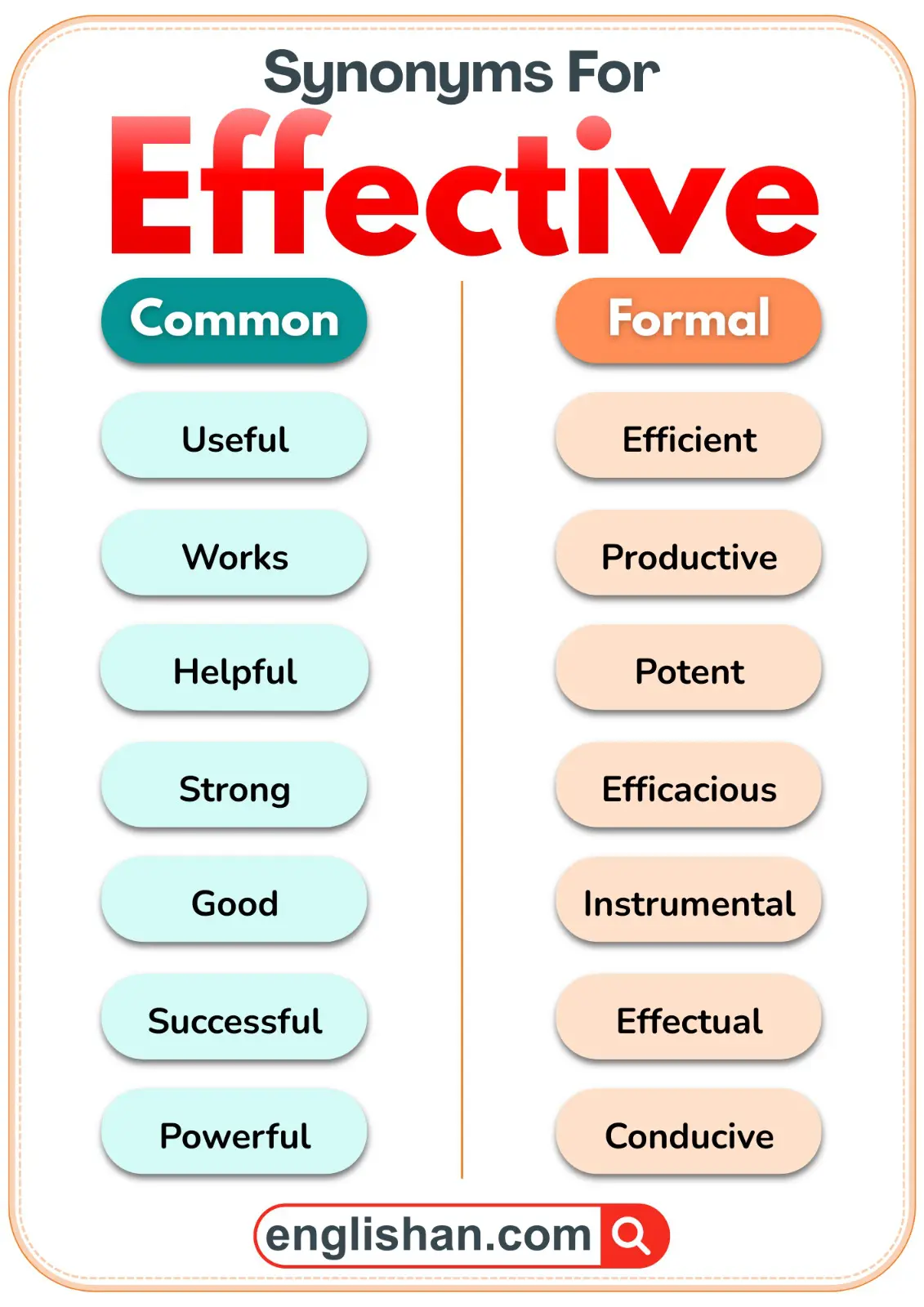
Journals resist effective because it claims a result without naming the evidence. Each of these commits to something a reviewer can check.
| Word | How formal | Best use |
|---|---|---|
| Efficacious | Formal, clinical | A treatment that produced the measured outcome |
| Effectual | Formal | A measure judged after the result is known |
| Efficient | Formal, standard | A method that minimised resource use |
| Valid | Formal | Reasoning or an instrument that survives testing |
| Sound | Formal | An argument with no logical weakness |
| Cogent | Formal | A case that compels agreement |
| Robust | Technical | A finding that survives changed assumptions |
| Optimal | Technical | The best available balance of competing demands |
| Substantive | Formal | A change that is real rather than presentational |
| Demonstrated | Formal | An effect shown by evidence rather than claimed |
| Practicable | Formal | Achievable within the study’s constraints |
| Operative | Formal, legal | The clause or factor actually doing the work |
The nearby quality words handle the standard-and-value half that these leave out.
Professional Words for Effective on a Resume
Recruiters skim past effective communicator because every applicant writes it. Replace the claim with something a hiring manager can verify.
| Instead of | Write | Why it works better |
|---|---|---|
| An effective communicator | Presented to boards of up to 40 | Names the audience and the scale |
| Effective leadership | Led a team of 12 through a merger | States what you actually led |
| An effective process | A streamlined process cutting cycle time 30 percent | Attaches the number |
| Effective at sales | Exceeded quota in seven of eight quarters | Replaces the adjective with a record |
| Effective training | Training that lifted first-year retention to 88 percent | Shows the result the training produced |
| Effective solutions | Cost-effective solutions saving £180k annually | Keeps the claim and adds the money |
| Highly effective | Results-driven | Signals the same thing without self-praise |
The same treatment applies to how you describe what you can do, and the skill words handle that half of the document.
Related:
Casual Ways to Say Something Is Effective
Speech drops the Latin words entirely. These are what people say when the thing simply worked.
| Phrase | How formal | When it fits |
|---|---|---|
| It works | Very casual | The plainest verdict there is |
| It does the job | Casual | Adequate rather than impressive |
| It did the trick | Casual, warm | A fix that solved a specific problem |
| Spot on | Casual, British | Exactly right |
| A game changer | Casual, overused | Something that altered the whole situation |
| Worth every penny | Casual | Effective and priced fairly |
| Like a charm | Idiomatic | Worked immediately and completely |
| No-brainer | Casual | So obviously effective nobody argues |
| Bang for your buck | Casual | The cost-effective verdict in speech |
| It stuck | Casual | Effective over the long run |
Related:
Effective vs Efficient vs Effectual vs Efficacious
Four near-identical words, four different claims. Getting the wrong one is the most common mistake in this whole family.
| Word | The claim it makes | What it describes |
|---|---|---|
| Effective | It produced the intended result | Almost anything |
| Efficient | It produced the result without waste | Methods, systems, people |
| Effectual | The result was achieved, judged afterwards | Measures and actions already taken |
| Efficacious | It has the particular power to produce the result | Treatments and remedies |
| Productive | It yielded a large amount | Output, meetings, land |
| Useful | It helped, without claiming the result | Tools and advice |
| Practical | It works in real conditions | Solutions and plans |
Effective against efficient: walking to the office and driving there are both effective, because you arrive either way. Driving is more efficient, because it costs you less time and energy. Effective asks whether you got there; efficient asks what it cost you.
Effective against effectual: effectual looks backward at a finished result, which is why it suits legal and administrative measures. You call a remedy effectual once it has worked, not while you are hoping.
Effective against efficacious: efficacious names a power the thing possesses, rather than an outcome it happened to produce. A drug is efficacious because of what is in it, and effective because of what it did.
Effective against productive: productive counts output, effective checks the aim. A meeting that produced forty suggestions and no decision was productive and ineffective at once.
Affective vs Effective
These two sound identical and mean nothing alike. Affective relates to emotions and feelings; effective relates to producing results. Both come from nouns rather than verbs, which is where the confusion starts: the noun affect means an emotional state in psychology, and the noun effect means a result.
The memory device is short. The a is for emotion, the e is for action.
Seasonal effective disorder affects millions each winter. ❌
Seasonal affective disorder affects millions each winter. ✅
Watch the verbs too, because they run the opposite way. To affect something is to influence it, and to effect something is to bring it about. A policy affects morale; a manager effects change.

Words That Are Not Effective Synonyms
Thesauruses mix these in and they wreck a sentence, because each one names a different quality. Four kinds of near miss cause almost every wrong swap.
Accuracy, not effect: accurate, precise, exact, correct, faultless, meticulous. A calculation can be perfectly accurate and completely ineffective at solving your problem.
Standing, not effect: eminent, prominent, leading, commanding, formidable, distinguished. These describe reputation. A leading consultant and an effective consultant are different claims, and clients pay for the second.
Effort, not effect: industrious, diligent, hardworking, thorough, painstaking. Each names how much work went in, which says nothing about what came out.
Character, not effect: resolute, determined, strategic, perspicacious, shrewd. A strategic decision is one relating to strategy, not one that worked. The nearby adjectives that describe qualities rather than outcomes answer a different question entirely.
Choosing the Right Word for Common Effective Phrases
Effective locks to one meaning in each of these fixed phrases, and the replacement changes with it.
| Phrase | Meaning it takes | Better choice |
|---|---|---|
| Effective immediately | In force | In force from today |
| Effective date | In force | Commencement date |
| Effective tax rate | Real not theoretical | Actual rate paid |
| Effective control | Real not theoretical | De facto control |
| Effective range | Real not theoretical | Usable range |
| Cost-effective | Produces results | Economical |
| Effective treatment | Produces results | Efficacious treatment |
| Effective argument | Persuasive | Compelling argument |
| Effective communicator | Produces results | Persuasive speaker |
| Effective strength | Real not theoretical | Available strength |
Another Word for Effectiveness and Effectively
The noun and the adverb take their own replacements, and swapping the adjective form into either one produces a sentence nobody would write.
For effectiveness, the noun: efficacy, efficiency, potency, force, success, productivity, usefulness, value, impact, performance, capability, competence, validity, soundness.
For effectively, the adverb: successfully, efficiently, powerfully, convincingly, ably, well, in practice, to good effect, in effect, for all practical purposes.
Two of those adverbs deliver the real not theoretical meaning rather than the works meaning. The company effectively owns the market says it controls the market in practice, not that it owns it well.
Antonyms for Effective
Opposites define this word faster than more synonyms do, and it has four sets because it works four ways.
Against producing a result: ineffective, ineffectual, inefficacious, useless, futile, fruitless, unproductive, unsuccessful, counterproductive, inadequate.
Against persuading: unconvincing, unpersuasive, weak, inconclusive, feeble, hollow.
Against being real rather than quoted: nominal, titular, theoretical, ostensible, notional, in name only.
Against being in force: void, lapsed, expired, revoked, inoperative.
Pairing each word with its opposite fixes the meaning faster than reading more substitutes, which is why working through the antonyms alongside a synonym set repays the time.
Related:
Mistakes to Avoid When Replacing Effective
Four errors account for almost every awkward swap, and each takes one line to fix.
Swapping in an accuracy word: writing an accurate campaign when you mean an effective one replaces the result with the arithmetic. Keep accurate, precise, and exact for measurements.
Using efficacious outside medicine: an efficacious marketing plan reads as showing off, because the word is reserved for treatments and remedies. Use effective or successful instead.
Mixing the meanings: the contract is effective and effective from Monday is nonsense, because the two uses need different words. Write the contract is sound and takes effect on Monday.
Claiming effect when you mean effort: a thorough process and an effective process make different promises. Thorough describes how much you did, and effective describes what it produced.

FAQs
The closest single replacements are efficacious and successful, and both claim the result was produced. For everyday writing, efficient and powerful land more naturally. Which one fits depends on whether you mean something worked, something convinced, something is real rather than nominal, or something is now in force.
Effective means you achieved the result, and efficient means you achieved it without wasting time, money, or energy. Walking and driving to work are both effective, since you arrive either way, but driving is more efficient. A process can be effective and wildly inefficient at the same time.
Efficacious, effectual, and cogent are the strongest formal replacements, and each makes a narrower claim than effective. Academic writing prefers efficacious for treatments, valid and sound for reasoning, and robust for findings that survive changed assumptions.
Affective relates to emotions and feelings, while effective relates to producing results. The two come from different nouns: affect is an emotional state, and effect is a result. Remember it as a for emotion and e for action, which is why seasonal affective disorder takes the a.
No, and the difference is where each one looks. Effectual judges a result after it has happened, so it suits measures and actions already taken. Efficacious names a power the thing possesses, which is why medical writing uses it for treatments before the outcome is known.
There it means in force rather than successful. Effective 1 January says the agreement starts applying on that date, and says nothing about whether it works. The formal replacements are operative, in force, and commencing, and contracts also call this the commencement date.
Ineffective and ineffectual are the direct opposites when you mean producing a result, while unconvincing opposes the persuasive meaning and void or lapsed opposes the in-force meaning. Choose the antonym matching how you used effective, since the three sets are not interchangeable.
Successfully, efficiently, and convincingly replace the adverb when you mean something was done well. When you mean in practice rather than officially, use in effect, to good effect, or for all practical purposes, since the company effectively owns the market uses that second meaning.