

Iceberg lettuce is the one most people already know, but vegetables that start with I stretch far beyond the salad aisle. Quite a few trace their names back to the regions they grow in, which gives this letter a surprisingly global feel.
Some are everyday staples, others belong to South Asian or Mediterranean cooking and barely show up in a typical grocery store. That mix of familiar and unexpected is what makes this letter worth a closer look.
Whether you’re filling out a food list or hunting for a new ingredient to try, every I vegetable worth knowing is right here.
Quick List Of Vegetables That Start With I
- Ice plant
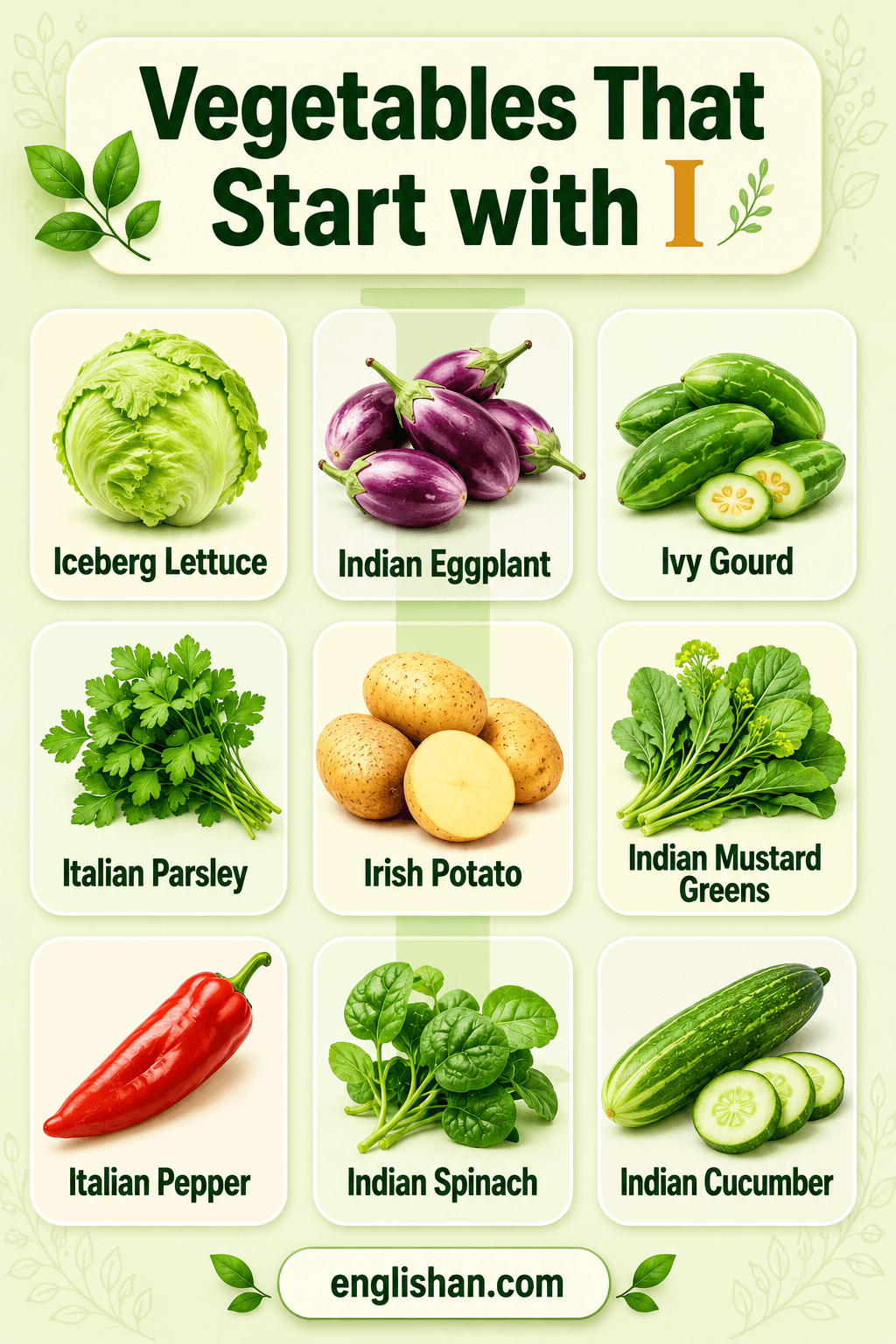
- Iceberg lettuce
- Ice cream bean
- Icicle radish
- Idaho potato
- Ichiban eggplant
- Indian bitter melon
- Indian cucumber
- Indian eggplant
- Indian fig (nopales)
- Indian mustard greens
- Indian okra
- Indian pea
- Indian spinach
- Irish moss
- Irish potato
- Italian broccoli (rapini)
- Italian dandelion
- Italian parsley
- Italian red onion
- Italian squash (zucchini)
- Italian sweet pepper
- Ivory gourd
- Ivy gourd
Vegetables That Start With I With Pictures
Ice Plant
Ice plant (Mesembryanthemum crystallinum) earns its name from the tiny sparkling bladder cells that coat its leaves, catching light like frost on a cold morning. The leaves are juicy, faintly salty, and pleasantly crisp, almost as if the plant carries a trace of the coast inside its flesh.
Toss young ice plant into salads alongside citrus, cucumber, seafood, or mild goat cheese. The snap and salinity do the work, so heat is rarely needed. In fact, cooking dulls the very texture that makes this succulent worth growing.
Iceberg Lettuce
Iceberg lettuce (Lactuca sativa var. capitata) is the pale, tightly packed head lettuce that built its reputation on crunch rather than complexity. It doesn’t carry the peppery bite of arugula or the bitterness of chicory, and for burgers, tacos, wedge salads, and deli sandwiches, that neutral crispness is exactly the point.
Chill it well before serving, and the leaves turn cold, snappy, and refreshing. With about 96% water content, iceberg hydrates more than it nourishes, but pair it with a creamy blue cheese dressing over a thick wedge and nothing else quite competes.
Ice Cream Bean
Ice cream bean (Inga edulis) produces long green pods filled with black seeds wrapped in soft, cottony white pulp. The flavor is sweet, mild, and faintly vanilla-like, which is exactly why the name stuck across tropical Latin America.
The edible pulp is typically eaten raw as a snack, and in some regions the seeds are boiled or roasted after proper preparation. For a vegetable list, ice cream bean earns its place as a tropical pod food with a flavor profile that surprises anyone expecting a green bean.
Icicle Radish
Icicle radish (Raphanus sativus) looks like a slim white carrot, but one bite reveals its true family. The flesh is crisp and peppery, sharpest when eaten raw and gentler after a quick sauté in butter and herbs.
Slice it into spring salads, pickle it with rice vinegar and sugar, tuck it into banh mi, or use it as a crunchy garnish on grain bowls. Its long white shape makes it especially easy to tell apart from round red radishes, and the peppery snap softens just enough when briefly blanched.
Idaho Potato
Idaho potato is a market name strongly tied to russet varieties grown in the volcanic soil of southern Idaho. The rough brown skin and high starch content produce baked potatoes that split open into a cloud-like center and fries with crisp, golden edges.
Bake them whole, mash them with butter and cream, dice them into hash browns, or cut them into thick steak fries. The starch-to-moisture balance in Idaho russets is what separates a fluffy baked potato from a waxy, dense one.
Ichiban Eggplant
Ichiban eggplant is a long, slim Japanese-style cultivar with glossy purple skin and tender, almost seedless flesh. It cooks faster than a large globe eggplant and carries less bitterness, which makes it well-suited for quick weeknight stir-fries, miso glazes, and grilled slices.
The narrow shape gives more skin-to-flesh ratio, so you get better surface browning and silky interiors without a long roast. Slice one lengthwise, brush it with sesame oil, and grill until the flesh collapses into soft, smoky strips.
Indian Bitter Melon
Indian bitter melon (Momordica charantia), also called karela or bitter gourd, does not apologize for its flavor. The ridged green fruit has a firm bite and a pronounced bitterness that fans prize rather than mask.
Cooks across South Asia salt and squeeze the slices to draw out excess bitterness before frying, stuffing, or simmering them with spices, onions, tamarind, or jaggery. In the Philippines, it goes into ginisang ampalaya. In Chinese kitchens, it appears in stir-fries with fermented black beans. Bitterness is the whole point, and every cuisine that adopts this vegetable builds recipes around it rather than against it.
Indian Cucumber
Indian cucumber refers to the cucumber varieties grown across the subcontinent, typically longer-skinned and milder than the stubby, waxed American slicing cucumber. The flesh is watery, cool, and almost flavorless on its own, which is exactly what makes it a natural partner for salt, red chili powder, lemon, yogurt, and fresh herbs.
Dice it into kachumber, stir it into raita, add it to chaat, or serve it sliced on a plate alongside a fiery dal. After a spice-heavy meal, crisp cucumber slices feel like relief.
Indian Eggplant
Indian eggplant, also called brinjal, is smaller than the large globe eggplant most Western shoppers recognize. These round or oval fruits, often no bigger than a tennis ball, have glossy purple skin and creamy flesh that absorbs spice and oil beautifully.
Their size makes them ideal for stuffing whole, as in bharwa baingan, or simmering in thick masala until the flesh turns silky. Baingan bharta, a roasted and mashed preparation seasoned with onion, tomato, and green chili, is one of the most celebrated Indian eggplant dishes. The small shape also means faster cooking and deeper flavor penetration.
Indian Fig (Nopales)
Indian fig (Opuntia ficus-indica) is better known in Mexican kitchens as nopal or nopales. The thick, flat cactus pads are de-spined, sliced into strips, and sautéed, grilled, or simmered into soups and stews.
The texture is slightly chewy with a mild, green-bean-like flavor and a faint tartness. Nopales are rich in dietary fiber and have a long history in traditional diets across Mexico, the Mediterranean, North Africa, and parts of South Asia. Grilled with lime and salt, they make an excellent taco filling on their own.
Indian Mustard Greens
Indian mustard greens (Brassica juncea) deliver bold, peppery leaves that wake up a cooking pot the moment they hit the heat. In North Indian cooking, they are inseparable from sarson ka saag, the slow-cooked mustard-green dish traditionally served with makki ki roti and a generous pour of white butter.
Raw, these leaves taste fierce and almost hot. Cooked down with spinach, bathua, garlic, ginger, and green chili, the sharpness deepens into something earthy, rich, and deeply comforting. Mustard greens also appear in Chinese, Japanese, Ethiopian, and Southern US cooking, making them one of the most geographically versatile greens on any list.
Indian Okra
ndian okra, or bhindi, is a staple across South Asian kitchens and one of the most frequently cooked vegetables in Indian home cooking. The slender green pods have a ridged exterior and a soft, slightly mucilaginous interior that thickens curries and stews naturally.
Slice the pods into rounds and fry them until crisp for bhindi masala, or cook them whole with onions, tomatoes, and turmeric. The sliminess that puts off some Western eaters is precisely what makes bhindi effective as a thickener in gumbo across the American South as well.
Indian Pea
Indian pea (Lathyrus sativus), also called grass pea or khesari dal, is a hardy legume consumed across South Asia, Ethiopia, and parts of the Mediterranean. The small, flat seeds are boiled, ground into flour, or cooked into dal.
In Bihar and other eastern Indian states, khesari dal is a staple pulse cooked with turmeric, cumin, and mustard oil. The plant grows in poor soil where other crops struggle, which makes it an important food security crop in drought-prone regions. Its flavor is earthy and mild, sitting between yellow lentil and chickpea.
Indian Spinach
Indian spinach most commonly refers to Malabar spinach (Basella alba), a heat-loving climbing green with thick, glossy leaves. It fills the role of regular spinach in tropical climates where true spinach (Spinacia oleracea) bolts quickly in warm weather.
The leaves turn silky when cooked and release a slight mucilaginous quality into soups, dals, and stir-fries. That thickness gives body to broths and curries without adding starch. In Bangladesh, it appears in pui shak dishes. In the Philippines, it goes by alugbati and shows up in stews and sautés with garlic and vinegar.
Irish Moss
Irish moss (Chondrus crispus) is an edible red seaweed harvested from rocky Atlantic coastlines in Ireland, the UK, and eastern North America. It fits culinary lists as a sea vegetable rather than a land-grown green, valued primarily for its natural thickening power.
When simmered, Irish moss releases carrageenan, a gelling agent used to set puddings, blancmange, Caribbean sea moss drinks, and dairy-free desserts. The flavor is mild and oceanic, almost neutral once cooked into a recipe. In Caribbean foodways, blended sea moss gel has become a popular health tonic mixed with nutmeg, cinnamon, and condensed milk.
Irish Potato
Irish potato is a regional name for the common white potato (Solanum tuberosum), used especially in contrast with sweet potato across the American South and parts of the Caribbean. The name carries deep historical weight tied to Ireland’s dependence on the crop and the devastating famine of the 1840s.
In the kitchen, Irish potato points to a familiar tuber with pale, starchy flesh that boils, mashes, roasts, and fries without complaint. Mash it for breakfast, roast it alongside a Sunday chicken, or simmer it into chowder. Few vegetables cross so many meal boundaries with so little effort.
Italian Broccoli (Rapini)
Italian broccoli, better known as rapini or broccoli rabe, belongs to the Brassica rapa family rather than the Brassica oleracea group that includes standard broccoli. The plant has thin stems, jagged leaves, and small scattered florets, and its flavor is distinctly bitter with a slight nuttiness.
Blanch the stems briefly to tame the bitterness, then sauté them with garlic, olive oil, chili flakes, and a squeeze of lemon. In Italian-American cooking, rapini is a classic filling for sausage-and-broccoli-rabe sandwiches and a standard side for orecchiette pasta in Puglia. The bitterness is the draw, not a flaw to fix.
Italian Dandelion
Italian dandelion (Cichorium intybus) is not the same plant as the common lawn dandelion. It’s a cultivated chicory relative with long, jagged, dark green leaves and a more intense bitterness that stands up well to garlic, lemon, olive oil, and anchovy.
Wilt the leaves in a hot pan with sliced garlic and finish with a splash of vinegar, or add them to white bean soup for a sharp, earthy contrast. Italian dandelion is rich in vitamins A and K and carries the kind of mineral bite that fans of bitter greens actively seek. If you enjoy broccoli rabe, Italian dandelion is a natural next step.
Italian Parsley
Italian parsley (Petroselinum crispum var. neapolitanum), also called flat-leaf parsley, tastes stronger and more herbaceous than its curly counterpart. The flat leaves chop finely, and their bright, slightly peppery bite cuts through rich dishes built on garlic, olive oil, butter, cream, beans, and roasted meat.
Treat it as a finishing ingredient rather than a decorative sprig. A generous handful stirred into a heavy braise or scattered over roasted potatoes lifts the entire plate. In Middle Eastern tabbouleh, Italian parsley is the dominant green, not the side note.
Italian Red Onion
Italian red onion (Allium cepa) brings sweetness, color, and a gentle sharpness that works raw or cooked. Thin slices brighten salads, sandwiches, bruschetta, and quick pickles, while slow cooking turns the onion soft, jammy, and almost caramelized.
The purple-red rings add visual punch to any plate. Pickled red onion, made with vinegar, sugar, and a pinch of salt, has become a near-universal condiment on tacos, grain bowls, pulled pork, and smoked fish. Raw or cooked, the red onion moves between cuisines without effort.
Italian Squash (Zucchini)
Italian squash is the traditional name for zucchini (Cucurbita pepo), a tender summer squash with smooth green skin and pale, watery flesh. It grows fast, produces heavily, and lends itself to everything from spiralized noodles and grilled planks to ratatouille and fritters.
The flavor is mild and slightly sweet, which makes zucchini a reliable carrier for stronger seasonings. Shred it into bread batter for zucchini bread, slice it into rounds for a gratin, or grill thick spears brushed with olive oil and herbs. Gardeners who grow zucchini know that a single plant produces enough to feed the whole street.
Italian Sweet Pepper
Italian sweet pepper (Capsicum annuum) is long, tapered, and thin-skinned, with a sweeter flavor and softer flesh than a standard bell pepper. Roast it and the skin blisters while the interior collapses into silky, almost honeyed strips.
Use it in antipasti, pasta sauces, sandwiches, peperonata, omelets, pizza toppings, and grilled vegetable platters. The friggitello and corno di toro varieties are especially prized in Italian cooking. Raw, they taste bright and snappy. Roasted, they deliver a depth of sweetness that bell peppers rarely reach.
Ivory Gourd
Ivory gourd, also called ash gourd, winter melon, or white gourd (Benincasa hispida), is a large, pale-skinned cucurbit with mild, watery white flesh. The flavor is neutral enough to absorb whatever broth, spice, or sweetener surrounds it.
In South and Southeast Asian cooking, ivory gourd goes into curries, soups, and slow-simmered stews. In Chinese cuisine, it appears in winter melon soup, often stuffed with shrimp and served inside the hollowed-out gourd itself. In Ayurvedic traditions, the juice is consumed for its cooling and digestive qualities. The neutral taste makes it a blank canvas rather than a flavor star.
Ivy Gourd
Ivy gourd (Coccinia grandis), also known as tindora or scarlet gourd, is a small green cucurbit used widely across South and Southeast Asian kitchens. The young gourds are crisp, mild, and slightly bitter. Older fruits turn red inside and develop a stronger, more assertive taste.
Slice them lengthwise, cook with mustard seeds, curry leaves, chili, turmeric, and fresh coconut, and they absorb spice beautifully while keeping a pleasant crunch. In Kerala, tindora stir-fry is a quick everyday side dish. In Thai cooking, ivy gourd leaves and young shoots are eaten alongside curries. This is one of the most widely used I-named vegetables outside Western produce aisles.
Common Types Of I-Named Vegetables
Vegetables that start with I stretch across several plant parts, food traditions, and growing regions.
- Leafy greens: Iceberg lettuce, Indian mustard greens, Indian spinach (Malabar spinach), Italian parsley, Italian dandelion, and rapini all bring different textures, from cold crunch to earthy bitterness to peppery heat.
- Roots and tubers: Icicle radish, Idaho potato, and Irish potato give the letter its starchy, underground contingent. The radish adds raw crunch, while both potatoes dominate cooked preparations.
- Fruits used as vegetables: Ichiban eggplant, Indian bitter melon, Indian cucumber, Indian eggplant, Indian okra, Italian red onion, Italian squash, Italian sweet pepper, and ivy gourd all qualify botanically as fruits but live in the savory side of the kitchen.
- Pods, seeds, and legumes: Ice cream bean and Indian pea represent the pod and pulse side of the list, one tropical and sweet, the other a drought-hardy staple grain.
- Sea vegetables: Irish moss stands apart as an edible red seaweed harvested for its natural gelling agent, carrageenan.
- Succulent and cactus vegetables: Ice plant and Indian fig (nopales) come from arid-climate plants with thick, fleshy tissue and unusual textures.
- Regional and market names: Idaho potato, Irish potato, Indian spinach, Italian parsley, Italian sweet pepper, and Italian squash show how geography shapes the way we name and recognize produce.
Frequently Asked Questions
What Vegetables Start With The Letter I?
Iceberg lettuce, ice plant, ice cream bean, icicle radish, Idaho potato, Ichiban eggplant, Indian bitter melon, Indian cucumber, Indian eggplant, Indian fig (nopales), Indian mustard greens, Indian okra, Indian pea, Indian spinach, Irish moss, Irish potato, Italian broccoli (rapini), Italian dandelion, Italian parsley, Italian red onion, Italian squash (zucchini), Italian sweet pepper, ivory gourd, and ivy gourd.
What Is The Most Common Vegetable That Starts With I?
Iceberg lettuce is the most widely sold in North America, followed by Italian parsley, Italian red onion, and Italian squash (zucchini). In South Asian grocery stores, ivy gourd, Indian bitter melon, and Indian okra are everyday staples.
What Green Vegetables Start With I?
Green options on this list include ice plant, iceberg lettuce, Indian bitter melon, Indian cucumber, Indian mustard greens, Indian okra, Indian spinach, Italian broccoli (rapini), Italian dandelion, Italian parsley, Italian squash, and ivy gourd.
What Indian Vegetables Start With I?
Indian bitter melon, Indian cucumber, Indian eggplant, Indian mustard greens, Indian okra, Indian pea, Indian spinach, and ivy gourd are all used in everyday Indian cooking across curries, stir-fries, dals, chutneys, and raitas.
What Italian Vegetables Start With I?
Italian parsley, Italian red onion, Italian sweet pepper, Italian broccoli (rapini), Italian dandelion, and Italian squash (zucchini) all carry Italian names and play strong roles in Mediterranean and Italian-American cooking.
Is Ivy Gourd A Vegetable?
Ivy gourd (Coccinia grandis) is botanically a fruit but cooked as a vegetable across South and Southeast Asia. It appears in stir-fries, curries, and dry spiced dishes.
Is Irish Moss A Vegetable?
Irish moss is an edible red seaweed, so it fits as a sea vegetable rather than a land-grown green. It’s valued for releasing carrageenan, a natural gelling agent, when simmered.
Is Ice Cream Bean A Vegetable?
Ice cream bean is a tropical pod food. The sweet white pulp is eaten fresh, and the seeds are cooked in some regions. It belongs on a culinary list of I-named plant foods even though it sits outside the standard grocery-store vegetable category.
What Is The Best I Vegetable For Salads?
Iceberg lettuce is the most accessible salad green on this list. Ice plant, Italian red onion, Italian parsley, Italian dandelion, Indian cucumber, and thinly sliced icicle radish also add crunch, color, or bite to fresh salads.
What Is The Difference Between Idaho Potato And Irish Potato?
Idaho potato refers specifically to russet potatoes grown in Idaho, prized for high starch and fluffy baked texture. Irish potato is a broader regional name for white potatoes in general, used especially to distinguish them from sweet potatoes in the American South and the Caribbean.
You May Also Like
Vegetables That Start With I Quiz
Vegetables That Start With I
Which of these is a leafy vegetable?
Iceberg lettuce is a leafy vegetable. Bred for crispness and shelf life rather than flavour, and mostly water.
Group by what the thing actually is, not by where it turns up.
Iceberg lettuce is a leafy vegetable.
Two of these vegetables begin with I. Which one does not?
Watercress begins with W, so it is the one that does not belong.
Check each first letter before reading further.
Watercress is the odd one out.
Which of these vegetables begins with the letter I?
Bred for crispness and shelf life rather than flavour, and mostly water.
Read the first letter before anything else.
Iceberg lettuce begins with I.
Name a vegetable beginning with this letter.
A vegetable whose name begins with I is ___.
Accepted here: Iceberg lettuce, Indian spinach.
More than one answer is right; any vegetable starting with the letter counts.
Iceberg lettuce begins with I.
Which vegetable does this describe? Also called Malabar spinach, a climbing vine unrelated to true spinach.
Also called Malabar spinach, a climbing vine unrelated to true spinach.
Match the description to the fruit rather than to the letter.
Also called Malabar spinach, a climbing vine unrelated to true spinach.
Turn on JavaScript for the interactive quiz. The full practice set is shown above.