Words ending in sion are English nouns formed when a verb or adjective takes the -sion suffix to express an action, state, or result. Decide becomes decision, explode becomes explosion, and tense becomes tension, each shifting from a doing word into a naming word.
This suffix follows specific spelling rules depending on the last letters of the root word, which is why -sion and -tion often confuse learners even at advanced levels.
The vocabulary lists ahead breaks down -sion words by root connection, spelling pattern, and meaning so each word builds on what you already know.
Quick Answer: Common Words Ending In Sion
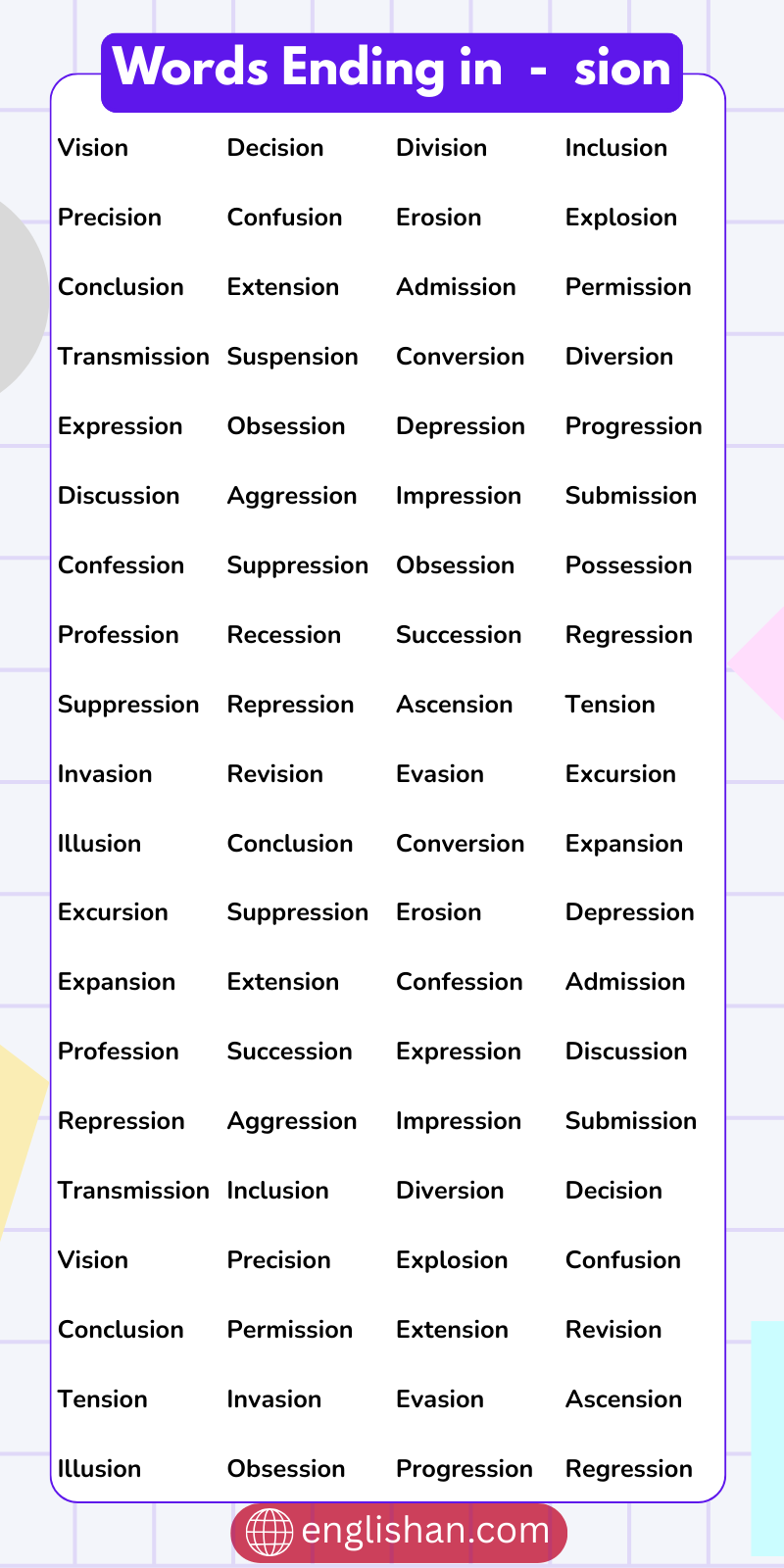
Common words ending in sion include decision, mission, vision, division, passion, session, expression, conclusion, discussion, confession, possession, admission, permission, conversion, submission, transmission, commission, recession, confusion, illusion, expansion, explosion, erosion, tension, profession, impression, depression, and suppression.
Common Words Ending In Sion With Meanings
- Decision: A choice, judgment, or final answer.
- Mission: An important task, purpose, journey, or organized operation.
- Vision: Sight, imagination, or a strong idea about the future.
- Division: Separation into parts, groups, sections, or categories.
- Passion: Strong emotion, enthusiasm, or deep interest.
- Session: A period of activity, meeting, training, study, or work.
- Expression: A word, phrase, look, gesture, or act that shows meaning or feeling.
- Conclusion: The final idea, result, or ending.
- Discussion: A serious conversation or exchange of views.
- Confession: An admission of truth, fault, guilt, or private information.
- Possession: Ownership, control, or something that belongs to someone.
- Admission: Entry, acceptance, or acknowledgment of truth.
- Permission: Approval or consent to do something.
- Conversion: A change from one form, use, belief, system, or state to another.
- Submission: The act of sending work, giving something formally, or yielding.
- Transmission: The passing, sending, or spreading of signals, data, disease, power, or information.
- Commission: A payment, official group, formal task, or act of authorizing work.
- Recession: A period of economic decline.
- Confusion: Uncertainty, disorder, or lack of understanding.
- Illusion: A false image, false impression, or misleading appearance.
- Expansion: Growth, increase, spread, or enlargement.
- Explosion: A sudden burst, blast, or rapid increase.
- Erosion: Gradual wearing away by water, wind, use, time, or pressure.
- Tension: Strain, pressure, stress, or tightness.
- Revision: A corrected, changed, or improved version.
- Omission: Something left out or not included.
- Profession: A job or field requiring skill, training, or qualifications.
- Impression: An effect, opinion, mark, or first feeling about something.
- Depression: A mental health condition, low area, or economic decline.
- Suppression: The act of stopping, hiding, or holding something back.
List Of Words Ending In Sion By Length
6 Letter Words Ending In Sion
- Basion
- Fusion
- Lesion
- Nasion
- Vision
7 Letter Words Ending In Sion
- Cession
- Elision
- Elusion
- Erasion
- Erosion
- Evasion
- Fission
- Mansion
- Mission
- Passion
- Pension
- Plosion
- Pulsion
- Session
- Suasion
- Tension
- Torsion
- Version
8 Letter Words Ending In Sion
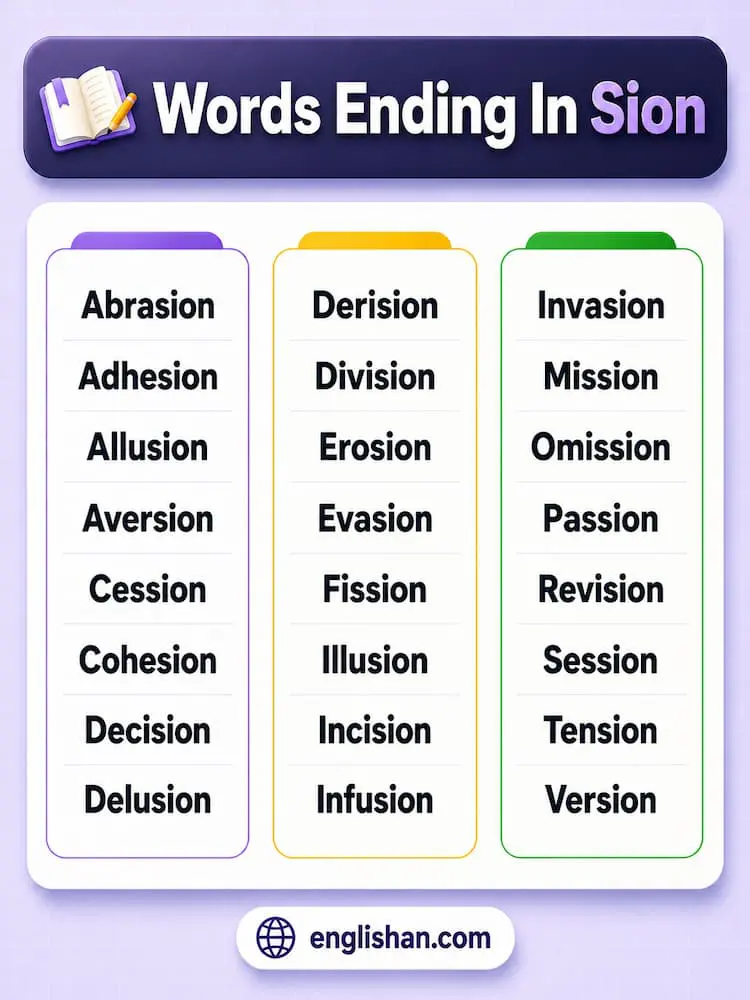
- Abrasion
- Adhesion
- Affusion
- Allusion
- Aversion
- Avulsion
- Cohesion
- Decision
- Delusion
- Derision
- Division
- Eclosion
- Effusion
- Emersion
- Emission
- Emulsion
- Envision
- Eversion
- Evulsion
- Excision
- Illusion
- Incision
- Infusion
- Inhesion
- Invasion
- Occasion
- Omission
- Recision
- Revision
- Scansion
- Scission
- Sponsion
9 Letter Words Ending In Sion
- Accession
- Admission
- Ascension
- Aspersion
- Collision
- Collusion
- Concision
- Confusion
- Contusion
- Corrasion
- Corrosion
- Demission
- Diffusion
- Dimension
- Diversion
- Egression
- Exclusion
- Excursion
- Expansion
- Explosion
- Expulsion
- Extension
- Extrusion
- Immersion
- Impassion
- Implosion
- Impulsion
- Inclusion
- Incursion
- Intension
- Intrusion
- Inversion
- Obsession
- Obtrusion
- Occlusion
- Perfusion
- Pervasion
- Precision
- Prelusion
- Prevision
- Profusion
- Prolusion
- Provision
- Recension
- Recession
- Reclusion
- Recursion
- Remission
- Repulsion
- Reversion
- Revulsion
- Secession
- Seclusion
- Suffusion
10 Letter Words Ending In Sion
- Abscission
- Aggression
- Commission
- Compassion
- Compulsion
- Concession
- Conclusion
- Concussion
- Confession
- Conversion
- Convulsion
- Declension
- Depression
- Descension
- Digression
- Discussion
- Dismission
- Dispassion
- Displosion
- Dissension
- Dissuasion
- Distension
- Expression
- Impression
- Indecision
- Ingression
- Misprision
- Oppression
- Percussion
- Permission
- Persuasion
- Perversion
- Possession
- Precession
- Preclusion
- Prehension
- Pretension
- Procession
- Profession
- Propulsion
- Protrusion
- Redivision
- Reemission
- Reenvision
- Regression
- Reinfusion
- Reinvasion
- Repression
- Rescission
- Submersion
- Submission
- Subversion
- Succession
- Suspension
- Television
11 Letter Words Ending In Sion
- Ambiversion
- Compression
- Deaccession
- Disillusion
- Hypotension
- Imprecision
- Interfusion
- Manumission
- Misdivision
- Nondecision
- Posttension
- Preinvasion
- Progression
- Reaccession
- Readmission
- Reimmersion
- Reperfusion
- Reprovision
- Subdecision
- Subdivision
- Supervision
- Suppression
- Transfusion
12 Letter Words Ending In Sion
- Apprehension
- Circumfusion
- Decommission
- Derepression
- Dermabrasion
- Extraversion
- Extroversion
- Hypertension
- Intercession
- Intermission
- Intersession
- Intromission
- Introversion
- Malocclusion
- Nonadmission
- Noninclusion
- Preadmission
- Prerecession
- Recommission
- Reconversion
- Reexpression
- Reimpression
- Repercussion
- Repossession
- Reprehension
- Resubmission
- Resuspension
- Retrocession
- Retroversion
- Supersession
- Transmission
13 Letter Words Ending In Sion
- Animadversion
- Anticorrosion
- Bioconversion
- Cardioversion
- Comprehension
- Condescension
- Decompression
- Dispossession
- Interspersion
- Introgression
- Misimpression
- Nonaggression
- Nonconclusion
- Nonpossession
- Overexpansion
- Overextension
- Photoemission
- Postrecession
- Prepossession
- Pretelevision
- Pretermission
- Retrogression
- Subcommission
- Transgression
14 Letter Words Ending In Sion
- Antidepression
- Antisubversion
- Hyperextension
- Interdiffusion
- Overpersuasion
- Postdepression
- Retransmission
- Seroconversion
- Ultraprecision
- Uncircumcision
15 Letter Words Ending In Sion
- Autotransfusion
- Counterinvasion
- Immunodiffusion
- Incomprehension
- Interconversion
- Microaggression
- Misapprehension
- Posttransfusion
Useful Meanings For Advanced Sion Words
- Abrasion: Damage caused by scraping or rubbing.
- Adhesion: The act or condition of sticking to a surface.
- Allusion: An indirect reference to a person, text, event, or idea.
- Aversion: Strong dislike or unwillingness.
- Cohesion: The quality of holding together.
- Delusion: A false belief held despite evidence against it.
- Derision: Mockery or ridicule.
- Emission: The release or sending out of gas, light, heat, sound, or particles.
- Excision: The act of cutting something out.
- Fission: Splitting, especially of an atomic nucleus or biological cell.
- Infusion: The act of adding, soaking, or introducing something.
- Incision: A cut, especially one made during surgery.
- Scansion: The analysis of rhythm and meter in poetry.
- Accession: The act of gaining a position, title, right, or collection item.
- Ascension: The act of rising or moving upward.
- Aspersion: A damaging or critical remark about someone’s character.
- Collision: An impact between people, vehicles, objects, or forces.
- Collusion: Secret cooperation, usually dishonest or illegal.
- Concision: Brief and exact expression.
- Contusion: A bruise.
- Corrosion: Gradual damage caused by chemical action, rust, or decay.
- Diffusion: The spreading of something through a space or substance.
- Dimension: A measurement, extent, aspect, or feature.
- Diversion: A change of direction, attention, or use.
- Exclusion: The act of leaving someone or something out.
- Excursion: A short trip or movement away from a main course.
- Expulsion: The act of forcing someone or something out.
- Extension: An addition, increase, or outward stretch.
- Extrusion: The act of forcing material through an opening.
- Immersion: Deep involvement or full placement in liquid.
- Implosion: A sudden inward collapse.
- Inclusion: The act of bringing someone or something in.
- Incursion: A sudden entry into a place, often hostile.
- Intrusion: Unwanted entry or interference.
- Inversion: A reversal of order, position, or arrangement.
- Obsession: A persistent thought, interest, or fixation.
- Occlusion: Blockage or closure.
- Precision: Exactness or accuracy.
- Provision: Supply, arrangement, or condition in a rule or agreement.
- Recension: A revised edition of a text.
- Remission: Reduction, pause, cancellation, or relief.
- Revulsion: Strong disgust or sudden rejection.
- Seclusion: Isolation or privacy.
- Aggression: Hostile behavior, attack, or forceful action.
- Compassion: Sympathy and concern for another person’s suffering.
- Concession: Something granted, admitted, or given up during negotiation.
- Concussion: A brain injury caused by a blow or violent shaking.
- Digression: A temporary move away from the main topic.
- Dissension: Strong disagreement within a group.
- Oppression: Cruel or unjust control over people.
- Persuasion: The act of influencing someone’s belief or action.
- Rescission: Cancellation, especially of a contract or legal decision.
- Succession: A sequence or the passing of power, rank, property, or position.
- Suspension: A pause, delay, hanging state, or temporary removal.
- Compression: Pressure that squeezes, reduces, or compacts something.
- Disillusion: The loss of a false belief or idealized view.
- Hypotension: Low blood pressure.
- Imprecision: Lack of exactness.
- Progression: Forward movement, development, or gradual change.
- Readmission: Entry or acceptance again.
- Subdivision: A smaller division within a larger whole.
- Supervision: Oversight, management, or guidance.
- Transfusion: The transfer of blood or another fluid into the body.
- Apprehension: Anxiety, fear, or understanding, depending on context.
- Hypertension: High blood pressure.
- Intermission: A pause between parts of a performance, event, or activity.
- Introversion: A personality orientation toward inner thought and lower social stimulation.
- Repercussion: A consequence, often an unwanted one.
- Repossession: Taking back property because payment terms were not met.
- Transmission: The sending, passing, or spreading of something.
- Comprehension: Understanding.
- Condescension: A superior attitude toward others.
- Decompression: Release from pressure, stress, or compression.
- Dispossession: The act of taking property, land, or rights away from someone.
- Misimpression: A mistaken impression.
- Nonaggression: The absence of attack or hostile action.
- Overextension: Stretching resources, duties, muscles, or claims too far.
- Transgression: A violation of a law, rule, boundary, or moral standard.
- Hyperextension: Extension of a joint beyond its normal range.
- Retransmission: Sending or broadcasting something again.
- Seroconversion: Development of detectable antibodies in the blood.
- Ultraprecision: Extremely high precision.
- Autotransfusion: Transfusion using a patient’s own blood.
- Counterinvasion: An invasion made in response to another invasion.
- Immunodiffusion: A laboratory method involving diffusion of antigens and antibodies.
- Incomprehension: Lack of understanding.
- Interconversion: Change between two forms or states.
- Microaggression: A subtle slight or hostile act toward a marginalized group.
- Misapprehension: A misunderstanding or mistaken belief.
- Posttransfusion: Occurring after a transfusion.
-Sion And -Ssion Words
| Ending | Examples | Sound |
|---|---|---|
| -sion | Decision, vision, division, conversion | Often /zhən/. |
| -ssion | Mission, session, discussion, permission | Often /shən/. |
- Discuss: Discussion.
- Permit: Permission.
- Submit: Submission.
- Decide: Decision.
- Convert: Conversion.
Commonly Confused Words Ending In Sion
- Illusion: A false image, misleading appearance, or false impression.
- Allusion: An indirect reference to a person, text, event, or idea.
- Delusion: A false belief held despite evidence against it.
- Collision: An impact between people, vehicles, objects, or forces.
- Collusion: Secret cooperation, usually dishonest or illegal.
- Recession: A period of economic decline.
- Secession: Withdrawal from a political union, state, or organization.
- Succession: A sequence or the passing of power, rank, property, or position.
- Emission: The release or sending out of gas, light, heat, sound, or particles.
- Omission: Something left out or not included.
- Evasion: Avoidance of duty, responsibility, capture, or a direct answer.
- Invasion: Entry by force, especially into a country, area, or private space.
- Inclusion: The act of bringing someone or something in.
- Exclusion: The act of leaving someone or something out.
- Compression: Pressure that squeezes or reduces something.
- Suppression: The act of stopping, hiding, or holding something back.
Common Mistakes With Words Ending In Sion
- Decompression: Use this instead of decontression.
- Conclusion: Use this in ordinary writing instead of preconclusion.
- Preliminary conclusion: Use this for an early or temporary conclusion.
- After aggression: Use this instead of postaggression in ordinary prose.
- Post-aggression period: Use this hyphenated form when a specialist context requires it.
- Evasion: Use this for common writing.
- Elusion: Use this only when you specifically mean the act of eluding.
FAQs
Common English words ending in sion include decision, mission, vision, division, passion, session, expression, conclusion, discussion, permission, admission, possession, confusion, expansion, explosion, erosion, and tension.
Short words ending in sion include basion, fusion, lesion, nasion, vision, cession, elision, elusion, erasion, erosion, evasion, fission, mansion, mission, passion, pension, plosion, pulsion, session, suasion, tension, torsion, and version.
Long words ending in sion include hyperextension, retransmission, seroconversion, autotransfusion, immunodiffusion, incomprehension, interconversion, microaggression, and misapprehension.
Yes. -Sion often works as a noun-forming suffix in English. It can name an action, result, process, state, or condition.
-Sion: Often sounds like /zhən/, as in vision and decision.
-Ssion: Often sounds like /shən/, as in mission, session, discussion, and permission.
You May Also Like
- Words That End With N
- Words Ending In On
- 5 letter words ending in ION
- Words Ending In Tion
- 5 Letter Words That End With IN
- Eight Letter Words In English