

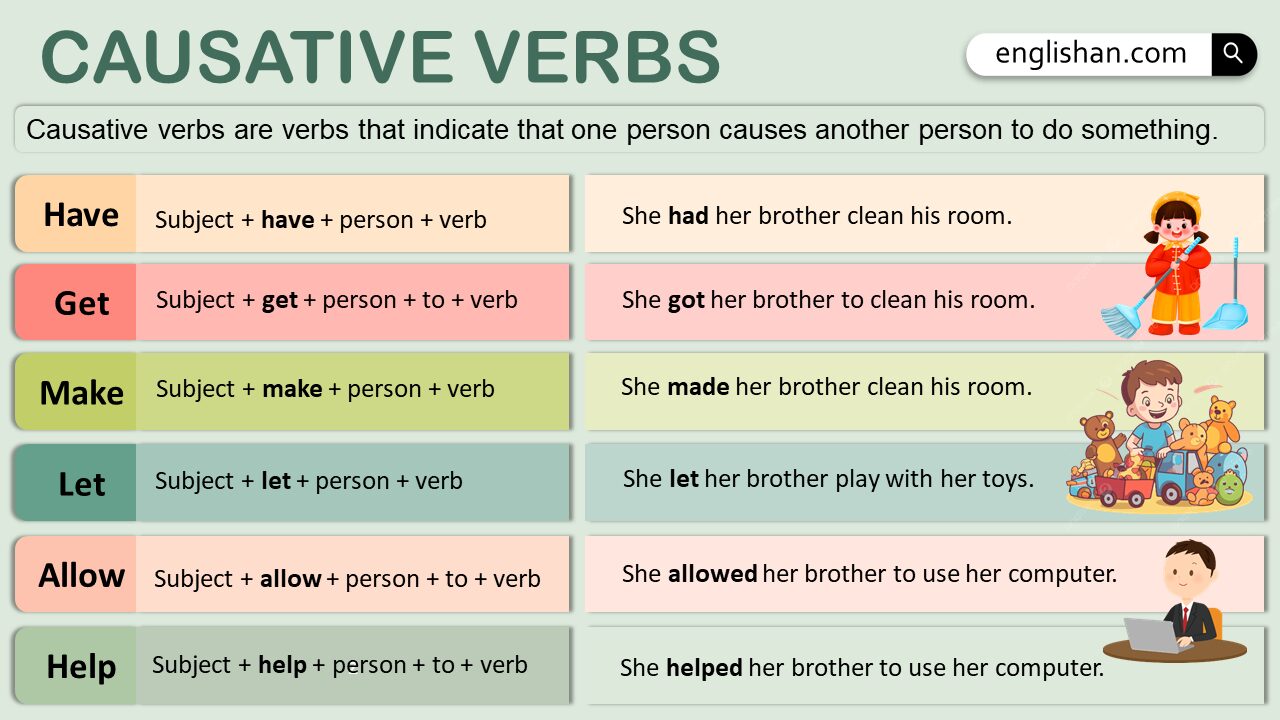
Causative verbs are words used when someone makes another person or thing do something. Examples include make, get, have, and let. For example, if you say, “She made me laugh,” made is the causative verb because she caused the laughter.
Why Use Causative Verbs?
Let’s look at a scenario to understand why we use causative verbs:
- If you paint the room yourself:
- Say: I painted the room.
- If someone else paints it for you:
- You can mention who did it: A painter painted the room.
- Or, use a causative verb to focus on the result:
- Say: I had the room painted.
Using a causative verb like had helps us talk about the painted room without mentioning who painted it.
Forming Causative Verbs
To use causative verbs, you usually follow this simple pattern:
- Start with the person who causes the action.
- Then use a causative verb like make, get, have, or let.
- Next, mention the person who does the action.
- Finally, say the action that was caused.
Common Causative Verbs
Make
When you force someone to do something.
- Subject + make + person + base form of verb
- She made her brother clean his room.
- He made his employees work overtime.
- They made their children finish their homework.
Have
When you arrange for someone to do something.
- Subject + have + object + base form of verb
- She had her brother clean his room.
- He had his employees finish the report.
- They had their children apologize for their behavior.
- I had my car repaired.
Let
When you allow someone to do something freely.
- Subject + let + person + base form of verb
- She let her brother play with her toys.
- He let his employees take a longer break.
- They let their children watch TV before dinner.
Get
When you convince or persuade someone to do something.
- Subject + get + person + to + base form of verb
- She got her brother to clean his room.
- He got his employees to finish the project.
- They got their children to eat their vegetables.
Allow
Similar to let, but more formal. It means giving permission.
- Subject + allow + person + to + base form of verb
- She allowed her brother to use her computer.
- He allowed his employees to leave work early.
- They allowed their children to play outside after dinner.
Help
When you assist or make it easier for someone to do something.
- Subject + help + person + (to) + base form of verb (Note: to is often optional in this structure)
- She helped her brother use her computer.
- He helps his employees leave work early.
- They helped their children play outside after dinner.
Examples of Causative Verbs in Sentences
Here are some examples to show how causative verbs work in real-life sentences.
- She made her brother wash the dishes.
- He had his sister bake cookies for the party.
- They let their children play outside after dinner.
- She got her friend to help with homework.
- He allowed his dog to sleep on the bed.
- She made her mom buy her favorite ice cream.
- They had their dad fix the broken toy.
- He let his sister borrow his bike.
- She got her dad to read her a bedtime story.
- They allowed their cat to explore the backyard.
- She made her brother clean up his mess.
- He had his mom make pancakes for breakfast.
- They let their friends stay over for the weekend.
- She got her teacher to explain the lesson again.
- He allowed his niece to watch cartoons on TV.
10 Common Causative Verbs
- Make: She made him clean his room.
- Have: I had my car repaired.
- Let: They let their children watch TV.
- Get: He got his hair cut.
- Allow: The teacher allowed the students to leave early.
- Force: She forced her sister to apologize.
- Enable: The new software enabled users to work more efficiently.
- Persuade: They persuaded their friend to join the hiking trip.
- Encourage: He encouraged his daughter to pursue her dreams.
- Prompt: The alarm clock prompted him to wake up early.
Causative Verbs in Different Tenses
Causative verbs can be used in various tenses to express when actions happen. Understanding how causative verbs change in different tenses helps you use them correctly in different situations.
Causative Verb Make in Different Tenses
| Tense | Affirmative | Negative | Interrogative |
|---|---|---|---|
| Present Simple | She makes her brother clean his room. | She doesn’t make her brother clean his room. | Does she make her brother clean his room? |
| Past Simple | She made her brother clean his room. | She didn’t make her brother clean his room. | Did she make her brother clean his room? |
| Future Simple | She will make her brother clean his room. | She will not make her brother clean his room. | Will she make her brother clean his room? |
| Present Continuous | She is making her brother clean his room. | She isn’t making her brother clean his room. | Is she making her brother clean his room? |
| Past Continuous | She was making her brother clean his room. | She wasn’t making her brother clean his room. | Was she making her brother clean his room? |
| Future Continuous | She will be making her brother clean his room. | She will not be making her brother clean his room. | Will she be making her brother clean his room? |
| Present Perfect | She has made her brother clean his room. | She hasn’t made her brother clean his room. | Has she made her brother clean his room? |
| Past Perfect | She had made her brother clean his room before their parents arrived. | She hadn’t made her brother clean his room before their parents arrived. | Had she made her brother clean his room before their parents arrived? |
| Future Perfect | She will have made her brother clean his room by tomorrow. | She will not have made her brother clean his room by tomorrow. | Will she have made her brother clean his room by tomorrow? |
Causative Verb Have in Different Tenses
| Tense | Affirmative | Negative | Interrogative |
| Present Simple | He has his employees finish the report. | He doesn’t have his employees finish the report. | Does he have his employees finish the report? |
| Past Simple | He had his employees finish the report. | He didn’t have his employees finish the report. | Did he have his employees finish the report? |
| Future Simple | He will have his employees finish the report. | He won’t have his employees finish the report. | Will he have his employees finish the report? |
Causative Verb Let in Different Tenses
| Tense | Affirmative | Negative | Interrogative |
| Present Simple | She lets her brother play with her toys. | She doesn’t let her brother play with her toys. | Does she let her brother play with her toys? |
| Past Simple | She let her brother play with her toys. | She didn’t let her brother play with her toys. | Did she let her brother play with her toys? |
| Future Simple | She will let her brother play with her toys. | She won’t let her brother play with her toys. | Will she let her brother play with her toys? |
Causative Verb Get in Different Tenses
| Tense | Affirmative | Negative | Interrogative |
| Present Simple | She gets her brother to clean his room. | She doesn’t get her brother to clean his room. | Does she get her brother to clean his room? |
| Past Simple | She got her brother to clean his room. | She didn’t get her brother to clean his room. | Did she get her brother to clean his room? |
| Future Simple | She will get her brother to clean his room. | She won’t get her brother to clean his room. | Will she get her brother to clean his room? |
Quiz: Test Your Understanding of Causative Verbs
- What causative verb is used to indicate permission or allowance?
- A) Make
- B) Have
- C) Let
- D) Get
- Which causative verb is commonly used to indicate persuasion or influence?
- A) Make
- B) Have
- C) Let
- D) Get
- What causative verb is often used to indicate arrangement or delegation of tasks?
- A) Make
- B) Have
- C) Let
- D) Get
- Which causative verb is used to indicate forcing or compelling someone to do something?
- A) Make
- B) Have
- C) Let
- D) Get
- What causative verb is used to indicate permission or agreement?
- A) Make
- B) Have
- C) Let
- D) Get
- Which causative verb is commonly used to indicate enabling or providing an opportunity?
- A) Make
- B) Have
- C) Let
- D) Get
- What causative verb is used to indicate obtaining or acquiring someone to do something?
- A) Make
- B) Have
- C) Let
- D) Get
- Which causative verb is typically used to indicate granting or permitting someone to do something?
- A) Make
- B) Have
- C) Let
- D) Get
- What causative verb is used to indicate insistence or urging someone to do something?
- A) Make
- B) Have
- C) Let
- D) Get
- Which causative verb is commonly used to indicate acquiring or obtaining something for oneself?
- A) Make
- B) Have
- C) Let
- D) Get
Answers:
- C) Let
- D) Get
- B) Have
- A) Make
- C) Let
- A) Make
- D) Get
- C) Let
- A) Make
- D) Get
FAQs
Causative verbs show that someone causes another to do something. Common causative verbs are:
1. Make: Forces someone.
Example: She made him clean.
2. Let: Allows someone.
Example: I let her borrow my book.
3. Have: Gives responsibility.
Example: He had the plumber fix it.
4. Get: Persuades someone.
Example: I got him to help.
5. Help: Assists someone.
Example: They helped me carry the boxes.
Here are 10 simple examples of the causative verb “allow”:
1. She allowed him to borrow her car.
2. The teacher allowed the students to pick their projects.
3. The manager allowed the team to take a longer break.
4. My parents allowed me to stay up late.
5. The rules allow us to use a calculator.
6. They allowed the kids to play outside.
7. The law allows people to speak freely.
8. She allowed her friend to use her phone.
9. The coach allowed the players to skip practice.
10. I allowed my brother to use my laptop.
The formula for the causative verb ‘make‘ is:
Subject + make + object + base verb.
Example:She made him work hard.
(Subject: She, Object: him, Base verb: work)
Here’s a simple explanation of the causative verbs “let” and “make”:
1. Let:
Used to allow someone to do something or give permission.
Formula: Subject + let + object + base verb
Example: She let him borrow her car.
(She allowed him to borrow her car.)
2. Make:
Used to force or compel someone to do something.
Formula: Subject + make + object + base verb
Example: The teacher made the students write an essay.
(The teacher forced the students to write an essay.)
You May Also Like

.)