The Internet Essay helps students understand the role of the internet in real life. It supports learning through clear essay samples in 10-line, 250-word, and 500-word formats. Designed for primary to middle school learners, these structured examples save time and improve writing. Students can learn the right way to express ideas. This topic also supports teachers and parents looking for ready-to-use formats that meet academic needs and search engine intent.
10 Lines Interne Essay for Class 2 to Class 5
- The internet is a network that connects computers.
- It helps people get information quickly.
- We can send emails using the internet.
- Students use it for online learning.
- It is useful for watching videos and reading.
- People shop online using websites.
- Many play games on the internet.
- It can be used anytime, anywhere.
- We must use it safely and wisely.
- The internet makes life easier every day.

250 Words Essay on Internet for Middle School
The internet is a system that connects millions of devices across the world. It is used by students, teachers, and workers every day. The internet makes it easier to learn new things, talk to others, and complete tasks quickly.
First, the internet helps in learning. Students can read lessons, watch videos, and find answers. Teachers also use it to share homework and videos. It is helpful in schools and homes. Many students use it to search for facts and study online.
Also, people use the internet to talk and share. They send messages, emails, and photos. It is easy to talk to friends or family who live far away. Online games and apps also give kids a way to relax after school. Many children also watch shows or listen to music online.
In the end, the internet is important for school and home life. But it should be used with care. Spending too much time online is not healthy. Parents and teachers should guide children to use it in the right way. The internet is a great tool when used wisely.
500 Words Internet Essay for Upper Primary and Lower Secondary
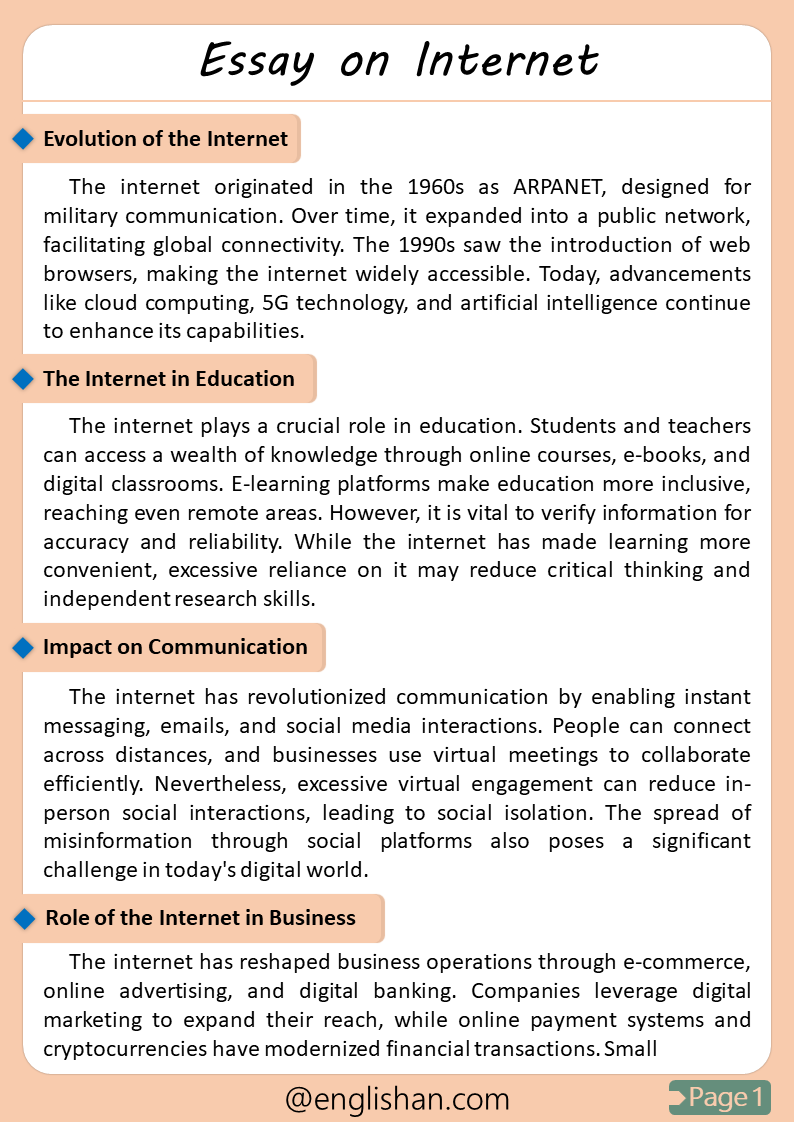
Evolution of the Internet
The internet originated in the 1960s as ARPANET, designed for military communication. Over time, it expanded into a public network, facilitating global connectivity. The 1990s saw the introduction of web browsers, making the internet widely accessible. Today, advancements like cloud computing, 5G technology, and artificial intelligence continue to enhance its capabilities.
The Internet in Education
The internet plays a crucial role in education. Students and teachers can access a wealth of knowledge through online courses, e-books, and digital classrooms. E-learning platforms make education more inclusive, reaching even remote areas. However, it is vital to verify information for accuracy and reliability. While the internet has made learning more convenient, excessive reliance on it may reduce critical thinking and independent research skills.
Impact on Communication
The internet has revolutionized communication by enabling instant messaging, emails, and social media interactions. People can connect across distances, and businesses use virtual meetings to collaborate efficiently. Nevertheless, excessive virtual engagement can reduce in-person social interactions, leading to social isolation. The spread of misinformation through social platforms also poses a significant challenge in today’s digital world.
Role of the Internet in Business
The internet has reshaped business operations through e-commerce, online advertising, and digital banking. Companies leverage digital marketing to expand their reach, while online payment systems and cryptocurrencies have modernized financial transactions. Small businesses and entrepreneurs benefit from online platforms, but competition has also increased. However, businesses must address cybersecurity risks to ensure safe operations and protect customer data.
The Internet and Entertainment
The internet has revolutionized the entertainment industry by providing access to movies, music, online gaming, and streaming services. People can watch content anytime and from anywhere, making entertainment more flexible. Social media platforms also contribute to content creation and sharing. However, excessive screen time and digital addiction are concerns that need to be managed for a balanced lifestyle.
The Internet and Social Media
Social media has become an integral part of the internet, allowing people to connect, share information, and express opinions. Platforms like Facebook, Twitter, and Instagram enable individuals and businesses to interact globally. While social media enhances communication and networking, it also contributes to cyberbullying, privacy concerns, and the spread of fake news. Responsible usage and digital awareness are essential for a safer online experience.
Challenges and Security Concerns
Despite its benefits, the internet has challenges, including cybercrime, online fraud, and data breaches. Protective measures such as strong passwords, encryption, and antivirus software enhance security. Additionally, online addiction and privacy violations require strict regulations to safeguard users. Governments and organizations must work together to ensure cybersecurity while promoting digital literacy.
The Future of the Internet
The internet will continue to evolve, shaping future technologies and lifestyles. Emerging trends like the Internet of Things (IoT), blockchain technology, and virtual reality (VR) will redefine digital interactions. The rise of artificial intelligence will further enhance automation, making online experiences more personalized. However, addressing privacy concerns, ensuring digital security, and promoting ethical technology use will be critical to sustaining its benefits.
Conclusion
The internet is an indispensable tool in contemporary society, aiding education, communication, business, and entertainment. However, responsible usage is necessary to mitigate risks. As technology advances, balancing digital convenience with cybersecurity remains essential. Users must adopt safe practices while utilizing the internet to maximize its benefits and minimize its drawbacks.
Difficult Words Used in 500 Internet Essay
| Word | Meaning |
|---|---|
| ARPANET | The first version of the internet |
| Cloud Computing | Storing and processing data over the internet |
| Cryptocurrency | Digital currency used for secure transactions |
| Cybersecurity | Measures to protect data from cyber threats |
| Encryption | Converting information into a secure code |
| E-learning | Learning through digital platforms |
| Misinformation | False or misleading information spread online |
| Digital Literacy | Ability to use and understand digital technologies |
Internet Essay PDF
You May Also Like