

Life on Mars Essay is designed to help students learn how to write structured essays with clear ideas. Whether you’re writing 10 lines, a 250-word piece, or a full 500-word essay, this topic offers ready-to-use samples that support real classroom needs. It’s made for middle and high school levels, using clear, academic formatting. This topic saves time for both readers and search engines by providing keyword-rich, ready essay formats built for fast, smart learning.
10 Lines Life on Mars Essay for Class 2 to Class 5
- Mars is the fourth planet from the sun.
- It is also called the “Red Planet.”
- People want to know if life is possible on Mars.
- Scientists have sent machines to study Mars.
- Some signs show there was water long ago.
- No life has been found on Mars yet.
- The weather is cold and the air is thin.
- Humans cannot live there without help.
- Scientists are still learning more about Mars.
- One day, people might live on Mars.

250 Words Essay on Life on Mars for Middle School
Life on Mars is a topic that has always caught the interest of scientists and students. Mars is the fourth planet from the sun and is often called the “Red Planet” because of its dusty surface. People want to know if there could be life on this planet.
Scientists have sent robots and rovers to Mars to check if there is water, air, or anything living. Some signs show that there might have been water a long time ago. If water once existed, it is possible that life may have existed too. But so far, no real proof of life has been found.
Mars has a very thin atmosphere, which makes it hard for humans or animals to live there without special suits or buildings. The weather is also very cold. Even though it is difficult, many space agencies like NASA and ISRO are still working hard to learn more.
The idea of people living on Mars in the future is still being studied. Scientists are thinking about sending humans to Mars, but they must first solve many problems like food, water, and safety.
In conclusion, life on Mars is still a question. We do not know if anything lives there now, but research continues. One day, students today might help find the answer.
500 Words Life on Mars Essay for Upper Primary and Lower Secondary
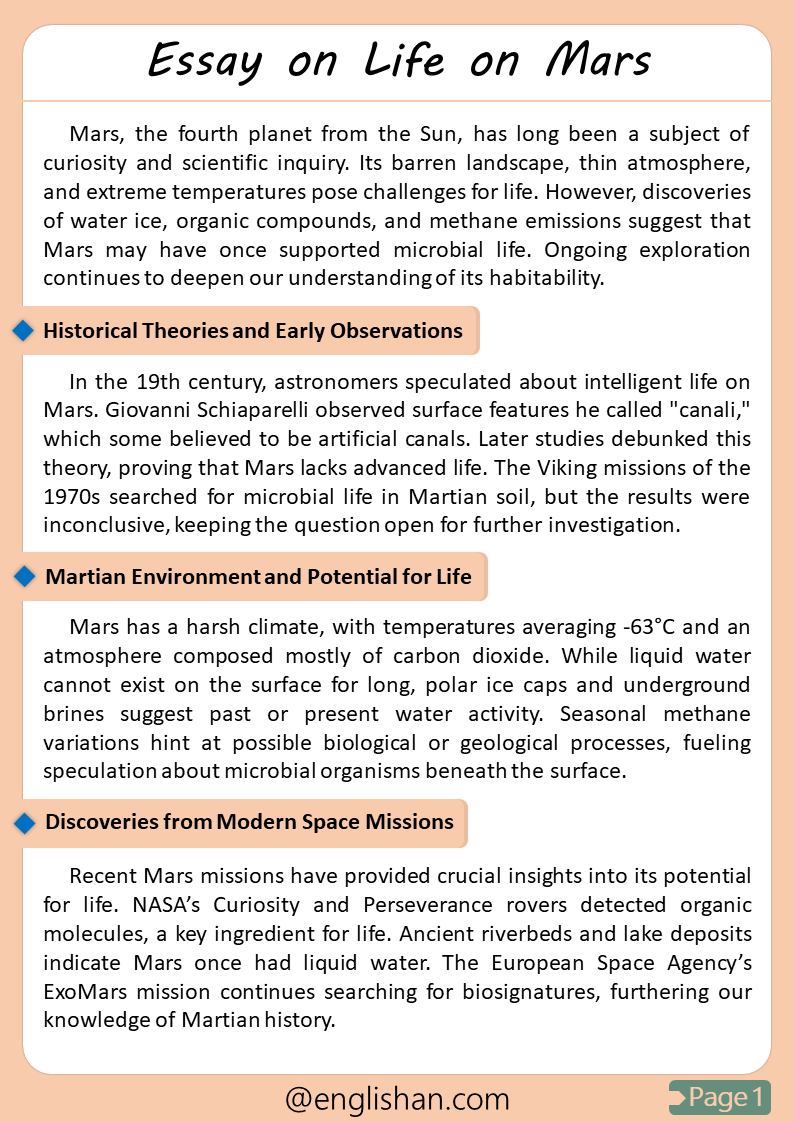
Historical Theories and Early Observations
In the 19th century, astronomers speculated about intelligent life on Mars. Giovanni Schiaparelli observed surface features he called “canali,” which some believed to be artificial canals. Later studies debunked this theory, proving that Mars lacks advanced life. The Viking missions of the 1970s searched for microbial life in Martian soil, but the results were inconclusive, keeping the question open for further investigation.
Martian Environment and Potential for Life
Mars has a harsh climate, with temperatures averaging -63°C and an atmosphere composed mostly of carbon dioxide. While liquid water cannot exist on the surface for long, polar ice caps and underground brines suggest past or present water activity. Seasonal methane variations hint at possible biological or geological processes, fueling speculation about microbial organisms beneath the surface.
Discoveries from Modern Space Missions
Recent Mars missions have provided crucial insights into its potential for life. NASA’s Curiosity and Perseverance rovers detected organic molecules, a key ingredient for life. Ancient riverbeds and lake deposits indicate Mars once had liquid water. The European Space Agency’s ExoMars mission continues searching for biosignatures, furthering our knowledge of Martian history.
Challenges of Human Colonization
Although Mars holds promise for future exploration, human settlement faces significant obstacles. The lack of breathable air, extreme temperatures, and high radiation levels make survival difficult. Scientists are developing life-support technologies, such as oxygen generation systems and sustainable food production, to make Mars colonization feasible in the coming decades.
Technological Innovations for Mars Exploration
Advancements in space technology are essential for Mars exploration. Scientists are working on autonomous robots, AI-driven research tools, and self-sustaining habitats to ensure long-term missions. 3D printing technology could be used to build shelters, and advanced propulsion systems aim to reduce travel time between Earth and Mars.
Ethical and Philosophical Considerations
The search for life on Mars raises ethical and philosophical questions. If microbial life exists, should humans interfere with its ecosystem? Additionally, Mars colonization poses moral dilemmas regarding planetary protection and resource exploitation. These considerations will shape future policies on space exploration and interplanetary settlement.
Future Prospects and Scientific Importance
Upcoming missions, including those by NASA and SpaceX, aim to deepen our understanding of Mars and explore the feasibility of human habitation. If microbial life is discovered, it would revolutionize our knowledge of biology and the potential for life elsewhere in the universe. The search for life on Mars remains a cornerstone of space exploration.
Conclusion
While the existence of life on Mars remains uncertain, scientific advancements continue to bring us closer to answers. Evidence of water, organic molecules, and methane emissions supports the possibility of past or present microbial life. Future missions will play a crucial role in uncovering Mars’ secrets and shaping humanity’s spacefaring future.
Difficult Words Used in 500 Life on Mars Essay
| Word | Meaning |
|---|---|
| Extraterrestrial | Relating to life beyond Earth |
| Geological | Pertaining to planetary structures and materials |
| Habitability | Suitability for supporting life |
| Microbial | Related to microscopic organisms |
| Radiation | Energy emitted as waves or particles |
| Brines | Highly concentrated saltwater solutions |
| Colonization | Establishing human settlements |
| Atmosphere | The layer of gases surrounding a planet |
Life on Mars Essay PDF
You May Also Like