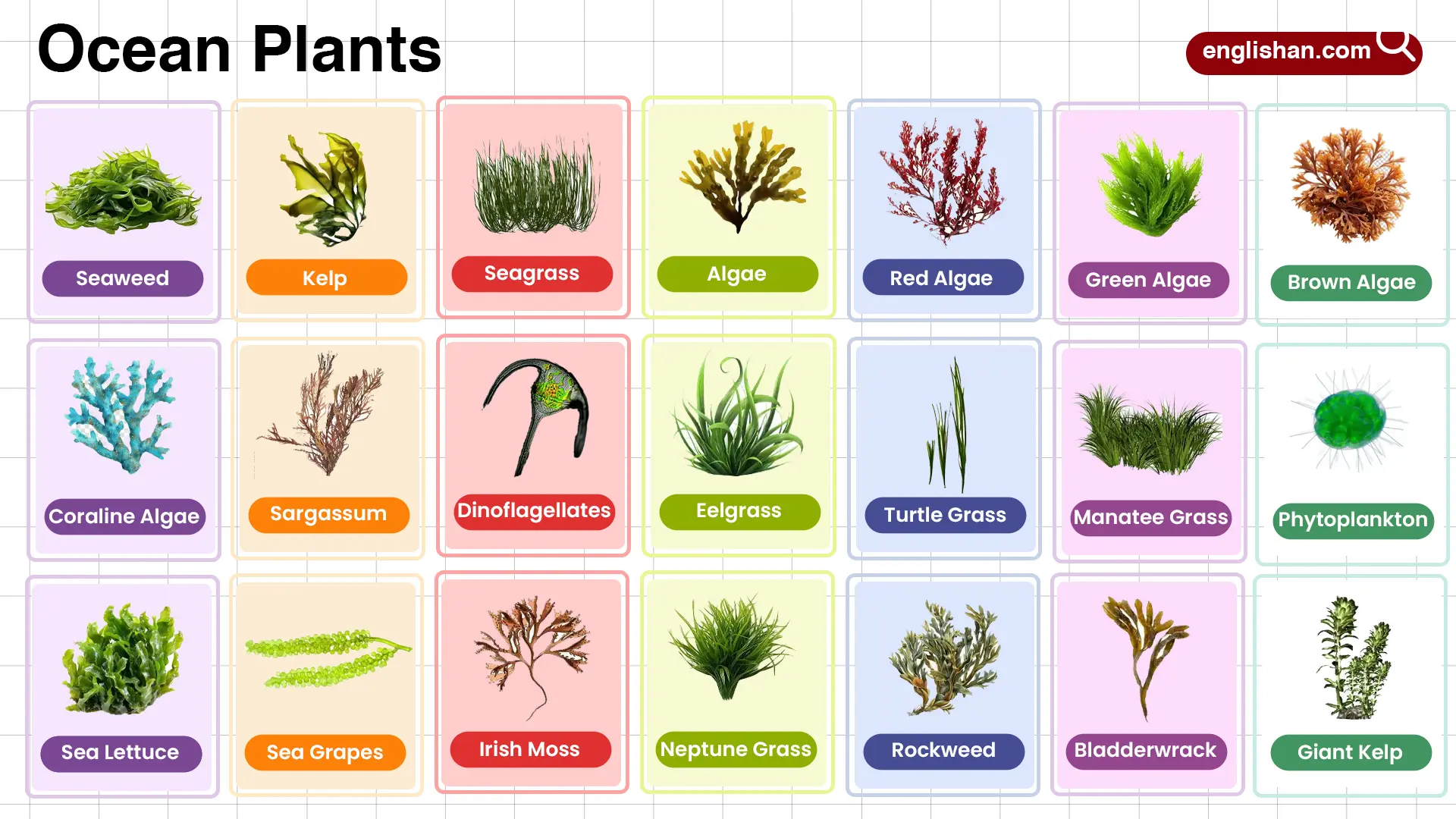
Ocean plants names include a wide variety of living plants and plant-like organisms found in saltwater environments. Some are leafy and large like kelp, while others, like phytoplankton, are too small to see with the eye. These plants grow in oceans around the world, supporting sea life and helping produce oxygen.
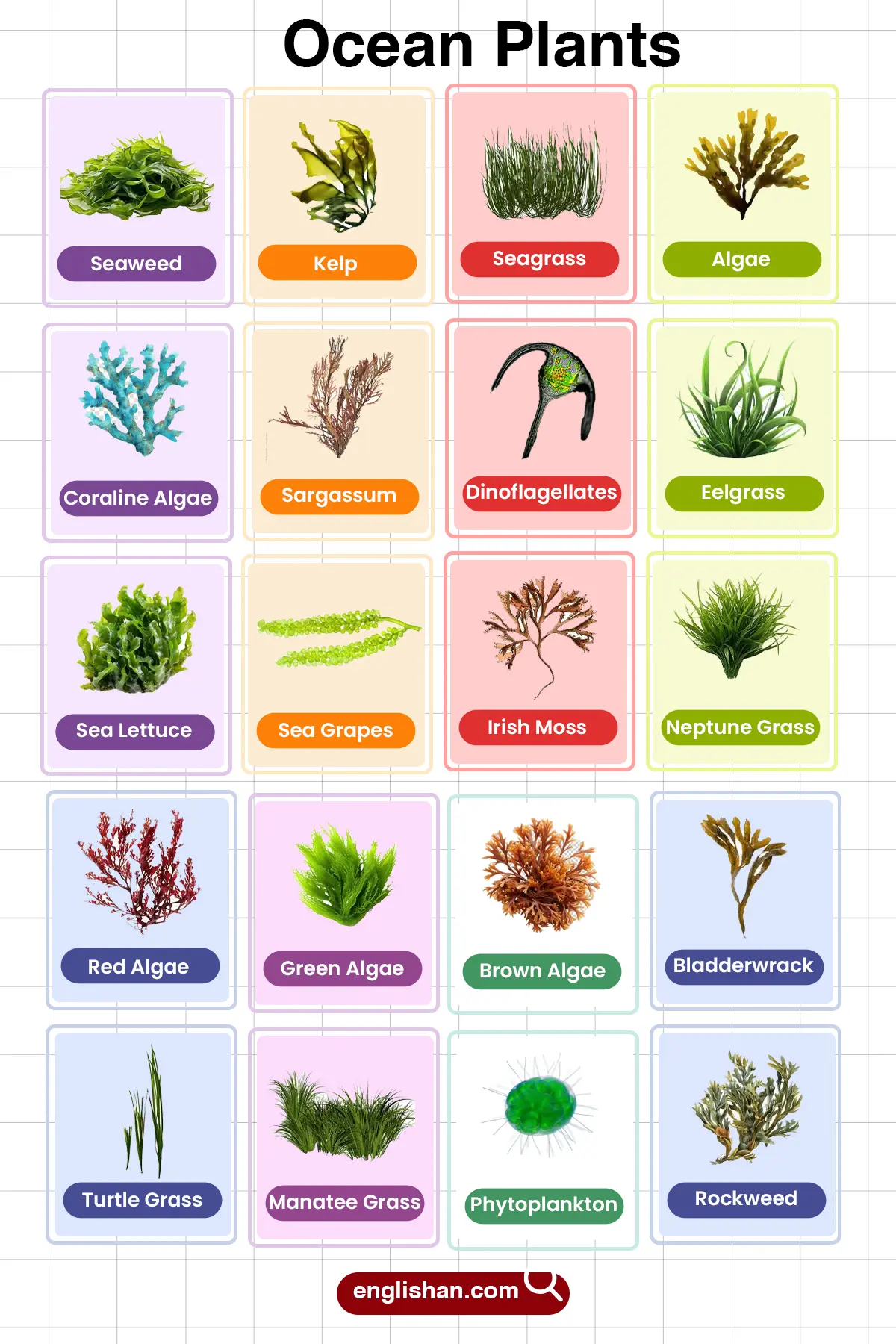
In this blog post, you’ll learn Ocean plants names with pictures. These help you talk about sea nature in science class, while writing, or when learning English vocabulary.
List of Ocean Plants Names
Ocean plants grow in saltwater and play a major role in the ocean’s ecosystem. Below is a list of well-known ocean plants names found in different parts of the sea.
- Seaweed
- Kelp
- Seagrass
- Algae
- Sea Lettuce
- Sea Grapes
- Sea Moss
- Red Algae
- Green Algae
- Brown Algae
- Coraline Algae
- Sargassum
- Halimeda
- Padina
- Phytoplankton
- Diatoms
- Dinoflagellates
- Eelgrass
- Turtle Grass
- Manatee Grass
- Neptune Grass
- Irish Moss
- Dead Man’s Fingers
- Mermaid’s Hair
- Rockweed
- Bladderwrack
- Giant Kelp
- Feather Boa Kelp
- Ribbon Seaweed
- Finger Kelp
Types of Ocean Plants
Ocean plants are grouped based on how they grow, what they look like, and their role in the sea. Below is a list of main types of ocean plants.
Seaweeds
Seaweeds are large algae that live in the shallow parts of the ocean. They support animals and protect coastlines.
- Giant Kelp: The tallest seaweed that grows fast and creates forest-like habitats.
- Feather Boa Kelp: Long, ruffled kelp that floats and looks like a feather boa.
- Ribbon Seaweed: Thin and wide, shaped like ribbons, sways with waves.
- Rockweed: Brown seaweed with round air bladders, often found on rocks.
- Bladderwrack: Floats with the help of air sacs and is common on northern coasts.
- Sea Lettuce: Bright green and flat, it grows in salty water near shores.
- Irish Moss: Small, bushy algae used in food thickeners.
- Sea Grapes: Edible green algae shaped like grapes, found in warm seas.
- Dead Man’s Fingers: Looks like small green fingers reaching upward from rocks.
- Mermaid’s Hair: Soft strands of algae that grow in clumps on shallow rocks.
List of Seagrasses
Seagrasses are true flowering plants that grow underwater and form green meadows.
- Eelgrass: Long, flat leaves that move with water and support small marine creatures.
- Turtle Grass: Has wide, ribbon-like leaves that turtles love to eat.
- Manatee Grass: Round and thin grass, often eaten by manatees.
- Neptune Grass: Slow-growing grass found in the Mediterranean Sea.
Names of Algae
Algae are plant-like organisms that range from tiny to huge. They live alone or in groups and grow in both shallow and deep parts.
- Green Algae: Lives in bright areas and grows on rocks or in tide pools.
- Red Algae: Grows deeper and is used in food and cosmetics.
- Brown Algae: Often grows large and creates homes for marine creatures.
- Halimeda: Has hard, chalky parts and grows like small chains.
- Padina: Brown algae with soft, curly, fan-like blades.
Microscopic Marine Plants
These are ocean plants you can’t see without a microscope. They float near the surface and feed many sea animals.
- Phytoplankton: Tiny floating plants that use sunlight to produce oxygen. They’re the first link in the ocean’s food web.
- Diatoms: Microscopic algae with clear, glass-like walls. They are very common and create large amounts of oxygen.
- Dinoflagellates: Tiny algae that spin while they swim. Some glow at night and create light in waves.
Floating Plants in the Ocean
Some ocean plants drift freely instead of staying attached to the seafloor.
- Sargassum: Has grape-like floats and forms mats on the sea surface.
- Sea Lettuce: A green algae that often floats in bays and estuaries.
- Sea Grapes: Loose and round algae that drift in warm tropical areas.
- Padina: Light brown and fan-like, floats gently near the shore.
- Bladderwrack: Bobs on water with the help of its air sacs.
Marine Plants in Deep Waters
These plants live where light is limited and grow slowly. They’re suited to cold and dark waters.
- Red Algae: Absorbs low light and grows where other plants cannot.
- Giant Kelp: Anchored deep but grows upward to reach light.
- Coraline Algae: Builds reef structures and lives far below the surface.
- Sea Moss: Deep-growing and often collected for its nutrients.
- Halimeda: Grows in dark reef zones and adds to reef building.
Conclusion
Learning ocean plants names helps you understand how different plants grow and support sea life. From large kelp forests to tiny floating algae, each name tells something about its shape, color, or where it lives. These names are useful in science lessons, marine studies, and English vocabulary.
Keep this list as a reference when you read, write, or talk about ocean habitats or marine biology.
FAQs on Ocean Plants Names
The most common ocean plants are seaweed, kelp, seagrass, algae, and phytoplankton. Each has its own role in supporting ocean life.
Seaweed is not a true plant. It is a type of algae, which performs photosynthesis but lacks roots, stems, and leaves.
Phytoplankton produces most of the ocean’s oxygen. These microscopic organisms use sunlight to create energy and release oxygen into the water.
You May Also Like