You need a unique synonym because unique is already on the page twice and using it a third time would look lazy.
The trouble is that unique makes two very different claims. In its strict sense, nothing else in existence matches it. Loosely used, it means no more than unusual, and a thesaurus lists the words for both together with no warning.
Choosing the right replacement comes down to two questions: which of those senses you mean, and how formal the sentence has to be. Answer both and only one word fits.
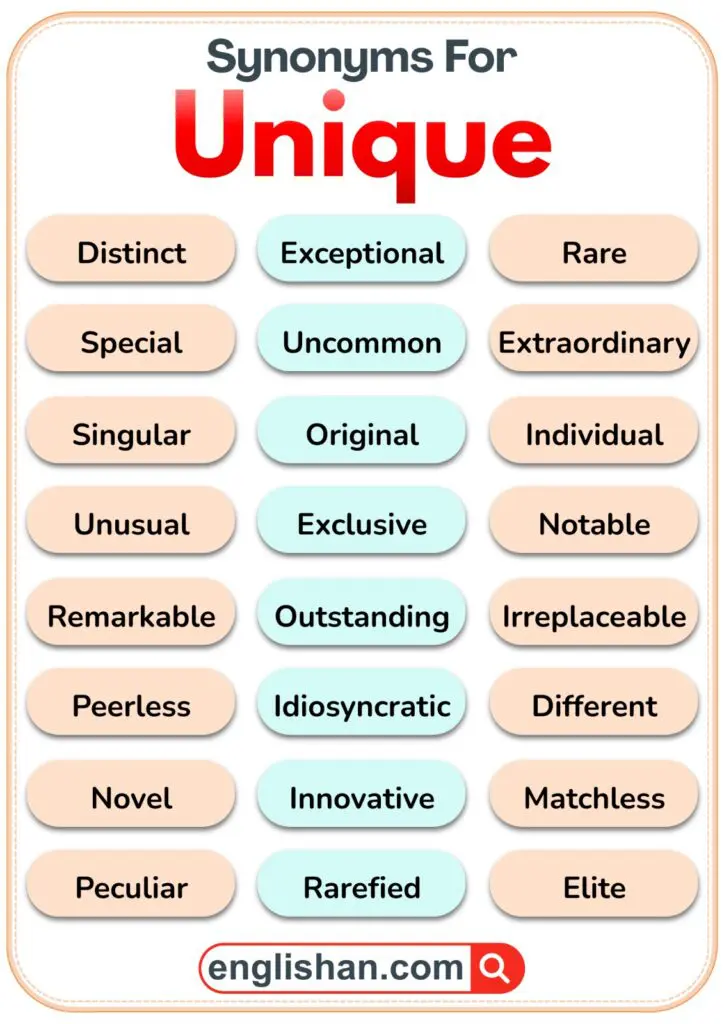
Another Word for Unique
Most writers use unique for one of three different senses, so a straight swap from a thesaurus regularly changes the meaning. A wedding venue that is unique is memorable. A fingerprint that is unique is mathematically singular. A neighbour who is unique is either charming or difficult, depending on the word you choose next. Sort the sense, then match the register, and only one word fits.
Synonyms for Unique That Mean One of a Kind
This is the strict sense of unique: nothing else in existence matches it. These replacements make a strong claim, so use them where the claim is true. Several are formal enough to change the tone of a sentence, and the labels mark those.
- One of a kind: the plainest replacement, and the one that works in every register from a text message to a board paper. Hyphenate it before a noun, leave it open after a verb. She restored a one-of-a-kind Bugatti chassis.
- Sui generis: Latin for of its own kind, used in law, philosophy, and academic prose for something that fits no existing category. (formal)
- Sole: the only one in a defined set, favoured by contracts and reporting. (formal) He remains the sole survivor of the 1954 expedition.
- Only: short, flat, and impossible to misread, which makes it stronger than it looks. The only copy burned in the fire.
- Single: one and no more, with a faint counting emphasis that only lacks.
- Singular: two senses in one word. It means both being the only one and strikingly unusual, so context has to disambiguate. (formal) Her singular talent for cross-examination made her a fortune.
- Solitary: one, and alone with it. The word adds isolation, which sole does not. (literary)
- Lone: a compact, slightly dramatic alternative to single, common in headlines.
- Unrepeatable: it happened once and the conditions will never recombine. Stronger than rare, and better suited to events than to objects.
- Inimitable: impossible to copy convincingly, said of a style, a voice, or a performer. (formal) Wodehouse wrote in an inimitable comic register.
- Incomparable: so far outside the field that comparison fails. (formal)
- Matchless: no equal anywhere. Literary, a touch old-fashioned, and very effective in praise. (formal)
- Unmatched: the everyday version of matchless, and the one to prefer in business writing.
- Unequaled: nothing has reached the same standard. (formal)
- Unrivaled: nothing competes with it. Slightly warmer than unequaled because it implies a contest that was won.
- Unparalleled: no parallel case exists. Strong, formal, and the safest of the heavyweight options. (formal)
- Peerless: without an equal among its peers, which is why it suits people and craftsmanship better than objects. (formal)
- Nonpareil: French by origin, meaning without equal. Rare enough that readers notice it, so use it once and no more. (formal)
- Unsurpassed: nothing has beaten it so far, which admits the possibility that something will.
- Unexcelled: a drier synonym for unsurpassed, common in older technical writing. (dated)
- Second to none: idiomatic, confident, and perfect for spoken English and marketing copy where a Latin word would sound stiff.
- Without equal: the phrase version of peerless, and a graceful way to avoid three heavy adjectives in a row. (formal)
- Without parallel: reserved for events and achievements rather than physical objects. (formal)
- Unprecedented: never before recorded. It describes novelty in time, not in kind, so a second occurrence would break the claim. (formal)
- Irreplaceable: losing it means losing the category. This one appeals to feeling rather than to counting.
- One and only: affectionate and informal, best for people. (casual) He is my one and only nephew.
- Unduplicated: technical and precise, standard in data, records, and manufacturing.
- One-off: something produced once and never again. British English uses it far more freely than American English does.
Distinctive Synonyms for Unique
Use this group when you mean easy to tell apart rather than the only one. These are the safest everyday substitutes because they praise without overclaiming, and none of them commits you to a mathematical absolute.
- Distinctive: recognisable at a glance because of a specific feature. The single best all-purpose replacement for unique in professional writing. A distinctive limp gave him away before he spoke.
- Distinct: different enough that nobody confuses it with a neighbour. Distinct separates; distinctive identifies.
- Characteristic: typical of one person or object and therefore telling. Her characteristic pause before answering unsettled the panel.
- Individual: owned by one person and shaped by them.
- Personal: private and particular to one person, with a warmth that individual lacks.
- Particular: this one and no other, in a specifying rather than praising sense.
- Specific: narrowly defined and exact. Common in technical prose where unique would sound like flattery.
- Idiosyncratic: marked by personal quirks that nobody else shares. Neutral in academic writing, faintly teasing in casual writing.
- Signature: the feature a person is known for. Powerful in food, fashion, music, and design writing. Sourdough with a burnt-butter crust became his signature loaf.
- Trademark: the same idea as signature, borrowed from commerce and slightly more emphatic.
- Hallmark: the feature that proves authenticity, from the assay marks stamped on English silver.
- Telltale: a small feature that reveals something, and normally something the owner would rather hide.
- Unmistakable: impossible to confuse with anything else, which is distinctive at its strongest.
- Recognizable: identifiable on sight, without the implied praise of distinctive.
- Defining: the feature without which it would not be itself.
- Distinguishing: the feature that separates one case from a near-identical case. Common in scientific description.
- Emblematic: it represents something larger than itself. (formal)
- Iconic: so widely recognised that it has become shorthand for a whole idea. Overused in marketing, so earn it before you write it.
- Discrete: separate and non-overlapping. Watch the spelling, because discreet means tactful and the mistake is common.
- Separate: apart from the rest, with no praise attached.
- Salient: the feature you notice first. (formal)
- Marked: noticeably different by degree. A marked improvement in her second draft won the commission.
Related:
Rare and Uncommon Words for Unique
Frequency, not identity, is what this group measures. Something rare exists in small numbers; something unique exists in one. Confusing the two is the most common substitution error in the whole vocabulary, so read the differences before you swap.
- Rare: few exist, and finding one takes luck or money. Rare is about scarcity in the world.
- Uncommon: you encounter it infrequently, though plenty exist somewhere.
- Unusual: it departs from the normal pattern. The most neutral member of the group and the safest in speech.
- Scarce: supply is short relative to demand, which is why economists prefer it to rare.
- Infrequent: it happens at long intervals. Time, not quantity.
- Rarefied: elevated and accessible to very few, said of air, of circles, and of tastes. (formal)
- Exotic: unfamiliar because it comes from somewhere else. Handle carefully when describing people, since the word has an uncomfortable history.
- Out of the ordinary: the plain-English phrase that works better than any Latin option in conversation.
- Atypical: it does not match the expected profile. Standard in medical and statistical writing. (formal)
- Irregular: it breaks the established pattern, with a faint hint of fault.
- Anomalous: it contradicts the rule the data predicted. (formal)
- Unwonted: unaccustomed and unexpected in a specific person. Rare, elegant, and misspelled as unwanted more than any word here. (dated)
- Uncustomary: outside normal practice, mainly in legal and historical prose. (dated)
- Seldom seen: the phrase to use when rare has already appeared twice in your paragraph.
- Little-known: obscure to the public rather than genuinely scarce.
- Obscure: hard to find and harder to explain, with a faint edge of insignificance.
- Unfamiliar: new to the reader rather than new to the world.
- Uncharacteristic: unusual for this particular person, which no other word in the group captures.
Synonyms for Unique That Mean Exceptional
Here unique is doing the work of praise, and readers know it. These replacements say it more honestly, ranked roughly from strong to strongest so you pick by force rather than by chance.
- Notable: worth mentioning. The mildest praise available.
- Noteworthy: worth recording, one step above notable and slightly more formal.
- Remarkable: worth remarking on, which is where the real praise begins.
- Striking: you notice it immediately, and appearance is the reason.
- Impressive: it earns respect through scale, skill, or result.
- Prominent: visible above everything around it, literally or in reputation.
- Distinguished: it has earned standing over time, which makes it a poor fit for anything young. (formal)
- Standout: it separates itself from a strong group. Informal, punchy, and excellent in reviews. (casual)
- Memorable: the reader still recalls it days later.
- Unforgettable: memorable, intensified, and quickly overspent.
- Exceptional: it falls outside the normal range, which is a statistical claim as much as a compliment. Her exceptional recall let her sit the exam without notes.
- Extraordinary: beyond the ordinary by a wide margin.
- Outstanding: it ranks above everything around it. Formal enough for a reference letter, plain enough for a menu board.
- Spectacular: dramatic enough to draw a crowd.
- Phenomenal: so far beyond expectation that it feels unaccountable.
- Stellar: top-tier, borrowed from astronomy and now standard in business English.
- Superlative: the highest grade there is. (formal)
- Exemplary: so good it sets the standard others copy. (formal)
Related:
Original and Innovative Synonyms for Unique
Novelty in method is a different claim from novelty in kind. A design nobody has attempted is original; a method nobody has attempted is innovative. Keep those two apart and this group becomes precise instead of interchangeable.
- Original: not copied from anything, and the first of its line.
- Novel: new in approach, with a faint academic flavour that suits research writing.
- Fresh: new and welcome after something stale. Register is casual to neutral.
- New: the shortest option, and stronger than writers give it credit for.
- Creative: produced by imagination rather than by procedure.
- Imaginative: creative with an emphasis on the vision behind the work.
- Inventive: creative in a practical, problem-solving direction. An inventive splint made from a bicycle spoke saved the climber’s hand.
- Innovative: it introduces a method that did not exist before, which is a claim about process rather than appearance.
- Groundbreaking: nobody had worked in the field before it.
- Pioneering: first into the field, with all the risk that going first implies.
- Trailblazing: pioneering with more energy and less formality. (casual)
- Revolutionary: it overturns the established approach rather than improving it.
- Trendsetting: others copied it afterwards, which is the proof the word depends on.
- Unconventional: it ignores the accepted way of working, and it does so neutrally.
- Nontraditional: outside inherited practice, and gentler than unconventional.
- Unorthodox: against the accepted method, with a hint of raised eyebrows.
- Avant-garde: ahead of the mainstream in art, film, fashion, and music. (formal)
- Experimental: still being tested, so the outcome remains open.
Related:
Words for Unique That Mean Exclusive
Scarcity that somebody engineered on purpose needs its own vocabulary. These words describe access and supply, not identity, which is why they dominate product copy, hospitality writing, and luxury retail.
- Exclusive: restricted to a defined group by design.
- Elite: the top layer, selected by ability or by status.
- Select: chosen rather than general, with a quieter tone than elite.
- Bespoke: made to one customer’s specification, from British tailoring. (formal)
- Custom: made to order, and the American counterpart to bespoke.
- Made-to-order: produced only after the order arrives, which is the plainest way to say it.
- Limited-edition: produced in a fixed run that will not be repeated.
- One-of-one: a single manufactured unit, standard in sneakers, watches, and collectibles. (casual)
- Proprietary: owned and controlled by one company, so no competitor supplies it.
- Private: restricted to one owner or one party.
Related: Synonyms For Quality
Words Like Unique to Use With Care
Every thesaurus lists these beside distinctive as though they were equivalent. They are not. Each one describes difference with an edge, and swapping it into a compliment insults what you meant to praise. The risk beside each word is the reason it earns its place here rather than higher up.
- Quirky: endearingly odd. Safe for a café or a novel, insulting for a surgeon or an audit.
- Offbeat: outside the mainstream in a stylish direction. The friendliest word in the group.
- Whimsical: playful and unpredictable. Charming for design, damning for a decision-maker.
- Eccentric: habitually strange in a way people tolerate because of wealth, age, or talent.
- Curious: oddly interesting, with a hint that the writer has reservations.
- Peculiar: strange in a way that unsettles. Readers hear disapproval whatever you intended.
- Odd: plainly not right. Neutral on the surface, negative in practice.
- Oddball: a person who does not fit. (casual)
- Strange: unfamiliar and slightly unwelcome.
- Abnormal: outside the healthy or expected range. Clinical, and cruel when applied to people.
- Far-out: wildly unconventional, in 1960s slang that now reads as a joke. (dated)
- Quaint: old-fashioned and charming, with a patronising undertone many readers miss.
- Bizarre: so strange it defies explanation.
- Outlandish: extravagantly strange, and implausible with it.
- Freakish: abnormal to the point of alarm. Rarely a compliment about anything living.
- Weird: the blunt everyday version, and the one readers most reliably hear as an insult. (casual)
Formal Synonyms for Unique in Academic Writing
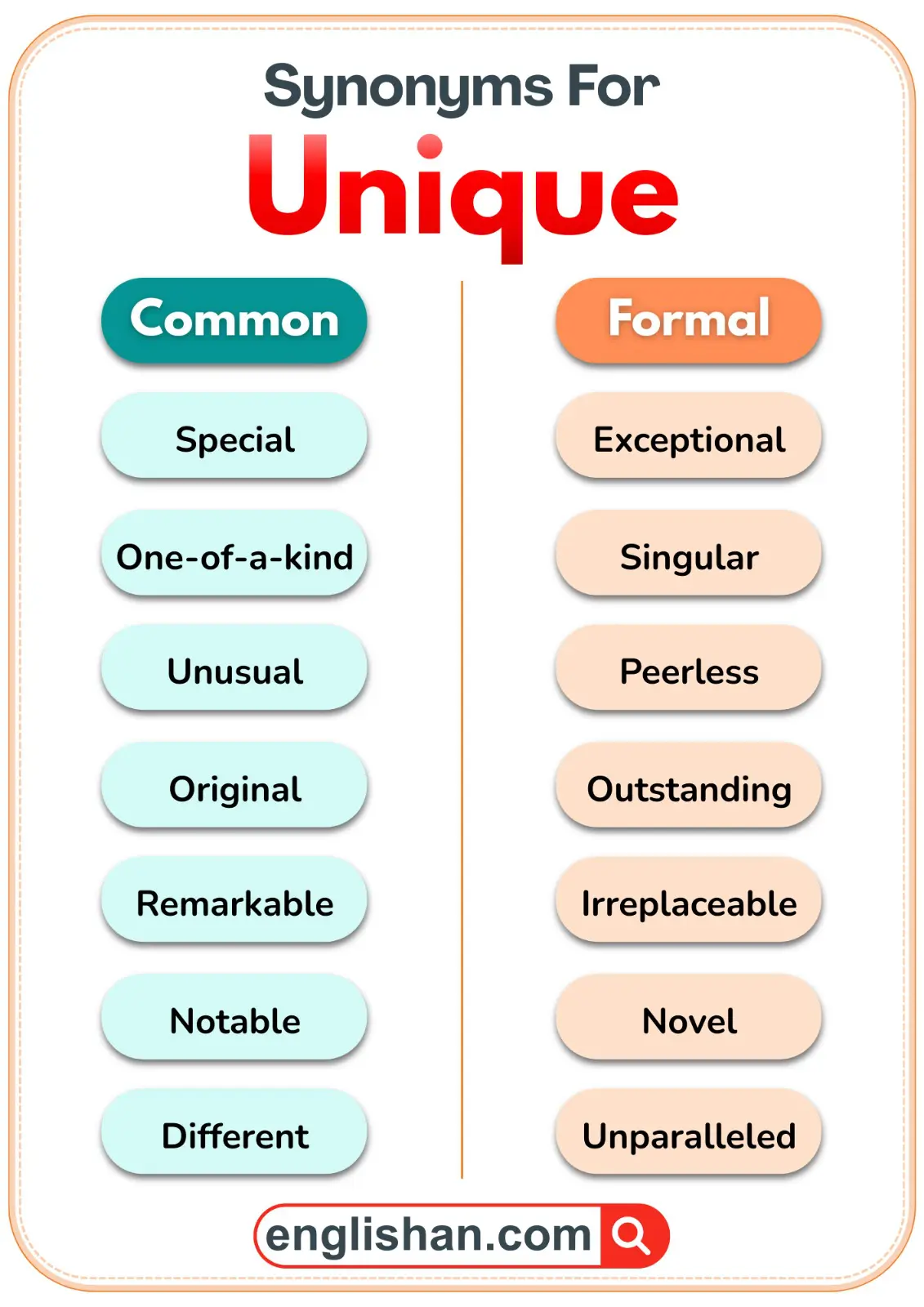
Academic prose wants precision and dislikes praise, so the words that work in a thesis are the ones making a checkable claim. Unique itself is discouraged in most style sheets because it overstates unless the singularity is demonstrable.
| Word | Register | Best use |
|---|---|---|
| Singular | Formal | A case with no counterpart in the dataset |
| Sui generis | Formal, Latin | A category that resists existing classification |
| Idiosyncratic | Formal, neutral | Variation specific to one research subject |
| Atypical | Formal, clinical | A case outside the expected profile |
| Anomalous | Formal, technical | A result the model failed to predict |
| Distinguishing | Formal | The trait that separates two close cases |
| Distinctive | Neutral to formal | An identifying feature that needs no praise |
| Unprecedented | Formal | An event with no recorded prior instance |
| Discrete | Technical | A category with no overlap |
| Novel | Formal | A method or finding reported for the first time |
| Salient | Formal | The feature most relevant to the argument |
| Inimitable | Formal, literary | A style no imitation reproduces |
Professional Synonyms for Unique on a Resume
Recruiters treat unique as a filler adjective because thousands of applicants use it about themselves, so the word signals nothing. Replace it with a term that names the actual advantage.
| Instead of | Write | Why it works better |
|---|---|---|
| A unique skill set | A distinctive combination of skills | Names the combination as the asset |
| A unique perspective | A cross-disciplinary perspective | States where the perspective came from |
| Unique experience | Specialised experience | Signals depth rather than novelty |
| A unique approach | An unconventional approach | Admits the risk and owns it |
| Unique results | Exceptional results | Praise a hiring manager already measures |
| Unique background | An atypical career path | Honest and instantly readable |
| Uniquely qualified | Singularly qualified | Formal, confident, and not overused |
Related:
Other Ways to Say Unique in Conversation
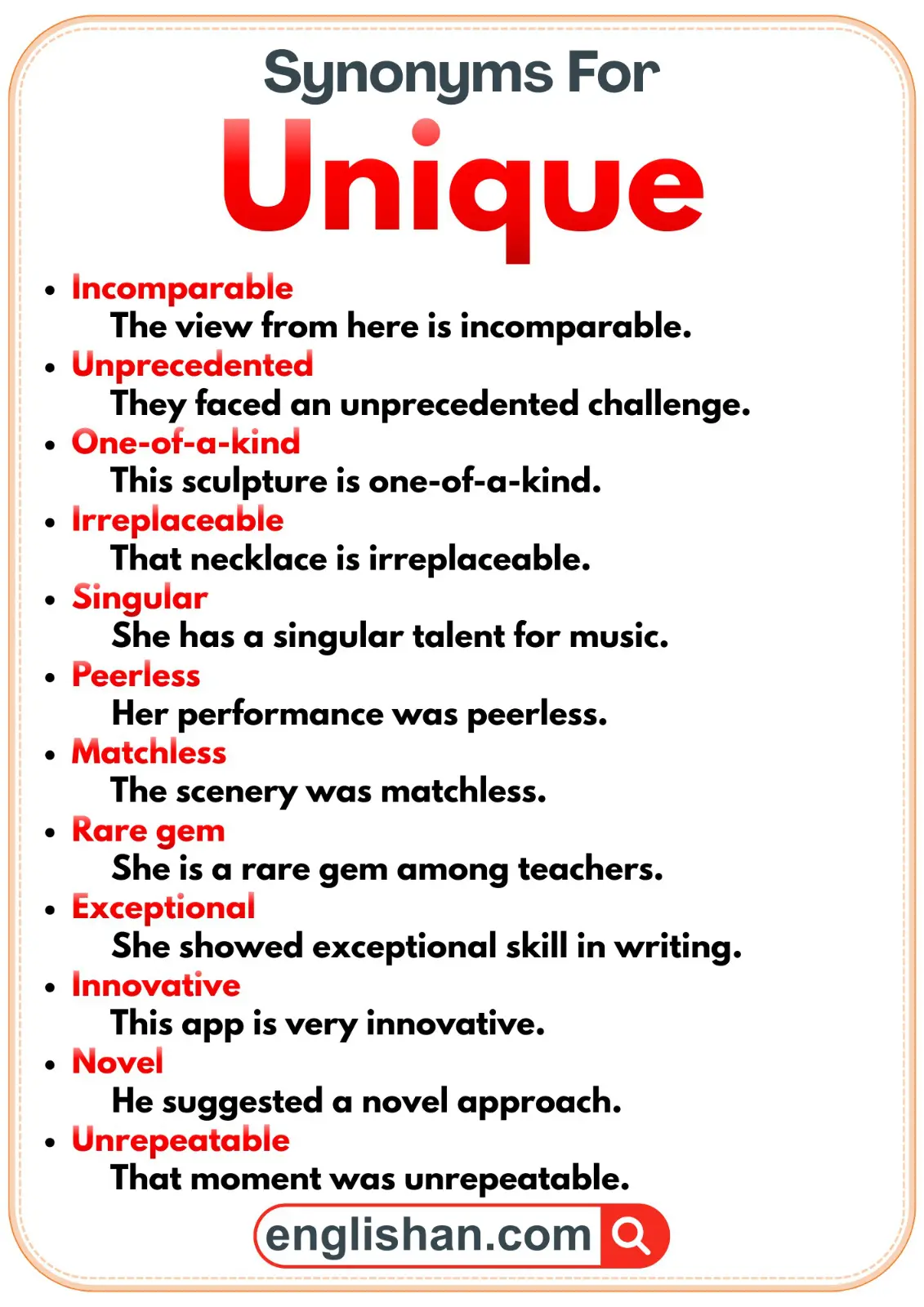
Latin adjectives sound wrong in speech. When you are talking rather than writing, these work just as well without sounding rehearsed.
- One of a kind: the default in speech, and nobody hears it as unusual phrasing.
- Like nothing else: the most natural spoken form of incomparable.
- Nothing like it: the same idea, shortened further.
- A real one-off: British English, affectionate, and almost always about a person.
- Standout: short and complimentary.
- Different: deliberately understated, and the meaning comes from your tone.
- Special: warm rather than precise. It says valued, not singular.
- Unlike anything I have seen: the sentence people actually say when they mean unprecedented.
- Second to none: confident, idiomatic, and slightly boastful.
- A total original: said of people, and always a compliment.
Related:
Unique vs Special vs Rare vs Distinctive
These four get swapped for each other daily, and each one makes a different claim. The table separates them, and the rule under each keeps them separated.
| Word | The claim | True when | False when |
|---|---|---|---|
| Unique | Only one exists | A fingerprint, a serial number, a signed original | Ten thousand were manufactured |
| Special | It is valued above others | A birthday, a family recipe, a first edition | Nobody attaches any value to it |
| Rare | Very few exist | A 1933 Double Eagle, a blood type, a first pressing | It is merely unusual to see |
| Distinctive | You recognise it at once | A voice, a logo, a roofline | Nothing identifies it on sight |
- Unique against special: unique counts, special values. A mass-produced mug your grandmother owned is special and not remotely unique.
- Unique against rare: rare is a matter of degree, unique is a matter of one. Rare objects have peers; a unique object does not.
- Unique against distinctive: distinctive asks whether you would recognise it, unique asks whether a second one exists. A distinctive haircut turns up on a hundred heads.
Which Synonyms for Unique Are True Absolutes
Some of these words describe a yes-or-no state, so intensifying them makes no logical sense. Others describe a degree, so intensifying them is correct. Knowing which is which prevents the most-corrected mistake in this whole vocabulary.
- True absolutes, no intensifier: one of a kind, sui generis, sole, only, unrepeatable, matchless, peerless, incomparable, inimitable, unprecedented, unparalleled, second to none.
- Gradable, intensifier fine: unusual, uncommon, rare, distinctive, remarkable, exceptional, striking, original, quirky, memorable.
Her approach is very matchless. ❌
Her approach is matchless. ✅
The word unique itself works both ways, which is why the argument continues. Merriam-Webster records two working senses: the original absolute sense of being the only one, and a later sense of unusual or distinctive. The Chicago Manual of Style keeps the traditional line and treats unique as ungradable, so very unique and more unique both fail in edited prose. The practical ruling for your own writing is short. Mean the only one, and never modify it. Mean unusual, and write unusual, which takes very without an argument.
Related: Types Of Adjectives
Best Synonym for Unique in Common Phrases
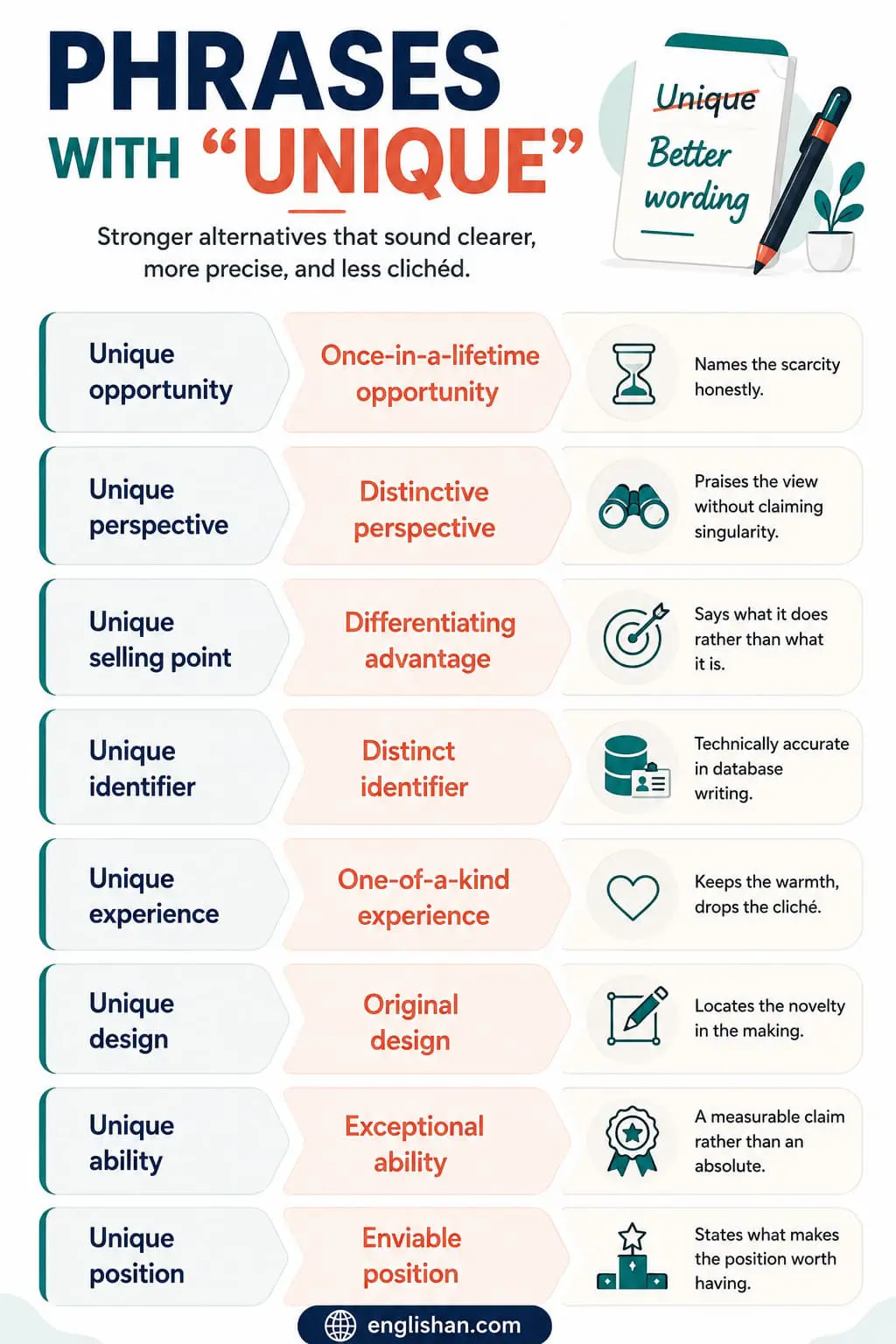
Unique pairs with a small set of nouns, and each pairing wants a different replacement. Substitute at the phrase level rather than the word level and the sentence still reads correctly.
| Phrase | Better wording | What changed |
|---|---|---|
| Unique opportunity | Once-in-a-lifetime opportunity | Names the scarcity honestly |
| Unique perspective | Distinctive perspective | Praises the view without claiming singularity |
| Unique selling point | Differentiating advantage | Says what it does rather than what it is |
| Unique identifier | Distinct identifier | Technically accurate in database writing |
| Unique experience | One-of-a-kind experience | Keeps the warmth, drops the cliché |
| Unique design | Original design | Locates the novelty in the making |
| Unique ability | Exceptional ability | A measurable claim rather than an absolute |
| Unique position | Enviable position | States what makes the position worth having |
Antonyms for Unique
Opposites define a word faster than more synonyms do, and unique has three sets of them because it has three senses.
- Against one of a kind: common, ordinary, commonplace, everyday, run-of-the-mill, standard, generic, garden-variety.
- Against rare: usual, frequent, widespread, universal, familiar, prevalent.
- Against distinctive: indistinct, unremarkable, nondescript, undistinguished, interchangeable, cookie-cutter.
Related:
Another Word for Uniqueness
Writers get the noun wrong more than the adjective, because the abstract form and the person-or-object form need different words.
- Singularity: the quality of being the only one. Formal, and borrowed by physics and computing.
- Individuality: the quality of being recognisably yourself.
- Distinctiveness: the quality of being recognisable at once.
- Idiosyncrasy: a personal peculiarity that nobody else shares.
- Originality: the quality of not being copied.
- Rarity: scarcity, and also the scarce object itself.
- Nonesuch: a person or object with no equal. (dated)
- Paragon: the perfect example of a quality, from the Italian paragone, a touchstone. (formal)
Mistakes to Avoid When Replacing Unique
Four errors account for almost every awkward substitution, and each takes one line to fix.
- Intensifying an absolute: very one of a kind and more matchless both fail, because there is no scale to move along. Swap in a gradable word or drop the intensifier.
- Praising with a negative word: peculiar, odd, and weird mean strange, not special. Your reader hears criticism even when you meant admiration, so keep them out of compliments.
- Trading singularity for scarcity: writing rare about a serial number, or unique about a limited run of five hundred, reverses the claim you meant to make.
- Over-formalising: sui generis, nonpareil, and unexcelled in casual writing read as showing off. Match the word to the register.
FAQs
The strongest unique synonym is one of a kind, which works in every register and makes exactly the same claim. For formal writing, singular and unparalleled deliver the meaning without sounding conversational. For everyday speech, special and standout fit more naturally.
Singular, sui generis, unparalleled, and inimitable are the strongest formal replacements. Academic writing prefers singular and idiosyncratic because both make a checkable claim, while sui generis fits legal and philosophical prose where something resists existing classification.
In edited writing, no. The Chicago Manual of Style treats unique as an absolute adjective, so it takes no intensifier. Merriam-Webster records a second, looser sense meaning unusual, which is why the phrase survives in speech. Write very unusual or highly distinctive instead and the objection disappears.
Unique claims that only one exists, while distinctive claims only that something is recognisable. Millions of people share a distinctive accent; only one person would have a unique one. Distinctive is the safer choice whenever you cannot prove singularity.
One of a kind, a total original, and inimitable all work as compliments. Eccentric and quirky describe difference with an edge, so they suit affectionate writing rather than professional writing. In a reference letter, exceptional or distinguished say it without risk.
Common, ordinary, and commonplace are the direct opposites of the one of a kind sense. For the distinctive sense, the opposites are nondescript, unremarkable, and indistinct. Choose the antonym that matches the sense you were using.
Singularity names the strict sense of being the only one, while individuality and distinctiveness name the everyday sense. Originality fits creative work, and idiosyncrasy names a personal peculiarity rather than the quality in general.