Subordinating conjunctions are essential linking words that connect a dependent clause to an independent clause to establish a logical relationship between two ideas. By using words such as although, because, or since, you can explain the “why,” “when,” or “how” behind a statement in a single, fluid sentence.
As a teacher, I have noticed that students often struggle with choppy writing because they rely too heavily on short, simple phrases. I have created this guide to show you how these connectors act as the glue for more sophisticated communication. I will walk you through the primary categories of these conjunctions and explain the specific punctuation rules you need to follow. By the end of this article, you will have a clear framework for building more detailed, professional sentences that flow naturally.
What Is a Subordinating Conjunction?
A subordinating conjunction is a word or phrase that joins a dependent clause to an independent clause. It signals that one part of the sentence depends on the other to complete its meaning.
In simpler terms, it helps answer questions like why, when, how, under what condition, or to what extent something happens. This creates complex sentences that add depth and clarity to your writing.
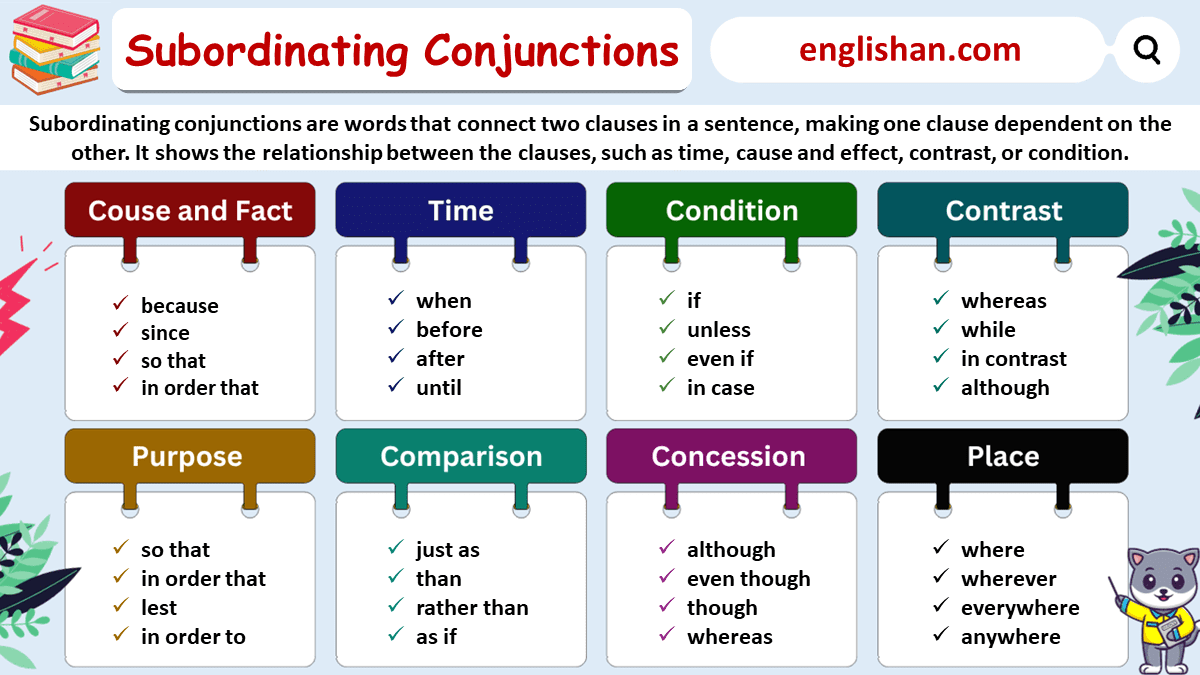
Subordinating Conjunctions List
One-Word Subordinating Conjunctions List
Here are some of the most common single-word subordinating conjunctions:
- after
- although
- as
- because
- before
- even though
- if
- once
- since
- than
- that
- though
- unless
- until
- when
- whenever
- where
- wherever
- while
Each of these starts a dependent clause and must be followed by a complete idea to form a full sentence.
Compound Subordinating Conjunctions List
Compound subordinating conjunctions are two or more words that function together:
- as long as
- as soon as
- even if
- in order that
- now that
- provided that
- so that
- as though
- as if
These work just like single-word subordinators but are slightly more formal or specific.
Subordinating Conjunctions by Function
Understanding function is easier with examples. Here’s how subordinating conjunctions work by category:
Time:
- We left after the show ended.
Cause/Reason:
- She stayed home because she was sick.
Condition:
- I’ll go if it doesn’t rain.
Contrast:
- Although it was late, he continued working.
Purpose:
- She practices daily so that she can improve.
These examples show how each subordinating conjunction links ideas logically.
Common Mistakes with Subordinating Conjunctions
- Incorrect punctuation: Don’t place a comma before a subordinating conjunction if it’s in the middle of a sentence.
✅ I’ll help you if you ask.
❌ I’ll help you, if you ask. - Incomplete thoughts: Don’t leave the dependent clause alone.
❌ Because I was tired.
✅ I slept early because I was tired. - Misusing coordinating conjunctions in place of subordinators: Don’t use and or but where a subordinating conjunction is needed.
Rules for Using Subordinating Conjunctions
- Use subordinating conjunctions to build complex sentences:
One idea depends on the other for full meaning. - Use coordinating conjunctions for compound sentences:
Two full ideas joined together.
Complex: He left although he was tired.
Compound: He was tired, but he left.
This structure helps in writing more logically connected and grammatically correct sentences.
Subordinating Conjunctions Examples
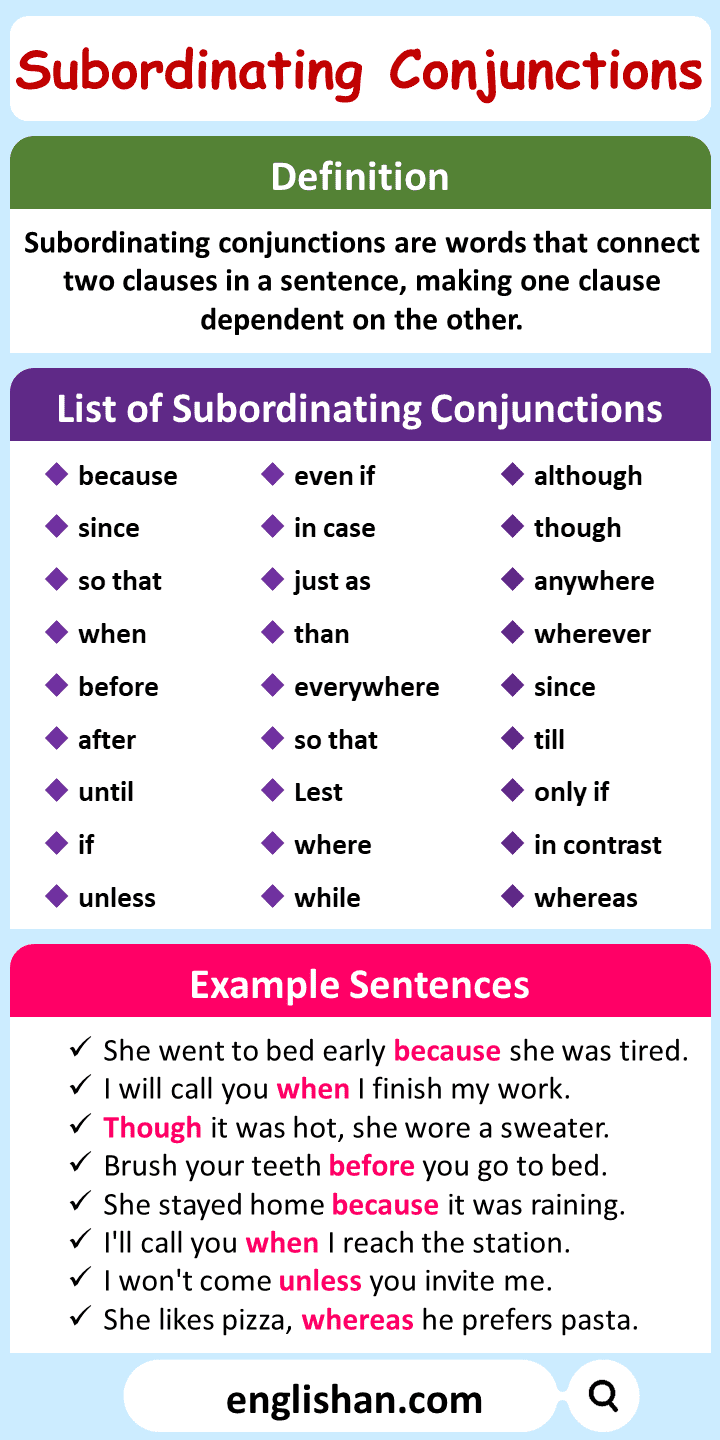
- She went to bed early because she was tired.
- I will call you when I finish my work.
- Though it was hot, she wore a sweater.
- Brush your teeth before you go to bed.
- She stayed home because it was raining.
- If you overeat, you might feel sick.
- I’ll call you when I reach the station.
- I won’t come unless you invite me.
- She likes pizza, whereas he prefers pasta.
- I’ll go for a walk whether it rains or not.
- Although the movie was long, they enjoyed it.
- She smiled because she was happy.
- After the storm passed, they went outside.
- I’ll be happy when I see you again.
- Call me when you arrive at the airport.
- Finish your dinner before you have dessert.
Subordinating vs Coordinating Conjunctions
While Coordinating Conjunctions (like and, but, or) connect two equal parts of a sentence, subordinating conjunctions connect unequal parts: one clause cannot stand alone.
A subordinating conjunction begins a dependent clause, which cannot be a full sentence on its own. The meaning is only complete when it’s joined with a main clause.
Coordinating: I was tired but I stayed up.
Subordinating: I stayed up although I was tired.
Confusing Words: Are These Subordinating Conjunctions?
Many learners mix up certain words and wonder if they count as subordinating conjunctions. Here’s a chart of frequently asked-about words that cause confusion:
| Subordinating Conjunctions | Not Subordinating Conjunctions |
|---|---|
| as | and (coordinating conjunction) |
| when | or (coordinating conjunction) |
| that | for (coordinating or preposition) |
| while | which (relative pronoun) |
| because | however (conjunctive adverb) |
| although | who (relative pronoun) |
| since | at (preposition) |
| where | from (preposition) |
| after | so (coordinating, unless “so that”) |
| though | |
| until | |
| before | |
| even though | |
| if |
Subordinating Conjunctions Quiz
Subordinating Conjunctions Quiz
Pick the best word to complete each sentence. You’ll see correctness after you choose. Open the hint only if you want help.
Your Results
FAQs About Subordinating Conjunctions
A subordinating conjunction connects two parts of a sentence: one that can stand alone (independent clause) and one that can’t (dependent clause). It shows how the parts are related.
Examples:
1. I stayed home because it was raining.
2. Although it was late, we went to the park.
3. I will go if you come.
4. I will call you when I get home.
5. She read a book while waiting.
These words help connect ideas in a sentence.
Here are 12 subordinating conjunctions:
1. Because
2. Although
3. If
4. When
5. While
6. Since
7. Unless
8. Before
9. After
10. As
11. Even though
12. Until
A subordinating conjunction is a word that connects two parts of a sentence. It helps show how one part depends on the other.
For example:
1. I stayed home because it was raining. (Tells why.)
2. I will go if you come. (Tells when or what happens.)
3. Although it was cold, we went outside. (Shows a difference.)
These words help make sentences clear and interesting!