

A paradox is a statement that contradicts itself on the surface yet resolves into truth when you look again: less is more, the only constant is change, you must spend money to make money. The contradiction is the hook and the resolution is the payload, which is why proverbs, advertising, and philosophy all run the same machine. English divides the family in two: literary paradoxes that reward a second reading with insight, and logical paradoxes that defeat reason permanently and entertain it in the process. Both kinds are worth owning, and telling them apart settles most classroom arguments.
What Is a Paradox?
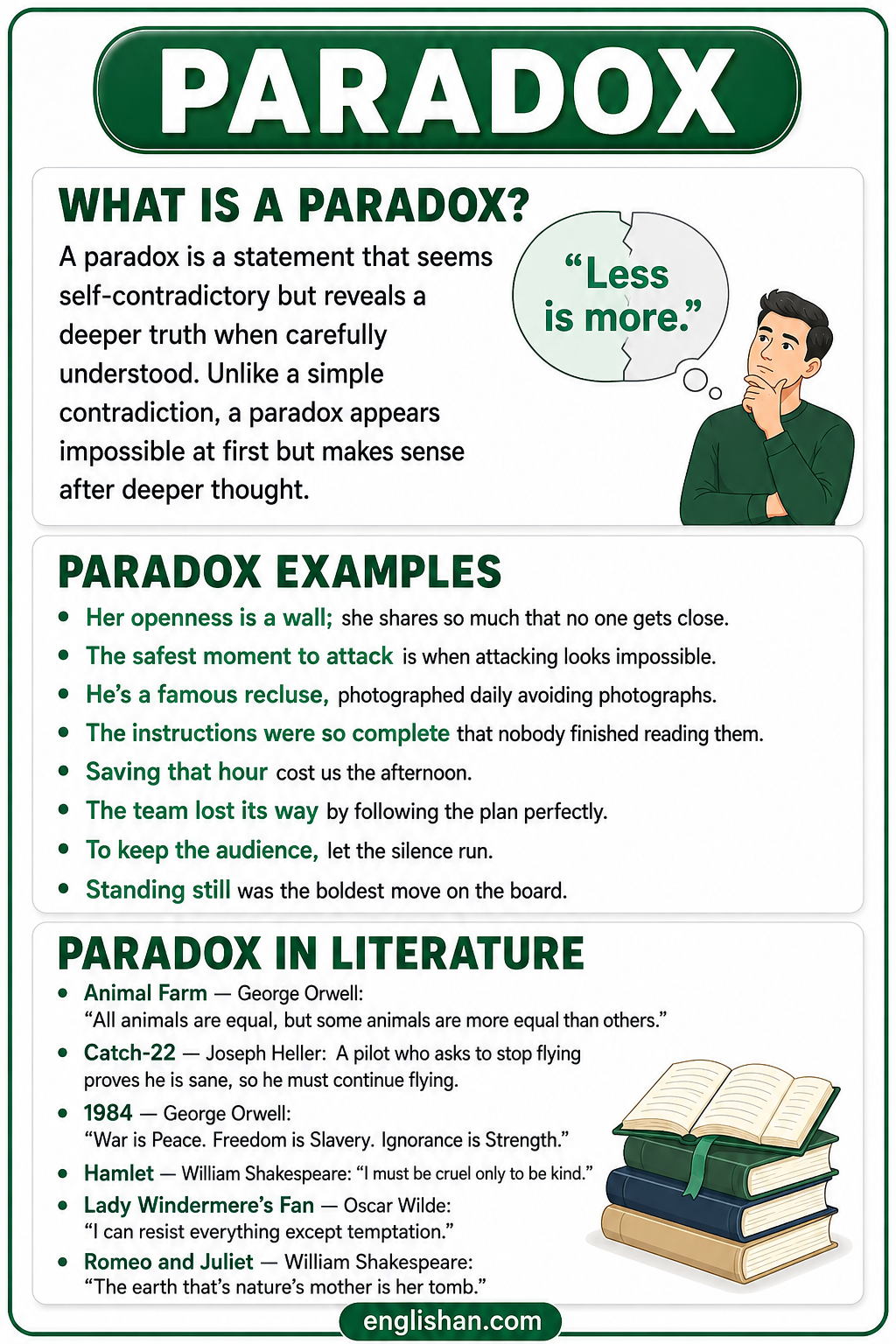
A paradox stages a collision between two claims that cannot both be true, then lets a hidden reading reconcile them. Less is more fails arithmetic and wins design: fewer parts produce greater effect, and the sentence needed the contradiction to make you find that reading. The word arrived from the Greek paradoxos, “contrary to expectation,” built from para (against) and doxa (opinion), and the etymology is the instruction manual: a paradox exists to run against what everyone assumes.
Scale separates the device from its small cousin. An oxymoron finishes its contradiction inside a two-word phrase (deafening silence), while a paradox needs a complete claim with room for the turn. A contradiction with no reconciling truth underneath is not a paradox at all; it is just noise, and the difference decides whether a line becomes a proverb or gets deleted.
Common Paradox Examples With Their Hidden Truths
Each of these contradicts itself in the first reading and pays out in the second, glossed here so the machinery shows.
- Less is more: restraint produces stronger effect than excess.
- You must spend money to make money: investment precedes return.
- The more you learn, the less you know: knowledge exposes the size of your ignorance.
- This is the beginning of the end: an ending has phases, and one just started.
- The only constant is change: permanence exists, and it is impermanence itself.
- If you want peace, prepare for war: deterrence, compressed into Roman advice.
- Nobody goes there anymore; it’s too crowded: Yogi Berra’s line, where “nobody” means “none of us regulars.”
- I know one thing: that I know nothing: the Socratic starting point of all inquiry.
- Youth is wasted on the young: the capacity and the wisdom to use it never coincide.
- The child is father of the man: Wordsworth’s claim that childhood shapes the adult who follows.
- You have to be cruel to be kind: short-term harm in service of long-term good.
- Silence speaks louder than words: a refusal to answer is itself an answer.
- The more things change, the more they stay the same: surface novelty, structural repetition.
- Freedom demands discipline: options stay open only for those who govern themselves.
- Slowing down makes you faster: control beats hurry, on racetracks and in careers.
- The busiest people find the most spare time: organization, not leisure, creates hours.
Paradox Examples in Sentences
- Her openness is a wall; she shares so much that no one gets close.
- The safest moment to attack is when attacking looks impossible.
- He’s a famous recluse, photographed daily avoiding photographs.
- The instructions were so complete that nobody finished reading them.
- Saving that hour cost us the afternoon.
- The team lost its way by following the plan perfectly.
- To keep the audience, let the silence run.
- Standing still was the boldest move on the board.
Literary Paradox vs Logical Paradox
The two families share a name and part ways at resolution. A literary paradox contradicts itself rhetorically and resolves into insight; every example above is of this kind, and the insight is the purpose. A logical paradox cannot be resolved at all: the contradiction survives every reading, and its job is to expose a fault line in reasoning itself. The famous specimens are worth knowing by name.
- The liar’s paradox: “This statement is false.” True if false, false if true, and philosophy has argued about it since ancient Crete.
- The grandfather paradox: travel back and prevent your grandparents’ meeting, and you erase the traveler who did the preventing.
- Zeno’s Achilles and the tortoise: to catch the tortoise, Achilles must first reach its last position, forever; motion wins in life and loses in the argument.
- The ship of Theseus: replace every plank of a ship one by one, and the question of whether it is the same ship never finds a floor.
- The barber paradox: a barber shaves everyone who does not shave themselves; whether he shaves himself breaks the rule both ways, Bertrand Russell’s puzzle in a barbershop.
- The omnipotence paradox: the old classroom question of whether absolute power survives its own test.
Exams and essays nearly always want the literary kind, and the label to reach for is: contradiction plus hidden truth.
Paradox Examples in Literature
Writers place paradoxes at the pressure line of a work, where the theme itself is contradictory.
- Animal Farm by George Orwell: “All animals are equal, but some animals are more equal than others.” The revolution’s betrayal is complete the moment its slogan becomes a paradox.
- Catch-22 by Joseph Heller: a pilot excused from missions must be insane, but requesting the excuse proves sanity, so the excuse cancels itself. The novel named the trap, and the term now names every rule that defeats you from both directions.
- 1984 by George Orwell: “War is Peace. Freedom is Slavery. Ignorance is Strength.” The Party rules through paradox because a mind that accepts contradiction accepts anything.
- Hamlet by William Shakespeare: “I must be cruel only to be kind” compresses the whole play’s method: damage dealt in the name of repair.
- Lady Windermere’s Fan by Oscar Wilde: “I can resist everything except temptation.” Wilde built a career on paradoxes that confess while they joke.
- Romeo and Juliet by William Shakespeare: Friar Laurence’s “the earth that’s nature’s mother is her tomb” folds birth and burial into one ground, the play’s tragedy in a single line.
Dickens’s “it was the best of times, it was the worst of times” is the famous near-miss: the clauses oppose without fusing, which files it under antithesis, and the distinction is the next test.
Paradox vs Oxymoron and Antithesis
Three devices trade in opposites at three scales. An oxymoron fuses two contradictory words into one phrase and stops: sweet sorrow. A paradox needs a full statement whose contradiction resolves into truth: you have to be cruel to be kind. Antithesis never fuses or resolves; it balances opposites against each other in parallel grammar and lets the contrast argue: speech is silver; silence is golden. Fusion, resolution, balance: match the scale and the label writes itself.
| Device | Scale | Example |
|---|---|---|
| Oxymoron | Two fused words | Deafening silence |
| Paradox | A full self-contradicting claim | Less is more. |
| Antithesis | Balanced unfused opposites | To err is human; to forgive, divine. |
How to Write a Paradox
A working paradox is a discovered truth wearing a contradiction, and three steps build one honestly. Start from a genuine tension you have observed: the mentor who teaches by refusing to answer, the crowd that makes a place lonely. Phrase both halves so they collide head-on, since a glancing contradiction produces confusion instead of the double-take. Then verify the resolution: a reader who pauses on the line must be able to name the truth underneath, and if no truth exists the line is surrealism, not paradox.
The blue silence tasted of yesterday’s tomorrow. ❌
The busiest people find the most spare time. ✅
The first contradicts everything and resolves into nothing; the second contradicts once and pays the reader for noticing.
Why Paradox Persuades
The device works because contradiction is a trap for attention. A consistent sentence slides past; a paradox stops the eye, demands a second reading, and rewards it, which converts a claim into a small experience. Proverbs across languages run on the mechanism because a resolved contradiction is nearly impossible to forget, and speechwriters use it for the same reason: Kennedy’s “ask not” era built its most quoted lines on reversals. One per piece is the working ration, placed at an opening or a close, where the double-take earns the most.
FAQs
A paradox is a statement that contradicts itself yet proves true on reflection. “Less is more” fails as arithmetic and succeeds as design advice: fewer parts produce a stronger effect, and the contradiction exists to make you find that reading.
An oxymoron contradicts itself inside a two- or three-word phrase (deafening silence), while a paradox needs a complete statement whose contradiction resolves into truth (“you must spend money to make money”). Scale is the whole test: fused words versus a full claim.
The liar’s paradox (“this statement is false”) is the oldest and most argued, defeating logic in five words. In literature, the crown goes to Catch-22 and Orwell’s “all animals are equal, but some animals are more equal than others.”
A catch-22 is a rule that defeats you from both directions, named after Joseph Heller’s novel: a pilot excused from flying must be insane, yet asking to be excused proves sanity. The term now labels any trap whose escape clause cancels itself.
A literary paradox resolves: the contradiction opens into an insight, as in “the child is father of the man.” A logical paradox never resolves: “this statement is false” stays contradictory under every reading, and its purpose is to expose the limits of reasoning itself.
A literary paradox is true by design; the surface contradiction protects a real insight underneath. Logical paradoxes are the exception, since they are built to have no consistent truth value at all, which is exactly what makes them famous.