An allusion is an indirect reference to a person, story, place, or event that the writer trusts the audience to recognize: call a weakness an Achilles’ heel and three thousand years of Greek epic arrive in two words, uninvited and unexplained. The device works entirely on shared knowledge, which makes it the most social figure of speech in English; every allusion is a bet that the reader owns the same shelf of stories. Win the bet and one phrase does a paragraph’s work. Lose it and the reference sails past unseen, which is a risk worth learning to manage.
What Is an Allusion?
An allusion names without explaining. When a colleague calls a project “our Trojan horse,” no one pauses to retell the fall of Troy; the story arrives compressed inside the phrase, and its meaning (a gift concealing an attack) transfers instantly to the project. The device traces to the Latin alludere, “to play with,” and play is accurate: writer and reader share a quick game of recognition over the head of the sentence.
Two conditions make an allusion work. The reference stays brief, a name or phrase rather than a retelling, and it stays indirect, never announcing its source. “As the Bible says in Genesis 3” is a citation; “she took the forbidden fruit” is an allusion. The compression is the power, and the shared culture is the fuel.
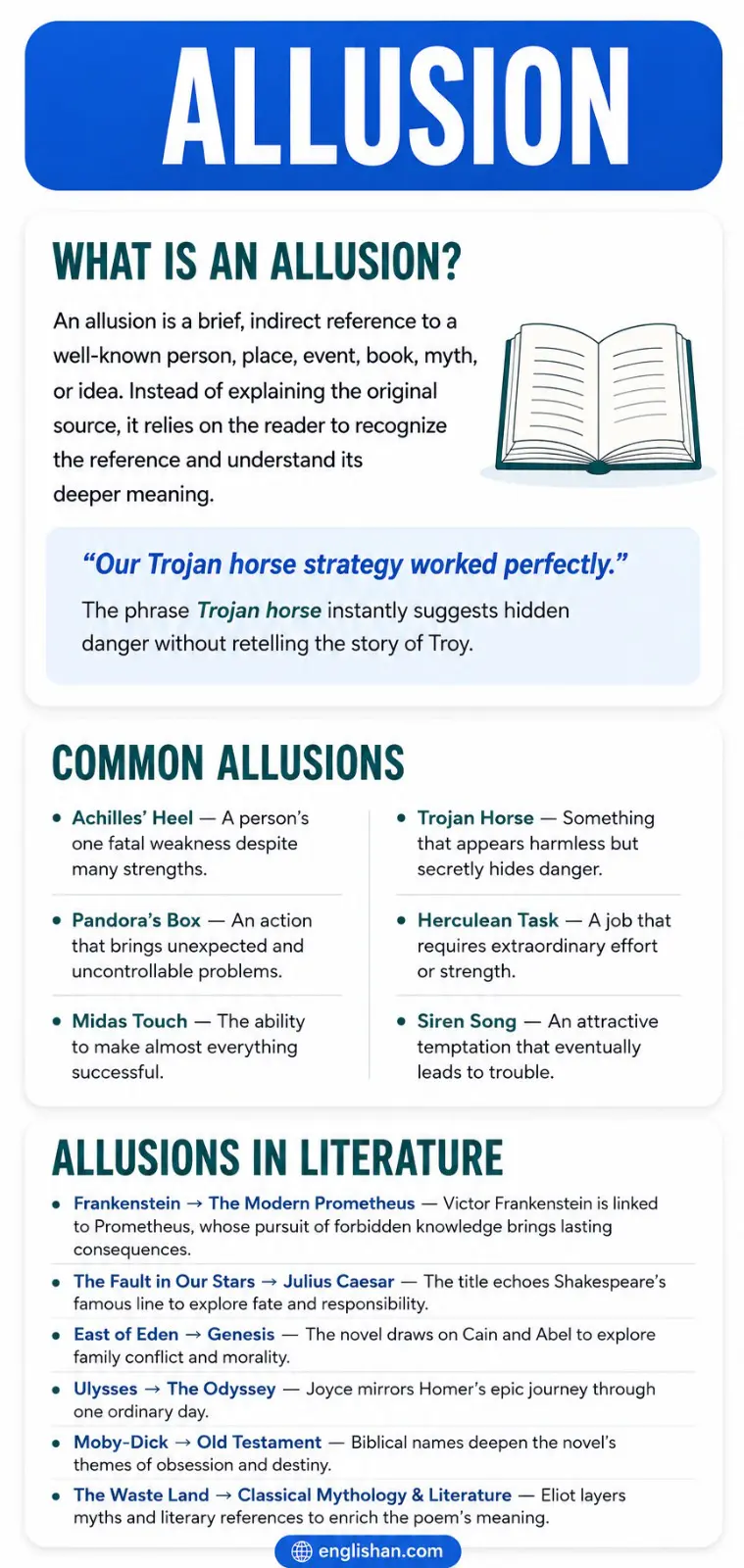
Common Allusion Examples With Meanings
English conversation trades on a standing library of references, and each of these names its source and its transferred meaning.
- Achilles’ heel: from Greek myth; the one fatal weakness in an otherwise strong person.
- Pandora’s box: from Greek myth; an act that releases uncontrollable troubles.
- Midas touch: from Greek myth; the knack of turning every venture profitable.
- Trojan horse: from Greek epic; a gift or offer hiding an attack.
- Herculean task: from Greek myth; work demanding superhuman effort.
- Siren song: from the Odyssey; a temptation that lures you toward ruin.
- An odyssey: from Homer; any long, transforming journey.
- Cupid’s arrow: from Roman myth; sudden, unchosen love.
- Good Samaritan: from the Gospels; a stranger who helps at cost to himself.
- Prodigal son: from the Gospels; the wayward child welcomed home.
- David and Goliath: from Scripture; the underdog toppling the giant.
- Forbidden fruit: from Genesis; the desirable thing whose price is ruin.
- Crossing the Rubicon: from Roman history; the decision after which there is no return.
- Meeting your Waterloo: from Napoleon’s defeat; the contest that finally ends a winning run.
- A Scrooge: from Dickens; a miser at war with generosity.
- A Romeo: from Shakespeare; a romantic, and at times a reckless one.
- A real Sherlock: from Conan Doyle; a sharp deducer, or ironically the opposite.
- A catch-22: from Joseph Heller; a rule that defeats you from both directions.
- Big Brother: from Orwell’s 1984; surveillance wearing a smile.
- Quixotic: from Cervantes; nobly impractical, tilting at windmills.
- Kryptonite: from Superman; the one thing that undoes an otherwise strong person.
- A Cinderella story: from the fairy tale; the overlooked contender’s sudden rise.
Allusion Examples in Sentences
- Don’t open that Pandora’s box in the meeting.
- Chocolate is my kryptonite.
- He turns into a Scrooge every December.
- The slow back line was the team’s Achilles’ heel.
- Finishing the migration in one weekend was a Herculean task.
- She met her Waterloo in the semifinal.
- Nice parking job, Einstein.
- The fifth-division club’s cup run is a pure Cinderella story.
- Signing that lease was our Rubicon.
- The new monitoring policy feels straight out of 1984.
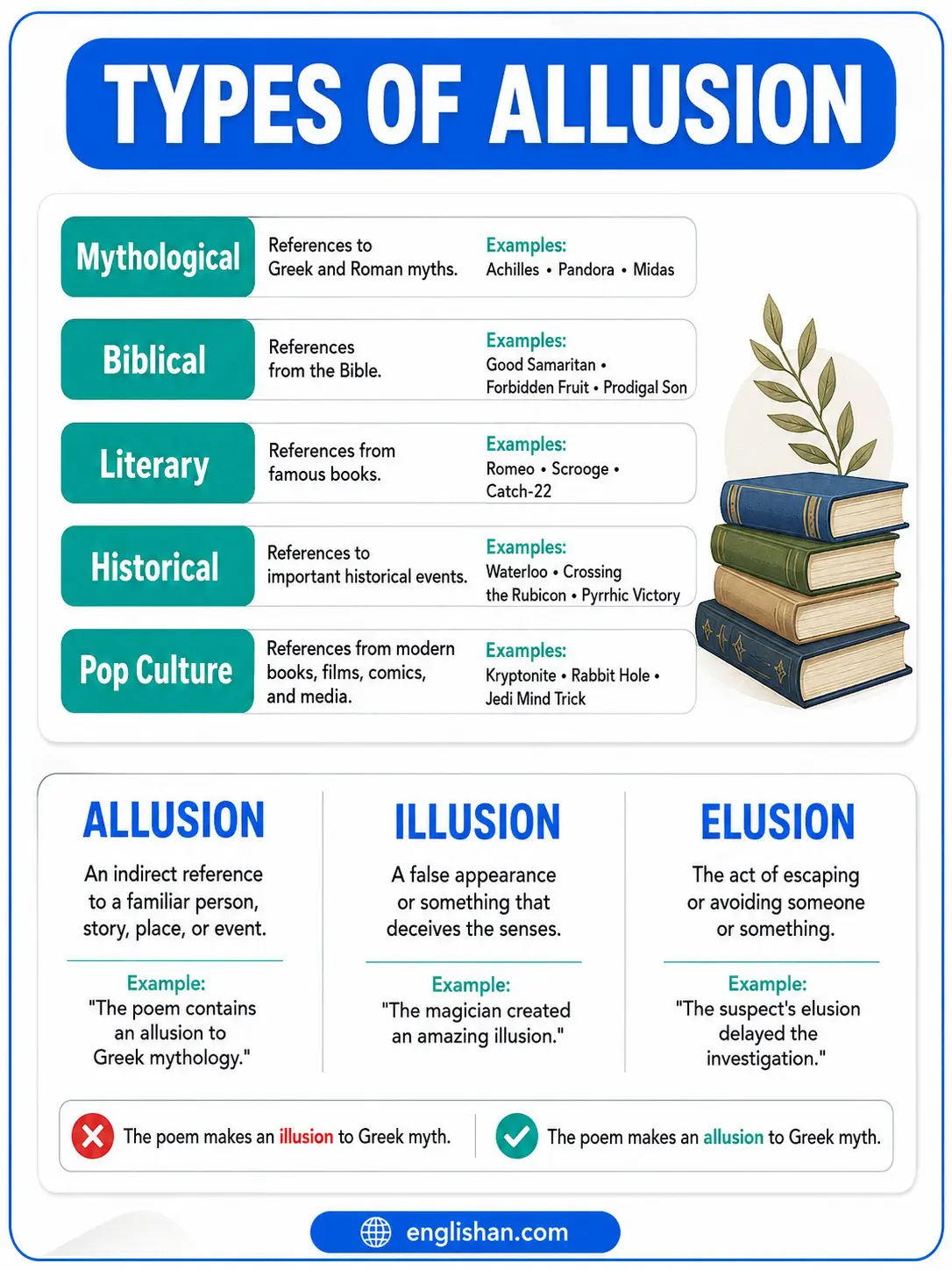
Types of Allusion
Five source families supply nearly every allusion an English reader meets.
Mythological Allusions
Greek and Roman myth is the deepest reserve: Achilles, Pandora, Midas, Hercules, the Sirens, Icarus (flying too close to the sun), and Narcissus (drowned in his own reflection) all function as portable judgments on modern behavior.
Biblical Allusions
Scripture supplies the moral vocabulary: forbidden fruit, the Good Samaritan, the prodigal son, thirty pieces of silver for betrayal, a Judas, an exodus, a garden of Eden. The references work even for readers who never open the source, because the stories soaked into the language centuries ago.
Literary Allusions
Fiction’s characters outlive their books as shorthand: a Scrooge, a Romeo, a quixotic scheme, a catch-22, Big Brother, a Jekyll-and-Hyde temper. One proper noun imports a whole psychology.
Historical Allusions
Real events serve as measures: meeting your Waterloo, crossing the Rubicon, a Pyrrhic victory (won at ruinous cost), Rome burning while someone fiddles, a Titanic effort headed for its iceberg.
Pop Culture Allusions
The newest layer refreshes fastest: kryptonite, going down the rabbit hole, a Jedi mind trick, the red pill, a Hogwarts letter that never came. These date quickly, which is their charm and their risk.
Allusion Examples in Literature
Writers allude to borrow gravity, and some titles are allusions before page one.
- Frankenstein by Mary Shelley: the subtitle, The Modern Prometheus, aligns Victor with the Titan who stole fire and paid forever, so the novel’s judgment arrives on the cover.
- The Fault in Our Stars by John Green: the title reverses Cassius in Julius Caesar (“the fault, dear Brutus, is not in our stars, but in ourselves”), and the whole novel argues with Shakespeare’s line.
- East of Eden by John Steinbeck: the title, from Genesis, plants Cain and Abel inside a California family two generations deep.
- Ulysses by James Joyce: one Dublin day is scaffolded on the Odyssey, episode by episode, the most sustained allusion in modern fiction.
- Moby-Dick by Herman Melville: Ishmael, Ahab, and Elijah wear Old Testament names that predict their natures, allusion doing the work of prophecy.
- The Waste Land by T. S. Eliot: the poem is built almost entirely from allusions, Dante to tarot cards, and its famous difficulty is the reader’s bet multiplied by a hundred.
Allusions in Movies and Pop Culture
Screens allude as densely as poems ever did. The Lion King restages Hamlet on the savanna, murdered king, usurping uncle, exiled heir and all. The Matrix tells Neo to follow the white rabbit, wiring itself to Alice in Wonderland before the plot starts. O Brother, Where Art Thou? runs the Odyssey through Depression-era Mississippi, sirens and cyclops intact. Shrek earns its comedy by alluding to every fairy tale on the shelf at once, and Stranger Things is one long allusion to the 1980s. Each case bets on the audience’s shelf, exactly as Eliot did.
Allusion vs Illusion and Elusion
Three near-identical words cause a permanent spelling accident, and one sentence fixes each. An allusion is an indirect reference (the noun of allude). An illusion is a false perception or deceptive appearance: a mirage, a magician’s trick. Elusion is the act of escaping (the noun of elude), rare on its own but alive in elusive. The writer alludes, the magician creates illusions, and the fugitive eludes.
The poem makes an illusion to Greek myth. ❌
The poem makes an allusion to Greek myth. ✅
The first claims the poem performs a magic trick; the second says it references Homer, and only one of those earns marks on an exam.
How to Use Allusions in Writing
An allusion is a bet on your reader, so place the bets deliberately. Match the reference to the audience, since catch-22 lands in a boardroom and a Fortnite reference lands in a classroom, rarely both. Give quiet scaffolding when stakes demand it: “a Trojan horse of a clause, a gift with an attack inside” pays even the reader who missed Troy. Never explain a joke-level allusion, because the recognition is the pleasure. And ration the habit, since prose that alludes in every line stops speaking for itself and becomes a quiz.
FAQs
An allusion is a brief, indirect reference to a story, person, or event the audience is expected to recognize. Calling a plan’s weak point its “Achilles’ heel” is an allusion: the Greek myth of the hero’s one vulnerable spot transfers in two words, with no retelling.
An allusion is an indirect reference to something outside the text, while an illusion is a false perception or deceptive appearance. A poet makes allusions; a magician makes illusions. The verbs sort the same way: writers allude, appearances deceive.
Achilles’ heel, Pandora’s box, a Scrooge, crossing the Rubicon, and kryptonite. They reach into myth, literature, history, and pop culture respectively, and each compresses its whole source story into a phrase.
Mythological, biblical, literary, historical, and pop culture allusions supply nearly all real usage. The five differ only in their source shelf; the mechanism, an unexplained reference the audience completes, stays identical.
An allusion imports an entire story’s weight in a phrase, flatters the reader who catches it, and lets a new work converse with an old one. Shelley’s Modern Prometheus subtitle delivers a verdict on her scientist that would otherwise take chapters.
A biblical allusion references Scripture without citing it: forbidden fruit, a Good Samaritan, a prodigal son, thirty pieces of silver. The stories are so deep in English that the references work even for readers who have never opened the source.