

Alliteration is the repetition of the same consonant sound at the beginning of nearby words: Peter Piper picked, safe and sound, Coca-Cola. The repeated sound gives a phrase a beat the ear notices before the mind does, which is why tongue twisters torment, slogans stick, and half the superheroes you know have matching initials. The device costs nothing, works in four words or fewer, and has powered English verse since poems were written in Old English, a thousand years before rhyme took over the job.
What Is Alliteration?
Alliteration binds words through their opening sounds. Say worried wanderers wait and three w strikes in a row turn a plain statement into a pattern; the repetition is doing rhythmic work no meaning supplies. Two conditions define the device: the repeated consonant sound opens the words (or their stressed syllables), and the words stand close enough together for the ear to connect them. Three words in one clause alliterate; the same three scattered across a paragraph do not.
The name traces to the Latin ad plus littera, “to the letter,” which is history’s small joke, because letters are exactly what the device ignores. Alliteration is a sound pattern, and English spelling betrays sound constantly, which is why the next rule decides more exam answers than the definition itself.
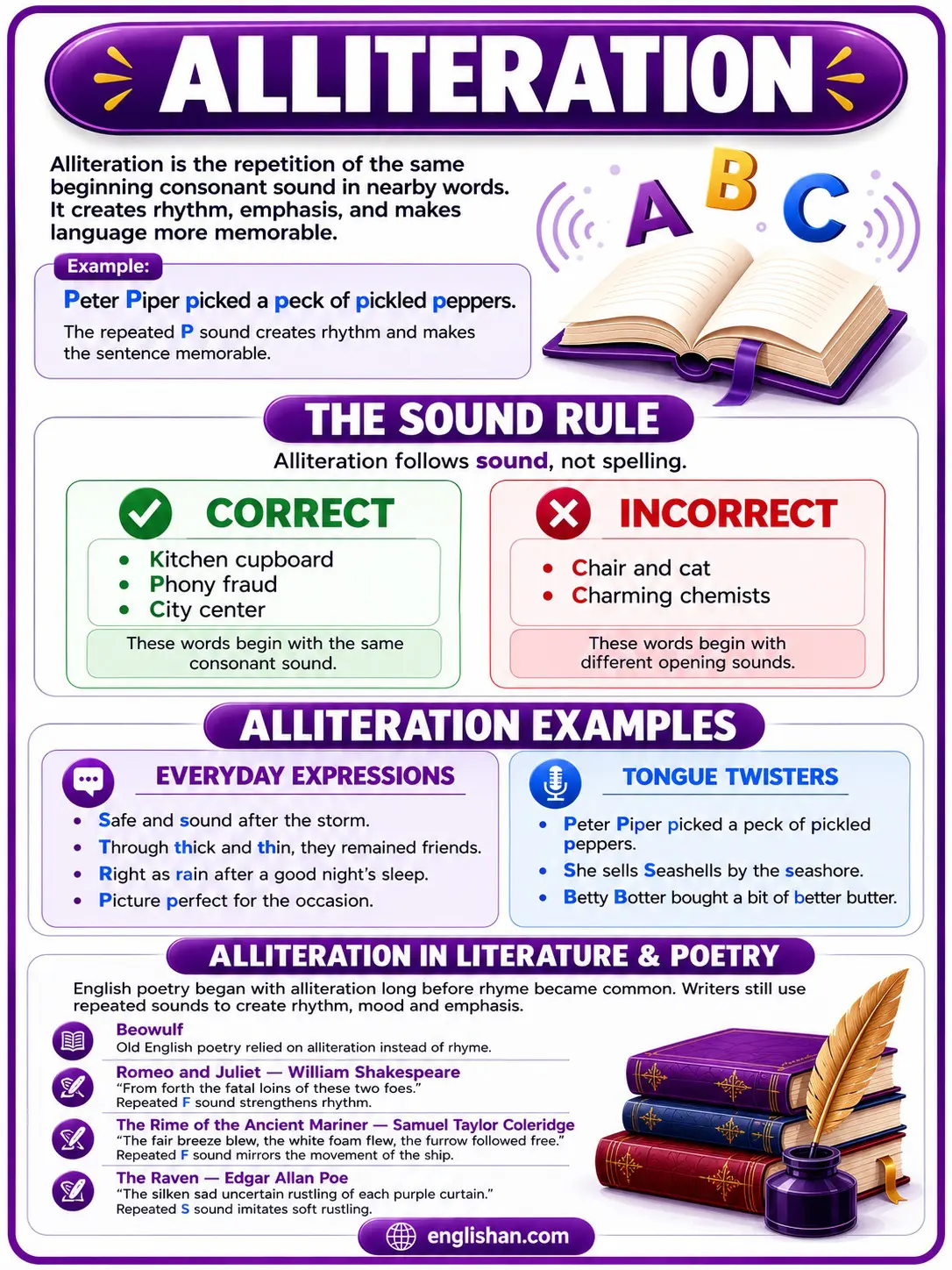
The Sound Rule in Alliteration
Alliteration follows the ear, never the alphabet, and the rule cuts both ways. Different letters that produce one sound alliterate: kitchen cupboard (both k), phony fraud (both f), city center (both s). Identical letters that produce different sounds do not: charming chemists opens with ch as in chair against k as in kite, and no pattern reaches the ear despite the matching spelling. Silent letters follow the same law, so knuckle alliterates with night, not with kick.
Charming chemists checked the chart. ❌
Kind chemists checked the chart. ✅
The first repeats a letter and loses the sound; the second repeats the k sound across two spellings and the alliteration lands. Test with your voice, not your eyes, and the sound rule never fails you.
Alliteration Examples in Everyday Phrases
Fixed English expressions preserve alliteration because the pattern helped them survive, and the repetition still does the memorizing for you.
- Safe and sound: unharmed after risk.
- Right as rain: fully recovered.
- Fit as a fiddle: in excellent health.
- Good as gold: perfectly behaved.
- Dead as a doornail: beyond all doubt finished.
- Home sweet home: the comfort of returning.
- Do or die: committed past retreat.
- Now or never: the last possible chance.
- Friend or foe: ally or enemy, demanded at the gate.
- Tried and true: proven by long use.
- Through thick and thin: loyal in every condition.
- Part and parcel: an inseparable piece of the whole.
- Rags to riches: poverty to wealth in one life.
- Labor of love: work done for devotion, not pay.
- Live and learn: experience as the tuition.
- Method to the madness: hidden order inside chaos.
- Make a mountain out of a molehill: to inflate a small problem.
- Beat around the bush: to avoid the main matter.
- Turn the tables: to reverse a losing position.
- Picture perfect: flawless enough to photograph.
Alliteration Examples in Tongue Twisters
Tongue twisters are alliteration stress-tested, built to make the repeated sound collide with its nearest neighbors.
- Peter Piper picked a peck of pickled peppers.
- She sells seashells by the seashore.
- Betty Botter bought a bit of better butter.
- How much wood would a woodchuck chuck if a woodchuck could chuck wood?
- Fuzzy Wuzzy was a bear; Fuzzy Wuzzy had no hair.
- Six slippery snails slid slowly seaward.
- A proper copper coffee pot.
- Round the rugged rocks the ragged rascal ran.
Alliteration Examples in Literature and Poetry
English poetry began alliterative and never fully stopped.
- Beowulf: Old English verse used no rhyme at all; every line was built on alliteration, with stressed syllables echoing one sound across the line’s two halves. The device was the poetry.
- Romeo and Juliet by William Shakespeare: the prologue opens the tragedy with “from forth the fatal loins of these two foes,” four f strikes that toll like a bell before the story starts.
- The Rime of the Ancient Mariner by Samuel Taylor Coleridge: “The fair breeze blew, the white foam flew, the furrow followed free,” a line so alliterative it moves like the ship it describes.
- The Raven by Edgar Allan Poe: “the silken sad uncertain rustling of each purple curtain” repeats s until the sound itself rustles.
- Stopping by Woods on a Snowy Evening by Robert Frost: “whose woods these are I think I know” opens on paired w sounds soft as the falling snow.
- I Have a Dream by Martin Luther King Jr.: “with this faith we will be able to hew out of the mountain of despair a stone of hope”; King alliterates d in “the dark and desolate valley” and returns to matched sounds at every climax.
- Pied Beauty by Gerard Manley Hopkins: “Glory be to God for dappled things,” a poet who stacked alliteration more densely than any writer since Beowulf.
Alliteration in Brand Names and Characters
Marketers and storytellers use matched initials because repeated sounds are cheaper to remember than plain ones.
- Brands: Coca-Cola, PayPal, Best Buy, Dunkin’ Donuts, Krispy Kreme, Range Rover, TikTok.
- Characters: Mickey Mouse, Donald Duck, Peter Parker, Bruce Banner, Willy Wonka, Severus Snape.
The pattern is a memory device wearing a smile: two matched strikes make a name feel designed, and a designed name feels established before you know the product or the plot.
Alliteration Examples for Kids
Short, loud repetitions teach the device before anyone names it.
- The silly snake slid down the slide.
- Six sleepy sheep sailed south.
- My mom makes marvelous muffins.
- The tiny turtle tiptoed to town.
- Happy hippos hop on hay.
- Brave bunnies bake brown bread.
- The dazzling dragon drew a door.
- Wet wellies walk wild woods.
Alliteration vs Assonance and Consonance
Three sound devices divide the territory by position and type. Alliteration repeats consonant sounds at the beginnings of words. Assonance repeats vowel sounds anywhere inside nearby words: “the light of the fire is a sight.” Consonance repeats consonant sounds in any position, not only the front: “the lumpy bumpy road.” Position and sound type are the whole test, so one line can run all three at once, and skilled poets braid them deliberately.
| Device | Repeats | Position | Example |
|---|---|---|---|
| Alliteration | Consonant sound | Word openings | Big brown bear |
| Assonance | Vowel sound | Anywhere | Mellow wedding bells |
| Consonance | Consonant sound | Anywhere | Pitter-patter |
How to Use Alliteration in Writing
The device rewards restraint, and three habits produce professional results. Pair two or three matched sounds where you want emphasis: titles, opening lines, and final sentences take alliteration best, because those are the positions readers reread. Match the sound to the mood, since soft consonants (s, m, l) soothe while hard ones (b, k, t) strike; “the moon’s slow silver” and “a brutal black betrayal” work opposite rooms of the same house. And stop before comedy: two strikes read as craft, three as rhythm, and six as a circus poster, unless the circus is the point. Headlines, speeches, and children’s stories absorb heavy alliteration; literary prose wants it nearly invisible.
FAQs
Alliteration is the repetition of the same consonant sound at the beginning of nearby words. “She sells seashells by the seashore” repeats the opening s and sh sounds, and that repetition, not the meaning, is what makes the phrase memorable.
Peter Piper picked a peck of pickled peppers. Safe and sound. Coca-Cola. The fair breeze blew, the white foam flew. Busy as a bee. Each repeats an opening consonant sound across neighboring words.
No, it has to use the same sound. Kitchen cupboard alliterates because both words open with a k sound despite different letters, while charming chemists fails because ch and k differ in sound despite identical letters. The ear decides, never the spelling.
Alliteration repeats consonant sounds at the beginnings of words, while assonance repeats vowel sounds anywhere inside nearby words. “Big brown bear” is alliteration; “the light of the fire is a sight” is assonance. Sound type and position separate the two devices.
Repeated opening sounds make a name easier to store and recall, so Coca-Cola, PayPal, and Dunkin’ Donuts pay for themselves in memory. The same logic names fictional characters, which is why Marvel alone runs from Peter Parker to Bruce Banner.
A tongue twister is alliteration pushed to the point of difficulty: the repeated sounds are chosen and packed to trip the mouth. All tongue twisters use alliteration, while most alliteration, from safe and sound to Shakespeare, reads smoothly on purpose.