An antithesis sets two opposed meanings against each other in matched grammar. Dickens opens A Tale of Two Cities with the best of times against the worst of times, where the noun times is the subject of both halves, the verb repeats, and only the judgement reverses.
The same word names two further senses: a stage in a philosophical argument, and the everyday remark calling someone the antithesis of a leader. Only the first sense follows a rule that holds for any line you are reading.
What Antithesis Is
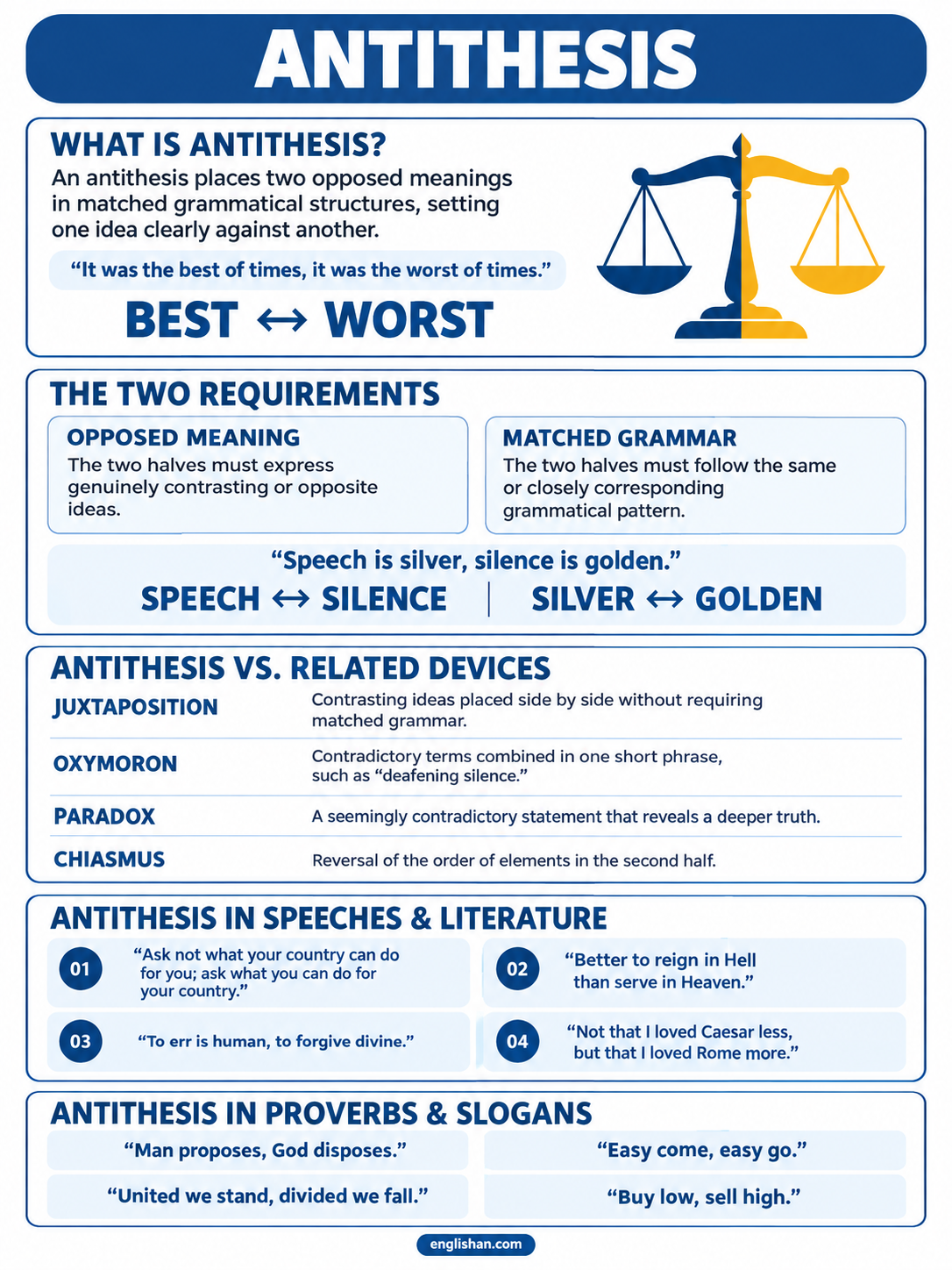
An antithesis is two opposed meanings set against each other inside one sentence, balanced across halves built to the same grammatical pattern. Writers choose the pattern to make an option audible, because two matched halves force a listener to weigh one against the other.
- It was the best of times, it was the worst of times. ✅
- The period had good sides, although plenty of people suffered under it. ❌ Suffering contrasts with good sides, yet the second clause abandons the shape of the first, so no balance forms.
Both conditions have to apply at once. Drop one and the line belongs to a neighbouring device instead.
The Two Requirements: Opposed Meaning and Matched Grammar
An antithesis needs two conditions at the same time: meanings that genuinely oppose each other, and grammar that matches across the two halves.
Antithesis comes from Greek antitithenai, to set one thing against another, from anti, against, joined to tithenai, to place. Placing one meaning against another needs a shape for the two to meet in, and matched grammar makes that shape. Matched grammar completes the move the Greek verb describes, one meaning set opposite the other.
Each neighbouring device follows from removing one part of the pair.
- Remove the matched grammar: the two meanings still oppose, and the line is a juxtaposition.
- Compress both halves into one phrase: the contradiction becomes an oxymoron.
- Reverse the order of the second half: the line becomes chiasmus.
- Remove the opposition: plain parallel structure remains.
- Move the opposition off the sentence entirely: you are using the philosophical or the everyday sense.
The Two-Question Test
Ask two questions of any candidate line, meaning first and grammar second.
Question 1, test the meaning: do the two halves oppose each other in meaning, rather than merely differ?
Question 2, test the grammar: do the two halves repeat one grammatical shape, part for part?
Run both questions on speech is silver, silence is golden. Question one finds speech against silence and silver against gold, two oppositions rather than one. Question two finds a noun, a verb and a complement in each half, repeated in the same order. Both questions come back yes, so the line is an antithesis.
A line that merely feels balanced passes neither question, though the feeling persuades readers anyway. Readers accept the feeling, stop there, and call a merely contrasting sentence an antithesis, which answering the two questions separately prevents.
- Speech is silver, silence is golden. ✅
- Speech has value, but keeping quiet works better in a crisis. ❌ Quiet opposes speech, yet the halves repeat no shape at all, so the sentence contrasts without balancing.
Antithesis in Speeches
Kennedy’s inaugural clause, ask not what your country can do for you, ask what you can do for your country, answers both questions with a yes. Country and you swap places while the verb do repeats unchanged, and the imperative ask opens each half.
- We must learn to live together as brothers or perish together as fools. ✅
- Give me liberty, or give me death. ✅
- That’s one small step for man, one giant leap for mankind. ✅
- We shall fight on the beaches, we shall fight in the fields. ❌ Churchill repeats the shape exactly, yet beaches and fields are two places rather than opposites, so the balance opposes nothing.
Repetition without opposition belongs to anaphora, the pattern of starting successive clauses with the same words. Anaphora and antithesis stack together in speeches, and one sentence can qualify as both at once.
Antithesis in Literature
Milton writes Satan the line better to reign in Hell than serve in Heaven, where reigning opposes serving and Hell opposes Heaven. Both oppositions appear inside one comparative frame, and Satan’s whole rebellion fits into nine words.
- To err is human, to forgive divine. ✅ Erring opposes forgiving and human opposes divine, with each half built from an infinitive plus a complement.
- Some say the world will end in fire, some say in ice. ✅ Fire opposes ice inside a clause repeated word for word, and Frost trims the second half to the contrasting term alone.
- I must be cruel only to be kind. ✅
- Not that I loved Caesar less, but that I loved Rome more. ✅
Verse favours the pattern because a matched pair of halves fits a line of metre. Prose favours it at the moment a character has to choose, weighing one course against its opposite.
Antithesis in Proverbs, Slogans and Song
Man proposes, God disposes runs the whole pattern in four words. Both halves repeat one noun-plus-verb shape, while man opposes God and proposing opposes disposing.
- Easy come, easy go. ✅ Two phrases of identical length oppose the gaining to the losing, and both halves open on the same repeated word.
- United we stand, divided we fall. ✅
- Float like a butterfly, sting like a bee. ✅
- Buy low, sell high. ✅
Proverbs and slogans keep the pattern because a balanced first half prepares the ear for the second. A listener who hears the first half can predict the shape of what follows, and a line predicted that way stays in the memory.
Antithesis and Juxtaposition
Juxtaposition places two unlike subjects side by side, while antithesis places two opposite meanings in halves built to one grammatical shape. Every antithesis is also a juxtaposition, and most juxtapositions are not antitheses.
Contrast belongs to both terms, so you can end up treating them as synonyms; test the grammar instead of the feel. Testing the grammar means covering the meanings, looking only at the shape of the two halves, and asking whether the parts line up one for one. Matching parts make an antithesis, and mismatched parts leave a juxtaposition.
A line can match its halves and still contrast only mildly, and it is no antithesis because the meanings never oppose. A line with real opposites in unmatched grammar falls short from the other side, and stays a juxtaposition.
- The rich man begged while the poor man gave. ✅ Rich opposes poor while the two verbs swap the expected roles, with subject, verb and modifier lining up across both halves.
- He spoke about hope, and the factory behind him had stood empty for years. ❌ Hope contrasts with a ruined factory, yet the two halves repeat no shape, so the sentence juxtaposes without balancing.
Antithesis and Oxymoron
Readers meeting deafening silence reach for antithesis, and counting the halves first prevents the error.
An oxymoron is a contradiction inside one phrase of two or three words. An antithesis runs wider than one phrase: two halves, each with its own subject and verb. Count the halves first, since one phrase can only be an oxymoron and an antithesis needs two balanced clauses.
- We spend more and enjoy less. ✅
- a deafening silence ❌ The contradiction fits inside one phrase two words wide, so the line is an oxymoron rather than an antithesis.
Antithesis and Paradox
A paradox aims its contradiction at one statement, while an antithesis spreads opposition across two matched halves, so count statements here rather than phrases.
A paradox is one proposition that contradicts itself on the surface and proves true underneath. An antithesis is two propositions, both of them true on the surface, set against each other.
- Less is more. ❌ One statement contradicts itself and resolves on reflection, since less ornament persuades more strongly, which makes the line a paradox.
- We have more medicine and less health. ✅ More opposes less across two halves that both stay literally true, so nothing resolves and the balance itself states the meaning.
Nothing in an antithesis resolves, because each half is true on its own and the opposition falls between the halves rather than inside either one.
Antithesis, Chiasmus and Antimetabole
Kennedy’s inaugural clause is antithesis, chiasmus and antimetabole at once, because the three names answer three different questions about one sentence.
Antithesis answers a question about balance: do the two halves oppose each other in one repeated shape? Chiasmus answers a question about order: has the second half reversed the sequence of the first? Antimetabole answers a narrower version of the order question: has the reversal repeated the same words, rather than merely the same parts of speech?
Run all three questions on Kennedy’s line and each comes back yes. Country and you oppose each other inside matched imperative clauses, which satisfies antithesis. The order of country and you reverses across the comma, which satisfies chiasmus. Those reversed terms repeat word for word, which satisfies antimetabole as well.
- Fair is foul, and foul is fair. ✅ Fair opposes foul inside matched clauses and the two terms swap places, so antithesis and antimetabole both apply to the witches’ line.
- When the going gets tough, the tough get going. ❌ Going and tough swap places, which makes an antimetabole, yet neither pair states an opposite, so no antithesis forms.
- Many that live deserve death, and some that die deserve life. ✅ Live opposes die and death opposes life inside matched clauses, yet no order reverses, so Tolkien’s line makes an antithesis without chiasmus.
Word order alone answers the reversal question, and chiasmus is the name for that reversal, with antimetabole its word-for-word variety.
Antithesis and Parallel Structure
I came, I saw, I conquered repeats one grammatical shape three times, and nothing in the line states an opposition. Parallel structure alone accounts for the line, and antithesis needs an opposition this line lacks.
Do not call every parallel sentence an antithesis, since parallelism on its own never opposes anything. Parallelism repeats a grammatical shape across two or more clauses and asks nothing about the meanings inside them. Antithesis places opposite meanings in the repeated positions, so a line meeting requirement two alone stays parallel structure, and requirement one completes the antithesis.
- He studies at home, he practises at the gym. ❌
- He studies alone, he practises with a crowd. ✅
Matched grammar has rules of its own, and a line breaking them fails antithesis at the same moment, which makes parallel structure the check to run first.
Must the Grammar Match?
Must the two halves match in grammar? In most definitions matched grammar is part of the definition itself, and in a smaller group the opposition alone is enough, with no repeated shape required at all.
Write the matched grammar into your own sentences every time, because a line built that way is an antithesis under both conventions. Where the grammar stays unmatched and the meanings still oppose, call the line a contrast or a juxtaposition, then describe the opposition in a clause of your own.
- He promised the earth, and what arrived at the door came to nothing. ❌ Promising the earth opposes delivering nothing, yet the two halves differ in shape, so the sentence contrasts without balancing.
- He promised the earth and delivered a stone. ✅
Thesis, Antithesis, Synthesis
The antithesis in thesis, antithesis, synthesis is a stage in an argument, not the sentence device.
Philosophers apply the trio to an argument that moves through three stages, one position at a time. A thesis is a position, an antithesis is the opposition to it, and a synthesis keeps what holds true in each. Opposition still drives the pattern, and the opposition here divides two positions rather than two halves of a sentence.
Hegel never wrote thesis, antithesis and synthesis, though the trio is credited to him everywhere. Those three terms came from two earlier writers: Johann Fichte developed the version behind them, and Heinrich Moritz Chalybäus fixed the three words everybody now quotes. Those three Hegel had rejected, since he preferred abstract, negative and concrete.
Two opposed positions treated as the only two available make a dichotomy, which is a division in the thinking rather than a shape in the sentence. That argumentative sense makes antithesis a counter-position rather than a figure of speech, so say which sense you mean at first mention.
“The Antithesis Of” in Ordinary English
Calling Voldemort the antithesis of Harry uses the everyday sense rather than the device: the phrase is ordinary English, while the device stays inside a single sentence.
The antithesis of means complete opposite in everyday English. A speaker calling someone the antithesis of a leader describes a person rather than a sentence pattern, and no grammar repeats anywhere in the remark.
A character built to contrast with the protagonist and reveal something about them makes a foil. Voldemort and Harry make a foil pair, and so do Snow White and the Queen.
- War is the very antithesis of peace. ❌
- In war, resolve; in peace, goodwill. ✅
Reserve antithesis for the sentence pattern in a literary answer, keep the ordinary sense for speech, and call two opposed characters a foil.
Writing Your Own Antithesis
Choose the opposition first and fit the grammar to it second. Reversing that order leaves balanced halves with nothing opposed inside them.
Set down the two opposed ideas in plain words, one idea at a time. Build a clause around the first idea, copy that clause’s shape for the second, and change only the words that differ. Keep both halves short, because a listener has to remember the first half while hearing the second.
- We build machines that think and forget how to think ourselves. ✅
- We build machines that think, and modern life has grown complicated in ways nobody planned. ❌ The second half neither opposes the first nor repeats its shape, so the sentence trails away instead of balancing.
Forcing an opposition where none exists leaves two halves that merely differ, which a reader hears as a false balance. Stacking them is the other common error, since four antitheses in one stretch of prose make a rhythm loud enough to drown the argument.
One antithesis at the decisive moment of an argument persuades more than four spread through the speech. Speech-writers place theirs at the moment an audience has to choose, and essay writers can borrow the placement without borrowing the volume.
Antithesis joins repetition, appeals to an audience and figures of sound in persuasive writing, all of which appear under rhetorical devices.
Frequently Asked Questions
Q1. What is the difference between antithesis and juxtaposition?
Antithesis needs halves built to one grammatical pattern, while juxtaposition places two unlike subjects side by side and asks nothing about grammar. Every antithesis is therefore also a juxtaposition, and a juxtaposition without matched halves is never an antithesis. Check the shape of the two halves first.
Q2. What is the difference between antithesis and oxymoron?
An oxymoron states its whole contradiction in two or three words, as in deafening silence. An antithesis needs more words than that: two balanced halves, each with a subject and a verb. Count the halves first, since an oxymoron never grows past one phrase.
Q3. Does antithesis have to use parallel structure?
Most definitions require it, though in a smaller group the opposition alone is enough. Both conventions accept a line with the matched grammar, so write it into your own sentences every time. Where two meanings oppose without matched halves, call the line a contrast or a juxtaposition instead.
Q4. What is thesis, antithesis, synthesis?
A thesis is a position, an antithesis is the opposing position, and a synthesis keeps what holds true in both. Those three stages describe an argument in motion rather than a sentence pattern, and the trio has a disputed origin. Most sources credit the origin to Hegel, who never wrote the three terms; Johann Fichte developed the earlier version and Heinrich Moritz Chalybäus fixed the wording. Wording aside, say which sense you mean at first mention in an essay.
Q5. Is “ask not what your country can do for you” antithesis or chiasmus?
Both names fit, because each one answers a different question about the same sentence. Antithesis answers the balance question, and Kennedy’s matched imperative halves oppose two meanings. Chiasmus answers the order question, and the second half reverses the first with the same words, which makes the clause an antimetabole as well. Name antithesis when a question concerns contrast, and chiasmus when it concerns order.