A palindrome is a word, phrase, number, or date that reads the same forward and backward, the way racecar does letter for letter. One mechanism drives every example: flip the order, and the exact sequence stays intact. English has a genuine stock of them, from real words recorded for centuries to dates that line up this way once or twice in a decade.
What Is a Palindrome?
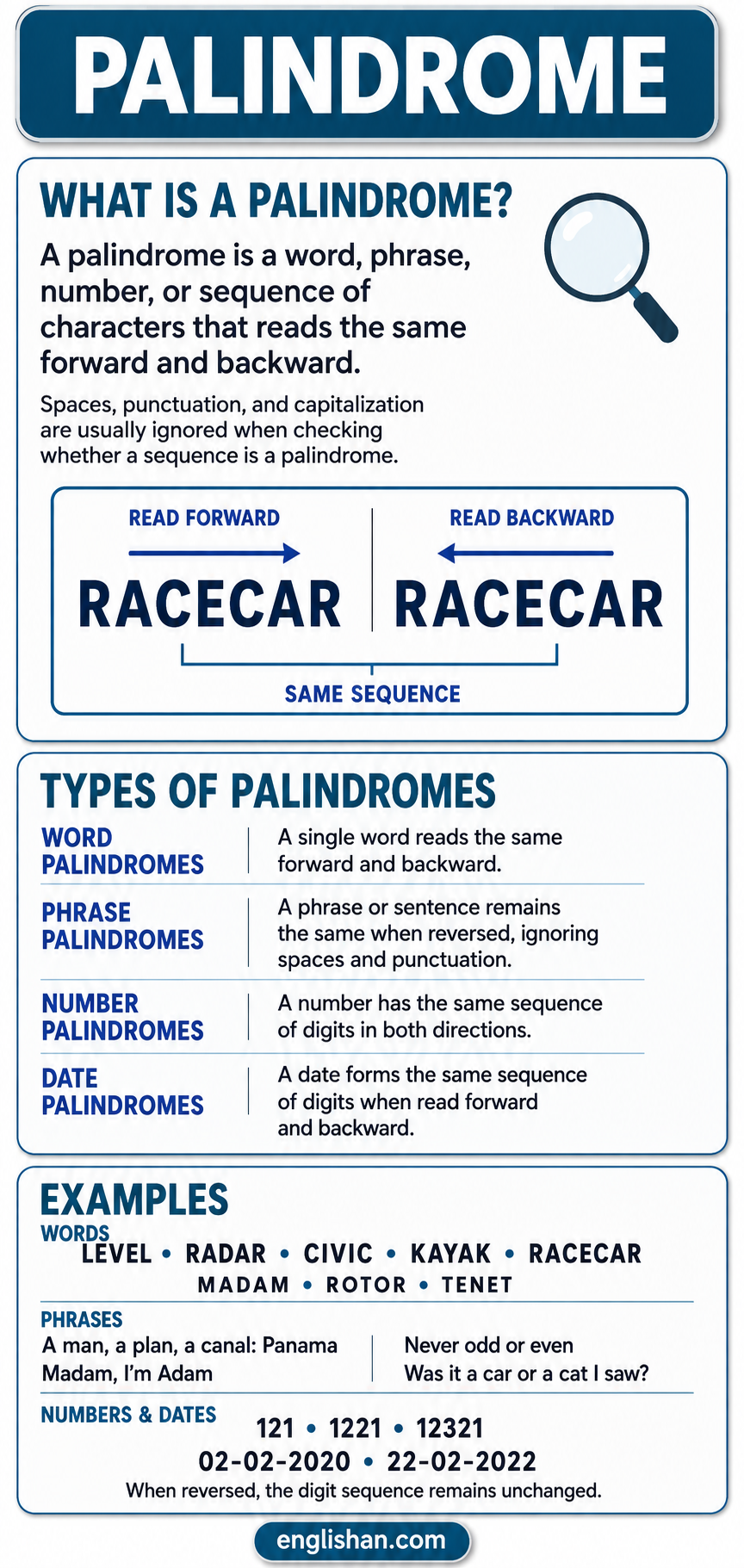
A palindrome is a word, phrase, number, or sequence of characters that reads identically forward and backward, ignoring spaces, punctuation, and capitalization.
The term comes directly from Greek. Palin means “again” or “back,” and dromos means “running” or “course.” Joined together, the word literally means “running back again.” The name fits text whose letters read the same when you run them in reverse. English speakers adopted the term late. The writer Henry Peacham introduced it in 1638, though wordplay based on this exact principle predates the label by centuries.
The Sator Square proves the point. Scratched into a wall in Pompeii before the eruption in 79 CE, it arranges five Latin words: SATOR AREPO TENET OPERA ROTAS. The grid reads correctly across, down, and in reverse, all at once.
A Byzantine inscription carved centuries later on baptismal fonts does something similar in Greek. Nipson anomemata me monan opsin, meaning roughly “wash your sins, not only your face,” reads the same letter for letter forward and back. Both predate the English word by well over a thousand years. The instinct to write in mirrored form is far older than the term coined to describe it.
Words That Are the Same Backward and Forward
Most palindromic words run three, four, or five letters, since few longer words keep a perfectly mirrored letter sequence. Sorting them by length reveals the pattern fastest and trains you to spot new ones on your own.
- Three letters: Eye, mom, dad, pop, wow, gag, bib, sis, tot, pip
- Four letters: Noon, deed, peep, poop, toot, boob, sees
- Five letters: Level, civic, radar, rotor, kayak, refer, tenet, minim, madam
- Six letters: Redder, denned
- Seven letters and longer: Racecar, deified, reviver, repaper, rotavator, detartrated
Tattarrattat holds the record in everyday English: James Joyce coined the twelve-letter word in Ulysses for the sound of a knock at the door. Guinness World Records still credits it as the longest one in common use in the language. Malayalam is a genuine nine-letter example, the name of a language spoken in the Indian state of Kerala. It shows up in passports and place names, not just in wordplay books.
A word that spells a different word backward is a semordnilap, not a palindrome. Stressed reverses into desserts and drawer into reward, yet neither word matches its own reversal, so the pairs fail the palindrome test.
Word game writers even coined a joke term for the fear of them: aibohphobia. It has no clinical standing, but its coiners spelled it in the very shape it names, letter for letter, which is most of the joke.
Given Names That Reverse Perfectly
A handful of given names read the same in reverse without any adjustment, which explains why they appear as subjects in so many longer palindromic sentences. Anna, Ava, Elle, Eve, Hannah, Nan, Otto, and Bob all read the same in reverse. Each name has been given to real people for generations, rather than existing only as a curiosity.
Famous Sentences That Read the Same Backward
Writing a palindromic sentence takes far more effort than finding a palindromic word, because the reversed letters must still break into real English words in a grammatical order. The sentences that survive the attempt become famous precisely because so few writers manage the feat.
A man, a plan, a canal: Panama is the most quoted example in English, credited to the puzzle writer Leigh Mercer in 1948. Madam, I’m Adam works as a shorter, older favorite; a longer version, Madam, in Eden, I’m Adam, folds Eve’s introduction into the same joke.
Able was I ere I saw Elba is attributed to Napoleon reflecting on his exile. It reads like a tidy anecdote, but the line almost certainly postdates the man himself. In print, it first appeared only in 1848, decades after Napoleon’s death. No record shows him ever speaking or writing it, in French, English, or any other language.
Shorter phrases repeat the same trick with less setup. Was it a car or a cat I saw?, Never odd or even, No lemon, no melon, and Step on no pets all reverse letter by letter, with no changes at all.
Longer comic versions push the form toward absurdity on purpose: Go hang a salami, I’m a lasagna hog and Mr. Owl ate my metal worm. Read them straight and they amount to pure nonsense, closer to a non sequitur than a sentence anyone would say without the constraint forcing it there. Grammar bends in every case so the letters stay in mirrored order.
Sentences like these count as character-unit palindromes, judged letter by letter once spacing and punctuation are stripped away. A word-unit palindrome reverses whole words instead, so the sentence repeats word for word in either direction.
Palindrome Numbers and Dates
A number built the same way reads the same both directions, the way 121, 1221, and 12321 do. Some of these numbers are also prime, dividing evenly only by themselves and one. Among three-digit examples, 191, 313, 353, and 787 satisfy both conditions at once. Number theorists study how they cluster along the number line.
Dates get the same treatment when every digit lines up in reverse. Written 02-02-2020, February 2, 2020 reads identically in the day-month-year and month-day-year formats used across different countries. The coincidence gave it the informal title Universal Palindrome Day.
Two years later, February 22, 2022 drew similar attention for the same reason, since 22-02-2022 and 2-22-22 both reverse to the same digits. Dates like these turn up only a handful of times each century, and that scarcity explains the attention they draw.
Mirrored Wordplay as a Literary Device
This exact structure rarely survives intact into serious prose or poetry, because English grammar does not run backward without strain. Instead, writers turn to related devices that mirror meaning rather than letters.
Chiasmus reverses the order of words or ideas across a sentence rather than the letters inside them, the way John F. Kennedy’s line about asking what you can do for your country works. A reader who looks twice sees the pattern in each: a palindrome in its spelling, and chiasmus in the parallel structure of its clauses.
A pun depends on that same second look, though its trick is a double meaning inside one word rather than a mirrored letter sequence or a reversed clause.
Constrained writing kept this kind of wordplay alive as a genuine literary exercise rather than a party trick. In twentieth century France, the Oulipo movement took up the challenge, and poets working in English have followed since. Some have written a single line that reads the same in reverse; others have built a whole poem around the same reversal.
Weird Al Yankovic’s 2003 song “Bob” strings short mirrored lines together for its whole length. A novelty constraint becomes a running motif that recurs in every line, first to last.
How to Write Your Own Palindrome
Start from the middle and build outward rather than writing left to right. Pick a short word that already works this way, or a single letter, as the center. Add matching letters to both sides at the same time, and check the reversal after every addition rather than waiting until the end.
Rely on short words that already reverse as ready-made building blocks. Did, eye, noon, and level already read the same both directions. Join several together, or set one at the center of a longer attempt, and half of your letters are already matched.
Use short function words to connect longer stretches. A, I, no, and so read the same regardless of direction and slot neatly between longer pieces without breaking the pattern.
Ignore spacing, punctuation, and capitalization while you build. The match only has to line up letter for letter once those are stripped away. That rule explains why Panama and canal fit inside one sentence built this way, even though neither word reverses on its own.
Read the result backward letter by letter, not word by word. Checking word order alone will miss a broken letter sequence in the middle of a word. Accuracy depends on individual characters, not on whole words lining up.
Expect the grammar to bend. Nearly every working sentence sacrifices natural word order somewhere, so a slightly odd phrase that satisfies the reversal beats a natural sentence that does not.
FAQs
Q1. What is the longest palindrome word in English?
Tattarrattat is the longest one in common English use. James Joyce invented the twelve-letter word in Ulysses to represent the sound of a knock. Guinness World Records still recognizes it as the record for everyday English.
Q2. What is a palindrome number?
A palindrome number reads the same forward and backward, such as 121, 1221, or 12321. Palindromic primes exist too, such as 191 and 313, numbers that satisfy both the reversal pattern and the definition of a prime.
Q3. Is aibohphobia a real word?
No, aibohphobia is a joke rather than a clinical term. Word game writers built it deliberately in the shape it names, to describe an imaginary fear of palindromes. Dictionaries that list it treat it as informal wordplay rather than a recognized diagnosis.
Q4. What is Palindrome Day?
Palindrome Day marks a date that reads the same forward and backward regardless of format. February 2, 2020, written 02-02-2020, matched that pattern in every common date format worldwide, and February 22, 2022 drew the same attention for the same reason.
Q5. What is the difference between a palindrome and a chiasmus?
A palindrome mirrors the exact sequence of letters or characters, while a chiasmus mirrors the order of words or ideas across a sentence without reversing any spelling. One operates at the level of individual letters, and the other operates at the level of meaning and grammar.