A haiku is a three-line, unrhymed poem that captures one moment in nature, traditionally in a 5-7-5 sound pattern. Japanese poets shaped it into a serious literary form in the seventeenth century, when Matsuo Basho raised a folk verse into an art that holds an entire season in a single breath.
A haiku works through restraint rather than explanation. It sets two images beside each other and names a season without describing it. A line break does the work that an English poem would otherwise assign to punctuation.
What Is a Haiku?
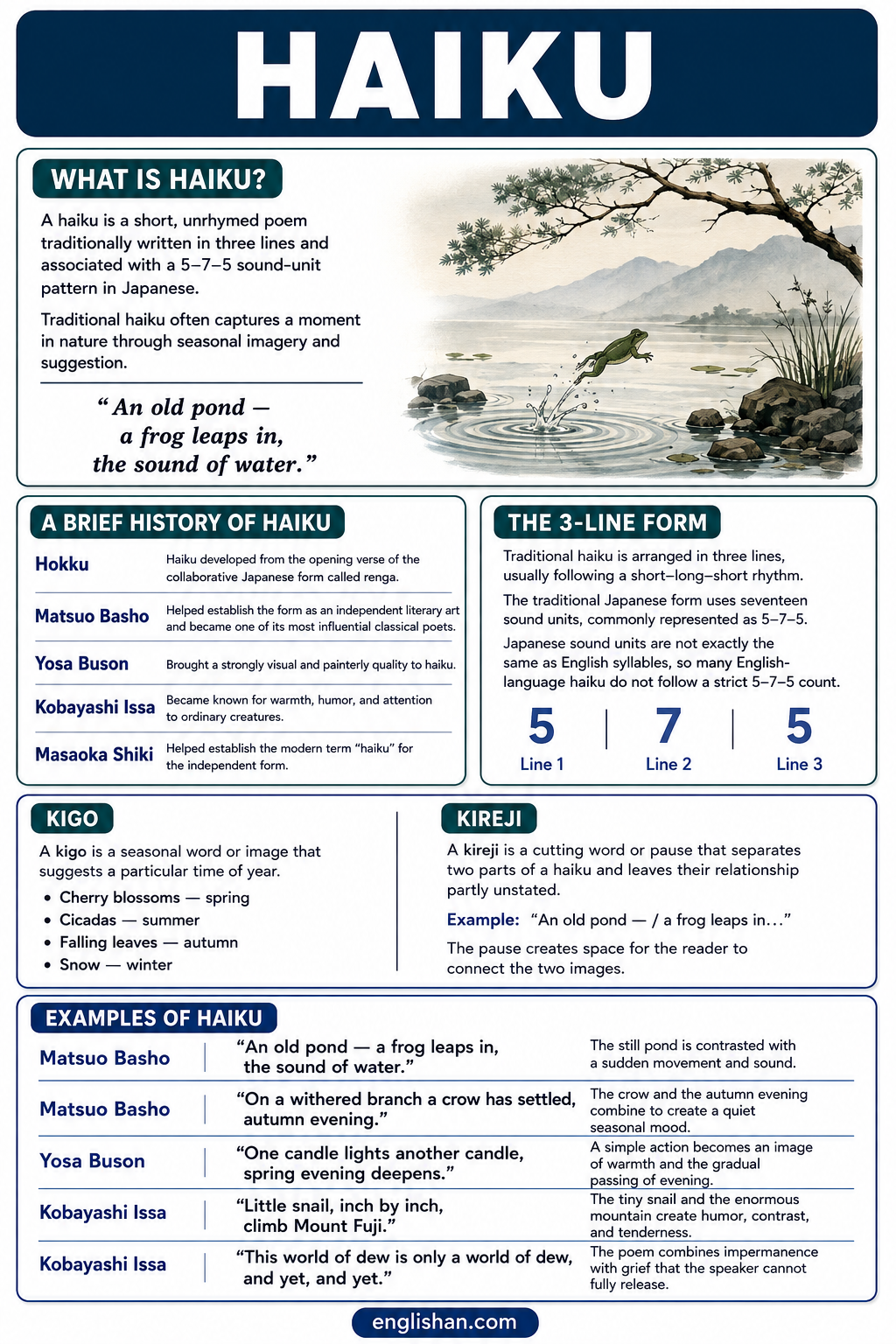
A haiku is a three-line poem, unrhymed, built from a fixed pattern of seventeen sound units set 5-7-5 across its lines. The word itself is already plural in English (one haiku, several haiku), a habit carried over from Japanese, where nouns do not take a separate plural form.
The form descends from hokku, the opening verse of a longer collaborative form called renga, and only became an independent genre once poets began writing and reading them on their own.
Two traits separate it from any other short poem written about nature. The first is a kigo, a word or phrase that names the season without stating it outright. The second is a kireji, a cutting word or pause that splits the poem into two parts and leaves you to supply the connection between them.
Both grew out of a poetic culture that valued suggestion over statement, and both still separate a haiku from a stray three-line thought.
A Brief History of the Three-Line Form
Haiku grew out of renga, a collaborative linked-verse form where guests at a gathering took turns adding stanzas to a shared poem. The opening stanza, the hokku, set the season and the mood for everything that followed, so poets treated it with special care long before anyone imagined it standing alone.
Matsuo Basho (1644 to 1694) did more than anyone to turn that opening verse into an independent art. He traveled much of Japan on foot and wrote hokku as a running record of what he saw and felt along the road. That work raised the form’s standing from a party game to a discipline worth a lifetime.
Yosa Buson (1716 to 1784) followed a generation later and brought a painter’s eye to the form: his poems work the way a brushstroke does, placing color and light where Basho placed silence.
Kobayashi Issa (1763 to 1827) wrote with warmth and a humor often aimed at himself, qualities neither earlier poet shared. He turned insects, snails, and stray animals into images worth a poet’s full attention. Together, the three are still read as the classical core of the tradition, and their poems remain the examples most commonly taught wherever the form is studied.
The word haiku itself is younger than the poems it now describes. The poet and critic Masaoka Shiki popularized the term in the late nineteenth century. He separated the standalone hokku from its old role inside renga and gave the independent poem a name of its own.
Shiki’s reform reached English-speaking audiences decades later through the British-born scholar R.H. Blyth. Blyth’s four-volume study of the form, published between 1949 and 1952, introduced it to a generation of American poets after the Second World War.
Writers such as Richard Wright and Jack Kerouac then carried the form into English on their own terms. Wright composed thousands of haiku in the last two years of his life. Both loosened the rules to fit a language built differently from Japanese.
The 5-7-5 Structure and Its Limits in English
A traditional Japanese haiku counts seventeen on, not syllables in the English sense. An on is a sound unit shorter and more even than a typical English syllable, which is why the neat math of 5-7-5 does not carry into English as directly as it looks.
The Haiku Society of America has noted that roughly twelve English syllables take about the same speaking time as seventeen Japanese on. A strict 5-7-5 count in English therefore holds more content than the original form carried.
That mismatch is why so much English-language verse written since the mid-twentieth century treats 5-7-5 as a shape to aim for rather than a rule to enforce. Many poets and specialist journals favor a short-long-short pattern, three lines where the middle runs longest, over a poem stretched or padded to hit an exact syllable count.
If you force a weak line to seventeen sounds with filler words, you lose the compression that gives the poem its charge. Counting syllables still teaches economy as a discipline, but the count exists for the image, not the other way around.
Line breaks do more work in English than they do in Japanese. Where Japanese relies on grammatical particles and the kireji to mark a pause, English has to signal that same break with punctuation, a dash, or the plain gap between one line and the next. A poem that reads as three complete, connected sentences has lost the pause that makes the form work.
Kigo and Kireji: The Traditional Devices of Haiku
A kigo is a season word, drawn from a long, established list of terms that Japanese poets have used for centuries to fix a poem in a particular time of year. Cherry blossoms mean spring, and cicadas mean summer. A bare branch or the first frost signals autumn, while snow places a poem in winter without the word itself ever appearing.
Each kigo comes close to symbolism, where a single concrete image stands in for a whole cluster of seasonal feeling rather than describing that feeling directly. A poet naming autumn through a falling leaf, rather than through the word autumn, lets you arrive at the season instead of being told about it.
A kireji, or cutting word, is a short grammatical marker in Japanese that has no direct equivalent in English. It works as a verbal punctuation mark, closing one image and opening space for the next. Its placement decides where the poem breaks into its two working parts. In English translation and in English-language verse, that break takes the form of a dash, a colon, or the plain space at the end of a line.
What the kireji creates, wherever it falls, is juxtaposition: two images placed side by side with no stated connection, leaving you to feel how they meet. A crow on a branch and an autumn evening say nothing about each other directly, yet set next to each other they create a mood neither image produces alone.
This is also where a poem’s ambiguity comes from. A well-made cut does not explain itself, and a poet who resists spelling out the connection between the two halves trusts you to complete the thought. Autumn imagery in particular evokes a quiet nostalgia, an ache for a season already slipping past, and that feeling arrives through the image rather than through any word that names it.
Classic Examples From Basho and Issa
Reading a handful of classical haiku shows the form working at full strength inside three lines and almost nothing else.
An old pond, a frog leaps in, the sound of water.
Basho’s best-known poem sets a motionless pond against a single sudden sound, and the cut falls right where the frog jumps. Nothing in the poem states what the silence afterward feels like. You supply that.
On a withered branch a crow has settled, autumn evening.
Here the crow and the evening are two separate observations joined only by their placement, a plain example of kireji-driven juxtaposition doing the poem’s real work.
One candle lights another candle, spring evening deepens.
Buson’s poem, painterly the way his work always is, turns a small domestic action into an image of one season quietly giving way to warmth.
Little snail, inch by inch, climb Mount Fuji.
Issa’s snail expresses his signature warmth toward small creatures, and the mismatch in scale between the snail and the mountain produces the humor and the tenderness at once.
This world of dew is only a world of dew, and yet, and yet.
Issa wrote this poem after the death of his young daughter. It sets a Buddhist teaching on impermanence, the truth that nothing lasts, against a grief the poet cannot fully accept. The repeated “and yet” marks his refusal to rest in the calm acceptance the first line offers.
A frog, a crow, a candle, a snail, and a drop of dew recur across centuries of the form as a motif. Poet after poet picks up the same handful of ordinary images and turns them into something new.
Writing Your Own Three-Line Poem
Writing a strong haiku starts with restraint rather than inspiration. Follow these steps and you will end with a poem that earns its three lines instead of merely filling them.
One moment, not a broad theme: a haiku about autumn in the abstract has nowhere to go, while a poem about one leaf hitting the surface of a pond has everywhere to go. Start from something you actually noticed, a specific sound, a specific object, a specific instant, rather than a wide theme you think a poem should cover.
Two images that meet without touching: once you have a central image, look for a second image placed nearby that doesn’t explain it. This is where you place your kireji. Put the two images on either side of a line break or a dash, and resist the urge to add a phrase that ties them together. If the poem states the feeling outright, the cut has failed.
A season grounded in something concrete: name the time of year through something you can see, hear, or smell rather than through the season’s name itself. A single well-chosen kigo does more work than a full sentence of description, and it links your poem to a tradition stretching back to Basho.
Sensory, concrete language over abstraction: cut every abstract word you can. “Sadness” describes a feeling; “the smell of rain on dust” produces one. Word choice does more work in a three-line poem than almost anywhere else in writing, since a single vague choice weakens the whole poem. Precise diction is what separates a flat poem from a sharp one.
A syllable count kept loose, after the image is right: draft first for the image and the cut. Once both work, tighten the lines toward a short-long-short shape, closer to 5-7-5 than not, but never at the cost of a strong line stretched thin with filler words.
No metaphor, no simile, no explanation: the poem shows two images next to each other and trusts you to feel the connection. Writing “the moon is like a coin” states the comparison outright. Writing just “the moon” beside a second, unrelated image lets you arrive at your own comparison, which has more force every time.
An ending that stays open: the strongest poems close on an image, not a conclusion. That closing image amounts to a small epiphany, a moment where meaning arrives on its own rather than being delivered by the poet. Resist adding a final line that sums up what the poem already showed.
A poet who skips the season, states the feeling outright, or ties the two images together with a full explanation has written a short observation, not a haiku. The gap between those two forms is almost always the missing cut.
Haiku vs Senryu: What Sets Them Apart
Senryu shares its shape with haiku: three unrhymed lines, roughly the same short-long-short rhythm, and the same tradition of cutting words dividing the poem in two. What separates them is focus and mood.
Haiku center on nature and the natural world, marked by a kigo and read in a quiet, reflective mood. Senryu turn that same compressed form toward human behavior instead, aiming at vanity, foolishness, and everyday absurdity with a wit closer to a punchline than a meditation.
A senryu leaves out the kigo, since it has no need to place its scene in a season. It treats its kireji-style cut as a setup for a twist rather than a pause for reflection. Where a poem about a crow on a branch draws you into a mood, a senryu about a man rehearsing an apology prompts a laugh of recognition.
Both forms require the same compression and the same trust that you will fill a gap the poet leaves open. What they aim that compression at is where the two forms part ways.
How to Write Your Own Haiku
Start with the count, but do not let it become the finished poem. Set seventeen sound units across three lines, five, then seven, then five, and use that structure as a frame: something to build the poem around, not the reason the poem exists. The count trims a draft down to its sharpest words. Once a line reaches its target through filler rather than a real image, the syllables have done more harm than good.
The image outweighs the count, and it comes from something you noticed, not a feeling you want to name. A haiku that starts from the word “lonely” states a condition and stops there. A haiku that starts from frost on an empty mailbox gives that same condition a body, a season, and a texture, without ever naming it directly.
Root every line in something visible, audible, or touchable, tied to a specific time of year, and let that one sensory image do the work a stated emotion would otherwise do alone.
The final move is the turn. Give the first two lines a single scene, then break from it in the third line: a shift in scale, an unexpected sound, an object set beside the first with no stated link between them. This is the kireji-style cut translated into English, the same cutting pause that splits a classical Japanese poem into two halves left for a reader to join.
Without that turn, three lines of even syllable counting describe a scene and stop there. With it, those same three lines leave a connection the reader completes alone, the real dividing line between a haiku and a plain three-line syllable count.
I feel so lonely, no one calls or visits me, sadness fills my heart. ❌
This verse hits the 5-7-5 count exactly, yet it names the emotion in every line and offers no image, no season, and no turn for a reader to complete.
Frost on the mailbox, a single letter still waits, no one comes today. ✅
This haiku roots the same lonely mood in one physical image, then lets the silence of the third line supply the turn without naming the feeling outright.
FAQs
Q1. What is a haiku poem?
A haiku poem is a three-line, unrhymed poem built on a traditional pattern of seventeen sound units set 5-7-5. It captures a single moment in nature, marked by a season word and a cutting pause between its two halves.
Q2. Is haiku singular or plural?
Haiku stays the same in both forms. English speakers write “one haiku” and “several haiku,” following the word’s original Japanese, where nouns do not change between singular and plural.
Q3. Do haiku have to rhyme?
No, haiku do not rhyme. The form relies on compression, a season word, and a cut between two images rather than on rhyme or a regular beat. A rhymed ending works against the pause the form depends on.
Q4. Are all haiku written in 5-7-5 syllables?
Not every haiku follows an exact 5-7-5 syllable count, particularly in English. Japanese haiku count seventeen on rather than English syllables. Many English-language poets and journals favor a short-long-short shape over a strict count, since forcing the numbers can pad a line with words the image does not need.
Q5. What is the most famous haiku poem?
Matsuo Basho’s “old pond” haiku is the poem most widely cited as the most famous in the entire tradition. It centers on a frog leaping into still water and the sound that follows, and it remains the poem most teachers introduce first.