Ambiguity is a word, phrase, or sentence that genuinely supports more than one interpretation, rather than one meaning stated poorly. A sentence can be grammatically correct and still leave a reader caught between two readings, unsure which one the writer meant. Poets and novelists build it into a line on purpose, while it turns up in ordinary conversation and news headlines by accident. Both kinds matter to a reader of English, since telling them apart decides whether a strange sentence is a mistake or a technique worth noticing.
What Is Ambiguity?
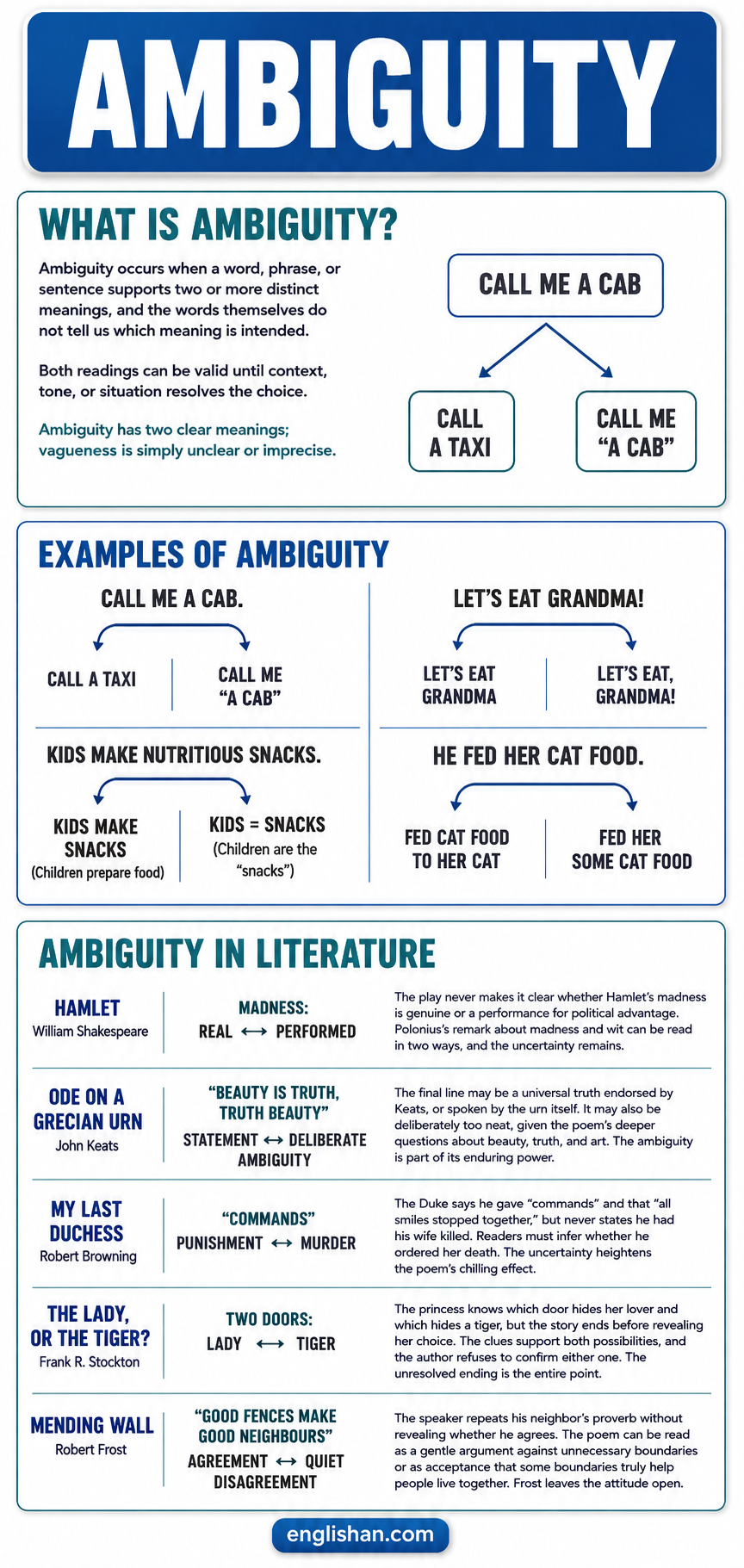
Ambiguity is a property of language in which a single word, phrase, or sentence supports two or more distinct, equally valid meanings, so that the words alone cannot settle which one is intended. Because both readings are genuinely correct, more than one interpretation stays available until something outside the sentence narrows it down. That outside signal may be the surrounding paragraph, the speaker’s tone, or the real-world situation.
The word traces back to the Latin ambiguus, built from ambi- (“both ways, around”) and agere (“to drive, to act”). The root idea is something that leads in two directions at once. That is still exactly what happens inside an ambiguous sentence. A reader reaches a point where the grammar or the vocabulary branches, and nothing in the sentence itself settles the choice.
Not every unclear sentence is ambiguous in this strict sense. A sentence is ambiguous only when it supports two or more sharp, nameable meanings, not when it is fuzzy at the edges. That distinction separates ambiguity from vagueness.
Types of Ambiguity
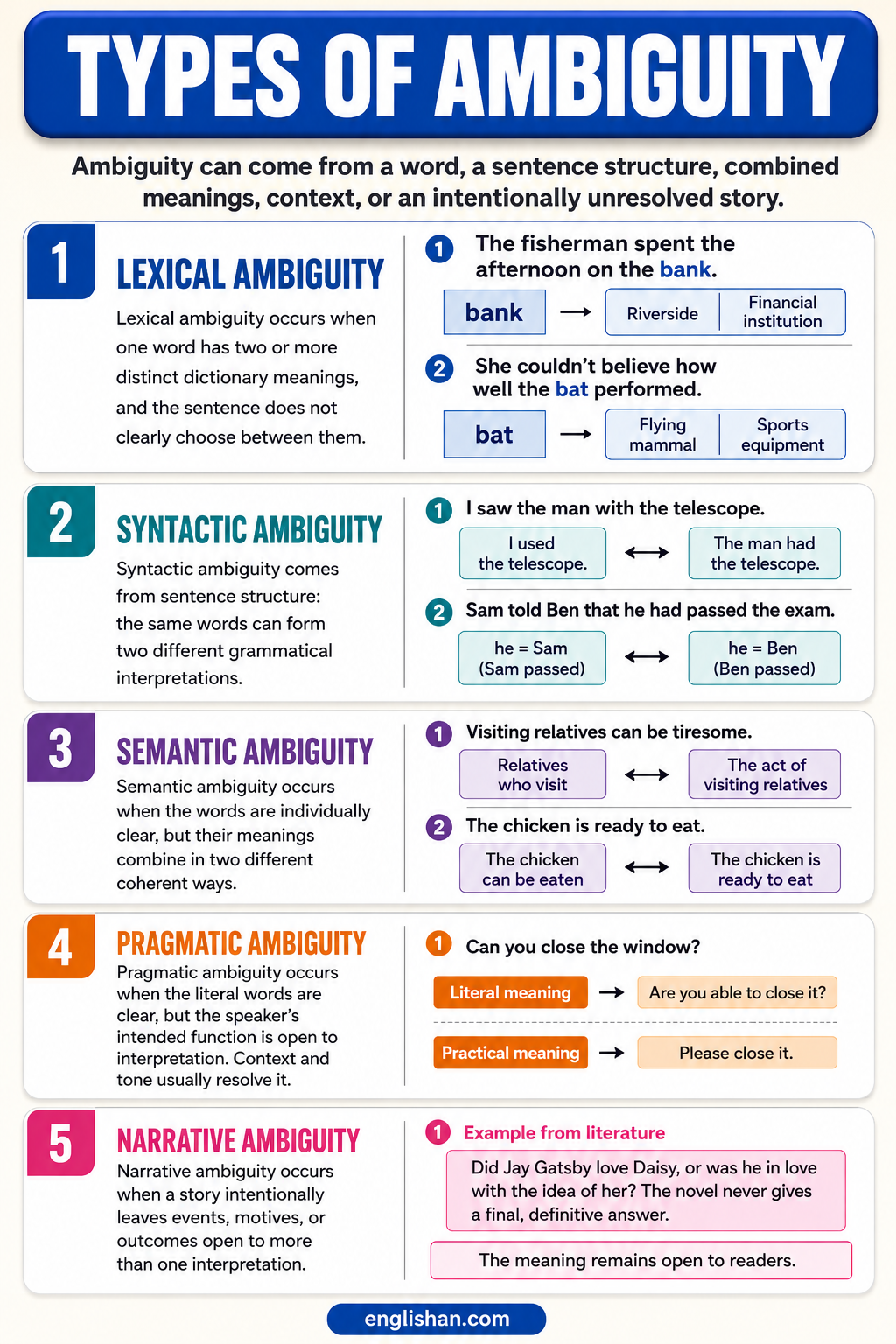
Linguists and literary critics sort ambiguity into a handful of recognizable patterns, and naming the pattern at work is the fastest way to explain why a sentence reads two ways. Five types cover almost every real case an English learner or a reader of literature will meet.
Lexical Ambiguity
Lexical ambiguity happens when a single word has two or more separate dictionary meanings, and the sentence around it does not rule either one out. English has many words like this, since one spelling can carry two entirely unrelated meanings.
- The fisherman spent the afternoon on the bank. Here bank can name the raised ground beside a river or a financial institution. Only the word fisherman tips the reading toward the riverside.
- She couldn’t believe how well the bat performed. Here bat can refer to the flying mammal or to a piece of sporting equipment, and nothing before this sentence in isolation decides which one is meant.
The test is direct: replace the word with a synonym for only one of its senses, and check whether the sentence still makes sense. If swapping in the other sense also produces a coherent sentence, the ambiguity comes from that single word. A word’s connotation can tip an ambiguous reading toward one sense over the other, even when the dictionary meaning alone would leave both options open.
Syntactic Ambiguity
Syntactic ambiguity, also called structural ambiguity, comes from how a sentence is built rather than from any one word’s meaning. Each word is unambiguous on its own; the grammar just allows two different sentence structures to apply to the same string of words.
- I saw the man with the telescope. This sentence can mean that the speaker used a telescope to see the man, or that the man being seen was holding the telescope. The prepositional phrase with the telescope can attach to either the verb or the noun.
- Sam told Ben that he had passed the exam. Here the pronoun he can refer back to Sam or to Ben. English pronouns do not mark which earlier noun they belong to, and the sentence gives no further clue.
To spot syntactic ambiguity, try drawing two different sentence trees from the same words. If a phrase can attach to more than one place, or a pronoun can point to more than one earlier noun, the structure itself is the source.
Semantic Ambiguity
Semantic ambiguity shows up when every individual word in a sentence is unambiguous on its own, yet the way their meanings combine still produces two coherent readings. It is commonly mistaken for lexical ambiguity, but the two are different. The confusion comes from how the words relate to each other, not from any single word.
- Visiting relatives can be tiresome. This can mean that relatives who come to visit are tiresome, or that the act of going to visit relatives is tiresome. Both readings use every word in its one normal sense.
- The chicken is ready to eat. This can mean the chicken, as a cooked dish, is ready for someone to eat, or the chicken, as a live bird, is ready to eat its own food. Again, no single word is at fault.
This type explains why some sentences resist a quick fix: swapping a word rarely works, because the trouble comes from who is doing what to whom, not from a word choice.
Pragmatic Ambiguity
Pragmatic ambiguity is about function rather than meaning. The literal content of the sentence is not in question. The open question is what the speaker is doing with those words: making a statement, asking a question, or issuing a request.
- Can you close the window? Taken literally, this asks about someone’s ability to close a window. In almost every real conversation, though, it functions as a polite request to close it. A listener who answered “yes” without moving would be technically correct and still miss the point.
Tone, setting, and shared assumptions resolve pragmatic ambiguity in speech in a way that plain writing cannot manage on its own. That gap is one reason writers of instructions and legal text take such care to avoid it.
Narrative Ambiguity
Narrative ambiguity is specific to storytelling. A writer leaves a plot event, a character’s motive, or an ending genuinely open, so that more than one account of what actually happened is equally supported by the text itself. This is not a flaw in the writing; it is a deliberate choice, and works from Hamlet to Stockton’s The Lady, or the Tiger? run on it.
Ambiguity and Vagueness
Ambiguity and vagueness both make a sentence unclear, but they fail in different ways. English learners confuse the two constantly. An ambiguous word or sentence has two or more sharp, distinct meanings, and a reader who picks the wrong one has picked a real, definable alternative. A vague word has one blurry meaning with no sharp edge, so a reader is not choosing between two distinct options; they are struggling to find any precise line at all.
Bank is ambiguous, since it names two entirely separate referents, a riverbank and a financial institution, and nothing in between. Tall is vague, since there is no exact height where a person stops being short and starts being tall, only a wide gray zone. Fixing ambiguity means adding a detail that chooses between the two sharp meanings; fixing vagueness means adding a number, a comparison, or a stricter definition.
Examples of Ambiguity in Everyday Language
Ambiguity is not confined to poetry and novels. It turns up constantly in casual speech, advertising, and especially in newspaper headlines, where writers strip out small words to save space and accidentally create a second reading.
- Call me a cab. This can be a request for a taxi, or, read as a command about naming, an instruction to address the speaker as “a cab.” That double reading is exactly the joke behind the old comedy routine built on this line.
- Let’s eat Grandma! Without the comma, this sentence reads as a proposal to eat Grandma. With it, Let’s eat, Grandma!, the speaker is calling Grandma to a meal, which is why teachers use this pair to show how a single comma changes real meaning.
- Kids Make Nutritious Snacks A real newspaper headline of this shape can be read as advice for children preparing food, or, briefly and alarmingly, as a claim that children themselves are nutritious snacks. The verb make can mean either “prepare” or “become,” and the headline supports both.
- Eye Drops Off Shelf A headline like this can describe a product, eye drops, falling off a shelf. If drops is read as a verb instead, it describes an eye that has come loose and dropped off a shelf. The headline’s stripped-down grammar does nothing to prevent that second reading.
- He fed her cat food. This can mean he gave cat food to her cat, or he gave her some food intended for cats. The pause a speaker uses in conversation resolves in speech what the plain written sentence leaves open.
Examples of Ambiguity in Literature
Writers choose ambiguity on purpose, and some of the most studied passages in English literature turn on exactly this type of doubled meaning.
Hamlet, by William Shakespeare
Shakespeare leaves it genuinely unclear, for most of the play, whether Hamlet’s madness is real or performed for political cover. Polonius calls it “a happiness that often madness hits on.” The line itself works two ways, as praise for an accidental flash of wit, or as a warning that something calculated lies underneath the apparent confusion. Four centuries of critics have argued both sides without the text ever settling the question.
Ode on a Grecian Urn, by John Keats
The poem’s closing line, “Beauty is truth, truth beauty,” has puzzled readers since 1820. It is unclear whether the urn is speaking, or whether Keats endorses the claim as a universal truth. Or the line is deliberately too neat, a final flourish that the rest of the poem has already complicated through its own unresolved imagery. Readers who admire the poem’s symbolism still disagree on what the closing line actually asserts.
My Last Duchess, by Robert Browning
The Duke narrating this poem never states outright that he had his previous wife killed. He describes giving “commands” after which “all smiles stopped together,” and lets the listener infer the rest. The ambiguity is the poem’s entire method: readers piece together a murder from implication alone, which makes the Duke’s calm, controlled voice far more unsettling than a direct confession would be.
The Lady, or the Tiger?, by Frank R. Stockton
Stockton’s short story leads to a single choice: a princess knows which of two doors hides her lover and which hides a tiger. The story ends before revealing which door she signals him toward. It gives real evidence for both outcomes and endorses neither, turning the ending itself into the point of the story rather than a withheld detail.
Mending Wall, by Robert Frost
Frost’s speaker repeats his neighbor’s proverb, “good fences make good neighbours,” without ever clearly stating whether he agrees with it. The poem can be read as a quiet argument against needless barriers, or as a reluctant acceptance that some boundaries genuinely benefit people. Frost never resolves which reading the poem itself favors.
Why Writers Use Ambiguity
Ambiguity has a permanent place in literature because it produces effects that a single, settled meaning cannot. A writer who wants a reader actively interpreting a text, rather than passively receiving it, gives the text a line that supports two readings at once. Holding both meanings in mind is a more active way of reading than accepting just one.
It also creates suspense. Leaving a plot event or a character’s fate genuinely open, as Stockton does, keeps a reader turning the idea over long after the final page. That is a different level of engagement than a definite resolution provides. In comedy, the same doubled meaning becomes a punchline, the exact mechanism behind a pun: a joke like “call me a cab” only works because the listener catches both readings at once.
Ambiguity can also let a character, or a writer, avoid stating something directly. Browning’s Duke never confesses to murder, and that refusal to be explicit is exactly what makes his voice so chilling. This overlaps with aporia, the related device of expressing genuine or performed doubt, since both let a speaker withhold a direct claim while still communicating something real. Ambiguity also pairs naturally with symbolism: an image like Keats’s urn conveys more than one meaning at once precisely because the object represents more than one idea. A symbol that resolved into a single fixed meaning would lose most of its power.
The Seven Types of Ambiguity by William Empson
In 1930, the English literary critic William Empson published Seven Types of Ambiguity. The book became one of the most influential works of twentieth-century literary criticism and a founding text of the New Criticism movement. That movement studied poems as self-contained objects rather than through an author’s biography. Empson argued that a poem’s best lines work because of ambiguity, not despite it. He classified the effect into seven increasingly complex categories, moving from a plain double meaning to a case where a poet’s words expose a genuine contradiction in their own thinking.
Empson’s seven types, in his ascending order of complexity, are these:
- A detail effective in several ways at once, as in a rich metaphor that works on more than one level simultaneously.
- Two or more meanings folded into one, where separate images collapse together through the same word.
- Two senses conveyed by one word at the same time, with the surrounding context supporting both.
- Two or more meanings that do not agree, yet combine to reveal a complicated attitude in the author, rather than a single controlled stance.
- A discovery made in the act of writing, where a comparison forms between two statements the writer has not fully worked out yet.
- A statement that says nothing on its own, forcing readers to supply a meaning that does not always match what the writer intended.
- A single word expressing two contradictory meanings at once, exposing a genuine contradiction underneath the poem.
Empson’s categories run from mild to extreme. These examples, along with most everyday and literary ambiguity, fall comfortably inside his first three types.
How to Avoid Unintentional Ambiguity in Writing
Ambiguity is a technique only when a writer chooses it. Most ambiguity in student essays, emails, and instructions is accidental, and it comes from one of four repeatable causes, each with a direct fix.
Unclear pronoun reference
When a pronoun can point back to more than one earlier noun, name the noun again instead of relying on the pronoun.
- Sam told Ben that he had won the prize. ❌ A reader cannot tell whether Sam or Ben won, since he has two equally available antecedents.
- Sam told Ben that Ben had won the prize. ✅ Repeating the name removes the second possible reading entirely.
Misplaced modifiers
A descriptive phrase attaches to whichever noun is nearest to it, so placing it near the wrong noun creates an unintended second meaning.
- The teacher gave a book to the student that was falling apart. ❌ As written, the clause that was falling apart immediately follows student, which briefly suggests the student, not the book, was falling apart.
- The teacher gave the falling-apart book to the student. ✅ Moving the description directly beside book removes the unwanted reading.
Vague or double-duty word choice
A word with two active meanings should be replaced with a more specific one whenever the surrounding sentence does not rule either sense out on its own.
- Please make the kids something to eat. ❌ Out of context, make briefly recalls the “become” sense that produced the Kids Make Nutritious Snacks headline, though most readers resolve it quickly.
- Please prepare a snack for the kids. ✅ Replacing make with prepare removes the second sense entirely, which matters most in writing meant to be read quickly, like signs or headlines.
Missing or misplaced punctuation
Commas, hyphens, and apostrophes change what a sentence grammatically means, and leaving one out can shift who or what it addresses.
- Let’s eat Grandma! ❌ Without the comma, the sentence directly addresses eating Grandma rather than addressing Grandma about eating.
- Let’s eat, Grandma! ✅ The comma marks Grandma as the person being spoken to, not the object of the verb.
Careful diction means choosing the one word that says exactly what is meant rather than the first word that comes to mind. That habit resolves more accidental ambiguity than any other a writer can develop.
FAQs
Ambiguity is pronounced am-big-yoo-i-tee, with the main stress on the third syllable, big. The adjective form, ambiguous, shifts the stress one syllable earlier, onto big as well, but drops the extra syllable at the end.
The nearest substitutes are vagueness, equivocation, and double meaning, though none matches ambiguity exactly. Equivocation is the closest true synonym, since it also describes language that supports more than one distinct, defensible reading. Vagueness describes a different, blurrier type of unclear language: one hazy meaning rather than two sharp ones.
It depends entirely on whether it is intentional. Ambiguity used on purpose, as Keats, Browning, and Stockton use it, adds depth and keeps a reader actively interpreting the text. Ambiguity that shows up by accident in an email, an instruction, or a legal document is a real problem, since it leaves the reader guessing about something the writer actually needed to state plainly.
Clarity is the general opposite, and univocality is the precise linguistic term for language that supports exactly one meaning. A sentence with no ambiguity at all states its single intended reading so plainly that no other interpretation is grammatically or semantically available.